Every species
Filters
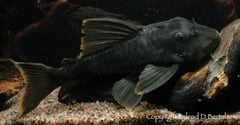
Peckoltia sp.L076
authority not recorded
Max length140mm SL6in SLTank120 × 45cm48 × 18inTemp25–29°C77–84°FpH5.5–7.5L076 is a Peckoltia species, a suckermouth catfish apparently collected from the rio do Pará near Portel in Pará state, northern Brazil. L076 and L099 appear to be the same species, the former showing a darker colour pattern by day, though both look similar at night. It spawns in caves and the male is responsible for brood care.
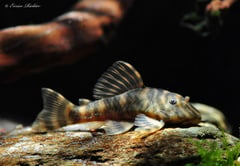
Peckoltia sp.L038
authority not recorded
Max length120mm SL5in SLTank120 × 30cm48 × 12inTemp23–29°C73–84°FpH6.0–7.5L038 is an unidentified Peckoltia, a suckermouth catfish collected near Mocajuba on the lower rio Tocantins in Pará state, Brazil. It is relatively peaceful but territorial with conspecifics and similarly-shaped species, and spawns in caves with the male responsible for brood care.
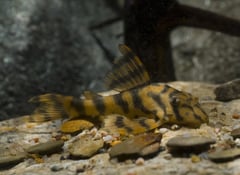
Peckoltia sp.L288
authority not recorded
Max length100mm SL3.9in SLTank80 × 30cm31 × 12inTemp26–30°C79–86°FpH5.0–7.0L288 is a Peckoltia species, a suckermouth catfish from the rios Curuá Una and Uruará in Pará state, Brazil. The Curuá Una joins the main lower Amazon channel downstream of Santarém and carries a large hydroelectric power plant. The species spawns in caves with the male responsible for brood care.
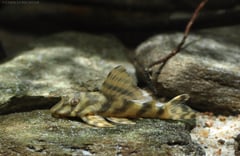
Peckoltia wernekeiL243
Armbruster & Lujan, 2016
Max length120mm SL5in SLTank120 × 30cm48 × 12inTemp25–29°C77–84°FpH5.5–7.5Peckoltia wernekei, also known as L243 and LDA086, is a suckermouth catfish known only from parts of the upper Río Orinoco drainage in Amazonas state, southern Venezuela. Armbruster and Lujan described it in 2016 from the Ventuari drainage. It is sometimes confused with Peckoltia lineola, alongside which it is often exported for the aquarium trade.
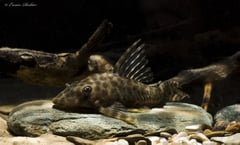
Peckoltichthys bachiL146
(Boulenger, 1898)
Max length130mm SL5in SLTank120 × 45cm48 × 18inTemp22–29°C72–84°FpH6.0–8.0The bola pleco, Peckoltichthys bachi, is a loricariid catfish from the upper Amazon region in Brazil, Colombia, Ecuador and Peru. It has been assigned several L-numbers, including L146 from Colombia and L232 from the Río Putumayo/Içá, and has been exported under other generic names including Hemiancistrus and Sophiancistrus. Its mottled colour pattern separates it from most Peckoltia species, and it lives among submerged grasses and branches in flowing water along the margins of medium to large rivers.

Pelvicachromis pulcherKribensis
authority not recorded
Max length100mm SL3.9in SLTanknot recordedTemp24–27°C75–81°FpH5.0–7.5The kribensis, Pelvicachromis pulcher, is a cichlid from Nigeria and Cameroon, found in still and slow-moving, heavily vegetated waters. One of the most common cichlids in the hobby since the 1950s, it is almost always captive bred, and farmed fish are far more adaptable to water chemistry than wild ones. A cave spawner that forms monogamous pairs, it is often the first fish bred by newcomers and becomes very territorial when breeding.

Pelvicachromis subocellatusOcellated Kribensis
authority not recorded
Max length80mm SL3.1in SLTanknot recordedTemp22–26°C72–79°FpH5.5–7.5The ocellated kribensis, Pelvicachromis subocellatus, is a cichlid from Nigeria, Gabon and the Democratic Republic of Congo. It inhabits pools and slow-moving streams in coastal areas, some of them brackish. Less commonly seen than other Pelvicachromis, it is available in morphs such as 'Matadi' and 'Moanda', and has a higher, shorter body than its congeners with much lighter spotting in the upper part of the caudal fin.

Pelvicachromis taeniatusStriped Kribensis
authority not recorded
Max length80mm SL3.1in SLTanknot recordedTemp22–26°C72–79°FpH5.0–7.5The striped kribensis, Pelvicachromis taeniatus, is a cichlid from still and slow-moving forest streams and rivers in Nigeria and Cameroon. Over a dozen morphs are available, including 'Dehane', 'Moliwe', 'Lobe' and 'Nigeria Red', and these should not be cross bred if the lines are to stay pure. A more pronounced upper lip, often bright yellow, separates it from congeners, and unlike most Pelvicachromis the males rival the females in colour.
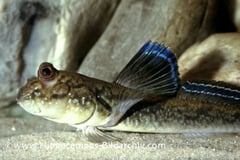
Periophthalmus barbarusAtlantic Mudskipper
authority not recorded
Max length150mm SL6in SLTanknot recordedTemp25–30°C77–86°FpH7.0–8.5The Atlantic mudskipper, Periophthalmus barbarus, is a highly amphibious goby from the west African coast, from Mauritania south to Angola. It lives on and around mudflats in estuarine mangrove swamps, so an aquarium needs exposed land and a very humid atmosphere at the same temperature as the water. Males are extremely territorial with one another, and a species tank is preferable in most cases.
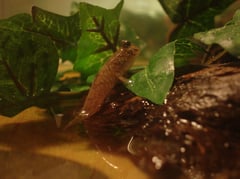
Periophthalmus novemradiatusDwarf Indian Mudskipper
(Hamilton, 1822)
Max length100mm SL3.9in SLTanknot recordedTemp25–30°C77–86°FpH7.0–8.5The dwarf Indian mudskipper, Periophthalmus novemradiatus, is an amphibious goby of coasts from eastern India to southern Thailand. It lives on mudflats in estuarine mangrove swamps and is thought to be the smallest species in the genus. An aquarium needs exposed land areas and a very humid atmosphere at the same temperature as the water, and the fish is territorial with conspecifics.

Pethia aurea
Knight, 2013
Max length25mm SL1.0in SLTank45 × 30cm18 × 12inTemp18–24°C64–75°FpH6.0–7.0Pethia aurea is a small cyprinid known from ponds in South 24 Parganas District, West Bengal, in the Ganges delta of northern India. Considered a phenotype of the similar P. gelius before its description, it has a yellowish-golden body, a broad black band around the caudal peduncle and a black blotch beneath the dorsal-fin origin. Very peaceful but timid, it does best in a group of at least 8-10 alongside other diminutive species.

Pethia canius
(Hamilton, 1822)
Max length30mm SL1.2in SLTank60 × 30cm24 × 12inTemp18–24°C64–75°FpH6.0–7.0Pethia canius is a small cyprinid from West Bengal in northern India, with recent collections from Cooch Behar and Nadia districts. Long considered a synonym of the closely related P. gelius, it had its identity settled and a neotype designated by Knight (2013). It inhabits ponds and other still-to-sluggish waters, and its small size and timid nature mean it does best alone or with other diminutive species.

Pethia conchoniusRosy Barb
(Hamilton, 1822)
Max length100mm SL3.9in SLTank100 × 30cm39 × 12inTemp16–24°C61–75°FpH6.0–8.0The rosy barb, Pethia conchonius, is a small cyprinid found from Pakistan throughout India, Nepal and Bangladesh. Generally considered one of the hardiest small cyprinids in the hobby, it is an excellent choice for newcomers. Wild specimens are not usually available and the vast majority are commercially bred, with long-finned, 'veil-tail', 'super red', 'neon' and 'golden' strains among the forms selective breeding has produced. Feral populations exist in several countries.
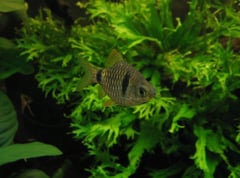
Pethia cumingiiCuming's Barb
(Günther, 1868)
Max length41mm SL1.6in SLTank60 × 30cm24 × 12inTemp20–27°C68–81°FpH5.5–7.0Cuming's barb, Pethia cumingii, is a small cyprinid endemic to southwestern Sri Lanka, apparently only in the Bentara and Gin river drainages. It was long thought to occur in yellow- and red-finned forms, and the red-finned fish are now recognised as P. reval, a smaller species of sluggish lowland rivers. Reports suggest the more brightly-coloured fish are becoming scarcer, and selective collection for the aquarium trade may have altered wild populations.

Pethia didi
(Kullander & Fang, 2005)
Max length41mm SL1.6in SLTank60 × 30cm24 × 12inTemp15–25°C59–77°FpH6.5–9.0Pethia didi is a small cyprinid from the Ayeyarwady drainage around Lake Indawgyi and Myitkyina, Kachin State, where it appears to be endemic. Rare in the aquarium trade though occasionally available, it has two black, vertically-orientated flank blotches, one behind the operculum and one on the caudal peduncle, a pattern shared with several congeners. The type locality is a swift, shaded stream through bamboo forest, and the species is subject to seasonal temperature fluctuations in nature.

Pethia erythromycterLipstick Barb
(Kullander, 2008)
Max length35mm SL1.4in SLTank90 × 30cm36 × 12inTemp18–24°C64–75°FpH7.0–7.5The lipstick barb, Pethia erythromycter, is a small cyprinid from the upper Ayeyarwady River basin in northern Myanmar, including Lake Indawgyi. Sometimes traded as 'Tulip barb', it first appeared in the hobby in 2006 and was described by Kullander (2008). Males have red pigmentation around the mouth and tubercules on the snout when nuptial. It may nip slow-moving or long-finned tankmates but does very well with other small, active cyprinids or nemacheilid loaches.

Pethia geliusGolden Dwarf Barb
(Hamilton, 1822)
Max length40mm SL1.6in SLTank60 × 30cm24 × 12inTemp18–24°C64–75°FpH6.0–7.0The golden dwarf barb, Pethia gelius, is a small cyprinid native to the Ganges and Brahmaputra river drainages of northern India and Bangladesh. Records suggest a wider range, including Tamil Nadu and the Ayeyarwady delta in Myanmar, though the latter may warrant investigation. Knight (2013) settled its identity, revalidating P. canius and describing P. aurea, both previously treated as phenotypes of P. gelius. Very peaceful but timid, it does best alone or with other diminutive species.

Pethia guganioGlass Barb
(Hamilton, 1822)
Max length65mm SL2.6in SLTank75 × 30cm30 × 12inTemp18–26°C64–79°FpH6.0–7.5The glass barb, Pethia guganio, is a small cyprinid widespread in the Ganges and Brahmaputra river systems of Bangladesh, Nepal and northern India. It lives in slow-moving or standing waters such as pools, ditches and minor rivers. Poorly known in the hobby, it shares its stiff, serrated last dorsal-fin ray, incomplete lateral line and 36-39 lateral scales only with Puntius nangalensis.

Pethia manipurensis
(Menon, Rema Devi & Vishwanath, 2000)
Max length62mm SL2.4in SLTank80 × 30cm31 × 12inTemp18–25°C64–77°FpH5.5–7.5Pethia manipurensis is a small cyprinid apparently endemic to Loktak Lake in Bishnupur District, Manipur state, northeastern India. The species is considered endangered with a declining population trend, though it is bred commercially for the aquarium hobby. Males carry orange-red pigmentation on the flanks and caudal fin, as in P. meingangbii and P. padamya, but its humeral marking is a small spot where both of those have a large, vertically-elongated one.

Pethia nigripinnis
(Knight, Rema Devi, Indra & Arunachalam, 2012)
Max length45mm SL1.8in SLTank90 × 30cm36 × 12inTemp16–21°C61–70°FpH5.5–7.5Pethia nigripinnis is a small cyprinid of cool, flowing hill streams in Kerala and Tamil Nadu, apparently endemic to the southern Western Ghats. Adult males have black dorsal, anal, pelvic and pectoral fins. Its need for cooler temperatures makes it unlikely to suit the general community aquarium, and it will probably do best alone or with comparably-sized species needing similar conditions.