Every species
Filters
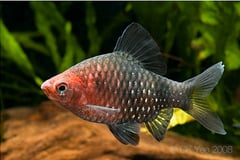
Pethia nigrofasciataBlack Ruby Barb
(Günther, 1868)
Max length55mm SL2.2in SLTank80 × 30cm31 × 12inTemp20–27°C68–81°FpH5.5–7.5The black ruby barb, Pethia nigrofasciata, is a small cyprinid endemic to the Kelani and Nilwala river basins in the 'wet zone' of Sri Lanka. Sometimes traded as 'purple-headed barb' or 'ruby barb', it has three dark, vertical flank markings, and in spawning males the head and front of the body turn reddish-purple. Farm-raised fish are fairly adaptable in water chemistry, while wild stock are likely to prefer slightly acidic to neutral conditions.

Pethia padamyaOdessa Barb
(Kullander & Britz, 2008)
Max length46mm SL1.8in SLTank80 × 30cm31 × 12inTemp16–25°C61–77°FpH6.5–8.5The Odessa barb, Pethia padamya, is a small cyprinid from central Myanmar, also recorded from the lower Chindwin, a tributary of the Ayeyarwady. In the trade since the early 1970s, it first appeared in Ukraine and was widely considered a hybrid until natural populations were found, with the formal description following in October 2008. Males carry a thick band of bright red-orange on the flanks, and farm-produced fish seem to hold their colour better when stressed.

Pethia phutunioDwarf Barb
(Hamilton, 1822)
Max length30mm SL1.2in SLTank60 × 30cm24 × 12inTemp21–26°C70–79°FpH6.0–7.0The dwarf barb, Pethia phutunio, is a small cyprinid from the lower Ganges and Brahmaputra river basins in Bangladesh and India. Frequently misidentified and quite rare in the trade, it is sometimes called 'spotted-sail barb' or 'spotted-tail barb'. Several congeners share its two black flank blotches, but it is smaller than all of them at 25 to 30 mm. It inhabits sluggish rivers, streams, ponds and swamps, often over deep mud or silt.

Pethia pookodensisPookode Lake Barb
(Mercy & Jacob, 2007)
Max length42mm SL1.7in SLTank75 × 30cm30 × 12inTemp20–25°C68–77°FpH5.5–7.5The Pookode Lake barb, Pethia pookodensis, is a small cyprinid described from Pookode Lake in Wayanad district, Kerala, and possibly endemic there. Pookode is a small forest lake and tourist destination that has suffered some degradation, and the IUCN classify the species as 'Critically Endangered'. It is most similar to P. ticto and P. punctata, with two dark flank markings, one on the front of the body and one on the caudal peduncle.

Pethia punctata
(Day, 1865)
Max length55mm SL2.2in SLTank75 × 30cm30 × 12inTemp21–26°C70–79°FpH6.0–7.5Pethia punctata is a small cyprinid endemic to the Western Ghats of southwestern India, where it appears restricted to west-flowing rivers. Poorly known in the hobby, it has a confusing taxonomic history and has been treated as both a synonym and a subspecies of P. ticto. It has a complete lateral line, two dark body blotches with the front one a scale row below the lateral line, and rows of spots in the dorsal fin.
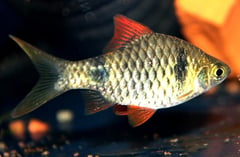
Pethia reval
(Meegaskumbura, Silva, Maduwage & Pethiyagoda, 2008)
Max length34mm SL1.3in SLTank75 × 30cm30 × 12inTemp18–26°C64–79°FpH6.0–7.5Pethia reval is a small cyprinid endemic to western Sri Lanka, known from the Kelani and Maha Oya river systems and the drainages between them. Considered a red-finned colour form of P. cumingii before its description, it is a smaller fish, to 33.6 mm SL, with red dorsal, anal and pelvic fins (pale yellow in the Kalu River population). The Mahaweli River population appears to have been introduced.

Pethia setnaiNarayan Barb
(Chhapgar & Sane, 1992)
Max length65mm SL2.6in SLTank90 × 30cm36 × 12inTemp20–26°C68–79°FpH6.0–7.5The Narayan barb, Pethia setnai, is a small cyprinid common in rivers draining the Western Ghats of India, described from Sanguem in Goa. It is widely traded as 'Puntius' narayani, though the trade fish all have the serrated dorsal-fin spine of P. setnai, a feature 'P.' narayani lacks. The central of its three dark flank markings, beneath the dorsal fin, is uniquely pale and diffuse. In hill streams and smaller rivers it gathers in backwater pools and deeper, slower areas.

Pethia shalyniusShalyni Barb
(Yazdani & Talukdar, 1975)
Max length55mm SL2.2in SLTank75 × 30cm30 × 12inTemp16–24°C61–75°FpH6.0–7.5The Shalyni barb, Pethia shalynius, is a small cyprinid that appears to be endemic to Meghalaya state in northeastern India. It is known from only a handful of localities in the Khasi and Jaintia hills, mostly streams above 1200 metres with cool, clear, well-oxygenated water, and is apparently under threat from industrial activity. Very peaceful, it is still a poor choice for the general community aquarium because of its preference for cooler temperatures.

Pethia sharmai
(Menon & Rema Devi, 1993)
Max length40mm SL1.6in SLTank60 × 30cm24 × 12inTemp20–26°C68–79°FpH5.5–7.5Pethia sharmai is a small cyprinid known only from a handful of localities around Chennai in Tamil Nadu, India. It mostly inhabits ponds and lakes, many of them in urban areas under pressure from urbanisation. Very peaceful but small and timid, it does best alone or with other diminutive species, and it is almost unheard of in the hobby outside India.

Pethia sp. 'Myanmar'
authority not recorded
Max length55mm SL2.2in SLTank75 × 30cm30 × 12inTemp18–24°C64–75°FpH6.0–7.5Pethia sp. 'Myanmar' appears to be an undescribed small cyprinid, supposedly collected in northern Myanmar. This fish has been widely misidentified and sold as the congener P. tiantian or 'Burmese bumble-bee barb'. Generally very peaceful, it suits the well-researched community aquarium in a mixed-sex group of at least 8-10, where rival males display their best colours.

Pethia stoliczkana
(Day, 1871)
Max length50mm SL2.0in SLTank75 × 30cm30 × 12inTemp18–26°C64–79°FpH6.0–7.5Pethia stoliczkana is a small cyprinid that appears to range from Manipur state in northeastern India through Myanmar and Thailand to western Laos. Much of the literature confuses it with P. ticto, but the two do not occur in the same waters and the lateral line is complete in this species and incomplete in P. ticto. The form from Mandalay division in Myanmar is sometimes sold as Puntius sp. 'pearlscale'. It mostly inhabits shady, flowing streams and tributaries.

Pethia tiantian
(Kullander & Fang, 2005)
Max length50mm SL2.0in SLTank75 × 30cm30 × 12inTemp15–25°C59–77°FpH6.5–7.5Pethia tiantian is a small cyprinid known only from the remote, mountainous area of Putao in Kachin state, northern Myanmar. Both known localities, the Nan Hto Chaung and the Mali Hka River, are part of the upper Ayeyarwady system. The species is only exported occasionally, and an undescribed fish often traded as 'Burmese bumblebee barb' is sometimes mislabelled with its name. It is subject to seasonal temperature fluctuations in nature.

Pethia tictoTicto Barb
(Hamilton, 1822)
Max length65mm SL2.6in SLTank80 × 30cm31 × 12inTemp18–25°C64–77°FpH6.0–7.5The ticto barb, Pethia ticto, is a small cyprinid widely distributed through most of the Indian subcontinent, from Pakistan and Nepal to Bangladesh. Its name is frequently misapplied to P. padamya in aquarium literature, though P. ticto is much the less colourful fish and males lack reddish-orange pigmentation on the body. Morphology and colour pattern vary by population, and some populations have already been described as distinct species.

Petitella bleheriFirehead Tetra
authority not recorded
Max length50mm SL2.0in SLTanknot recordedTemp23–26°C73–79°FpH5.5–7.0The firehead tetra, Hemigrammus bleheri, is a characin from blackwater rivers of the Rio Meta and Rio Negro in Colombia and Brazil. Most fish sold as the 'rummy-nose tetra' are this species. Of the three look-alikes, with H. rhodostomus and Petitella georgiae, only H. bleheri has red extending beyond the gill covers, although the red fades in fish in poor condition. Bittencourt et al. (2020) proposed moving it to Petitella. It should be kept in groups of 10 or more.

Petitella georgiaeFalse Rummy-nose
authority not recorded
Max length50mm SL2.0in SLTanknot recordedTemp22–26°C72–79°FpH5.5–7.0The false rummy-nose, Petitella georgiae, is a small tetra from the Rio Purus in Peru and Brazil and the Rio Negro and Rio Madeira in Brazil. This is one of three very similar species commonly sold as 'rummy-nose tetra', and the lack of a dark blotch at the bottom of the caudal peduncle is one way to separate it from the other two. One of the more tightly shoaling small tetras, it needs a group of at least ten.

Petitella rhodostomaRummy-nose tetra
authority not recorded
Max length50mm SL2.0in SLTanknot recordedTemp24–27°C75–81°FpH5.5–7.0The rummy-nose tetra, Hemigrammus rhodostomus, is a characin from blackwater rivers of the Rio Orinoco and lower Amazon basin in Venezuela and Brazil. This is the 'real' rummy-nose. Most fish sold under the name are the firehead tetra, H. bleheri, and the 'false' rummy-nose, Petitella georgiae, is also very similar. The head colour, the caudal peduncle blotches and the line from the central caudal band separate the three. Bittencourt et al. (2020) proposed moving it to Petitella.

Petrochromis famula
authority not recorded
Max length150mm SL6in SLTank120 × 30cm48 × 12inTemp24–27°C75–81°FpH7.5–9.0Petrochromis famula is a cichlid endemic to Lake Tanganyika, found in both the north and the south of the lake in shallow water over rocky bottoms. Its highly specialised mouthparts form a rasping 'plate' for scraping algae from rock, so the diet in captivity should be high in fibre and low in protein. Like others in the genus it has a nasty reputation, though aggression is directed primarily towards conspecifics.
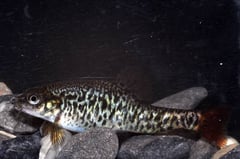
Petruichthys brevisInle Loach
(Boulenger, 1893)
Max length60mm SL2.4in SLTank90 × 30cm36 × 12inTemp18–24°C64–75°FpH6.0–8.0The Inle loach, Petruichthys brevis, is a small nemacheilid loach known only from Lake Inlé and its watershed in Shan state, eastern Myanmar. Sometimes traded as 'Lake Inle red-tailed loach', it is listed as 'Vulnerable' on the IUCN Red List due to deterioration of the lake. Unlike most loaches it spends a lot of time in the open, often hovering in midwater, and it is highly gregarious, needing a group of at least 8-10.

Phalacronotus apogon
(Bleeker, 1851)
Max length700mm SL28in SLTanknot recordedTemp20–27°C68–81°FpH6.0–7.5Phalacronotus apogon is a large silurid catfish from much of Southeast Asia, including Thailand, the Mekong basin and the Greater Sunda Islands. It reaches 700 mm and arguably should not be considered a home aquarium subject at all, but juveniles are sometimes sold as 'blue neon sheatfish' or 'metallic cheatfish' without adequate information on long-term care. It is an important food fish across much of its native range.
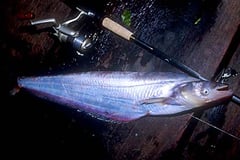
Phalacronotus bleekeriBleeker's Sheatfish
(Günther, 1864)
Max length600mm SL24in SLTank180 × 60cm72 × 24inTemp22–27°C72–81°FpH6.0–7.0Bleeker's sheatfish (Phalacronotus bleekeri) is a large silurid catfish from Thailand, Cambodia, Laos and Vietnam. An irregular import, it is often confused with some of its congeners. At up to 60 cm it needs a lot of open swimming space, powerful filtration and a heavy, tightly fitting cover, and it will eat any smaller fish it can fit in its mouth.