Results for “cobitis”
Type a name: scientific, common, or one a species used to go by. Or narrow the catalogue with the filters.
Filters

Crossocheilus cobitis
Bleeker, 1854
Matched on Lobocheilos cobitis, a name it was formerly known by
Max length52mm SL2.0in SLTank100 × 30cm39 × 12inTemp20–26°C68–79°FpHnot recordedCrossocheilus cobitis is a cyprinid ranging from the Mekong drainage in Laos, Vietnam and Thailand south to Sumatra, Borneo and Java. Primarily a lowland species, it lives in the turbid lower reaches of rivers over mud, close to submerged logs and similar objects. Given its wide range it has probably reached the trade as the invalid 'Crossocheilus siamensis', and it is likely to represent a group of similar-looking, closely related species.
Microcobitis misgurnoides
Rendahl, 1944
Matched on Cobitis misgurnoides, a name it was formerly known by
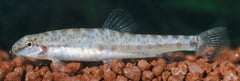
Max length41mm SL1.6in SLTank45 × 30cm18 × 12inTemp20–24°C68–75°FpH5.5–7.0Microcobitis misgurnoides is a small cobitid loach from central Vietnam and the Mekong system in eastern Laos, growing to 41 mm SL. It was described in Cobitis and stayed there for over 60 years until Bohlen and Harant (2011) moved it to the new genus Microcobitis. It apparently lives in groups, and a soft, sandy substrate probably suits it best.
Kottelatlimia pristes
Roberts, 1989
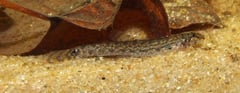
Max length40mm SL1.6in SLTank45 × 30cm18 × 12inTemp21–26°C70–79°FpH3.5–6.5Kottelatlimia pristes is a small cobitid loach from Peninsular Malaysia, Sumatra and Borneo, the most widely-distributed member of its genus. It inhabits small, slow-moving forest streams and peat swamps with tannin-stained water, often in piles of leaf litter. It turns up occasionally in the trade, sometimes as bycatch among other species and under names such as 'Sumatran mini royal loach' or Cobitis cf. sumatranus.
Lepidocephalichthys guntea
Hamilton, 1822
Matched on Cobitis guntea, a name it was formerly known by
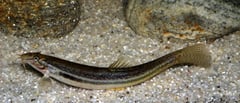
Max length150mm SL6in SLTank80 × 30cm31 × 12inTemp20–25°C68–77°FpH6.0–8.0Lepidocephalichthys guntea is a cobitid loach from the Ganges and Brahmaputra systems of northern India, Nepal and Bangladesh, and much of Myanmar. One of the most frequently-traded members of the group, it is an excellent choice for those new to keeping loaches. Males carry a solid, dark lateral stripe and females spotted flanks, and patterning varies with origin. It is also used as a food fish, eaten fresh and dried.
Canthophrys gongotaMoose-faced Loach
Hamilton, 1822
Matched on Cobitis gongota, a name it was formerly known by
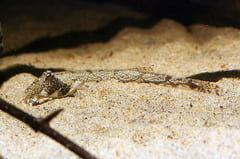
Max length110mm SL4in SLTank90 × 30cm36 × 12inTemp18–22°C64–72°FpH6.0–7.0The moose-faced loach, Canthophrys gongota, is a cobitid loach from the Ganges and Brahmaputra river systems in Nepal, northern India and Bangladesh. Often referred to as Somileptes gongota in aquarium literature, it is rarely seen in the trade, being notoriously delicate and difficult to ship. It mostly inhabits slow-moving, shallow tributaries and minor rivers over mud, sand or gravel.
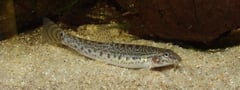
Lepidocephalichthys thermalis
Valenciennes, 1846
Matched on Cobitis thermalis, a name it was formerly known by
Max length50mm SL2.0in SLTank45 × 30cm18 × 12inTemp20–25°C68–77°FpH6.0–8.0Lepidocephalichthys thermalis is a cobitid loach from Sri Lanka and Peninsular India, described from the hot waters of Cania, Sri Lanka. Available sporadically, it makes an excellent choice for those new to keeping loaches. Unlike most of the genus it shows a preference for headwaters and clear, flowing streams. It was for a number of years included in Lepidocephalus until Havird and Page (2010) placed it in Lepidocephalichthys.
Acantopsis dialuzonaHorseface Loach
van Hasselt, 1823
Matched on Cobitis choirorhynchos, a name it was formerly known by
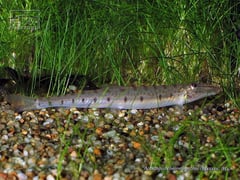
Max length200mm SL8in SLTank120 × 45cm48 × 18inTemp16–24°C61–75°FpH6.0–8.0The horseface loach, Acantopsis dialuzona, is a cobitid loach from Sumatra, Borneo, Java and Peninsular Malaysia, and possibly Thailand. Most literature lists it as A. choirorhynchos, which Kottelat treats as a junior synonym, and few if any fish in the trade come from near the type locality, so they may represent an unidentified species. Juveniles are exported in large numbers but adults are uncommon in the hobby, and it needs soft sand to bury in.
Iksookimia koreensis
Kim, 1975
Matched on Cobitis koreensis, a name it was formerly known by
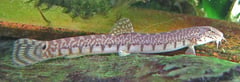
Max length130mm SL5in SLTank100 × 30cm39 × 12inTemp20–24°C68–75°FpH7.0–8.0Iksookimia koreensis is a cobitid loach endemic to Korea, relatively common in river drainages of northern and western South Korea. It is most similar to I. pumila, formerly treated as a subspecies, but has 10 or more dark bars on each flank, saddle-like markings along the back and irregular spots over the upper body. It apparently prefers small, shallow rivers and streams with moderate to fast currents, and needs clean, well-oxygenated water.
Iksookimia pumila
Kim & Lee, 1987
Matched on Cobitis koreensis pumilus, a name it was formerly known by
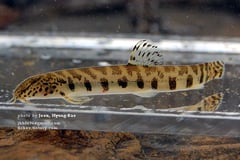
Max length80mm SL3.1in SLTank60 × 30cm24 × 12inTemp20–24°C68–75°FpH7.0–8.0Iksookimia pumila is a small cobitid loach endemic to Korea, known only from the Baek River drainage in the south-west of the country. A dam built in the middle reaches of the river in the late 1990s has undermined its presence at some localities. It is most similar to I. koreensis, of which it was formerly considered a subspecies, but has fewer than 10 bars on each flank and only a few larger, vertically orientated blotches on the upper body.
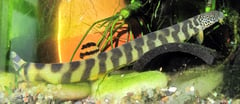
Kichulchoia multifasciata
Wakiya & Mori, 1929
Matched on Cobitis multifasciata, a name it was formerly known by
Max length120mm SL5in SLTank90 × 30cm36 × 12inTemp20–24°C68–75°FpH6.0–7.5Kichulchoia multifasciata is a cobitid loach known only from river basins of southwestern Korea. It is restricted to shallow, fast-flowing, highly-oxygenated headwaters with riffles and runs, and needs clean, well-oxygenated water in the aquarium. It is most easily told from K. brevifasciata, its only congener, by its body patterning, wrinkled lips and short barbels.
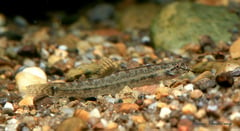
Lepidocephalichthys hasselti
Valenciennes, 1846
Matched on Cobitis hasselti, a name it was formerly known by
Max length60mm SL2.4in SLTank60 × 30cm24 × 12inTemp23–26°C73–79°FpH5.5–7.5Lepidocephalichthys hasselti is a cobitid loach described from Java and recorded from Myanmar to Vietnam, Peninsular Malaysia, Sumatra and Borneo. Its wide distribution makes it relatively common in the aquarium hobby. Colour and pattern vary with locality and have led to problems with identification, and the flanks usually show a row of dark blotches or a solid stripe with a light, unpigmented stripe above.
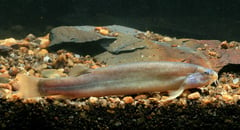
Lepidocephalus macrochir
Bleeker, 1854
Matched on Cobitis macrochir, a name it was formerly known by
Max length90mm SL3.5in SLTank75 × 30cm30 × 12inTemp22–26°C72–79°FpH5.5–7.5Lepidocephalus macrochir is a cobitid loach described from Sumatra and since recorded from Thailand, Peninsular Malaysia, Java and Borneo. It is traded sporadically as the 'pinky loach', 'deep water kuhli loach' and 'Borneo high body cave loach'. Although sometimes said to be a cave loach, Thai collectors report it from deep water, and in aquaria it spends a lot of time buried in soft substrates.
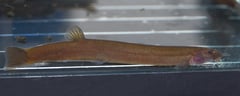
Pangio oblongaBlack Kuhli Loach
Valenciennes, 1846
Matched on Cobitis oblonga, a name it was formerly known by
Max length80mm SL3.1in SLTank60 × 30cm24 × 12inTemp21–26°C70–79°FpH3.5–7.0The black kuhli loach, Pangio oblonga, is a plain-bodied cobitid from Java, Sumatra, Borneo, Peninsular Malaysia and Thailand. Among the more readily available Pangio in the hobby, it is also traded as 'Java loach', 'cinnamon loach' and 'chocolate kuhli loach'. The species will probably turn out to be a complex of closely-related taxa, with at least four genetic lineages identified.
Crossocheilus elegans
Kottelat & Tan, 2011
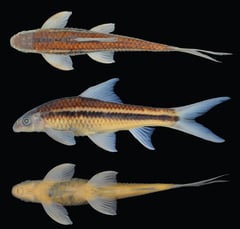
Max length110mm SL4in SLTank150 × 45cm60 × 18inTemp20–25.5°C68–78°FpHnot recordedCrossocheilus elegans is a cyprinid known only from the Segama and Kinabatangan river systems in Sabah, northern Borneo. It is mostly collected in or near the riffles of fast-flowing, rocky headwater hill streams. A pale yellowish brown stripe between the dark brown back and the blackish midlateral stripe separates it from other black-striped Crossocheilus, and before its description it was referred to as Epalzeorhynchos kalliurus and C. cobitis.
Iksookimia hugowolfeldi
Nalbant, 1993
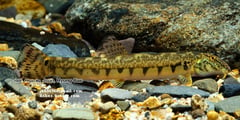
Max length160mm SL6in SLTank100 × 30cm39 × 12inTemp20–24°C68–75°FpH7.0–8.0Iksookimia hugowolfeldi is a cobitid loach endemic to Korea, known from the Yeongsan and Tamjin river systems in the province of Jeollanam-do. It is most similar to I. longicorpus, of which it was first considered a geographical variant, and has narrow dark bars below the lateral line with densely arranged small spots above. It apparently prefers small, shallow rivers and streams with moderate to fast currents, and needs clean, well-oxygenated water.
Iksookimia yongdokensis
Kim & Park, 1997
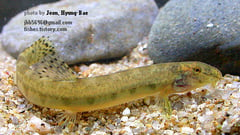
Max length160mm SL6in SLTank100 × 30cm39 × 12inTemp20–24°C68–75°FpH7.0–8.0Iksookimia yongdokensis is a cobitid loach endemic to Korea, known from four river drainages in the eastern province of Gyeongsangbuk-do. Most similar to I. longicorpus and I. hugowolfeldi, it has 9 to 13 dark vertical bars on the flanks, a small dark spot at the base of the upper caudal-fin lobe and a much smaller lamina circularis in males. It is most often seen in sluggish, shallow habitats with sand or pebble substrates in the mid-to-upper sections of rivers.
Kottelatlimia hipporhynchos
Kottelat & Tan, 2008
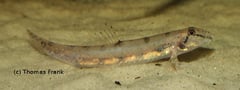
Max length52mm SL2.0in SLTank60 × 30cm24 × 12inTemp23–26°C73–79°FpH4.0–6.5Kottelatlimia hipporhynchos is a small cobitid loach known only from Central Kalimantan in Indonesian Borneo. It lives in slow-moving forest streams with clear, tannin-stained water over white sand, where it rests on the substrate or dives into it, so it must be given a soft sandy substrate. The largest member of the genus, it differs from its congeners in having papillae covering the lips, barbels and lobes of the mouth.
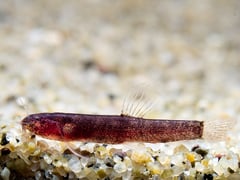
Kottelatlimia katik
Kottelat & Lim, 1992
Max length14mm SL0.6in SLTank45 × 30cm18 × 12inTemp23–26°C73–79°FpH3.5–6.5Kottelatlimia katik is a miniature cobitid loach from Johor in Peninsular Malaysia and the Batang Hari drainage of Sumatra, reaching 13.5 mm SL. It is considered paedomorphic, keeping juvenile features such as long fins and long nasal barbels into adulthood. It lives in small forest streams associated with blackwater peat swamps, often in leaf litter, and needs a soft sandy substrate and spotless water.
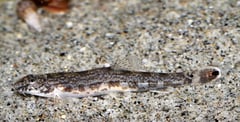
Lepidocephalichthys annandalei
Chaudhuri, 1912
Max length45mm SL1.8in SLTank45 × 30cm18 × 12inTemp22.5–26°C73–79°FpH5.5–7.5Lepidocephalichthys annandalei is a cobitid loach from the mid-to-lower Ganges and Brahmaputra systems in Nepal, Bangladesh and north-east India. Rarely traded, it has been sold as L. sp. 'peacock', presumably for its caudal-fin pattern of two dark v-shaped markings, unique within the genus. Fish in the trade differ slightly from the original description, in particular lacking a notched caudal fin.
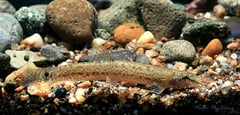
Lepidocephalichthys berdmorei
Blyth, 1860
Max length120mm SL5in SLTank75 × 30cm30 × 12inTemp20–25°C68–77°FpH6.0–8.0Lepidocephalichthys berdmorei is a cobitid loach found across Myanmar, Thailand, Laos, north-eastern India and Bangladesh. One of the most frequently-traded members of the genus, it is an excellent choice for those new to keeping loaches. Unlike most congeners it shows a preference for headwaters and streams with clear, flowing water, and its larger adult size separates it from the similar L. thermalis.