Basin
Pamba basin
Only species with a profile on Seriously Fish are counted.
- Species
- 12
- Rivers
- 3
- Photographed
- 12 of 12
- Difficulty rated
- 12 of 12
Rivers in this basinspecies recorded from each
Runs through

Batasio travancoriaMalabar Batasio
Bagridae · Hora & Law, 1941
The Malabar batasio, Batasio travancoria, is a bagrid catfish endemic to southern Kerala, India, in the Pamba, Chittar and Kallada drainages. Its darkish midlateral stripe and poorly-defined post-opercular spot separate it from B. sharavtiensis, the only other described member of the genus in southwestern India. Like its congeners it is an obligate inhabitant of shallow, fast-flowing, highly-oxygenated headwater streams.
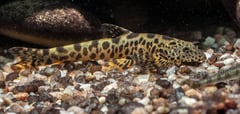
Bhavania australis
Balitoridae · (Jerdon, 1849)
Bhavania australis is a balitorid loach endemic to the Western Ghats mountains of southern India, recorded from Kerala, Tamil Nadu and Karnataka. An obligate dweller of shallow, fast-flowing, highly-oxygenated headwaters and minor tributaries, it has a flattened head and body and horizontally extended paired fins that form a powerful sucking cup for clinging to rocks. It is very rarely seen in the international aquarium trade but is maintained by a number of Indian aquarists.

Channa gachuaDwarf Snakehead
Channidae · (Hamilton, 1822)
The dwarf snakehead, Channa gachua, is a snakehead recorded across an enormous range from Iran to Taiwan and Bali. There is significant evidence that C. gachua as currently understood is a complex of similar-looking species in need of taxonomic review. A mouthbrooder bred regularly in captivity, it can share a well-chosen community with peaceful fishes too large to be prey, but populations should not be mixed as some may hybridise.

Laubuka fasciataMalabar Hatchet Chela
Cyprinidae · (Silas, 1958)
The Malabar hatchet chela, Laubuka fasciata, is a cyprinid endemic to the state of Kerala in southwestern India. A dark stripe runs from the eye to the caudal peduncle, and it favours slow-moving, shallow margins of rivers and streams over rock and gravel. It is occasionally available in the aquarium trade, apparently collected only in small numbers, and is an accomplished jumper.
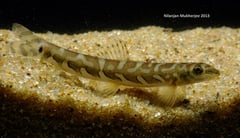
Mesonoemacheilus triangularisZodiac Loach
Nemacheilidae · (Day, 1865)
The zodiac loach, Mesonoemacheilus triangularis, is a loach from the Western Ghats of Kerala and Tamil Nadu in southern India. Also called the 'Batik loach', it is relatively common in the aquarium trade. Pale, black-edged saddles along the back and a similar set of bars from the belly set it apart from its congeners. Aquarists differ on its temperament, some finding it peaceful and others territorial and aggressive.
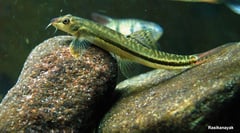
'Nemacheilus' anguilla
Nemacheilidae · Annandale, 1919
Nemacheilus anguilla is a loach endemic to the Western Ghats of southwestern India, recorded from rivers in Maharashtra, Karnataka and Kerala. Dark flank markings merged into a lateral stripe separate it from other Indian congeners, and its generic placement requires further study. It inhabits well-oxygenated, moderate to fast-flowing rivers over gravel and boulders, and is peaceful with its own kind, best kept in a group of four or more.

Opsarius bakeri
Cyprinidae · (Day, 1865)
Opsarius bakeri is a fast-swimming cyprinid endemic to the Western Ghats of southwestern India, with records from many rivers in Kerala and Karnataka. It is traded as 'royal danio', 'blue-spotted hill trout' and 'blue-dotted mirror fish', and has a single row of bluish-green spots that get smaller with age. Its well-oxygenated, fast-flowing rivers are being polluted and degraded by exotic species and sand mining.

Pseudetroplus maculatusOrange Chromide
Cichlidae · (Bloch, 1795)
The orange chromide, Pseudetroplus maculatus, is a euryhaline cichlid native to peninsular India and Sri Lanka. It mostly inhabits brackish estuaries, coastal lagoons and the lower reaches of rivers, and can be kept in fresh or brackish water so long as acidic conditions are avoided. Wild examples are rarely seen in the hobby, where selectively bred strains traded as 'red' or 'yellow' chromide are widely available.

Pseudosphromenus cupanusSpiketail Paradisefish
Osphronemidae · (Cuvier, 1831)
The spiketail paradisefish, Pseudosphromenus cupanus, is a small labyrinth fish restricted to southern India and Sri Lanka. It lives in sluggish and still waters such as rice paddies, swamps and weedy ponds. It lacks the two dark lateral stripes of its only congener, P. dayi. A secretive bubble nester, it is peaceful but too small and timid for most community aquaria.

Puntius mahecola
Cyprinidae · (Valenciennes, 1844)
Puntius mahecola is a cyprinid from rivers draining much of the Western Ghats mountains in Kerala, Karnataka and Tamil Nadu states, southern India. The name was misapplied to members of Dawkinsia for over a century, while the fish itself was widely misidentified as P. amphibius. A relatively plain fish, it has a single dark blotch on the caudal peduncle behind the anal fin. D. assimilis and other Dawkinsia species appear on trade lists as 'mahecola barb'.

Channa diplogrammaMalabar Snakehead
Channidae · (Day, 1865)
The Malabar snakehead, Channa diplogramma, is a large snakehead endemic to the southern Western Ghats in Kerala and Tamil Nadu, India. Treated as a synonym of the Indochinese C. micropeltes for over a century, it was revalidated in 2011 and has 103-105 lateral line scales, more than any other Channa. Its colour pattern changes markedly with age, and unlike most snakeheads it is pelagic and needs plenty of room to swim.

Garra surendranathanii
Cyprinidae · Shaji, Arun & Easa, 1996
Garra surendranathanii is a cyprinid known only from the Chalakkudy, Periyar and Pamba river basins in Kerala, southwestern India. It has appeared in the aquarium trade on a handful of occasions, marketed as 'green algae-eater'. The body is elongate and shallow, with black-edged scales and a black spot at the upper extremity of the opercle. It grows to around 150 mm SL.