Basin
Sarawak basin
Only species with a profile on Seriously Fish are counted.
- Species
- 19
- Rivers
- 1
- Photographed
- 19 of 19
- Difficulty rated
- 19 of 19
Rivers in this basinspecies recorded from each
Runs through
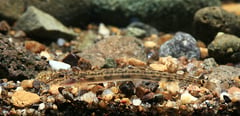
Acanthopsoides molobrion
Cobitidae · Siebert, 1991
Acanthopsoides molobrion is a dwarf horse-faced loach from Borneo, Peninsular Malaysia and southern Thailand. Like others in the genus it lives in flowing, clear-water river channels over sand, fine gravel or mud, and needs a soft, sandy substrate because it spends some of its time completely buried. Several Acanthopsoides in the trade have proven very tricky to identify. This one has 10 to 15 mid-dorsal markings and three bands in the caudal fin.
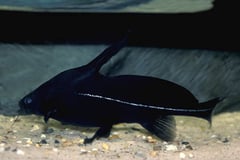
Bagrichthys macracanthusBlack Lancer
Bagridae · Bleeker, 1854
The black lancer, Bagrichthys macracanthus, is a bagrid catfish described from Sumatra, Indonesia, and possibly endemic to that island. The name 'lancer' comes from the extended dorsal spine of several members of the genus. Fish from the Chao Phraya and Mekong once included in it were described as B. majusculus in 2002. A shy, nocturnal catfish of large, turbid rivers, it needs a dimly lit tank with plenty of hiding places and is territorial towards other bottom-dwellers.
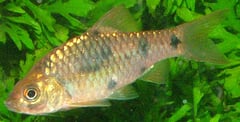
Barbodes banksi
Cyprinidae · Herre, 1940
Barbodes banksi is a cyprinid from Peninsular Malaysia, Singapore and western Borneo, plus the Anambas and Natuna islands of Indonesia. It is tentatively considered distinct from the closely related B. binotatus, differing in a dark, wedge-shaped marking below the dorsal fin in place of a midlateral spot, though the two may be colour forms of a single species. Occasionally exported as bycatch, it lives in habitats from fast hill streams to canals and floodplain ponds.
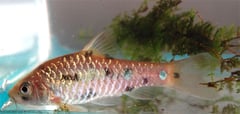
Barbodes everetti
Cyprinidae · Boulenger, 1894
Barbodes everetti is a cyprinid from Borneo, known from Sarawak and West Kalimantan, where it lives in clear forest streams in the foothills. Uncommon in the hobby, its name has been widely misapplied to the clown barb, B. dunckeri, from Peninsular Malaysia and Singapore. B. everetti is the less colourful of the two, with relatively small dark body markings, a dark blotch at the rear of the dorsal-fin base and 3½ scales above the lateral line.
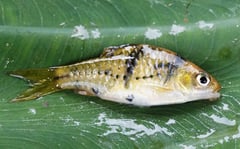
Barbodes kuchingensisFalse Spanner Barb
Cyprinidae · Herre, 1940
The false spanner barb, Barbodes kuchingensis, is a cyprinid apparently endemic to western Borneo, from Sarawak into the Kapuas system. It lives mainly in shallow, clear forest streams and is rarely exported, while subadult B. everetti and some populations of B. lateristriga are regularly traded under its name. B. kuchingensis sensu stricto has a prominent row of dark spots along the lateral line and a short streak extending from the upper part of the operculum.

Belontia hasseltiJava Combtail
Osphronemidae · Cuvier, 1831
The Java combtail, Belontia hasselti, is a labyrinth fish from peninsular Thailand, Peninsular Malaysia, Singapore, Sumatra, Borneo and Java. Also known as the 'Malay combtail', it mostly inhabits acidic forest peat swamps with little water movement. It differs from its only congener, B. signata, in its brownish grey body and the mosaic pattern in its unpaired fins. Growing to 200 mm SL, it will eat very small fishes and is not recommended for the average community aquarium.
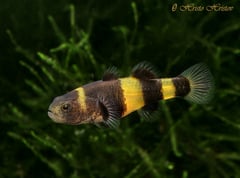
Brachygobius doriaeBumblebee Goby
Gobiidae · Günther, 1868
The bumblebee goby, Brachygobius doriae, is a small goby from western Borneo and the Natuna Islands, described from Sarawak. Among the more frequently traded members of the genus, it is often misidentified as B. nunus or B. xanthozonus and is most easily confused with B. sabanus. It lives in fresh and brackish water in lowland coastal habitats such as mangrove swamps, estuaries and tidal streams. It is best kept in a species-specific set-up.
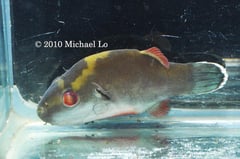
Carinotetraodon borneensis
Tetraodontidae · Regan, 1903
Carinotetraodon borneensis is a small red-eyed puffer known only from southern Sarawak, Malaysia (Borneo), in the Sarawak, Sadong and Rajang rivers. Uncommon in the hobby, it is sometimes mixed among shipments of C. salivator, which has distinct dark bars on the head and body in both sexes. Males in particular tend to be territorial, but a group can be kept where there is enough cover and space.
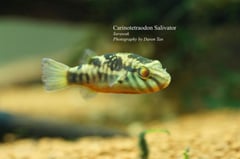
Carinotetraodon salivator
Tetraodontidae · Lim & Kottelat, 1995
Carinotetraodon salivator is a small red-eyed puffer known only from Sarawak, Borneo, in the Lupar, Sarawak and Rajang river systems. Sometimes traded as the 'striped redeye puffer' or 'zebra puffer', it has distinct dark bars on the head and body in both sexes, a colour pattern unique within the genus. Unlike most congeners, there is evidence that it prefers flowing water.

Datnioides polotaSilver Tiger Perch
Datnioididae · Hamilton, 1822
The silver tiger perch, Datnioides polota, is a tiger perch widely distributed in southeastern Asia, from India and Bangladesh east to Indonesia. Mostly found in brackish habitats such as estuaries, mangroves and coastal lagoons, it has a highly variable colour pattern with up to 7 dark bars. The name D. quadrifasciatus is sometimes applied to it, but that name is a junior homonym and polota takes precedence.
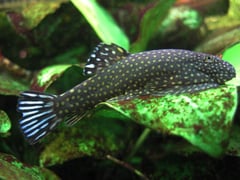
Gastromyzon ctenocephalus
Gastromyzontidae · Roberts, 1982
Gastromyzon ctenocephalus is a hillstream loach from western Borneo, known only from headwaters of the Sarawak and Sambas rivers. One of the more commonly traded members of the genus, it turns up in mixed shipments labelled 'Borneo sucker', 'Hong Kong pleco' or 'butterfly loach'. It is sometimes misidentified as G. punctulatus, which has yellow fins and a lighter, less intensely spotted body.
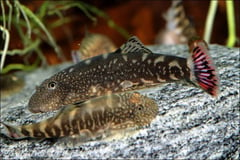
Gastromyzon ocellatus
Gastromyzontidae · Tan & Ng, 2004
Gastromyzon ocellatus is a small hillstream loach known only from the Sarawak River drainage in southern Sarawak, Malaysian Borneo. One of the more commonly traded members of the genus, it turns up in mixed shipments labelled 'Borneo sucker', 'Hong Kong pleco' or 'butterfly loach'. The dark brown body has cream bars that break up into an ocellus pattern on the flanks, and the caudal fin is red in life.
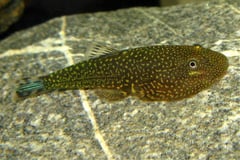
Gastromyzon stellatus
Gastromyzontidae · Tan, 2006
Gastromyzon stellatus is a hillstream loach from the Sarawak, Sadong and Lupar River drainages in southern Sarawak, Malaysian Borneo. Its dark brown head and body carry many small yellow spots. It forms a pair of cryptospecies with G. zebrinus and is often confused with it, since both show intermediate colour patterns. One of the more commonly-traded members of the genus, it usually arrives in mixed shipments labelled 'Borneo sucker' or 'Hong Kong pleco'.
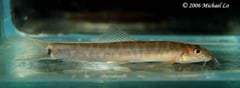
Nemacheilus saravacensis
Nemacheilidae · Boulenger, 1894
Nemacheilus saravacensis is a nemacheilid loach from Borneo, recorded from drainages in Sarawak (Malaysia) and West Kalimantan (Indonesia). It inhabits clear, tea-coloured forest streams with low mineral hardness and pH. Rare in the aquarium hobby, it may only have appeared as bycatch, and it carries 13-17 irregular dark blotches along the lateral line with a similar number of saddles across the back.
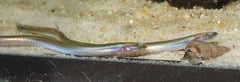
Pangio doriae
Cobitidae · Perugia, 1892
Traded as 'eel loach', Pangio doriae is a worm-like cobitid loach from Sarawak in Borneo and from Peninsular Malaysia. Some authors have suggested it is synonymous with P. anguillaris, but it can be told apart by a pair of prominent nasal barbels. The Sumatran population once identified as this species was described as P. bitaimac in 2009. It is most commonly available as bycatch among shipments of other fishes.
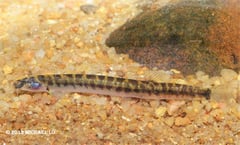
Pangio shelfordii
Cobitidae · Popta, 1903
Pangio shelfordii is a variably patterned kuhli loach from Peninsular Malaysia, Singapore, Sumatra and Borneo. Its patterning varies within and between populations, and as currently understood the species represents an assemblage containing a number of unidentified taxa. Some Sumatran and Bornean populations resemble P. piperata, which often occurs alongside it. It is exported occasionally, often as bycatch among shipments of congeners.
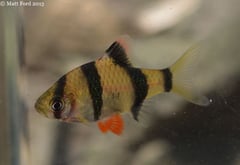
Puntigrus anchisporus
Cyprinidae · Vaillant, 1902
Puntigrus anchisporus is a small cyprinid endemic to Borneo, recorded from Kalimantan in Indonesia and much of Sarawak in Malaysia. One of the four-barred species once called the 'Puntius tetrazona group', it has a complete lateral line, a black dorsal fin with a red outer band and red pelvic fins. It occasionally appears in the hobby, but the trade relies largely on commercially-produced 'tiger barbs' of questionable origin.
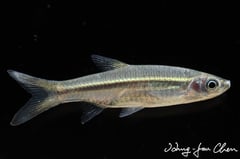
Rasbora argyrotaeniaSilver Rasbora
Cyprinidae · (Bleeker, 1849)
The silver rasbora, Rasbora argyrotaenia, is a cyprinid from Peninsular Malaysia, Singapore, Sumatra, Java, Borneo and the Palawan islands. One of the larger rasboras at up to 140 mm TL, it is a plain, silvery fish with a faint dark stripe, and fish pictured under this name with a bold black stripe are probably a regional variant of R. daniconius. A DNA barcode study found two mitochondrial lineages under the name, and the species as currently recognised is likely to be split.
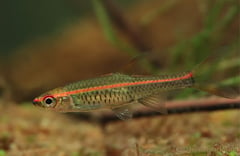
Trigonopoma pauciperforatumGlowlight Rasbora
Cyprinidae · Weber & de Beaufort, 1916
The glowlight rasbora, Trigonopoma pauciperforatum, is a small cyprinid from Peninsular Malaysia, Singapore, Borneo and Sumatra. Also sold as the 'redline' rasbora, its lateral stripe varies from deep orange to golden with locality, diet, condition and mood. It inhabits blackwater streams associated with peat swamps, where the pH can drop as low as 3.0 or 4.0, and the name R. agilis is a junior synonym of it.