Rasbora argyrotaenia
Silver Rasbora
Formerly Leuciscus argyrotaenia Bleeker, 1849 · Leuciscus cyanotaenia Bleeker, 1849 · Leuciscus schwenkii Bleeker, 1857
Last revised 2013Edit this page
On this page12 sections
Quick factsEdit
Difficulty6 of 8 measures
- Space
- large tank
- Water
- flexible
- Temp
- flexible
- Diet
- unknown
- Temperament
- peaceful
- Social
- needs to be in a group
- Compatibility
- fine with others
Other demands
Each of these can raise the rating on its own, whatever the measures above say.
- Hardiness
- unknown
Before you buy
Needs a tight-fitting lid as this species is known to jump
It will also thrive in a well-planted aquarium if you prefer but either way be sure to add a tightly-fitting cover as this species is an accomplished jumper.
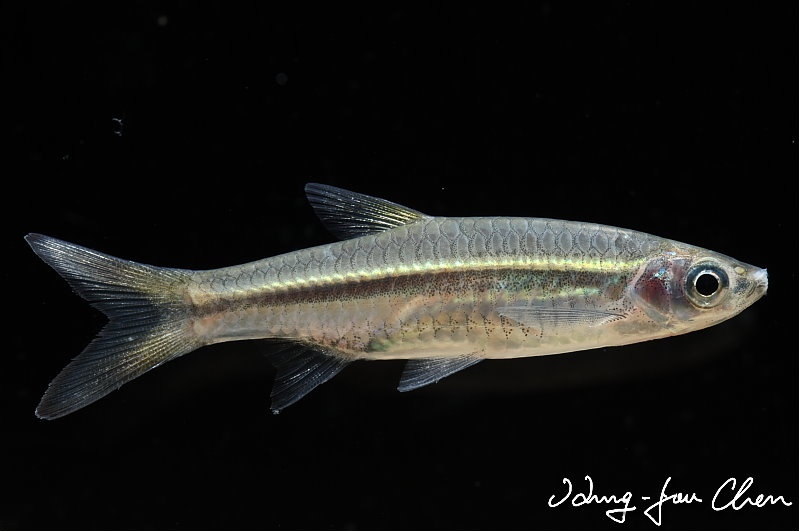
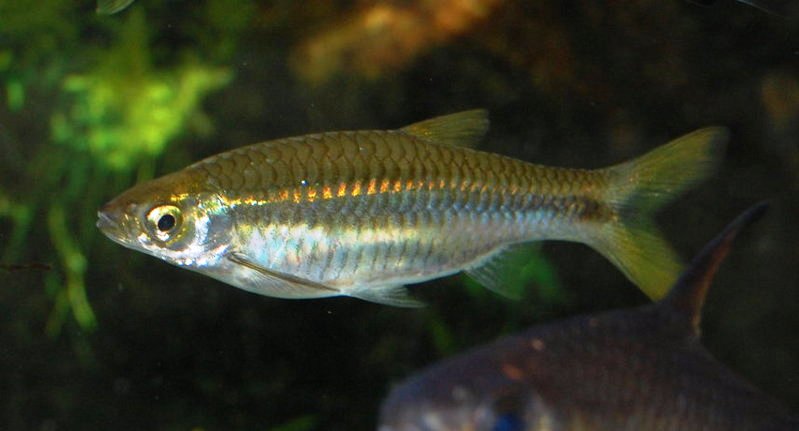
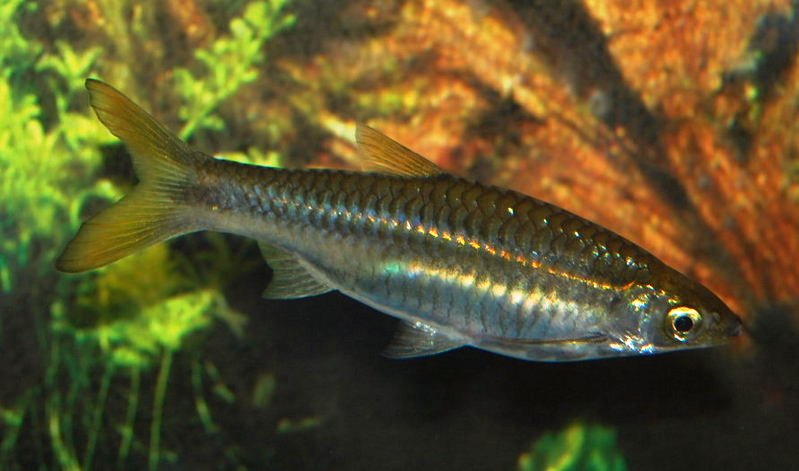
The silver rasbora, Rasbora argyrotaenia, is a cyprinid from Peninsular Malaysia, Singapore, Sumatra, Java, Borneo and the Palawan islands. One of the larger rasboras at up to 140 mm TL, it is a plain, silvery fish with a faint dark stripe, and fish pictured under this name with a bold black stripe are probably a regional variant of R. daniconius. A DNA barcode study found two mitochondrial lineages under the name, and the species as currently recognised is likely to be split.
Distribution
EditPeninsular Malaysia and Singapore, the Philippines (Palawan group of islands), and the islands of Sumatra, Borneo and Java.
Type localities are given as Banyumas, Gombong, Purworejo and Surabaya, all on Java, Indonesia. The type series was drawn from several places and may include more than one species.
Records from the Chao Phraya, Mae Klong and Mekong river systems in Thailand, Cambodia, China and Vietnam are now considered misidentifications of other species, although FishBase still includes them.
Habitat
Write a noteEditThe majority of collections have occurred in rivers, tributaries, and forest streams rather than standing water bodies though records do exist from some inland lakes. During the rainy season it's been observed to move into inundated areas to feed and presumably spawn. A study in Brunei Darussalam reported that it's mainly found swimming just below the surface in slower-moving sections and pools of forest streams containing clear water.
Aquarium size
Write a noteEditA tank measuring 120 ∗ 45 ∗ 45 cm48 ∗ 18 ∗ 18 in/~243 litres~64 US gal should be the minimum considered to house a group of these.
Maintenance
Write a noteEditChoice of decor is not as critical as water quality and the amount of open swimming-space provided. However should you possess the means to both provide and decorate a sufficiently-sized tank for long term care this species would look superb in a set-up designed to resemble a flowing river with a substrate of variably-sized rocks and gravel and some large water-worn boulders. A rivertank manifold could also be constructed to provide naturalistic unidirectional flow.
The tank could be further furnished with driftwood branches and aquatic plants for aesthetic value. While the vast majority of plant species will fail to thrive in such conditions possibilities include hardy species such as Java fern, Bolbitis or Anubias species which can be grown attached to the decor. It will also thrive in a well-planted aquarium if you prefer but either way be sure to add a tightly-fitting cover as this species is an accomplished jumper.
Water conditions
EditTemperature: 20 – 26 °C68 – 79 °F
pH: 6.0 - 7.5
Hardness: 2 - 10°H
These recommendations come from this profile’s own figures. They contain affiliate links, so we may earn a commission.
Diet
Write a noteEditAccording to stomach analyses of wild specimens this species appears to be primarily herbivorous in nature feeding on algae and other phytoplankton although we feel sure that invertebrates both aquatic and terrestrial are taken as well. In the aquarium it's easily-fed but for it to develop its best colours and condition offer regular meals of live and frozen foods such as bloodworm, Daphnia and Artemia along with good quality dried flakes and granules containing Spirulina or other vegetable matter.
Behaviour and compatibility
Write a noteEditNot an aggressive species but it can upset slow-moving/much shyer tankmates simply by its size, especially at feeding times. It's therefore only appropriate for larger tanks containing sufficiently-bold species. There are lots of suitable choices including many cichlids, catfish and characins. A community based around one of its native countries or river basins would also make an interesting project with possibilities from Thailand alone including Botia rostrata, various Crossocheilus, Cyclocheilichthys, Devario, Puntius, Mystacoleucus, other Rasbora, Garra, Homaloptera, Lepidocephalichthys, Nemacheilus, Syncrossus, Yasuhikotakia and Schistura species. Please note that while members of these genera may make fitting companions for R. argyrotaenia not all of them can be housed together. As always when selecting a compatible community of fish proper research is essential.
It is a gregarious species by nature and really should be kept in a group of at least six to get the best out of it in the aquarium. The fish show better colours in the presence of conspecifics, are less nervous and the display on the whole is far more natural-looking.
Sexual dimorphism
Write a noteEditMature females are noticeably rounder-bellied and often a little larger than males.
Reproduction
Write a noteEditIt has been bred in captivity in Indonesia. At the ornamental fish research institute in Depok, single pairs spawned in controlled containers after the pH was lowered, using raffia rope as a spawning substrate, and produced around 80 eggs per spawning (Zamroni et al., 2011). Like most cyprinids this species is an egg-scattering, continuous spawner that exhibits no parental care. That is to say when the fish are in good condition they will spawn often and in a densely-planted, mature aquarium it is possible that small numbers of fry may start to appear without human intervention.
However if you want to increase the yield of fry a slightly more controlled approach is required and we suggest upscaling an approach that has proven successful for smaller members of the genus. The adult group can still be conditioned together but one or more long, shallow, say 36" x 12" x 12"/90cm x 30cm x 30cm/85 litre containers should also be set up and half-filled with water. These should be very dimly lit and the base covered with some kind of mesh of a large enough grade so that the eggs can fall through it but small enough so that the adults cannot reach them. The widely available plastic 'grass'-type matting can also be used and works very well for other species. The water itself should be of slightly acidic to neutral pH with a temperature towards the upper end of the range suggested above. An internal power filter can be added initially and this should be positioned so that the flow is directed down the full length of the tank.
When the adult fish are well-conditioned and the females appear full of eggs one or two pairs should then be introduced to each container. Spawning can be initiated by adding small amounts of cool water every few hours in such a way that the tank is gradually topped up and feeding small amounts of live and frozen foods. Several spawning events will probably occur before a female is spent of eggs.
The adults will likely eat any eggs they find and are best removed after a couple of days at which point the power filter should be switched for a mature sponge-type unit in order to avoid fry being sucked into the mechanism. Incubation in Rasbora eggs is temperature-dependent to an extent but usually takes between 18 and 48 hours with the young free-swimming 24 to 48 hours later. Initial food should be Paramecium or similar introducing Artemia nauplii and/or microworm once the fry are large enough to accept them.
Notes
EditThis species is pictured with a very well-defined dark lateral stripe by many of the available resources but we believe that fish to be a probable regional variant of R. daniconius. While the real R. argyrotaenia does possess such a stripe it's much less prominent. This species should also have a complete lateral line, 2 dorsal spines, 7 soft dorsal rays, 3 anal spines, 5 soft anal rays, 12-13 scales between the nape and dorsal fin and 9 (sometimes 8) scale rows over the top of the caudal peduncle counting from the lateral line on one side to the other. It's neither popular in the hobby nor regularly available in the trade, probably because of its rather plain appearance, as it's far from scarce in nature. Some of the populations exhibit differences in colour pattern and other characters, and a DNA barcode study found two mitochondrial lineages under this name, around 5% apart (Sholihah et al., 2020), so the species as currently recognised is likely to be split into a group of closely-related, but distinct, taxa at some point in the future.
Rainboth's 'Fishes of the Cambodian Mekong' characterised members of Rasbora by possession of an unbranched, non-spiny first dorsal fin ray and seven soft dorsal rays, origin of the dorsal fin in the middle of the body, five branched anal fin rays, a small mouth not extending below the eye and a lack of barbels. It's long been recognised as a polyphyletic lineage as noted by Kottelat (1999) amongst others, and in 2010 the results of a phylogenetic analysis by T. Y. Liao et al. suggested a number of changes in order to improve the taxonomy. The authors found species of rasborin genera to actually represent a monophyletic grouping existing in six clades and erected four new genera (all containing former members of Rasbora) in order to preserve monophyly of the existing groups i.e. Boraras, Horadandia, Rasbora, Rasboroides and Trigonostigma.
According to the authors the first two clades are monotypic; R. brittani should now be referred to as Kottelatia brittani and R. dorsiocellata as Brevibora dorsiocellata. The third clade comprises Boraras brigittae, Horadandia atukorali, Rasboroides vaterifloris, Trigonostigma heteromorpha and three species previously included in Rasbora but also moved into new genera; Trigonopoma gracile, T. pauciperforatum and Rasbosoma spilocerca. The results for B. brigittae and T. heteromorpha were found to be inconclusive in some respects and further work regarding their phylogenetic position was recommended.
The fourth clade includes Rasbora semilineata, R. borapetensis, R. rubrodorsalis and an undescribed fish similar to R. beauforti. Clade five consists of R. daniconius, R. hubbsi, R. paucisqualis, R. wilpita, R. kobonensis, R. ornata and R. cf. daniconius. Clade six, meanwhile, is subdivided into two groupings. The first contains R. einthovenii, R. elegans and R. cephalotaenia and the second R. lateristriata, R. argyrotaenia, R. volzii, R. paviana, R. rasbora (plus an undescribed, similar fish), R. caudimaculata and R. trilineata. As this final clade contains the type species (see below) its members retain the generic name Rasbora as do clade five species because they don't differ sufficiently to warrant the erection of a new genus/genera.
Unfortunately many species weren't included in the analysis, meaning inevitable questions are raised regarding the correct placement of the 40 or so other Rasboras, in particular. As the genus had previously been split into various 'species groups' (groups of closely-related species) dating back to Brittan (1972, who referred to them as 'species complexes') Liao et al. proposed the following arrangement whilst noting it may be subject to change with further phylogenetic studies:
R. semilineata species group: R. semilineata, R. borapetensis, R. rubrodorsalis.
R. trifasciata species group: R. trifasciata, R. amplistriga, R. api, R. bankanensis, R. dies, R. ennealepis, R. hubbsi, R. johannae, R. kluetensis, R. meinkeni, R. nodulosa, R. paucisqualis, R. rutteni, R. sarawakensis, R. taytayensis, R. tobana, R. truncata, R. tuberculata.
R. daniconius species group: R. daniconius, R. armitagei, R. dandia, R. kobonensis, R. labiosa, R. microcephalus, R. ornata, R. wilpita.
R. einthovenii species group: R. einthovenii, R. cephalotaenia, R. elegans, R. jacobsoni, R. kalochroma, R. kottelati, R. nematotaenia, R. patrickyapi, R. tubbi.
R. argyrotaenia species group: R. argyrotaenia, R. aprotaenia, R. aurotaenia, R. baliensis, R. borneensis, R. bunguranensis, R. dusonensis, R. evereti, R. hobelmani, R. hossi, R. lateristriata, R. laticlavia, R. leptosoma, R. philippina, R. septentrionalis, R. spilotaenia, R. steineri, R. tawarensis, R. tornieri, R. volzii.
R. sumatrana species group: R. sumatrana, R. atridorsalis, R. calliura, R. caudimaculata, R. dorsinotata, R. notura, R. paviana, R. rasbora, R. subtilis, R. trilineata, R. vulgaris.
Not classified: R. beauforti, R. chrysotaenia, R. gerlachi (validity in question), R. lacrimula (said to compare most closely with R. dies and R. semilineata which are members of the R. trifasciata and R. semilineata groups, respectively) R. kalbarensis, R. reticulata, R. vulcanus (possibly not Rasboras) and R. zanzibarensis (identity in question).
NB - this list has been amended from that published in Liao et al. to reflect subsequent new species descriptions and taxonomical changes.
Shortly afterwards a paper investigating systematics of the subfamily Danioninae was published by Tang et al. (2010) Their results differed wildly from those of Liao et al. and the four new genera plus Boraras and Trigonostigma were synonymised with Rasbora based on an incomplete knowledge of relationships within the group, an approach they describe as 'more conservative'. Though perhaps neither conclusion is satisfactory we decided to adopt the system of Liao et al. pending future studies, if only because we prefer to retain Boraras and Trigonostigma.
The identity of the type species, often given as R. rasbora in the past, is no longer in question; when Bleeker first referred to the name Rasbora in 1859 only four nominal members were included of which R. cephalotaenia (known as Leuciscus cephalotaenia at the time) should be considered the type. Howes (1980) suggested the separation of a number of species into the new genus Parluciosoma with type species P. (Rasbora) argyrotaenia but the monophyly of that grouping was not recovered by Liao et al..
References
- Kottelat, M. (1999). Nomenclature of the genera Barbodes, Cyclocheilichthys, Rasbora and Chonerhinos (Teleostei: Cyprinidae and Tetraodontidae), with comments on the definition of the first reviser. Raffles Bulletin of Zoology Supplement 47(2), 591-600
- Rainboth, W. J. (1996). Fishes of the Cambodian Mekong. FAO Species Identification Field Guide for Fishery Purposes. FAO, Rome, 1-265
- Choy, S. C. & Chin, P. K. (1994). Freshwater fishes from the headwaters of the Belalong-Temburong River system, Brunei Darussalam, Borneo. Raffles Bull. Zool. 42(4), 757-774.
- Tang, K. L., M. K. Agnew, W. J. Chen., M. V. Hirt, T. Sado, L. M. Schneider, J. Freyhof, Z. Sulaiman, E. Swartz, C. Vidthayanon, M. Miya, K. Saitoh, A. M. Simons, R. M. Wood and R. L. Mayden (2010). Systematics of the subfamily Danioninae (Teleostei: Cypriniformes: Cyprinidae). Molecular Phylogenetics and Evolution 57(1), 189-214
- Mayden, R. L., K. L. Tang, K. W. Conway, J. Freyhof, S. Chamberlain, M. Haskins, L. Schneider, M. Sudkamp, R. M. Wood, M. Agnew, A. Bufalino, Z. Sulaiman, M. Miya, K. Saitoh, S. He (2007). Phylogenetic relationships of Danio within the order Cypriniformes: a framework for comparative and evolutionary studies of a model species. Journal of Experimental Zoology, Molecular Development and Evolution 308B, 642-654
- Liao, T. Y., Kullander, S. O. and F. Fang (2010). Phylogenetic analysis of the genus Rasbora (Teleostei: Cyprinidae). Zoologica Scripta 39(2), 155-176
- Kottelat, M. (2013). The fishes of the inland waters of southeast Asia: a catalogue and core bibliography of the fishes known to occur in freshwaters, mangroves and estuaries. The Raffles Bulletin of Zoology Supplement 27, 1-663
- Sholihah, Arni; Delrieu-Trottin, Erwan; Sukmono, Tedjo; Dahruddin, Hadi; Risdawati, Renny; Elvyra, Roza; Wibowo, Arif; Kustiati, Kustiati; Busson, Frédéric; Sauri, Sopian; Nurhaman, Ujang; Dounias, Edmond; Zein, Muhamad Syamsul Arifin; Fitriana, Yuli; Utama, Ilham Vemendra; Muchlisin, Zainal Abidin; Agnèse, Jean-François; Hanner, Robert; Wowor, Daisy; Steinke, Dirk; Keith, Philippe; Rüber, Lukas; Hubert, Nicolas (2020). Disentangling the taxonomy of the subfamily Rasborinae (Cypriniformes, Danionidae) in Sundaland using DNA barcodes Scientific Reports 10(1)doi.org/10.1038/s41598-020-59544-9
- Zamroni, M.; Nurhidayat; Cindelaras, S. (2011). Pemijahan dan perkembangan awal larva ikan rasbora (Rasbora argyrotaenia) Konferensi Akuakultur Indonesia 2011researchgate.net/publication/349883854
Species images · 3
These photographs are used with each photographer's permission.
Send a photographDistribution
Profile completeness23 of 24
Community
Questions about Rasbora argyrotaenia?
Ask on Discord