Country · Africa
Equatorial Guinea
Only species with a profile on Seriously Fish are counted, whether native or introduced.
- Species
- 8
- Families
- 3
- Genera
- 5
- Found only here
- 1
- Photographed
- 8 of 8
Shares its fishes withspecies recorded in both
Found only here1
1 of the species on this page are recorded in Equatorial Guinea and in no other country. This is not the same as being endemic.
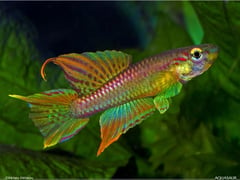
Aphyosemion splendopleureSplendid Lyretail
Nothobranchiidae · (Brüning, 1929)
The splendid lyretail, Aphyosemion splendopleure, is a killifish from the coastal lowlands of Nigeria, Cameroon, Equatorial Guinea and Gabon. It lives in slow-moving areas of small streams. Several colour forms exist depending on collection locality, and these should not be kept together, to prevent hybridisation. Very shy, it does not compete well with other species and is not recommended for the community aquarium.
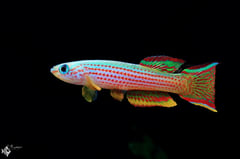
Aphyosemion striatumRed-Striped Lyretail
Nothobranchiidae · (Boulenger, 1911)
The red-striped lyretail, Aphyosemion striatum, is a killifish from coastal Equatorial Guinea and Gabon, as far south as the lower Ogooué basin. It inhabits perennial lowland rainforest streams, pools and freshwater swamps. Easy to breed and relatively long-lived, since it is not an annual species, it is a good beginner's killifish, though a shy one easily out-competed by more vigorous fishes.
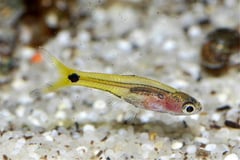
Barboides gracilis
Cyprinidae · Brüning, 1929
Barboides gracilis is a miniature cyprinid from coastal West and Central Africa, ranging from Benin through Nigeria and Cameroon to Equatorial Guinea. Adults measure less than 20 mm SL, and it inhabits slow-moving, shady rainforest streams and swamps with dense marginal vegetation. It has a following among enthusiasts of planted 'nano' aquaria and may be sold as 'dwarf amber/ember barb'. Very peaceful but timid, it is best kept alone or with other diminutive West African species.
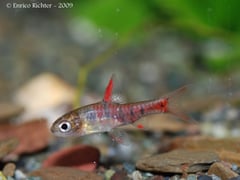
'Barbus' jae
Cyprinidae · Boulenger, 1903
'Barbus' jae is a small, delicate African barb from Cameroon, Equatorial Guinea, Gabon and the two Congos, sometimes sold as 'jae' or 'charcoal' barb. Populations vary in colour and pattern with locality, and the forms should never be mixed in the aquarium, to avoid crossbreeding. It lives in shady rainforest streams and swamps with soft, acidic, brown-stained water, and its shy nature makes it unsuitable for most community aquaria.

Chromidotilapia guntheri
Cichlidae · (Sauvage, 1882)
Chromidotilapia guntheri is a mouthbrooding cichlid from coastal drainages of western Africa between Liberia and Cameroon, plus the Niger and Benue. It occurs in a number of geographic forms, with fish from Cameroon tending to show dark blotches on the dorsal fin. A benthophagous omnivore, it sifts mouthfuls of substrate for food, and the male broods the eggs while the female defends the surrounding territory.
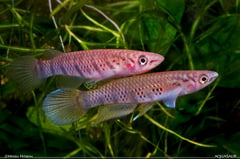
Epiplatys sexfasciatusSix-barred Panchax
Nothobranchiidae · Gill, 1862
The six-barred panchax, Epiplatys sexfasciatus, is a killifish from coastal regions between Gabon and Ghana. Well established in the hobby in several forms, it has a confusing taxonomy, and some authors restrict it to northwestern Gabon and Equatorial Guinea and treat other populations as subspecies. It mostly inhabits freshwater swamps and minor tributary streams, and is relatively easy to breed.
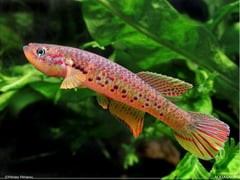
Aphyosemion herzogiHerzog's Lyretail
Nothobranchiidae · Radda, 1975
Herzog's lyretail, Aphyosemion herzogi, is a killifish described from northern Gabon and also found in Equatorial Guinea and southern Cameroon. In Gabon it occurs in the Ivindo and Okano drainages, both tributaries of the Ogooué system. It is also known from the upper parts of some Benito River tributaries in Equatorial Guinea and from the Ntem River in Cameroon.
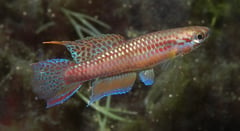
Aphyosemion erythronReddish Lyretail
Nothobranchiidae · (Sonnenberg, 2008)
The reddish lyretail, Aphyosemion erythron, is a small killifish that appears endemic to southwestern Equatorial Guinea. Described from Río Muni, it has also been collected in the Río Aye, Río Ecucu and lower Río Benito drainages. It was referred to as A. sp. Ecurya before its description.