Country · Africa
Nigeria
Only species with a profile on Seriously Fish are counted, whether native or introduced.
- Species
- 17
- Families
- 8
- Genera
- 13
- Found only here
- 2
- Photographed
- 17 of 17
Shares its fishes withspecies recorded in both
Found only here2
2 of the species on this page are recorded in Nigeria and in no other country. This is not the same as being endemic.

Alestopetersius smykalaiBlue Diamond Tetra
Alestidae · Poll, 1967
The blue diamond tetra, Alestopetersius smykalai, is an alestid from the Imo and Niger drainages in Nigeria. The only member of its genus found outside the Congo system, it has a prominent dark, roughly diamond-shaped marking on the caudal peduncle, and adult males lack extended median caudal-fin rays. Very rare in the hobby, it is considered Vulnerable by the IUCN because of rainforest loss, dams and habitat degradation in the Niger delta.
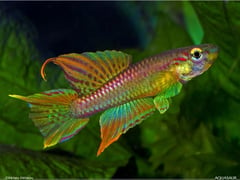
Aphyosemion splendopleureSplendid Lyretail
Nothobranchiidae · Brüning, 1929
The splendid lyretail, Aphyosemion splendopleure, is a killifish from the coastal lowlands of Nigeria, Cameroon, Equatorial Guinea and Gabon. It lives in slow-moving areas of small streams. Several colour forms exist depending on collection locality, and these should not be kept together, to prevent hybridisation. Very shy, it does not compete well with other species and is not recommended for the community aquarium.

Arnoldichthys spilopterusAfrican Red-eyed Tetra
Alestidae · Boulenger, 1909
The African red-eyed tetra, Arnoldichthys spilopterus, is a characin endemic to Nigeria, where it occurs in the Ogun and lower Niger river systems. Also known as the 'large-scaled African characin' or 'Niger tetra', it has large scales compared with most relatives and is hardy once settled. In the wild it is relatively scarce, known from fewer than 10 localities in an area of extensive deforestation and pollution.
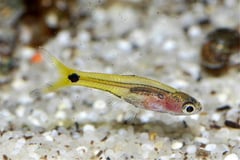
Barboides gracilis
Cyprinidae · Brüning, 1929
Barboides gracilis is a miniature cyprinid from coastal West and Central Africa, ranging from Benin through Nigeria and Cameroon to Equatorial Guinea. Adults measure less than 20 mm SL, and it inhabits slow-moving, shady rainforest streams and swamps with dense marginal vegetation. It has a following among enthusiasts of planted 'nano' aquaria and may be sold as 'dwarf amber/ember barb'. Very peaceful but timid, it is best kept alone or with other diminutive West African species.
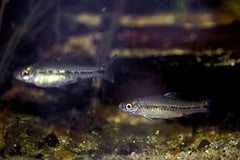
'Barbus' sublineatus
Cyprinidae · Daget, 1954
'Barbus' sublineatus is a widespread West African barb found in river basins from Senegal east to Cameroon, including the Niger and Volta. It is very variable in patterning and can be difficult to identify: Upper Niger fish show three elongate midlateral markings, Middle Niger fish a continuous band and Volta fish four spots. It may prove to be a complex of closely-related species. Little is known of its captive care.
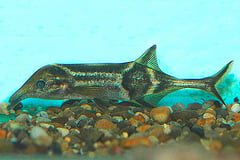
Campylomormyrus tamanduaWorm-Jawed Mormyrid
Mormyridae · authority not recorded
The worm-jawed mormyrid, Campylomormyrus tamandua, is a benthic mormyrid recorded from nine countries in West and Central Africa. It sometimes arrives among imports of the elephant fish, Gnathonemus petersii, but has both jaws extended into a beak-like shape. It needs pristine soft, acidic water, generally refuses standard foods and grows to 400 mm SL. Like other mormyrids it produces a weak electric field, used to navigate and to communicate.

Chromidotilapia guntheri
Cichlidae · Sauvage, 1882
Chromidotilapia guntheri is a mouthbrooding cichlid from coastal drainages of western Africa between Liberia and Cameroon, plus the Niger and Benue. It occurs in a number of geographic forms, with fish from Cameroon tending to show dark blotches on the dorsal fin. A benthophagous omnivore, it sifts mouthfuls of substrate for food, and the male broods the eggs while the female defends the surrounding territory.
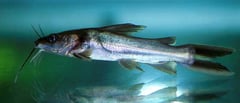
Clarotes laticepsWidehead Catfish
Bagridae · authority not recorded
The widehead catfish, Clarotes laticeps, is a large predatory catfish recorded across much of Africa, from Senegal and Guinea east to Egypt and Kenya. It inhabits large lakes and rivers and grows to 80 cm, though it is unlikely to reach this in captivity. Uncommon in the trade, it is capable of swallowing surprisingly large prey and is unsuitable for all but the biggest aquaria.
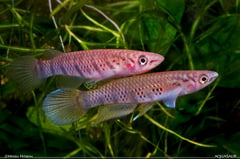
Epiplatys sexfasciatusSix-barred Panchax
Nothobranchiidae · Gill, 1862
The six-barred panchax, Epiplatys sexfasciatus, is a killifish from coastal regions between Gabon and Ghana. Well established in the hobby in several forms, it has a confusing taxonomy, and some authors restrict it to northwestern Gabon and Equatorial Guinea and treat other populations as subspecies. It mostly inhabits freshwater swamps and minor tributary streams, and is relatively easy to breed.
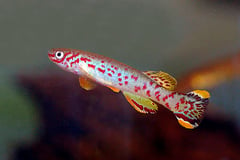
Fundulopanchax scheeli
Nothobranchiidae · (Radda, 1970)
Fundulopanchax scheeli is a killifish from Cameroon and Nigeria, living in small streams and ponds in a few areas of coastal rainforest. It occurs only in permanent water and is not an annual species. Very peaceful and shy, it is easily outcompeted by more vigorous fish and needs carefully chosen tankmates.
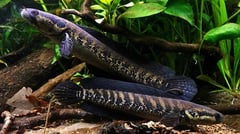
Parachanna africana
Channidae · Steindachner, 1879
Parachanna africana is an African snakehead found from Benin to Nigeria, in lowland coastal rivers draining into the Gulf of Guinea. Sometimes called the 'Niger snakehead', it is uncommon in the trade, and its name is sometimes misapplied to P. obscura. A series of 8-11 dark chevrons along the body identifies it, though these may not show depending on mood. It is best kept in a species-specific aquarium with a tight-fitting hood.
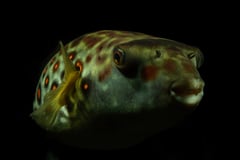
Tetraodon pustulatusCross River Pufferfish
Tetraodontidae · Murray, 1857
The Cross River pufferfish, Tetraodon pustulatus, is a puffer endemic to the Cross River basin of Nigeria and Cameroon. It lives in the moderately fast-flowing main channels and is assessed as endangered by the IUCN. Imports are scarce and costly. Primarily a molluscivore, it can share a tank with smaller, quick, peaceful fish, but similarly sized tankmates may be bitten.
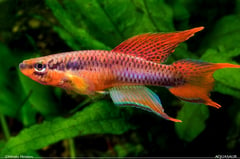
Aphyosemion bitaeniatumTwo-Striped Lyretail
Nothobranchiidae · Ahl, 1924
The two-striped lyretail, Aphyosemion bitaeniatum, is a killifish from lowland coastal regions of Togo, Benin and Nigeria. Its range reaches the Cross River delta and some inland localities along the lower Niger River. Populations in Cameroon, Equatorial Guinea and Gabon are now considered to represent other species.
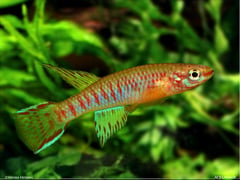
Aphyosemion elbertiRed-Barred Lyretail
Nothobranchiidae · Ahl, 1924
The red-barred lyretail, Aphyosemion elberti, is a killifish from central Cameroon and the upper Mambéré basin in the Central African Republic. Its range follows the Sanaga River system across Cameroon. It was described from 'Jade Plateau, Cameroon', which apparently corresponds to the Lebo River in what is now the Central African Republic.

Ctenopharyngodon idellaGrass Carp
Cyprinidae · Valenciennes, 1844
The grass carp, Ctenopharyngodon idella, is a large cyprinid native to the Amur River system in eastern Russia and northeastern China. Adults typically reach 800 to 1200 mm, making it a wholly unsuitable aquarium subject, though an albino form is traded. Widely introduced for aquaculture and weed control, it has caused serious damage to natural waters, and unwanted fish should never be released.
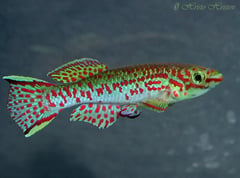
Fundulopanchax gardneriSteel-blue Killifish
Nothobranchiidae · Boulenger, 1911
The steel-blue killifish, Fundulopanchax gardneri, is native to the Cross River system in Nigeria and Cameroon and the Benue River drainage. Also known as Gardner's killi or blue lyretail, the common aquarium forms are among the best choices for those new to killifishes. Wild populations come in numerous colour forms, three of them described as subspecies. Its eggs can withstand a period of drying but will also hatch when kept submerged.
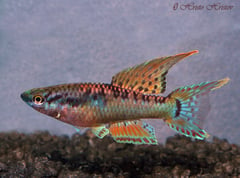
Aphyosemion bivittatumTwo-Banded Lyretail
Nothobranchiidae · Lönnberg, 1895
The two-banded lyretail, Aphyosemion bivittatum, is a killifish that appears restricted to coastal plains along the Cameroon and Nigeria border. Its range includes the Korup and Cross River National Parks, and the type locality is close to a waterfall on the Ndian River in southwestern Cameroon.