Country · Africa
Cameroon
Only species with a profile on Seriously Fish are counted, whether native or introduced.
- Species
- 60
- Families
- 21
- Genera
- 35
- Found only here
- 10
- Photographed
- 54 of 60
The country
These figures are from Wikidata, checked on 24 October 2026.
Shares its fishes withspecies recorded in both
Found only here10
10 of the species on this page are recorded in Cameroon and in no other country. This is not the same as being endemic.
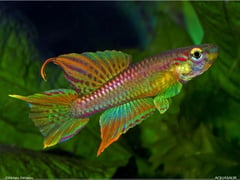
Aphyosemion splendopleureSplendid Lyretail
Nothobranchiidae · (Brüning, 1929)
The splendid lyretail, Aphyosemion splendopleure, is a killifish from the coastal lowlands of Nigeria, Cameroon, Equatorial Guinea and Gabon. It lives in slow-moving areas of small streams. Several colour forms exist depending on collection locality, and these should not be kept together, to prevent hybridisation. Very shy, it does not compete well with other species and is not recommended for the community aquarium.
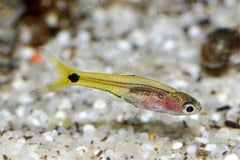
Barboides gracilis
Cyprinidae · Brüning, 1929
Barboides gracilis is a miniature cyprinid from coastal West and Central Africa, ranging from Benin through Nigeria and Cameroon to Equatorial Guinea. Adults measure less than 20 mm SL, and it inhabits slow-moving, shady rainforest streams and swamps with dense marginal vegetation. It has a following among enthusiasts of planted 'nano' aquaria and may be sold as 'dwarf amber/ember barb'. Very peaceful but timid, it is best kept alone or with other diminutive West African species.
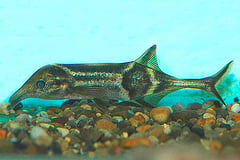
Campylomormyrus tamanduaWorm-Jawed Mormyrid
Mormyridae · authority not recorded
The worm-jawed mormyrid, Campylomormyrus tamandua, is a benthic mormyrid recorded from nine countries in West and Central Africa. It sometimes arrives among imports of the elephant fish, Gnathonemus petersii, but has both jaws extended into a beak-like shape. It needs pristine soft, acidic water, generally refuses standard foods and grows to 400 mm SL. Like other mormyrids it produces a weak electric field, used to navigate and to communicate.
Chiloglanis polypogonAfrican Suckermouth Catfish
Mochokidae · authority not recorded
Chiloglanis polypogon is an African suckermouth catfish from Nigeria and Cameroon, where it inhabits fast-flowing hilltop streams. Like most of the almost 50 described Chiloglanis, it is seen only rarely in the trade and the species are very difficult to tell apart. It needs strong water flow and well-oxygenated water, and it is peaceful with its own kind and with other rheophilic species.

Chromidotilapia guntheri
Cichlidae · (Sauvage, 1882)
Chromidotilapia guntheri is a mouthbrooding cichlid from coastal drainages of western Africa between Liberia and Cameroon, plus the Niger and Benue. It occurs in a number of geographic forms, with fish from Cameroon tending to show dark blotches on the dorsal fin. A benthophagous omnivore, it sifts mouthfuls of substrate for food, and the male broods the eggs while the female defends the surrounding territory.
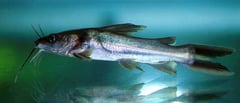
Clarotes laticepsWidehead Catfish
Bagridae · authority not recorded
The widehead catfish, Clarotes laticeps, is a large predatory catfish recorded across much of Africa, from Senegal and Guinea east to Egypt and Kenya. It inhabits large lakes and rivers and grows to 80 cm, though it is unlikely to reach this in captivity. Uncommon in the trade, it is capable of swallowing surprisingly large prey and is unsuitable for all but the biggest aquaria.
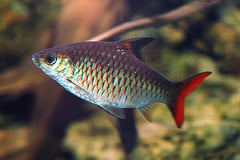
Enteromius guiraliAfrican Blackfin Barb
Cyprinidae · (Thominot, 1886)
The African blackfin barb, Enteromius guirali, is a cyprinid recorded only from Cameroon and Gabon, including the Sanaga and Ogooué basins. Primarily a river fish, it also enters affluent streams and tributaries. It is rare in the hobby and little is known of its captive care, though one lone fish kept by a forum member behaved well, and a batch of what appeared to be a different species has been imported under the same name.
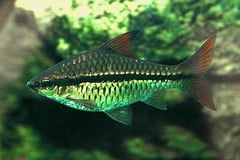
Enteromius holotaeniaSpotscale Barb
Cyprinidae · (Boulenger, 1904)
The spotscale barb, 'Barbus' holotaenia, is a cyprinid from Central West Africa, found principally in the Ogooué and Congo river systems. It has been recorded right across DR Congo and appears to be primarily riverine. Rare in the hobby, it has been suggested as the closest surface-dwelling relative of the Congo blind barb, Caecobarbus geertsii, a claim the profile considers questionable.
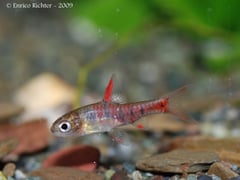
Enteromius jae
Cyprinidae · (Boulenger, 1903)
Enteromius jae is a small, delicate African barb from Cameroon, Equatorial Guinea, Gabon and the two Congos, sometimes sold as 'jae' or 'charcoal' barb. Populations vary in colour and pattern with locality, and the forms should never be mixed in the aquarium, to avoid crossbreeding. It lives in shady rainforest streams and swamps with soft, acidic, brown-stained water, and its shy nature makes it unsuitable for most community aquaria.
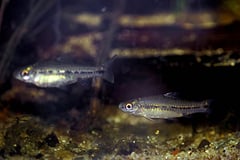
Enteromius sublineatus
Cyprinidae · (Daget, 1954)
Enteromius sublineatus is a widespread West African barb found in river basins from Senegal east to Cameroon, including the Niger and Volta. It is very variable in patterning and can be difficult to identify: Upper Niger fish show three elongate midlateral markings, Middle Niger fish a continuous band and Volta fish four spots. It may prove to be a complex of closely-related species. Little is known of its captive care.
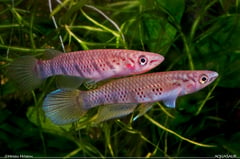
Epiplatys sexfasciatusSix-barred Panchax
Nothobranchiidae · Gill, 1862
The six-barred panchax, Epiplatys sexfasciatus, is a killifish from coastal regions between Gabon and Ghana. Well established in the hobby in several forms, it has a confusing taxonomy, and some authors restrict it to northwestern Gabon and Equatorial Guinea and treat other populations as subspecies. It mostly inhabits freshwater swamps and minor tributary streams, and is relatively easy to breed.
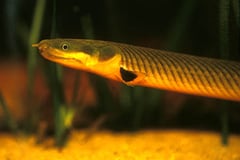
Erpetoichthys calabaricusRopefish
Polypteridae · authority not recorded
The ropefish, Erpetoichthys calabaricus, is a nocturnal polypterid from shallow, heavily vegetated waters in Western Africa. The only member of its genus, it is closely related to Polypterus, and its divided swim bladder serves as an accessory breathing organ, so it can drown if denied atmospheric air. It grows to 90 cm and will eat tankmates it can fit in its mouth.
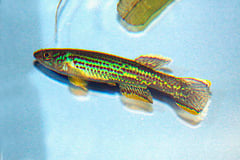
Fundulopanchax marmoratusMarbled Lyretail
Nothobranchiidae · authority not recorded
The marbled lyretail, Fundulopanchax marmoratus, is a rare killifish endemic to Cameroon, found in a single area of coastal rainforest. It inhabits small streams and ponds and occurs only in permanent water, so it is not an annual species. It needs cooler temperatures than most killifishes and is best kept in a species tank.
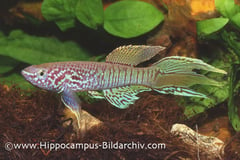
Fundulopanchax sjostedtiGolden Pheasant
Nothobranchiidae · (Lönnberg, 1895)
The golden pheasant, Fundulopanchax sjostedti, is a large killifish from Nigeria and Cameroon, reaching 12 cm, found in swampy coastal rainforest. Adult males are admired for their colouration. It was formerly classified as Aphyosemion sjostedti, and much of the literature still uses that name. Several colour forms exist, including a smaller variety known as 'Dwarf Red'. Males are aggressive towards one another.
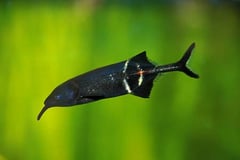
Gnathonemus petersiiElephantnose Fish
Mormyridae · authority not recorded
The elephantnose fish, Gnathonemus petersii, is a mormyrid with a vast African range, recorded in ten countries from Mali and Benin to Zambia. It uses its 'trunk' to find food hidden in the substrate, so it needs a soft substrate, and it needs dim lighting. Like other mormyrids it produces a weak electric field that it uses to navigate, hunt and communicate. It is very sensitive to deteriorating water conditions and to many medications, including salt.
Gymnarchus niloticusAba Aba
Gymnarchidae · authority not recorded
The aba aba, Gymnarchus niloticus, is a large predatory fish from much of the northern half of Africa, and the only species in its genus. An extended dorsal fin gives it the alternative name upside-down knifefish, although it is more closely related to the mormyrids, and it uses a weak electrical discharge to navigate and communicate. Growing to 165 cm and extremely aggressive, it is simply not suited to the home aquarium in any respect.
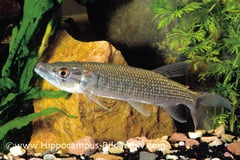
Hepsetus odoeAfrican Pike Characin
Hepsetidae · authority not recorded
The African pike characin, Hepsetus odoe, is a predatory characin of West and Central Africa, found from the Sassandra in Ivory Coast to Kribi in Cameroon and in the Niger, Volta and Chad basins. It is an ambush predator with a fearsome set of teeth that superficially resembles the European pike. Juveniles appear in the trade, but it reaches 70 cm in nature and is strictly for the specialist with a very large aquarium.
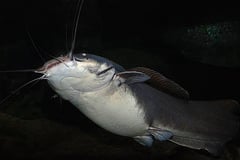
Heterobranchus longifilisVundu
Clariidae · authority not recorded
The vundu, Heterobranchus longifilis, is a clariid catfish widespread throughout Africa and one of the largest freshwater fishes on the continent. Growing to 150 cm, it is highly predatory, must be kept alone, and suits only public aquaria or a hobbyist able to house it properly. Its very long adipose fin separates it from similar members of the genus.
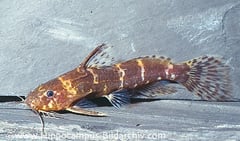
Microsynodontis batesiiDwarf Synodontis
Mochokidae · authority not recorded
The dwarf synodontis, Microsynodontis batesii, is a small catfish from the Congo and Ogowe basins in DR Congo, Gabon and Cameroon. The largest Microsynodontis, it is sometimes mislabelled as Synodontis sp. 'Nyong'. Young fish are sold with a spotted or reticulated pattern that breaks up into the characteristic barring as they grow, and new imports are often delicate. At least some of its recorded occurrences may be different species.
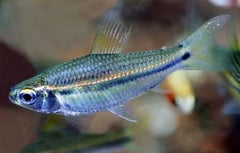
Nannaethiops unitaeniatusOne-lined African Characin
Citharinidae · authority not recorded
The one-lined African characin, Nannaethiops unitaeniatus, is a small citharinid from Cameroon, Nigeria, Gabon and both Congo republics. A shy, peaceful fish of streams, small rivers, lakes and ponds, it should be kept in a shoal. Not often seen for sale, it is often confused with similar-looking members of the genus Neolebias, and mature males are smaller, slimmer and more brightly coloured than females.
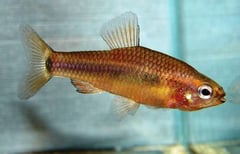
Neolebias ansorgiiAnsorge's Neolebias
Citharinidae · authority not recorded
Ansorge's neolebias, Neolebias ansorgii, is a small distichodontid from Cameroon, Democratic Republic of Congo, Nigeria, Gabon and Benin. It inhabits marshes and small, heavily vegetated ponds and creeks, and does not thrive in a brightly lit setup. Rarely offered for sale, it often looks fairly plain in dealers' tanks but colours up in the correct conditions. A very shy fish, it is ideally kept in a species setup.

Oreochromis niloticusNile Tilapia
Cichlidae · (Linnaeus, 1758)
The Nile tilapia, Oreochromis niloticus, is a cichlid with a very wide natural range in Africa, from Senegal east to Egypt and Uganda. Bred in huge numbers as a food fish, it has been introduced to over 70 other countries and is one of the most invasive fish species in the world. It reaches 60 cm, though usually around 35 cm, breeds readily, is very messy and does not make a good aquarium subject.
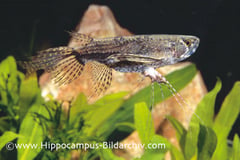
Pantodon buchholziAfrican Butterfly Fish
Pantodontidae · authority not recorded
The African butterfly fish, Pantodon buchholzi, is a surface-dwelling osteoglossiform from still and slow waters in West and Central Africa. The only member of its genus and family, it takes its name from the large pectoral fins, which make it look like a dead leaf at the surface and power leaps of several metres. It is quite inactive when not feeding, will eat any fish it can fit in its mouth, and needs a tightly fitting cover.
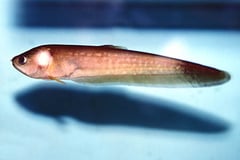
Papyrocranus aferArowana Knifefish
Notopteridae · authority not recorded
The arowana knifefish, Papyrocranus afer, is a notopterid knifefish widespread over much of western and central Africa, from Senegal to Sudan. Its anal and caudal fins are fused into one long, undulating fin. Infrequently imported, it grows to 80 cm and becomes increasingly territorial as it matures, so it is recommended only to the experienced fishkeeper and best kept as a single specimen.
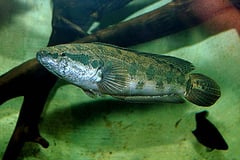
Parachanna obscuraAfrican snakehead
Channidae · authority not recorded
The African snakehead, Parachanna obscura, is widespread in West Africa from Senegal to Cameroon and ranges inland across the continent to Sudan. The most commonly seen African Parachanna, it is hard to tell apart from the rarely imported P. insignis. It will eat any fish less than two thirds its size and is best kept alone. Both parents guard the eggs among surface vegetation, and the female is said to feed the fry with infertile eggs.
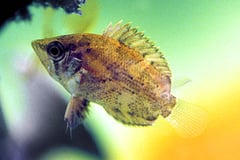
Polycentropsis abbreviataAfrican Leaf Fish
Polycentridae · authority not recorded
The African leaf fish, Polycentropsis abbreviata, is a predatory leaf fish from Nigeria, Benin, Cameroon and Gabon. Camouflaged to mimic a dead leaf, it stalks prey in a head-down stance and can swallow prey almost as big as itself. It is flighty and very sensitive to deteriorations in water quality, needs soft, acidic water and often accepts only live food. It is not recommended for the beginner.
Polypterus bichirNile Bichir
Polypteridae · Lacepède, 1803
The Nile bichir, Polypterus bichir, is a large bichir recorded from Egypt, Kenya, Ethiopia and Chad west to Nigeria, Ghana and Guinea-Bissau. It grows to 72 cm, though rarely that large in aquaria, and belongs to the 'lower-jawed' group of Polypterus. It will eat any tankmate it can fit in its mouth, and needs a tight-fitting cover as an excellent escape artist.
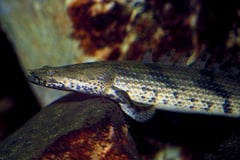
Polypterus endlicheriiSaddled Bichir
Polypteridae · Heckel, 1847
The saddled bichir, Polypterus endlicherii, is a nocturnal bichir recorded from ten African countries including Cameroon, Nigeria and Sudan. It lives in rivers and marshy areas and is occasionally found in brackish water around mangroves. One of the 'lower-jawed' tribe of Polypterus, it can reach 75 cm, though rarely in captivity, and a fully grown fish needs a very large aquarium. Like other bichirs it breathes atmospheric air and can drown if denied access to it. It is still often sold as Polypterus endlicheri.
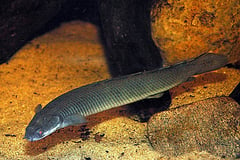
Polypterus senegalusSenegal Bichir
Polypteridae · Cuvier, 1829
The Senegal bichir, Polypterus senegalus, is the most widespread bichir, found in 26 African countries including Egypt and Senegal. It is usually found in shallow, slow-moving swamps, marshes and freshwater lagoons. One of the more peaceful and active Polypterus, it reaches 50 cm, is recommended for beginners with these fish, and has lived for over 30 years in aquaria.
Polypterus teugelsi
Polypteridae · Britz, 2004
Polypterus teugelsi is a bichir probably endemic to the River Cross drainage in Cameroon, where it lives in shady, slow-moving rainforest streams. Its colour pattern differs from every other member of the genus: a network of black marks over the upper half of the body, an orange belly and jet black pectoral fins. It is also more slender than other Polypterus. Discovered in 1988 and described in 2004, it stands apart from every other known bichir, all described before 1911.

Procatopus nototaeniaLarge-finned Lampeye
Poeciliidae · authority not recorded
The large-finned lampeye, Procatopus nototaenia, is a killifish thought to be endemic to the Lobi and Kienke river basins in southwestern Cameroon. It lives in shady forest streams with clear, moderately flowing water. Several colour forms are known by collection locality, among them 'Kribi', 'Edea' and 'Kopongo', and should never be mixed. The males carry the differences in colour and finnage, their dorsal, anal and caudal fins lengthening as they mature.

Pungu maclareni
Cichlidae · authority not recorded
Pungu maclareni is a maternally mouthbrooding cichlid endemic to Lake Barombi Mbo, a small volcanic crater lake in Cameroon. Enlarged jaw muscles and small teeth allow it to tear chunks from freshwater sponges, its characteristic diet. It is considered critically endangered because of its tiny range, habitat destruction, introduced species and overfishing, and is correspondingly rare in the hobby.

Stomatepia pindu
Cichlidae · authority not recorded
Stomatepia pindu is a cichlid endemic to Lake Barombi Mbo, a small volcanic crater lake in Cameroon. Its tiny range, water removal for the nearby town of Kumba, deforestation, introduced species and overfishing mean it is considered critically endangered, and it is correspondingly rare in the hobby. It can change colour rapidly, turning pure black when in good condition and particularly when spawning.
Synodontis albolineatusMustard Synodontis
Mochokidae · Pellegrin, 1924
The mustard synodontis, Synodontis albolineatus, is a small squeaker catfish endemic to the Majinga river system in Gabon. Also known as the mustard squeaker, it is imported infrequently but sometimes turns up in mixed boxes of Synodontis from exporters. It reaches around 10 cm and is peaceful with most species, though territorial towards its own kind in smaller systems.
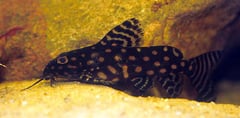
Synodontis angelicusPolka Dot Synodontis
Mochokidae · Schilthuis, 1891
The polka dot synodontis, Synodontis angelicus, is a squeaker catfish from the Democratic Republic of Congo, Cameroon and the Republic of Congo. Very nocturnal and long-lived, it can survive for over 20 years, and its spots vary from white to yellow on a grey to black base depending on locality. It becomes increasingly territorial as it matures, and adults are often completely intolerant of other bottom dwellers, especially other Synodontis.
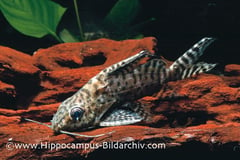
Synodontis eupterusFeatherfin Synodontis
Mochokidae · Boulenger, 1901
The featherfin Synodontis, Synodontis euptera, is a catfish from Nigeria, Cameroon, Mali, Ghana, Sudan, Chad and Niger. Juveniles are often sold as Synodontis 'Network' for their reticulated pattern, with no hint of an adult size of up to 300 mm SL. The pattern breaks up into simple spots with age as the long extensions of the 'feathered' dorsal fin develop. It can live for over 15 years in the aquarium.
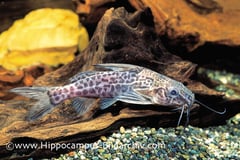
Synodontis greshoffi
Mochokidae · authority not recorded
Synodontis greshoffi is a Synodontis catfish from the Democratic Republic of Congo and Cameroon, growing to around 200 mm SL. Infrequently imported, it is occasionally confused with S. schoutedeni, which it superficially resembles. It becomes slightly territorial as it matures but can be kept in a small group if each fish has a refuge, and its adult size makes it unsuitable for the general community.
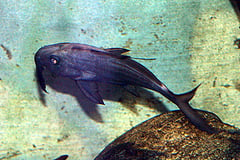
Synodontis membranaceusMoustache Catfish
Mochokidae · (Geoffroy Saint-Hilaire, 1809)
The moustache catfish, Synodontis membranaceus, is a large mochokid widespread in Africa, from Egypt and Sudan to Senegal and Nigeria. Its 'moustache' is a membrane along the maxillary barbels. It feeds mainly on plankton, filtered through its many gill rakers, and often feeds at the surface upside down. Often sold as a spotted juvenile, it can reach 50 cm and becomes territorial with conspecifics as it matures.
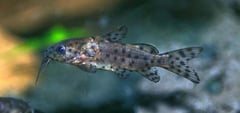
Synodontis nigritaFalse Upside-down Catfish
Mochokidae · authority not recorded
The false upside-down catfish, Synodontis nigrita, is a widespread Synodontis recorded from eleven African countries, among them Nigeria and Mali. Often sold as the upside-down catfish, it inverts far less often than the true one, S. nigriventris, and grows far larger, so adults returned by owners are a common sight in shops. It is also confused with the similar but smaller S. robbianus, from which its greyish base colour separates it.
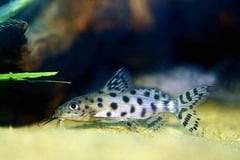
Synodontis ocelliferOcellated Synodontis
Mochokidae · authority not recorded
The ocellated Synodontis, Synodontis ocellifer, is a catfish from Nigeria, Gambia, Chad, Cameroon, Senegal, Mali, Ghana, Niger and Guinea. Often confused with similar Synodontis, it is distinguished by its very long adipose fin. One of the hardiest Synos available, it becomes slightly territorial as it matures, and many hybrids of it have been appearing on the market.
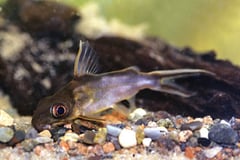
Synodontis pleuropsBig Eyed Synodontis
Mochokidae · authority not recorded
The big eyed Synodontis, Synodontis pleurops, is a Synodontis catfish from the Democratic Republic of Congo and Cameroon. Very large eyes and a downturned mouth suited to grazing algae make it hard to confuse with other species, though colouration and patterning vary considerably with locality. Very nocturnal, it is rarely seen unless the aquarium is dimly lit, and it keeps close to driftwood, rocks and broad plant leaves.
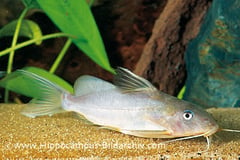
Synodontis schall
Mochokidae · authority not recorded
Synodontis schall is a large, predatory Synodontis catfish recorded from seventeen African countries, among them Nigeria, Egypt and Kenya. Regarded as the 'bad boy' of the genus in aquarium circles, it grows to 375 mm SL, is randomly aggressive and will eat smaller fish, so it should be kept only with tankmates that can stand their own ground. It is an important food fish in some of its native countries.
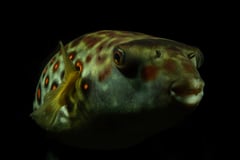
Tetraodon pustulatusCross River Pufferfish
Tetraodontidae · Murray, 1857
The Cross River pufferfish, Tetraodon pustulatus, is a puffer endemic to the Cross River basin of Nigeria and Cameroon. It lives in the moderately fast-flowing main channels and is assessed as endangered by the IUCN. Imports are scarce and costly. Primarily a molluscivore, it can share a tank with smaller, quick, peaceful fish, but similarly sized tankmates may be bitten.
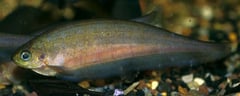
Xenomystus nigriAfrican Knifefish
Notopteridae · authority not recorded
The African knifefish, Xenomystus nigri, is a notopterid recorded from numerous African rivers, including the Nile, Congo and Niger systems. Its swim bladder acts as an accessory breathing organ, and it rises to the surface periodically to gulp air, often with a bell-like sound. Often confused with the far more aggressive Asian knifefish, Notopterus notopterus, it lacks the dorsal fin present in its Asian relative. A scaleless species, it is very sensitive to medications.
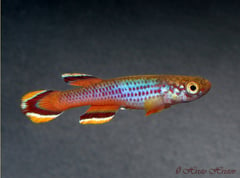
Aphyosemion celiaeCelia's Lyretail
Nothobranchiidae · Scheel, 1971
Celia's lyretail, Aphyosemion celiae, is a killifish from western Cameroon, where it appears restricted to parts of the central Mungo River basin. It was described from a small stream in Mambanda, near Kumba.
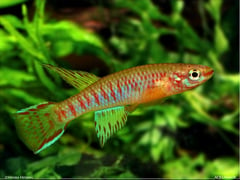
Aphyosemion elbertiRed-Barred Lyretail
Nothobranchiidae · (Ahl, 1924)
The red-barred lyretail, Aphyosemion elberti, is a killifish from central Cameroon and the upper Mambéré basin in the Central African Republic. Its range follows the Sanaga River system across Cameroon. It was described from 'Jade Plateau, Cameroon', which apparently corresponds to the Lebo River in what is now the Central African Republic.
Aphyosemion herzogiHerzog's Lyretail
Nothobranchiidae · Radda, 1975
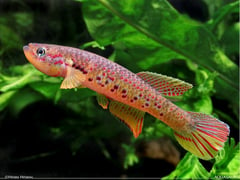
Herzog's lyretail, Aphyosemion herzogi, is a killifish described from northern Gabon and also found in Equatorial Guinea and southern Cameroon. In Gabon it occurs in the Ivindo and Okano drainages, both tributaries of the Ogooué system. It is also known from the upper parts of some Benito River tributaries in Equatorial Guinea and from the Ntem River in Cameroon.
Aphyosemion loennbergiiLönnberg's Lyretail
Nothobranchiidae · (Boulenger, 1903)
Lönnberg's lyretail, Aphyosemion loennbergii, is a killifish from southwestern Cameroon, described from the Kienké river (formerly the 'Kribi'). It has a wider distribution in the region and also occurs in the Lokundje and Nyong drainages.

Ctenopoma kingsleyaeTailspot Ctenopoma
Anabantidae · authority not recorded
The tailspot ctenopoma, Ctenopoma kingsleyae, is an anabantoid with an enormous range, recorded from Mauritania and Senegal to Gabon and the DR Congo. One of the more aggressive members of the genus, it can be particularly nasty towards conspecifics and will eat small fish. It is named after the explorer Mary Kingsley, and there are reports of specimens surviving in aquaria for over 30 years.
Fundulopanchax gardneriSteel-blue Killifish
Nothobranchiidae · (Boulenger, 1911)
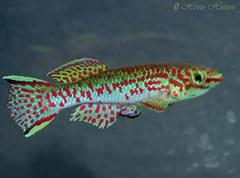
The steel-blue killifish, Fundulopanchax gardneri, is native to the Cross River system in Nigeria and Cameroon and the Benue River drainage. Also known as Gardner's killi or blue lyretail, the common aquarium forms are among the best choices for those new to killifishes. Wild populations come in numerous colour forms, three of them described as subspecies. Its eggs can withstand a period of drying but will also hatch when kept submerged.
Fundulopanchax gresensi
Nothobranchiidae · Berkenkamp, 2003
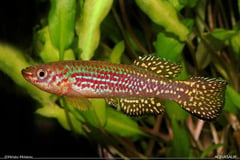
Fundulopanchax gresensi is a killifish known only from a small area in the upper Cross River basin, western Cameroon. It has been collected from shallow, swampy sections of forested streams, some of which may dry out in the dry season. The commonest hobby strain is known as 'Takwai'. It jumps well, so the aquarium needs a good cover.

Hemichromis elongatusFive Star General
Cichlidae · authority not recorded
The five star general, Hemichromis elongatus, is a highly aggressive cichlid recorded from Guinea, Cameroon, Angola, Namibia, Botswana and Zimbabwe. The common name comes from the row of five dark markings along its flanks. A piscivore, it eats any fish it can fit into its mouth, does not tolerate conspecifics outside a pair and is best kept in a species tank. The patchy recorded range suggests it has been misidentified in places or occurs in more countries.
Lates niloticusNile Perch
Latidae · authority not recorded
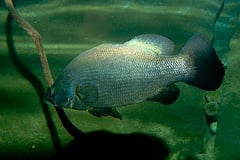
The Nile perch, Lates niloticus, is a giant predatory fish from Central and Western Africa, reaching 193 cm and up to 200 kg. Introduced into many African countries as a food fish, it is thought to have contributed to the extinction of over 200 endemic species in Lake Victoria, and the IUCN lists it among the world's top 100 invasive species. Juveniles turn up in some aquatic stores, but it is not suited to captive life in any respect.

Pelvicachromis pulcherKribensis
Cichlidae · authority not recorded
The kribensis, Pelvicachromis pulcher, is a cichlid from Nigeria and Cameroon, found in still and slow-moving, heavily vegetated waters. One of the most common cichlids in the hobby since the 1950s, it is almost always captive bred, and farmed fish are far more adaptable to water chemistry than wild ones. A cave spawner that forms monogamous pairs, it is often the first fish bred by newcomers and becomes very territorial when breeding.
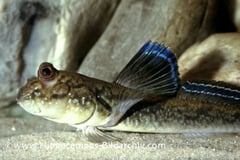
Periophthalmus barbarusAtlantic Mudskipper
Gobiidae · authority not recorded
The Atlantic mudskipper, Periophthalmus barbarus, is a highly amphibious goby from the west African coast, from Mauritania south to Angola. It lives on and around mudflats in estuarine mangrove swamps, so an aquarium needs exposed land and a very humid atmosphere at the same temperature as the water. Males are extremely territorial with one another, and a species tank is preferable in most cases.
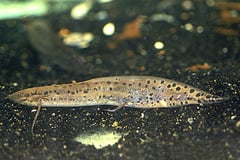
Protopterus annectensAfrican Lungfish
Protopteridae · (Owen, 1839)
The African lungfish, Protopterus annectens, is a lungfish found in 17 African countries, including Senegal, Nigeria, Kenya and Sudan. It inhabits temporary floodplains that dry out completely for part of the year and survives the dry season by aestivating in a mucus cocoon, for several years if need be. The most commonly seen lungfish in the hobby, it reaches 100 cm, bites hard and is best kept singly.
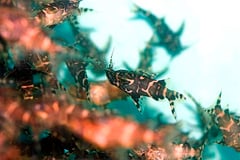
Synodontis nigriventrisUpside-down Catfish
Mochokidae · David, 1936
The upside-down catfish, Synodontis nigriventris, is a small Synodontis from the Democratic Republic of Congo, Republic of Congo and Cameroon. It lives among densely vegetated riverbanks and spends up to 90% of its time inverted, with a belly darker than its back. One of the most gentle members of the genus, it should be kept in groups of at least three or four.
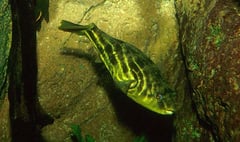
Tetraodon lineatusFahaka Puffer
Tetraodontidae · authority not recorded
The fahaka puffer, Tetraodon lineatus, is a large freshwater puffer from lakes and rivers across northern and West Africa, reaching 43 cm. Also known as the Nile puffer, it was previously named T. fahaka. One of the most aggressive puffers available, it learns to interact with its owner, but should be kept alone and needs no salt in its water.
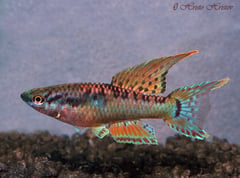
Aphyosemion bivittatumTwo-Banded Lyretail
Nothobranchiidae · (Lönnberg, 1895)
The two-banded lyretail, Aphyosemion bivittatum, is a killifish that appears restricted to coastal plains along the Cameroon and Nigeria border. Its range includes the Korup and Cross River National Parks, and the type locality is close to a waterfall on the Ndian River in southwestern Cameroon.
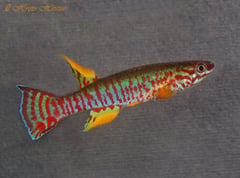
Aphyosemion bualanumBouala Lyretail
Nothobranchiidae · (Ahl, 1924)
The Bouala lyretail, Aphyosemion bualanum, is a killifish from the upper Benue and Mayo Kébbi systems in Cameroon, Central African Republic and Chad. It is listed as endangered by the IUCN. Before 1990 the name was misused for various populations of A. elberti.