Country · Oceania
Solomon Islands
Only species with a profile on Seriously Fish are counted, whether native or introduced.
- Species
- 4
- Families
- 2
- Genera
- 3
- Found only here
- 0
- Photographed
- 4 of 4
Shares its fishes withspecies recorded in both

Butis amboinensisOlive Flathead Gudgeon
Butidae · (Bleeker, 1853)
The olive flathead gudgeon, Butis amboinensis, is a nocturnal ambush predator from the eastern Indian Ocean to the West Central Pacific. It inhabits brackish estuaries, lagoons and mangroves, entering tidal freshwater rivers to an extent, and often aligns itself with solid surfaces or swims upside-down. It is occasionally exported as bycatch and differs from congeners in lacking enlarged outer teeth and scales on the cheek. It is territorial and should probably be kept singly.
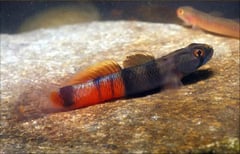
Sicyopus zosterophorus
Gobiidae · (Bleeker, 1856)
Sicyopus zosterophorus is a stream goby with a patchy but wide range from the Marquesas Islands westwards to Indonesia, Japan and southern China. It is occasionally available in the hobby as the 'flaming arrow goby', 'belted rockclimbing goby' or 'ornate goby', often under the invalid name Sicyopus zosterophorum. It inhabits short coastal streams on tropical islands, typically above waterfalls or cataracts.
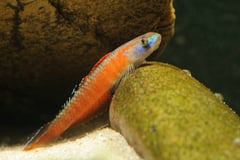
Stiphodon rutilaureus
Gobiidae · Watson, 1996
Stiphodon rutilaureus is a small rock-climbing goby from fast island streams, from northern Papua New Guinea east to Vanuatu and Fiji. Males are bright orange-red with 9 to 11 vertical bars and a blue upper lip, cheek and opercle. An algal grazer, it needs clean, well-oxygenated, flowing water.
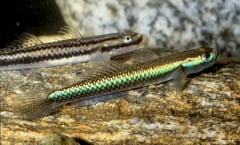
Stiphodon semoniCobalt Blue Goby
Gobiidae · Weber, 1895
The cobalt blue goby, Stiphodon semoni, is a stream-dwelling goby ranging from western Sumatra east to northern New Guinea and the Solomon Islands. It has been traded for a number of years but often under the wrong name, including S. elegans and S. atropurpureus. Males have a bright blue metallic stripe from snout to caudal peduncle and rounded, almost hyaline dorsal fins, while those of S. atropurpureus are dusky to black.