Country · Asia
Japan
Only species with a profile on Seriously Fish are counted, whether native or introduced.
- Species
- 25
- Families
- 9
- Genera
- 15
- Found only here
- 5
- Photographed
- 24 of 25
Regions here
Shares its fishes withspecies recorded in both
Found only here5
5 of the species on this page are recorded in Japan and in no other country. This is not the same as being endemic.
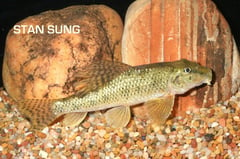
Abbottina rivularisChinese False Gudgeon
Cyprinidae · (Basilewsky, 1855)
The Chinese false gudgeon, Abbottina rivularis, is a small bottom-dwelling cyprinid native to China, the Korean peninsula and southern Japan. It has been widely introduced elsewhere, including the Mekong and Salween basins, Taiwan, Turkmenistan and Kyrgyzstan, and is considered invasive. It has started to appear in the aquarium trade and should never be released into natural waters outside its native range.
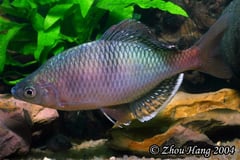
Acheilognathus macropterusGiant Chinese Bitterling
Cyprinidae · (Bleeker, 1871)
The giant Chinese bitterling, Acheilognathus macropterus, is a bitterling from China, the Korean peninsula, northern Vietnam and southeastern Russia. It has been introduced to Japan and is considered invasive there. Typical adults are 100 to 150 mm, and it appears in the trade only irregularly. Like all bitterlings it spawns in living unionid mussels, and its wide range suggests it may be a group of closely-related species.

Butis amboinensisOlive Flathead Gudgeon
Butidae · (Bleeker, 1853)
The olive flathead gudgeon, Butis amboinensis, is a nocturnal ambush predator from the eastern Indian Ocean to the West Central Pacific. It inhabits brackish estuaries, lagoons and mangroves, entering tidal freshwater rivers to an extent, and often aligns itself with solid surfaces or swims upside-down. It is occasionally exported as bycatch and differs from congeners in lacking enlarged outer teeth and scales on the cheek. It is territorial and should probably be kept singly.

Butis butisCrazy Fish
Butidae · (Hamilton, 1822)
The crazy fish, Butis butis, is a flathead gudgeon of coastal and brackish waters across the Indo-Pacific, from eastern Africa to Fiji. The most commonly traded member of the genus, it has many other names, including crocodile fish, duckbill sleeper and upside-down sleeper. A nocturnal ambush predator, it often swims upside-down, and it is territorial and not sociable with conspecifics, so is best kept singly.
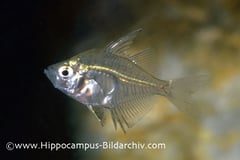
Chanda rangaIndian Glass Fish
Ambassidae · Hamilton, 1822
The Indian glass fish, Chanda ranga, is a small ambassid from South and Southeast Asia, with translucent skin that shows its bones and organs. For many years it was injected with luminous dyes on Asian fish farms and sold as 'painted' glass fish, and most injected fish do not survive more than a few months. It is found most often in freshwater, frequently soft and acidic, and needs no added salt. Parambassis lala and C. siamensis are often imported under its name.

Macropodus ocellatusRoundtail Paradise Fish
Osphronemidae · Cantor, 1842
The roundtail paradise fish, Macropodus ocellatus, is a labyrinth fish with an enormous range in China, Korea and Japan, north to the Amur River. It lives in ditches, rice paddies, marshes and river backwaters, where winter can freeze the surface and drop the water to 3 °C. It is sometimes referred to as M. chinensis in older literature, a name now considered a synonym of M. opercularis. Males are territorial when breeding and build bubble nests.
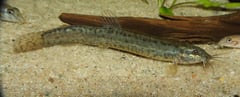
Misgurnus dabryanusLarge-scaled Loach
Cobitidae · (Guichenot, 1872)
The large-scaled loach, Misgurnus dabryanus, is a 'true' loach from the Yangtze and Pearl rivers in China, plus Taiwan and the Amur in Russia. It is sold regularly in the hobby but almost always labelled as or mixed in with M. anguillicaudatus, from which it differs in its high adipose crests on the caudal peduncle and the lack of a dark spot at the caudal-fin base. It spends some of its time completely buried, so it needs a soft, sandy substrate.
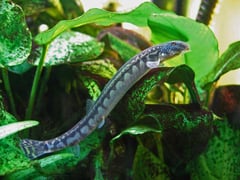
Niwaëlla delicataAjime Loach
Cobitidae · (Niwa, 1937)
The ajime loach, Niwaella delicata, is a 'true' loach that appears restricted to river drainages of central Honshu, Japan. It lives in shallow, fast-flowing, highly-oxygenated headwaters and minor tributaries, and retreats to streams or underflows to remain dormant between October and April. In Japan it is a prized food fish. A dark stripe or row of blotches along the lateral line separates it from its congeners.
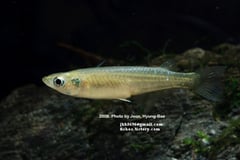
Oryzias latipesMedaka
Adrianichthyidae · (Temminck & Schlegel, 1846)
The medaka, Oryzias latipes, is a ricefish from Japan, Korea, Taiwan, eastern China, Laos and Vietnam. Long used as a model organism in genomic and experimental biology, it was the first vertebrate animal to mate in space, in the mid-1990s. The ornamental 'golden' variant is more often seen than the natural form, and a transgenic 'glowing' form is illegal to buy, sell or own within the European Union.
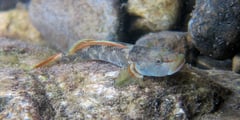
Rhinogobius flumineus
Gobiidae · (Mizuno, 1960)
Rhinogobius flumineus is a goby endemic to Japan, found in central and western Honshu and on the islands of Kyushu and Shikoku. Its entire life cycle takes place in freshwater, in smaller rivers, tributaries and streams, although it occurs alongside amphidromous congeners in places. Two colour forms appear to exist, based on the shape and patterning of the male's first dorsal fin, and its name is sometimes applied to other species.
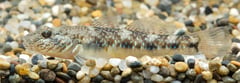
Rhinogobius giurinus
Gobiidae · (Rutter, 1897)
Rhinogobius giurinus is a goby found through much of China, plus Taiwan, the Korean Peninsula, Japan and the Red and Pha river basins in Vietnam. It appears to exist in a number of forms that differ in colour pattern, morphology or both, and it is unclear whether all of them are conspecific. Newly-imported wild fish tend to be aggressive towards conspecifics, so unlike most Rhinogobius it is best kept in sexed pairs.
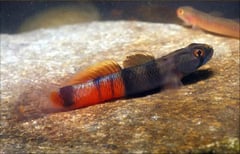
Sicyopus zosterophorus
Gobiidae · (Bleeker, 1856)
Sicyopus zosterophorus is a stream goby with a patchy but wide range from the Marquesas Islands westwards to Indonesia, Japan and southern China. It is occasionally available in the hobby as the 'flaming arrow goby', 'belted rockclimbing goby' or 'ornate goby', often under the invalid name Sicyopus zosterophorum. It inhabits short coastal streams on tropical islands, typically above waterfalls or cataracts.
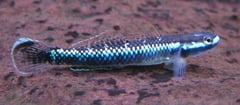
Stiphodon atropurpureusBlue Neon Goby
Gobiidae · (Herre, 1927)
The blue neon goby, Stiphodon atropurpureus, is a stream-dwelling goby from southern Japan, Taiwan, southern China, the Philippines and Malaysia. It is available occasionally but often under the wrong name, including S. elegans and 'Sumatran blue neon goby', though it is not found on Sumatra. In males the bright blue-green lateral stripe combined with a reddish outer edge to the first dorsal fin is unique within the genus.
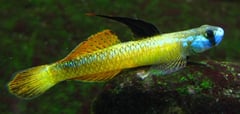
Stiphodon percnopterygionus
Gobiidae · Watson & Chen, 1998
Stiphodon percnopterygionus is a small stream-dwelling goby ranging from southern Taiwan through the Ryukyu and Bonin islands to Guam and Palau. Rare in the aquarium trade, it is among the most easily identified in the genus. Males have highly extended fourth and fifth spines in the first dorsal fin, and adults reach only 30-35 mm SL. Like other Stiphodon it is a specialised algal grazer with an amphidromous life cycle.
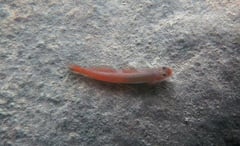
Stiphodon surrufus
Gobiidae · Watson & Kottelat, 1995
Stiphodon surrufus is a small stream-dwelling goby described from Leyte in the Philippines and also reported from Okinawa and Yakushima, Japan. Males are reddish in life and lack elongate spines in the first dorsal fin. It was possibly carried north by the Kuroshio Current, and is less abundant there than congeners such as S. percnopterygionus. Like other Stiphodon it is a specialised algal grazer with an amphidromous life cycle.
Xiphophorus helleriiGreen Swordtail
Poeciliidae · Heckel, 1848
The green swordtail, Xiphophorus hellerii, is a livebearer native to southeastern Mexico, Guatemala, Belize and Honduras. Among the world's most recognisable aquarium fishes, it is ubiquitous in the trade, where selective breeding and hybridisation with X. maculatus and X. variatus have produced a bewildering array of ornamental forms. The name is often misspelled X. helleri.
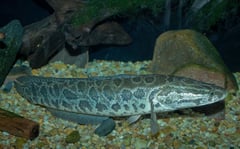
Channa argusNorthern Snakehead
Channidae · (Cantor, 1842)
The northern snakehead, Channa argus, is a large snakehead native to eastern China, southeastern Russia and the Korean peninsula. Growing to 850 mm, it is largely unsuitable for the home aquarium given its size and natural behaviour. Introduced populations, first intended for aquaculture, are now established in Japan, the United States, central Asia and parts of eastern Europe.

Ctenopharyngodon idellaGrass Carp
Cyprinidae · (Valenciennes, 1844)
The grass carp, Ctenopharyngodon idella, is a large cyprinid native to the Amur River system in eastern Russia and northeastern China. Adults typically reach 800 to 1200 mm, making it a wholly unsuitable aquarium subject, though an albino form is traded. Widely introduced for aquaculture and weed control, it has caused serious damage to natural waters, and unwanted fish should never be released.
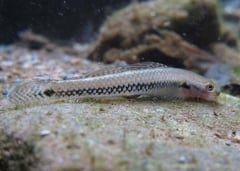
Stiphodon alcedo
Gobiidae · Maeda, Mukai & Tachihara, 2011
Stiphodon alcedo is a small stream-dwelling goby known only from the Ryukyu Islands, Japan, in streams on Okinawa and Iriomote. Nuptial males are blackish or sometimes orange with metallic turquoise on the head, and the male's first dorsal fin is pointed but not filamentous. Like other Stiphodon it is a specialised algal grazer with an amphidromous life cycle.
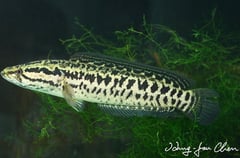
Channa maculataBlotched Snakehead
Channidae · (Lacepède, 1801)
The blotched snakehead, Channa maculata, is a snakehead from coastal drainages of southeastern China, including Hong Kong, and northern Vietnam. It is frequently confused with C. argus but has fewer fin rays and lateral line scales and carries 2-3 rounded blotches on the caudal peduncle. An important food fish, it has become established in Japan, Taiwan, the Philippines, Madagascar and Hawaii, and hybrids with C. argus appear to be quite common in aquaculture.
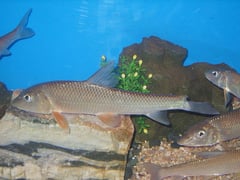
Hemibarbus labeoBarbel Steed
Cyprinidae · (Pallas, 1776)
The barbel steed, Hemibarbus labeo, is a cyprinid widespread in eastern Asia between the Yangtze and Amur river basins. A predominantly riverine fish of clear, well-oxygenated running water, it forms schools just above the substrate as an adult, and some populations make annual spawning migrations. Adults lack dark spots on the body and have a long snout and well-developed lips.
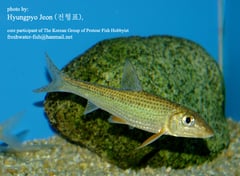
Hemibarbus longirostris
Cyprinidae · (Regan, 1908)
Hemibarbus longirostris is a cyprinid native to far eastern Asia, including northeastern China, southeastern Russia, the Korean peninsula and Japan. A predominantly riverine fish, it lives in clear, well-oxygenated running water over sand, gravel, rock or mud, and adults tend to form schools just above the substrate in slower-moving sections.
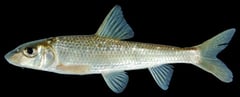
Hemibarbus maculatusSpotted Steed
Cyprinidae · Bleeker, 1871
The spotted steed, Hemibarbus maculatus, is a cyprinid widespread in eastern Asia between the Yangtze and Amur basins, including Taiwan and Hainan. It has 7–11 large blackish spots on each flank and a deep body with a clearly convex dorsal profile. A riverine fish of clear, well-oxygenated running water, it breeds in May and June, depositing its eggs among aquatic vegetation. It has probably been introduced to Vietnam and Laos, or records from there represent another species.
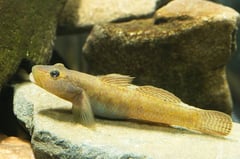
Rhinogobius sp. 'CB'
Gobiidae · authority not recorded
Rhinogobius sp. 'CB' is an unidentified goby of the R. brunneus complex, found through most of Japan except Hokkaido. 'CB' is shorthand for 'cross band', after the dark bars on the body. Among the unidentified members of the grouping it is the commonest in Japan. Some wild populations are amphidromous, with the larvae washed down to the sea and the fry developing in brackish to marine estuaries.
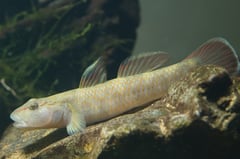
Rhinogobius sp. 'CO'
Gobiidae · authority not recorded
Rhinogobius sp. 'CO' is an unidentified goby of the R. brunneus complex that certainly occurs on the island of Honshu, Japan. 'CO' is shorthand for 'cobalt', after the blue spots on the head and body. Some populations live in brackish and others in freshwater environments, and this has led them to adopt different reproductive strategies.