Country · North & Central America
Trinidad and Tobago
Only species with a profile on Seriously Fish are counted, whether native or introduced.
- Species
- 7
- Families
- 5
- Genera
- 7
- Found only here
- 0
- Photographed
- 7 of 7
Shares its fishes withspecies recorded in both

Astyanax bimaculatusTwo Spot Astyanax
Characidae · Linnaeus, 1758
The two spot astyanax, Astyanax bimaculatus, is a characid ranging from Panama through most of the Amazon and Orinoco basins. It lives in a wide variety of biotopes, from swiftly-flowing rivers and streams to ponds, ditches and reservoirs. The name is currently applied to what is considered a species complex of at least four taxa, and aquarium fish most often arrive as contaminants among shipments of other species.

Cleithracara maroniiKeyhole Cichlid
Cichlidae · Steindachner, 1881
The keyhole cichlid, Cleithracara maronii, is a small cichlid from French Guiana, Guyana, Suriname, the Orinoco delta in Venezuela and Trinidad. It is told apart from relatives by the keyhole-shaped marking on each side of the body, and is one of few fishes whose generic name derives from its aquarium common name. It inhabits slow-moving blackwater streams, is naturally shy and sensitive to deteriorating water quality, and most fish on sale are commercially farmed.
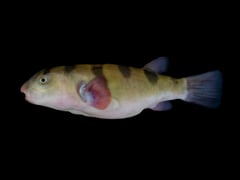
Colomesus psittacusBanded Puffer
Tetraodontidae · Bloch & Schneider, 1801
The banded puffer, Colomesus psittacus, is a large puffer of coastal waters from Colombia and Venezuela through the Guianas to northeastern Brazil. It also occurs in Trinidad and Tobago and the Caribbean islands, and inhabits mangrove swamps, estuaries and the lower reaches of rivers. Growing to 290 mm SL, it is the largest of its genus and has six dark bands across the back. Likely to prove aggressive in all but the largest systems, it is not a popular aquarium fish.

Corynopoma riiseiSwordtail Characin
Characidae · authority not recorded
The swordtail characin, Corynopoma riisei, is an unusual tetra from northern Venezuela, the Villavicencio area of Colombia and the island of Trinidad. Males have caudal glands that release pheromones to attract females, plus gill glands found in only a handful of glandulocaudinids, and females are inseminated by the males. Mainly a surface dweller, it needs open swimming space and a group of at least 6-8, since males can squabble.
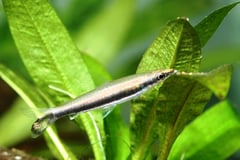
Nannostomus unifasciatusOne-lined Pencilfish
Lebiasinidae · Steindachner, 1876
The one-lined pencilfish, Nannostomus unifasciatus, occurs in the upper Amazon and upper Orinoco basins in Brazil, Bolivia, Colombia and Venezuela. A popular aquarium fish, it swims at an oblique angle, a trait shared only with N. eques. It differs from that species in lacking dark brown spots on the body scales and normally having an ocellus in the upper caudal-fin lobe.
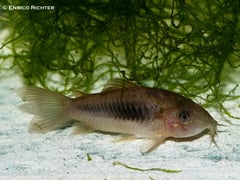
Osteogaster aeneaBronze Cory
Callichthyidae · (Gill, 1858)
The bronze cory, Osteogaster aenea, long known as Corydoras aeneus, is an armoured catfish described from Trinidad and accepted to occur across much of South America. That range looks more like a complex of similar, distinct species than a single one, and fish from outside Trinidad are of uncertain identity. Aquarium fish are almost all commercially farmed, and the names C. schultzei and C. venezuelanus are routinely misapplied to them.

Andinoacara pulcherBlue Acara
Cichlidae · Gill, 1858
The blue acara, Andinoacara pulcher, is a cichlid native to Trinidad and Tobago and parts of Venezuela. It occupies a variety of habitats, from murky still waters to clear streams. A mainstay of the hobby for many years, it is one of the easiest substrate-spawning cichlids to breed. Captive breeding has narrowed the gene pool, so most fish in the hobby are pale imitations of wild ones, and some are hybrids with related species. It was previously known as 'Aequidens' pulcher.