Country · South America
Venezuela
Only species with a profile on Seriously Fish are counted, whether native or introduced.
- Species
- 109
- Families
- 23
- Genera
- 71
- Found only here
- 9
- Photographed
- 103 of 109
Shares its fishes withspecies recorded in both
Found only here9
9 of the species on this page are recorded in Venezuela and in no other country. This is not the same as being endemic.
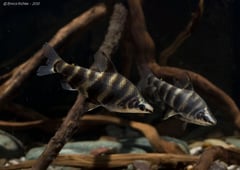
Abramites hypselonotusMarbled Headstander
Anostomidae · Günther, 1868
The marbled headstander, Abramites hypselonotus, is an anostomid from the Amazon, Orinoco and Paraguay-Paraná basins in South America. An ecological generalist, it occurs in turbid main river channels, minor tributaries and backwaters, and enters inundated zones during the annual floods. Best kept as a group in a large tank alongside cichlids, characins and catfishes, it may nip long or trailing fins and eat soft-leaved plants.
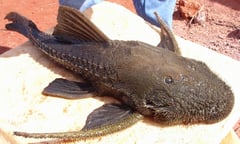
Acanthicus hystrixL155
Loricariidae · Spix & Agassiz, 1829
The lyre tail pleco, Acanthicus hystrix, is a very large loricariid catfish from the Amazon region of Brazil and Peru. A handful of records come from the Orinoco in Venezuela. Juveniles are traded in quite large numbers, but it can reach at least 1000 mm in nature and 500 to 600 mm in captivity, and becomes increasingly belligerent with age. Young fish are easily told from A. adonis by lacking its white to yellowish body spots.
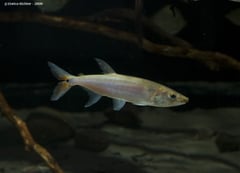
Acestrorhynchus falcatusRed-Tailed Freshwater Barracuda
Acestrorhynchidae · Bloch, 1794
The red-tailed freshwater barracuda, Acestrorhynchus falcatus, is a predatory acestrorhynchid from the northern Amazon and Orinoco basins. It also occurs in coastal rivers of Guyana, Suriname and French Guiana. Its large humeral spot, shaped like an inverted tear drop, separates it from other Acestrorhynchus. Reaching 250 to 275 mm, it needs plenty of open water, and a group must be of comparable size because acestrorhynchids are cannibalistic.
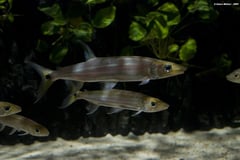
Acestrorhynchus falcirostrisBig-Eyed Cachorro
Acestrorhynchidae · Cuvier, 1819
The big-eyed cachorro, Acestrorhynchus falcirostris, is a large predatory acestrorhynchid from northern Amazon drainages and the Orinoco. The two dark body stripes of the A. nasutus group appear only in its juveniles, and at 320 to 350 mm SL it grows far larger than the other members. A black fringe to the rear of the operculum gives it a 'collared' look. It needs open water, and a group must be of comparable size because acestrorhynchids are cannibalistic.
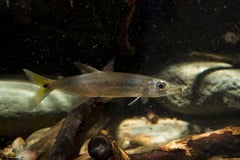
Acestrorhynchus microlepisPike Tetra
Acestrorhynchidae · Jardine, 1841
The pike tetra, Acestrorhynchus microlepis, is a predatory acestrorhynchid from northern Amazon drainages and the Orinoco. It also occurs in coastal rivers of Guyana, Suriname and French Guiana. A member of the A. microlepis group, it has a small blackish spot behind the gill cover and is separable from the very similar A. grandoculis only by counts. It tends to take smaller prey such as tetras, and acestrorhynchids are cannibalistic, so a group must be of comparable size.
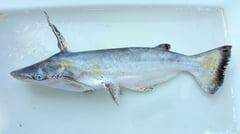
Ageneiosus inermisManduba
Auchenipteridae · Linnaeus, 1766
The manduba, Ageneiosus inermis, is a large auchenipterid catfish found throughout much of South America east of the Andes. At around 470 mm SL it would need an aquarium in excess of 400 x 120 cm as an adult and is largely unsuitable for private aquaria. An obligate carnivore, it can take surprisingly large prey, and the larger Ageneiosus species are often used as food fishes in their native countries.
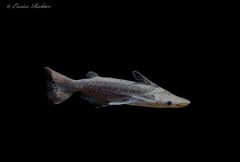
Ageneiosus marmoratusBottlenose Catfish
Auchenipteridae · Eigenmann, 1912
The bottlenose catfish, Ageneiosus marmoratus, is a predatory auchenipterid catfish from Guyana, Suriname and the upper Amazon in Peru and Ecuador. Also sold as 'Guyana slopehead', 'dolphin' or 'hammerhead' catfish, it loses much of its black-blotched juvenile patterning as it grows. Surprisingly peaceful with anything too large to swallow, it is active and sometimes skittish, and needs a tank of at least 150 x 60 cm.
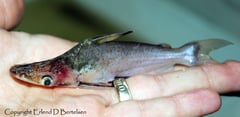
Ageneiosus ucayalensisDuck Catfish
Auchenipteridae · Castelnau, 1855
The duck catfish, Ageneiosus ucayalensis, is an auchenipterid catfish described from Peru and recorded across the Amazon, Orinoco and Guianas. Body patterning apparently varies with locality, and fish from black water habitats, particularly on the Guiana Shield, tend to be darker. Growing to around 290 mm SL and capable of taking large prey, it is safe only with similarly sized catfishes or large pelagic characins, mostly a combination for public aquaria.
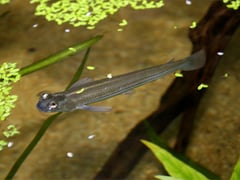
Anableps anablepsFour-Eyed Fish
Anablepidae · Linnaeus, 1758
The four-eyed fish, Anableps anableps, is a viviparous fish of brackish mangrove coasts in north-eastern South America, from Venezuela to Brazil. Each eye is split horizontally, with two corneas and two pupils, so it can see above and below the water at the same time. It moves in and out with the tides, and in aquaria it needs brackish water, shallow depth and a large surface area, with a group of at least six in a tank no smaller than 150 x 45 cm.
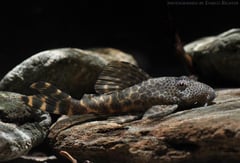
Ancistomus sp. L147L147
Loricariidae · authority not recorded
L147 is an undescribed Ancistomus species, a suckermouth catfish from tributaries of the middle Río Orinoco in Venezuela and the lower Río Meta in Colombia. Some reports suggest it occurs further up the Meta system, around Villavicencio, some 600 km upriver. It spawns in caves with the male responsible for brood care, and has been bred regularly in aquaria.
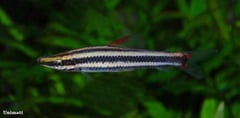
Anostomus anostomusStriped Headstander
Anostomidae · Linnaeus, 1758
The striped headstander, Anostomus anostomus, is an anostomid from the Amazon and Orinoco river systems in Peru, Brazil, Venezuela and Guyana. It lives along rocky shores of fast-flowing rivers, grazing algae and small invertebrates from the rocks. Although it shoals in nature, it is very quarrelsome with conspecifics when only a few are kept, so it is best kept singly or in a group of 6 or more in a larger tank.
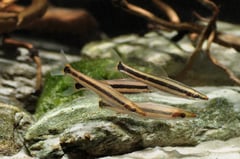
Anostomus ternetziGold-Striped Headstander
Anostomidae · Fernández-Yépez, 1949
The gold-striped headstander, Anostomus ternetzi, is an anostomid from the Río Orinoco system and coastal Guyana, Suriname and French Guiana. It lives in rocky areas at the edge of fast-flowing rivers and streams, grazing algae and small invertebrates. Like A. anostomus, it is quarrelsome with conspecifics when only a few are kept. Its distribution in Brazil is unclear, with patchy records from the Araguaia and Xingu basins.

Apistogramma hoignei
Cichlidae · Meinken, 1965
Apistogramma hoignei is a dwarf cichlid from the Río Orinoco basin in Venezuela, including the Apure, Arauca and Caura drainages. It is also known from much of the lower Orinoco mainstream. Coded A116 under the DATZ system, it has similar-looking, possibly conspecific populations referred to as A117 or A118, and inhabits slower-moving tributaries, backwaters and creeks where leaf litter collects.

Apistogramma hongsloi
Cichlidae · Kullander, 1979
Apistogramma hongsloi is a dwarf cichlid from the Río Vichada and middle Río Meta basins in Colombia and the middle Orinoco in Venezuela. Coded A110 under the DATZ system, it has similar-looking, possibly conspecific populations referred to as A111 to A115 depending on locality. It lives in small tributaries and still waters, and males grow to 55 to 60 mm and females to 40 to 45 mm.

Apistogramma sp. 'breitbinden'A164
Cichlidae · authority not recorded
Apistogramma sp. 'breitbinden' is an undescribed dwarf cichlid from the upper Rio Negro in Brazil, the Venezuelan Orinoco and the Inirida in Colombia. The German name means 'broad-banded' and refers to the uniformly broad suborbital stripe of males. Known in the hobby for several decades, it is often imported as bycatch among shipments of wild-collected A. iniridae, and some populations carry the DATZ codes A164, A165 and A167.
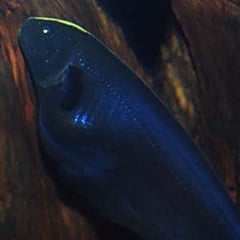
Apteronotus albifronsBlack Ghost Knifefish
Apteronotidae · (Linnaeus, 1766)
The black ghost knifefish, Apteronotus albifrons, is a weakly electric knifefish from the upper half of South America, from Colombia to Paraguay. Usually sold at around 4 inches, it grows to 50 cm and needs a long-term housing plan. Its eyesight is very poor, and it navigates, finds prey and communicates using a weak electric field. In the wild it lives in swiftly flowing streams and rivers over sand.
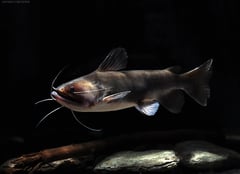
Asterophysus batrachusGulper Catfish
Auchenipteridae · Kner, 1858
The gulper catfish, Asterophysus batrachus, is a predatory auchenipterid catfish from the rio Negro in Brazil and the Orinoco in Venezuela. Also called the 'ogre catfish', it hunts in shallow blackwater tributaries, mostly at night. It can consume fishes almost twice its own size and is not recommended for the community aquarium.

Astronotus ocellatusOscar
Cichlidae · Agassiz, 1831
The oscar, Astronotus ocellatus, is a large cichlid widely distributed in the Amazon region, recorded from Colombia and Venezuela south to Argentina. It grows to 350 mm SL and typically lives 10 to 20 years, both of which need taking into account before purchase. Most fish on sale come from commercial breeders in Eastern Europe or the Far East, in numerous ornamental strains, and genetic analyses suggest the genus contains additional, morphologically cryptic species.

Astyanax bimaculatusTwo Spot Astyanax
Characidae · Linnaeus, 1758
The two spot astyanax, Astyanax bimaculatus, is a characid ranging from Panama through most of the Amazon and Orinoco basins. It lives in a wide variety of biotopes, from swiftly-flowing rivers and streams to ponds, ditches and reservoirs. The name is currently applied to what is considered a species complex of at least four taxa, and aquarium fish most often arrive as contaminants among shipments of other species.
Bario oligolepisGlass Tetra
Characidae · authority not recorded
The glass tetra, Bario oligolepis, is a characin from northern South America, with populations in Venezuela, the Guianas, Peru and Brazil. One of a handful of species that closely resemble the red-eye tetra, it is seen much less often in the hobby and is also known as the glassy tetra. It inhabits slow-moving rivers, tributaries and floodplain lakes. Very peaceful, it does not compete well with boisterous or much larger tankmates.
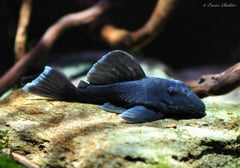
Baryancistrus begginiL239
Loricariidae · Lujan, Arce & Armbruster, 2009
Known as L239 before description, Baryancistrus beggini is a small loricariid from the Orinoco and lower río Guaviare in Venezuela and Colombia. Its body and fins are uniformly black to brownish with a turquoise to bluish sheen. Placement in Baryancistrus is tentative. Territorial with conspecifics but somewhat delicate, it is not recommended for the general community aquarium.
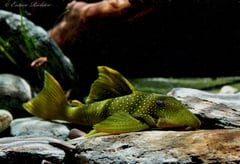
Baryancistrus demantoidesGreen Phantom Pleco
Loricariidae · Werneke, Sabaj Pérez, Lujan & Armbruster, 2005
The green phantom pleco, Baryancistrus demantoides, is a suckermouth catfish known only from where the río Ventuari meets the Orinoco in Venezuela. It closely resembles Hemiancistrus subviridis, which lives alongside it, and both have been marketed as L200. B. demantoides is the less common and more expensive of the two, sometimes sold as 'L200 high-fin' or 'L200a' for its longer dorsal-fin spine. Males become increasingly intolerant of conspecifics as they age.

Biotodoma wavriniOrinoco Eartheater
Cichlidae · Gosse, 1963
The Orinoco eartheater, Biotodoma wavrini, is a geophagine cichlid from the Orinoco and rio Negro basins of Venezuela, Colombia and Brazil. One natural habitat is the Río Cinaruco, a low-nutrient blackwater tributary of the Orinoco. It can be told from B. cupido by its noticeably elongate body and a dark flank blotch on or below the upper lateral line. Unless breeding it is surprisingly peaceful, and trade populations include 'Cuao', 'Orinoco', 'San Antonio' and 'Sipapo Ventuari'.
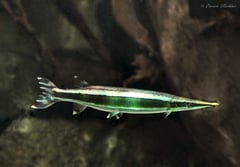
Boulengerella lateristrigaStriped Pike 'Characin'
Ctenoluciidae · Boulenger, 1895
The striped pike 'characin', Boulengerella lateristriga, is a ctenoluciid from the rio Negro basin and parts of the upper Río Orinoco. It appears limited to black water rivers and tributaries, where the water is stained darkly with humic acids and the pH can be as low as 3.0 or 4.0. A thin dark stripe from the rear of the eye to the caudal peduncle and dark crossbars on the caudal-fin lobes separate it from the similar B. maculata. It grows to 258 mm SL.
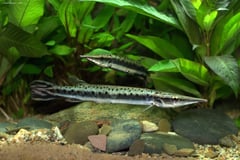
Boulengerella maculata
Ctenoluciidae · Valenciennes, 1850
Boulengerella maculata is a pelagic ctenoluciid found throughout much of the Amazon, Orinoco and Tocantins river systems. Colour pattern varies considerably, with some specimens much paler than others, and this may be correlated with water type. Random dark spots on the upper body, and a dark stripe only behind the eye when one is present, separate it from the similar B. lateristriga. It reaches 329 mm SL and needs an aquarium with base dimensions of 240 by 90 cm or more.

Brachychalcinus orbicularisDiscus Tetra
Characidae · Valenciennes, 1850
The discus tetra, Brachychalcinus orbicularis, is a deep-bodied characid generally considered endemic to coastal watersheds of Guyana and Suriname. Recent records suggest it, or a similar congener, may also occur in the Orinoco and Negro drainages. The genus is often referred to collectively as 'silver dollar tetras', and although B. orbicularis is normally said to be the species in the trade, identification is challenging.
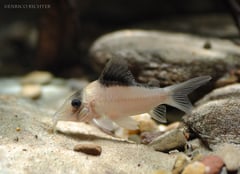
Brochis imitatorImitator Cory
Callichthyidae · (Nijssen & Isbrücker, 1983)
The imitator cory, Brochis imitator, long known as Corydoras imitator, is an armoured catfish endemic to the upper rio Negro basin in northern Brazil and southern Venezuela. It is one of several rio Negro congeners with an oblique dark bar along the dorsal surface of the body, a group that includes Hoplisoma adolfoi, H. burgessi and H. duplicareum. It inhabits pristine blackwater tributaries and flooded forest with tea-coloured water, very little hardness and a pH of 4.0-6.0.
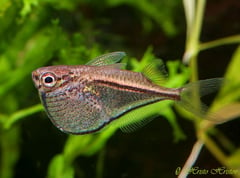
Carnegiella marthaeBlackwing Hatchetfish
Gasteropelecidae · Myers, 1927
The blackwing hatchetfish, Carnegiella marthae, is a small freshwater hatchetfish from the upper Orinoco in Venezuela and the rio Negro in Brazil. It appears to be a stenotypic inhabitant of blackwater, found in igapó and igarapé habitats with overhanging vegetation and leaf litter. Very peaceful but small and timid, it is best kept in a group of 10 or more with similarly sized, peaceful fishes.
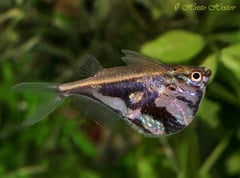
Carnegiella strigataMarbled Hatchetfish
Gasteropelecidae · Günther, 1864
The marbled hatchetfish, Carnegiella strigata, is a hatchetfish from the Amazon and Orinoco basins and coastal rivers of Guyana and Suriname. Popular in the hobby, it is collected for the trade mostly in the rio Negro basin in Brazil. Its larger size and dark, marbled pattern set it apart from congeners, though the pattern varies and the wide range may be open to question. It appears to live only in blackwater.
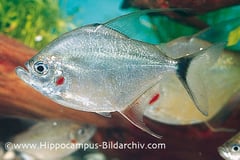
Catoprion mentoWimpel Piranha
Serrasalmidae · authority not recorded
The wimpel piranha, Catoprion mento, is a scale-eating fish from Colombia, Venezuela, Guyana, Brazil and Bolivia. Though not a true piranha, it resembles them and is quite closely related to Pygocentrus species. The common name comes from the German 'Wimpel' (banner), after the extensions to the leading dorsal-fin rays in mature fish. Adults are best housed alone, and it is sensitive to poor water quality and to swings in chemistry.
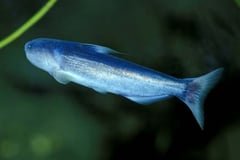
Cetopsis coecutiensBlue Whale Catfish
Cetopsidae · authority not recorded
The blue whale catfish, Cetopsis coecutiens, is a cetopsid catfish from the Amazon, Tocantins and Orinoco river basins. In the wild it swims in voracious feeding groups, homing in on weakened fish by smell and burrowing into prey. It will bite chunks out of tankmates much bigger than itself, so it is best kept alone, and at up to 26.5 cm it needs a large tank with strong water flow and dim lighting.

Chalceus macrolepidotusPink-tailed Chalceus
Characidae · authority not recorded
The pink-tailed chalceus, Chalceus macrolepidotus, is a large characin found throughout northern South America, from Colombia to French Guiana. It inhabits the surface layers of highly oxygenated rivers. Its very large scales tend to fall off during transport, so new imports can be delicate, though once acclimatised it usually proves fairly hardy. It does best singly or in a group of more than six, since smaller groups tend to scrap.
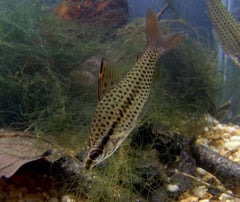
Chilodus punctatusSpotted Headstander
Chilodontidae · Müller & Troschel, 1844
The spotted headstander, Chilodus punctatus, is a headstander from much of the Amazon, the western Orinoco and coastal rivers of Guyana and Suriname. Also called the 'checkered headstander', it lives in slow-moving rivers, oxbows and floodplain lakes, and its colour pattern appears to vary with locality. Shy and peaceful, it is sensitive to dissolved organic wastes and should never be introduced to a biologically-immature aquarium.

Cleithracara maroniiKeyhole Cichlid
Cichlidae · Steindachner, 1881
The keyhole cichlid, Cleithracara maronii, is a small cichlid from French Guiana, Guyana, Suriname, the Orinoco delta in Venezuela and Trinidad. It is told apart from relatives by the keyhole-shaped marking on each side of the body, and is one of few fishes whose generic name derives from its aquarium common name. It inhabits slow-moving blackwater streams, is naturally shy and sensitive to deteriorating water quality, and most fish on sale are commercially farmed.

Colomesus asellusAmazon Puffer
Tetraodontidae · Müller & Troschel, 1849
The Amazon puffer, Colomesus asellus, is a freshwater puffer found throughout much of the Amazon basin, with records north to Guyana and Venezuela. Also traded as the South American puffer or 'SAP', it is told from congeners by a transverse row of dermal flaps across the chin. It lives mostly in well-oxygenated river habitats, is intolerant of organic waste, and forms loose aggregations, so a group of 6 or more is best, away from the general community.
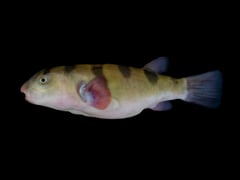
Colomesus psittacusBanded Puffer
Tetraodontidae · Bloch & Schneider, 1801
The banded puffer, Colomesus psittacus, is a large puffer of coastal waters from Colombia and Venezuela through the Guianas to northeastern Brazil. It also occurs in Trinidad and Tobago and the Caribbean islands, and inhabits mangrove swamps, estuaries and the lower reaches of rivers. Growing to 290 mm SL, it is the largest of its genus and has six dark bands across the back. Likely to prove aggressive in all but the largest systems, it is not a popular aquarium fish.
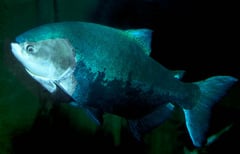
Colossoma macropomumBlack Pacu
Serrasalmidae · authority not recorded
The black pacu, Colossoma macropomum, is a very large serrasalmid from the Orinoco and Amazon basins in Colombia, Venezuela, Peru, Bolivia and Brazil. Known as the tambaqui in its native countries, it is the second largest scaled fish in the Amazon basin and easily capable of reaching 60 cm in captivity. It is regularly sold as a small juvenile, and releases of outgrown fish have led many wildlife authorities in the US to ban its sale. Wild stocks suffer from gross overfishing in many of its native waters.
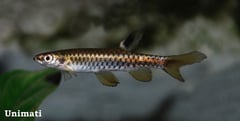
Copella eigenmanni
Lebiasinidae · Regan, 1912
Copella eigenmanni is a small lebiasinid from the Orinoco system in the llanos of Colombia and Venezuela, including the Meta, Caroní and Apure. It turns up in the trade from time to time among wild-caught fishes from the Orinoco basin. Colombian populations were formerly called C. metae until Zarske (2011) synonymised the two. A broad dark stripe runs from the snout to the eye, and the eggs are laid among vegetation and guarded by the male.
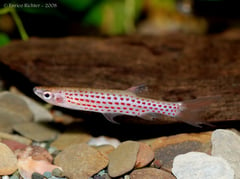
Copella meinkeniSpotted Splashing Tetra
Lebiasinidae · Zarske & Géry, 2006
The spotted splashing tetra, Copella meinkeni, is a small lebiasinid from the central Amazon region, with most records from the rio Negro and Orinoco. It has been widely referred to as C. nattereri in aquarium literature, but lacks that species' dark lateral stripe and has 5-6 rows of bright red spots on the body. The similar C. callolepis is also traded. It inhabits forest streams with tea-coloured water and lays its eggs among vegetation.

Corynopoma riiseiSwordtail Characin
Characidae · authority not recorded
The swordtail characin, Corynopoma riisei, is an unusual tetra from northern Venezuela, the Villavicencio area of Colombia and the island of Trinidad. Males have caudal glands that release pheromones to attract females, plus gill glands found in only a handful of glandulocaudinids, and females are inseminated by the males. Mainly a surface dweller, it needs open swimming space and a group of at least 6-8, since males can squabble.
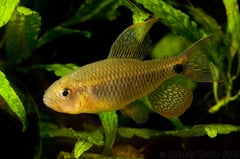
Crenuchus spilurusSailfin Characin
Crenuchidae · Günther, 1863
The sailfin characin, Crenuchus spilurus, is a crenuchid from much of the Amazon and Orinoco drainages and coastal rivers of the Guianas. The only described member of its genus, it varies considerably in colour pattern and morphology across that range. It lives in tea-stained forest streams, and its timid, predominantly benthic nature means it does not always make an ideal community fish. Males guard eggs laid on the roof of a small cave, often formed from leaf litter.
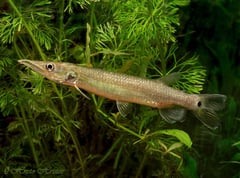
Ctenolucius hujetaGar Characin
Ctenoluciidae · Valenciennes, 1850
The gar characin, Ctenolucius hujeta, is a predatory pike characid from the Lake Maracaibo basin in Venezuela west to the Río Sinú in Colombia. Also traded as 'freshwater barracuda' and 'hujeta gar', it is surprisingly peaceful with anything too large to swallow. Juveniles school readily, and it is best kept in numbers of four or more with placid fishes that feed from the substrate. It is much the commoner of the two Ctenolucius in the hobby.
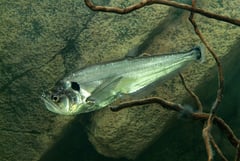
Cynodon gibbus
Cynodontidae · Agassiz, 1829
Cynodon gibbus is a cynodontid from much of the Amazon basin, the middle and lower Orinoco, and the Rupununi River in Guyana. A pelagic fish of main river channels and larger tributaries, it grows to around 280 mm SL. It is rare in the trade but arguably more suitable for the home aquarium than some of its better-known relatives, given its size and relatively docile behaviour. Being easily dominated, it is best kept alone or with similarly sized, non-aggressive fishes.
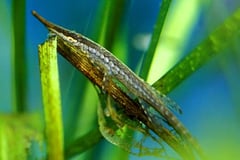
Farlowella vittataTwig Catfish
Loricariidae · Myers, 1942
The twig catfish, Farlowella vittata, is a stick-like loricariid from the Orinoco river basin in Colombia and Venezuela. This is the most common Farlowella in hobbyists' tanks, although much of the literature refers to it as F. acus, which has a shorter, less slender rostrum. It is super sensitive to poor water quality and should only go into an established aquarium with a good biofilm, algae or dried leaves.
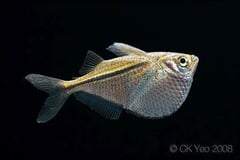
Gasteropelecus sterniclaCommon Hatchetfish
Gasteropelecidae · Linnaeus, 1758
The common hatchetfish (Gasteropelecus sternicla) is a freshwater hatchetfish from South America, described from Suriname. Its distribution is questionable, with records from the middle Amazon, Venezuela, Guyana, French Guiana and the Río Paraguay basin. It spends almost all of its time at or just below the surface. The most frequently seen of the silver hatchetfishes, it is peaceful but nervous and shy.

Geophagus abalios
Cichlidae · López-Fernández & Taphorn, 2004
Geophagus abalios is a cichlid from black and clear water tributaries of the río Orinoco in Venezuela, across the Llanos and south to the Casiquiare. One of the more commonly-traded members of the genus, it is rarely sold under the correct name and usually misidentified as G. altifrons or G. surinamensis. Juveniles are available cheaply because it is one of the few Geophagus bred commercially. Vertically split anterior flank bars separate it from the very similar G. brokopondo.

Geophagus brachybranchus
Cichlidae · Kullander & Nijssen, 1989
Geophagus brachybranchus is a cichlid from the Nickerie and Courantyne drainages of Suriname, also reported from Guyana and Venezuela. Generally rare in the aquarium hobby, it appears to be one of the commoner species in Australia, where it is often called the 'black-throated eartheater'. The largest wild specimen recorded measured 138 mm, but it is known to reach 180 to 200 mm in captivity.

Geophagus dicrozoster
Cichlidae · López-Fernández & Taphorn, 2004
Geophagus dicrozoster is a cichlid from tributaries of the río Orinoco in Venezuela, extending to the Casiquiare and the headwaters of the Negro. Commonly traded but rarely under the correct name, it is usually sold as G. altifrons or G. surinamensis, and it is one of the few Geophagus bred commercially. Seven flank bars, the fourth and fifth meeting in a 'Y', and a relatively elongate profile identify it. It appears restricted to acidic blackwater.

'Geophagus' steindachneriRed Hump Eartheater
Cichlidae · Eigenmann & Hildebrand, 1922
The red hump eartheater, Geophagus steindachneri, is a cichlid from the Magdalena and Sinú drainages in Colombia and the Río Limón basin in Venezuela. It lends its name to the 'G.' steindachneri group, whose taxonomic placement is unresolved. Colour forms vary with locality, and some appear on trade lists under the synonym Geophagus hondae. The species is an ovophilous, maternal mouthbrooder, and territorial males are best kept with three or more females.

Geophagus taeniopareius
Cichlidae · Kullander & Royero, 1992
Geophagus taeniopareius is a cichlid from the Venezuelan upper Río Orinoco, recorded from tributaries including the Caura, Cataniapo and Ocamo. Known in Germany as the 'Wangenstrich-Erdfresser' (cheek-stripe eartheater), it has been in the hobby since the late 1970s. A dark stripe runs from the eye to the corner of the opercle. It is markedly more aggressive than most congeners and spawns on the substrate.

Geophagus winemilleri
Cichlidae · López-Fernández & Taphorn, 2004
Geophagus winemilleri is a cichlid from southern Venezuela and probably northern Brazil, recorded from the upper Río Negro, Río Siapa and Casiquiare. It is rare in the hobby, though other species are sometimes sold under its name. A dark preopercular marking and four ventrally-inclined bars on each flank help identify it, and it may be restricted to acidic blackwater.
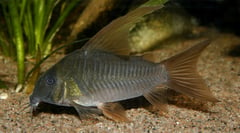
Hoplisoma concolorSlate Cory
Callichthyidae · (Weitzman, 1961)
The slate cory, Hoplisoma concolor, long known as Corydoras concolor, is an armoured catfish restricted to parts of the Orinoco river system in western Venezuela. Its uniformly greyish colour pattern sets it apart from congeners, along with a deep body, large eye and relatively long dorsal-fin spine. Mature males develop an extended dorsal fin.
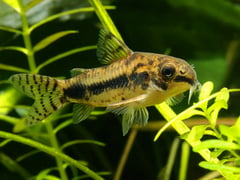
Hoplisoma habrosumSalt and Pepper Cory
Callichthyidae · (Weitzman, 1960)
The salt and pepper cory, Hoplisoma habrosum, long known as Corydoras habrosus, is a tiny armoured catfish from left bank tributaries of the upper Orinoco in Colombia and Venezuela. Most records come from the Río Apure watershed in the Llanos, where it apparently favours lagoons, streams, inundated forest and grassland with little flow. Also called 'dainty cory' and 'Venezuelan pygmy cory', it has 2-3 dark markings along the side of the body, against 4-5 in the similar H. cochui.
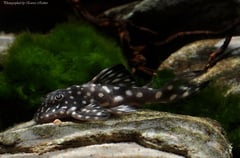
Hypancistrus inspectorL102
Loricariidae · Armbruster, 2002
The snowball pleco (L102), Hypancistrus inspector, is a suckermouth catfish from the upper rio Negro in Brazil and the Casiquiare in Venezuela. Brown to black with large whitish to yellow spots, it is most similar to H. contradens. It is normally collected from rocky rapids, is a cave-spawner with male brood care, and should not be kept with other Hypancistrus in order to prevent hybridisation.

Hyphessobrycon metaePurple Tetra
Characidae · Eigenmann & Henn, 1914
The purple tetra, Hyphessobrycon metae, is a characid endemic to the middle Río Orinoco watershed in Colombia and Venezuela. Also known as 'Río Meta tetra', it is often misidentified, and H. peruvianus has repeatedly appeared under its name. The dark band on the caudal peduncle, without a broad dark band along the lower body, separates it from H. peruvianus and H. loretoensis.

Hypselecara coryphaenoidesRio Negro Chocolate Cichlid
Cichlidae · authority not recorded
The Rio Negro chocolate cichlid, Hypselecara coryphaenoides, comes from rivers in Brazil and Venezuela including the Negro, Trombetas and Tapajós. It is much rarer in the trade than H. temporalis, from which it differs in a more elongate body, darker colour and a flank blotch on and above the lateral line. It lives in sluggish forest tributaries with dark, acidic water.

Iguanodectes adujai
Iguanodectidae · Géry, 1970
Traded as the 'red line lizard tetra', Iguanodectes adujai is a characin from the rio Negro in Brazil and the upper Río Orinoco in Venezuela. It is exported alongside the similar-looking I. geisleri, and differs in lacking the black lateral stripe beneath the red stripe and in having 28 to 34 anal-fin rays (20 to 25 in I. geisleri). It is assumed to live in smaller tributaries containing pristine blackwater.

Iguanodectes geisleri
Iguanodectidae · Géry, 1970
Iguanodectes geisleri is a characin from the rios Madeira and Negro in Brazil and the upper Río Orinoco in Venezuela. Traded with the similar-looking I. adujai as the 'red line lizard tetra', it differs in having a black lateral stripe beneath the red stripe and 20 to 25 anal-fin rays (28 to 34 in I. adujai). Adult males carry red markings in the pectoral, pelvic, anal and caudal fins.

Iguanodectes spilurusGreen Line Lizard Tetra
Iguanodectidae · Günther, 1864
The green line lizard tetra, Iguanodectes spilurus, is a characin found throughout the Amazon, Orinoco, Essequibo and Tocantins river systems. The most widespread Iguanodectes species, it has also been called the 'slender', 'spindle' or 'iguana' tetra, and differs from its congeners in its translucent dorsal and anal fins, lack of a red lateral stripe and prominent dark caudal-fin marking. It is sensitive to poor water conditions.
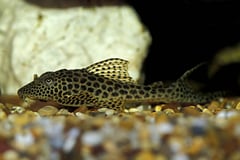
Isorineloricaria acuariusBlue Fin Thresher Pleco
Loricariidae · Ray & Armbruster, 2016
Isorineloricaria acuarius is a suckermouth catfish from the Apure and middle Orinoco drainages in the Venezuelan Llanos, where it lives on sandy runs in whitewater rivers. Traded as L093 and L195, the blue fin thresher pleco, it was sold as Hypostomus villarsi until it was described in 2016. I. villarsi is a different fish from the Lake Maracaibo basin, with a sharp ridge on each side of the head where I. acuarius has a rounded one.
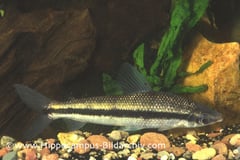
Laemolyta taeniataStriped Headstander
Anostomidae · Kner, 1858
The striped headstander, Laemolyta taeniata, is an anostomid from the central Amazon basin, also recorded from the Orinoco system in Venezuela. The largest-growing member of the genus, to 288 mm SL, it is rarely seen in the aquarium trade. Something of a habitat generalist, it migrates into flooded forest in the wet season and has been seen in large migratory shoals with Leporinus fasciatus and L. agassizii. Water quality is of the utmost importance, and anostomids are prodigious jumpers.
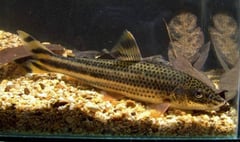
Leporellus vittatus
Anostomidae · Valenciennes, 1850
Leporellus vittatus is an anostomid with a huge natural range across the Amazon, Paraná-Paraguay, São Francisco and Orinoco river systems. Unlike most anostomids it is adapted to a benthic existence in flowing water and spends most of its time on or around the substrate. Occasionally exported, it requires quite specialised conditions, an aquarium of at least 210 by 60 cm and ideally a group of six or more.
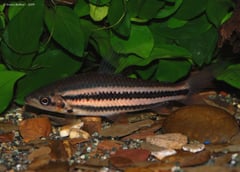
Leporinus arcusLipstick Leporinus
Anostomidae · Eigenmann, 1912
The lipstick leporinus, Leporinus arcus, is an anostomid from the Orinoco, Essequibo and upper Courantyne basins in Venezuela and the Guianas. It grows to 250 to 300 mm and needs an aquarium with base dimensions of at least 210 by 60 cm.
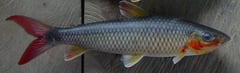
Leporinus brunneus
Anostomidae · Myers, 1950
Leporinus brunneus is an anostomid from the rios Madeira and Negro in Brazil, the Orinoco in Venezuela and Colombia, and the Casiquiare canal. The largest officially recorded specimen measured 256 mm, and an aquarium with base dimensions of at least 210 by 60 cm is needed.
Leptodoras linnelliElongate Mouse Catfish
Doradidae · authority not recorded
The elongate mouse catfish, Leptodoras linnelli, is a doradid catfish from river drainages of northern South America in Venezuela, Guyana and Brazil. It is found over sandy substrates in deeper, flowing sections of rivers and prefers cooler water than many related species. Totally unaggressive and schooling in nature, it is seldom exported and usually turns up only as bycatch among shipments of Opsodoras leporhinus or Hassar orestis.

Lugubria johannaRed-finned Pike Cichlid
Cichlidae · (Heckel, 1840)
The red-finned pike cichlid, Lugubria johanna, is a large pike cichlid that ranges over much of northern South America. It is known from the Orinoco, Essequibo, Oyapock and Approuague basins among others, mostly in faster moving rivers and streams, and a number of colour forms have developed across its range. Growing to 30 cm, it can be aggressive, especially towards its own kind, and will eat any fish small enough to be considered food.

Megalamphodus sweglesiRed Phantom Tetra
Characidae · Géry, 1961
The red phantom tetra, Megalamphodus sweglesi, is a small characid endemic to the upper and middle Río Orinoco watershed in Colombia and Venezuela. It apparently favours minor tributaries, oxbows and flooded forests, and in Venezuela is often found in morichals. Bred commercially in several countries, it has been traded in more than one colour form, and Zarske (2014) concluded that the particularly red form sold as 'red' or 'var. rubra' is conspecific.
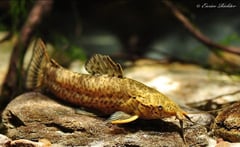
Megalechis pictaBar-tailed Hoplo
Callichthyidae · Müller & Troschel, 1849
The bar-tailed hoplo, Megalechis picta, is a callichthyid catfish widely distributed east of the Andes in Brazil, Venezuela and Guyana. It is recorded from the Amazon, Orinoco and upper Essequibo systems. Previously referred to as M. thoracata, it can be told from that species by a dark vertical bar in the caudal-fin and a longer dorsal-fin spine. Peaceful and hardy, it can even tolerate hypoxic conditions, and the male builds a nest.

Mikrogeophagus ramireziRam
Cichlidae · Myers & Harry, 1948
The ram, Mikrogeophagus ramirezi, is a dwarf cichlid from the llanos of the Rio Orinoco drainage in Venezuela and Colombia. Among the more popular dwarf cichlids in the hobby, it is produced commercially in huge numbers, and ornamental strains such as 'gold', 'long-finned' and 'balloon' tend to be genetically weak and short-lived. Wild fish are of superior stock but more demanding, and it requires pristine water quality.
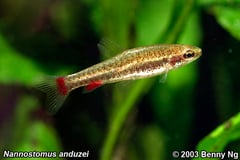
Nannostomus anduzei
Lebiasinidae · Fernandez & Weitzman, 1987
The smallest member of its genus, Nannostomus anduzei is a pencilfish from the upper Orinoco in Venezuela and the rio Negro basin in Brazil. Rarely traded in numbers, it is a relatively common contaminant among shipments of wild fishes from Manaus. Males have an intensely red caudal peduncle and anal-fin, and its size and timid nature suit a tank of its own or diminutive tankmates such as Paracheirodon simulans.
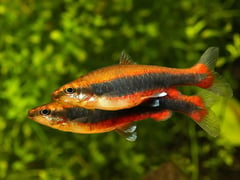
Nannostomus beckfordiGolden Pencilfish
Lebiasinidae · Günther, 1872
The golden pencilfish, Nannostomus beckfordi, is a lebiasinid widely distributed across Guyana, Suriname, French Guiana, Brazil and Venezuela. The type species of the genus and fairly ubiquitous in the trade, it is less demanding than most congeners and a good choice for a newcomer. Many fish on sale are farmed, and wild populations vary in colour pattern, several having been described as species now considered synonyms of N. beckfordi.
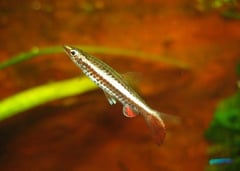
Nannostomus equesHockeystick Pencilfish
Lebiasinidae · Steindachner, 1876
The hockeystick pencilfish, Nannostomus eques, is a lebiasinid from the central and upper Amazon, the Orinoco drainage and rivers of Guyana. It swims at an oblique angle, a trait shared only with N. unifasciatus among congeners, and is also known as the 'rocket', 'diptail' or 'tubemouth' pencilfish. Genetic research on rio Negro populations raises the possibility that the species may be a complex of cryptic taxa.
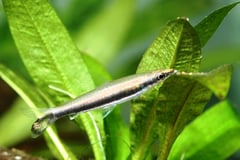
Nannostomus unifasciatusOne-lined Pencilfish
Lebiasinidae · Steindachner, 1876
The one-lined pencilfish, Nannostomus unifasciatus, occurs in the upper Amazon and upper Orinoco basins in Brazil, Bolivia, Colombia and Venezuela. A popular aquarium fish, it swims at an oblique angle, a trait shared only with N. eques. It differs from that species in lacking dark brown spots on the body scales and normally having an ocellus in the upper caudal-fin lobe.
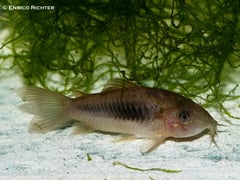
Osteogaster aeneaBronze Cory
Callichthyidae · (Gill, 1858)
The bronze cory, Osteogaster aenea, long known as Corydoras aeneus, is an armoured catfish described from Trinidad and accepted to occur across much of South America. That range looks more like a complex of similar, distinct species than a single one, and fish from outside Trinidad are of uncertain identity. Aquarium fish are almost all commercially farmed, and the names C. schultzei and C. venezuelanus are routinely misapplied to them.

Paracheirodon axelrodiCardinal Tetra
Characidae · Schultz, 1956
The cardinal tetra, Paracheirodon axelrodi, is a small characid from the rio Negro and Orinoco drainages of Brazil, Colombia and Venezuela. Immensely popular in the hobby, it is now commercially bred on a large scale, but a significant proportion of trade fish are still wild caught or come from community-led projects such as Project Piaba. Rio Negro and Orinoco populations differ in colour pattern, and wild fish are less tolerant of deteriorating water conditions than commercially-produced ones.

Paracheirodon simulansGreen Neon Tetra
Characidae · Géry, 1963
The green neon tetra, Paracheirodon simulans, is a small characid from the rio Negro and Orinoco drainages of Brazil, Colombia and Venezuela. An exclusive inhabitant of blackwater, it lives only in the upper, terra firme reaches of tributaries and is sometimes traded as 'false neon tetra' or 'blue neon tetra'. A greener lateral stripe that extends to the caudal-fin base and duller red flanks separate it from P. innesi and P. axelrodi.
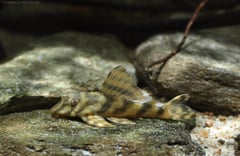
Peckoltia wernekeiL243
Loricariidae · Armbruster & Lujan, 2016
Peckoltia wernekei, also known as L243 and LDA086, is a suckermouth catfish known only from parts of the upper Río Orinoco drainage in Amazonas state, southern Venezuela. Armbruster and Lujan described it in 2016 from the Ventuari drainage. It is sometimes confused with Peckoltia lineola, alongside which it is often exported for the aquarium trade.
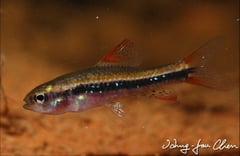
Poecilocharax weitzmaniBlack Darter Tetra
Crenuchidae · Géry, 1965
The black darter tetra, Poecilocharax weitzmani, is a crenuchid recorded from Brazil, Colombia, Peru and Venezuela. It has been collected from the upper Río Negro, Río Orinoco and Río Solimões drainages. Also traded as 'Black Morpho' tetra, it requires specialist care and is notoriously reluctant to accept dried foods. Unlike most small characids it does not form schools, and males are aggressively territorial towards one another. The Peruvian populations may apparently represent an undescribed species.
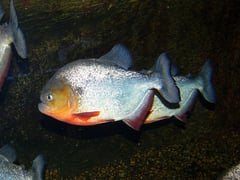
Pygocentrus caribaBlack Spot Piranha
Serrasalmidae · Humboldt, 1821
The black spot piranha, Pygocentrus cariba, is restricted to the Río Orinoco basin in Colombia and Venezuela. Many of its habitats lie within the llanos, and it has been recorded from river channels, tributaries and floodplain lakes, many of them acidic blackwater environments. Specimens over 100 mm SL have a large humeral spot and few spots on the body, which separates it from P. nattereri. It is best maintained alone.
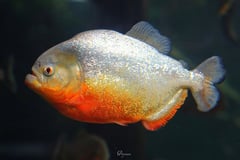
Pygocentrus nattereriRed Bellied Piranha
Serrasalmidae · Kner, 1858
The red bellied piranha, Pygocentrus nattereri, occurs through much of the Amazon basin and south into the Paraná and Uruguay river systems. Famed as a rapacious predator, it is among the most notorious freshwater fishes in the world. According to Herbert Axelrod (1976), the myth began with a feeding frenzy staged for Theodore Roosevelt in Brazil in 1913. Usually only juveniles form aggregations, and the species is relatively easy to breed in the aquarium.

Satanoperca daemonThreespot Eartheater
Cichlidae · Heckel, 1840
The threespot eartheater, Satanoperca daemon, is a cichlid from the rio Negro, Casiquiare and upper Orinoco systems in Brazil, Venezuela and Colombia. It is mostly observed in acidic, mineral-poor blackwater. Relatively common in the aquarium trade, it is by no means easy to maintain, needing particular attention to space, diet, water quality and chemistry. Two dark blotches on the flank separate it from the similar S. lilith, which has only one.

Satanoperca leucostictaWhitespot Eartheater
Cichlidae · Müller & Troschel, 1849
The whitespot eartheater, Satanoperca leucosticta, is a cichlid from the Guiana Shield in Guyana, Suriname, eastern Venezuela and northern Brazil. Farmed in several countries, it is frequently available in the ornamental trade. It is often confused with S. jurupari but is easily recognised by the prominent white spots or vermiform markings on the sides of the head. A larvophilous maternal mouthbrooder, it has been bred in aquaria.

Satanoperca mapiritensis
Cichlidae · Fernández-Yépez, 1950
Satanoperca mapiritensis is an eartheater cichlid native to the lower Río Orinoco basin in northern Venezuela, including the ríos Caura and Caroní. Uncommon in the aquarium trade, its name is frequently misapplied to S. leucosticta and similar, unidentified forms. Adults have white spots and vermiculations on the head, most intense on the operculum, and pale orange lips. Genetic research suggests it may turn out to be conspecific with S. jurupari and S. rhynchitis.
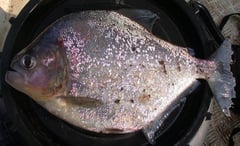
Serrasalmus gouldingiGoulding's Piranha
Serrasalmidae · Fink & Machado-Allison, 1992
Goulding's piranha, Serrasalmus gouldingi, is a deep-bodied piranha from the rio Negro drainage in Brazil and the Casiquiare system in Venezuela. It occasionally appears in the ornamental trade, sometimes as 'blue tiger piranha'. The eye is bluish or coppery, the body carries vertically-elongate dark spots and the caudal-fin has a blackish basal band. Its native rivers are acidic, mineral-poor blackwater, and it is best kept alone.
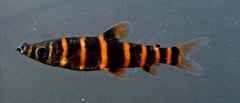
Synaptolaemus latofasciatus
Anostomidae · Steindachner, 1910
Synaptolaemus latofasciatus is a headstander from the upper Orinoco, the Casiquiare Canal and the middle-to-lower Amazon in Venezuela and Brazil. Described from a single specimen and placed in Leporinus until 2011, it was then recognised as the fish described as Synaptolaemus cingulatus. Alternating transverse bands of orange or yellow and dark brown or black run along the entire body, and snout shape and colour pattern vary with locality.
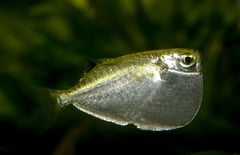
Thoracocharax stellatusSpotfin Hatchetfish
Gasteropelecidae · Kner, 1858
The spotfin hatchetfish, Thoracocharax stellatus, is the most widespread neotropical hatchetfish, recorded from much of South America. It is told from its only congener, T. securis, by a prominent dark spot in the dorsal fin, and is sometimes traded as 'platinum hatchetfish'. It feeds almost entirely on insects, and a tightly fitting cover is needed because it can clear several metres in one jump.

Aequidens tetramerusSaddle Cichlid
Cichlidae · Heckel, 1840
The saddle cichlid, Aequidens tetramerus, is a cichlid found across much of northern South America, from the Amazon and Orinoco basins to the Guianas. The type species of its genus, it occurs in several colour forms, and fish from Ecuador and Peru are sought after for the red or orange colouration on the lower head and belly. As currently recognised it is likely to represent a group of related fishes, some of which may be described as distinct species.
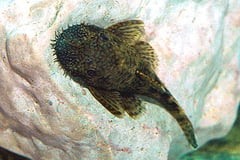
Ancistrus triradiatusHorned Bristlenose Pleco
Loricariidae · Eigenmann, 1918
The horned bristlenose pleco, Ancistrus triradiatus, is a small suckermouth catfish from Colombia and Venezuela, found among rocks in flowing streams. It is often confused with the common bristlenose, Ancistrus sp. (3), and other congeners, and some are so similar that a definite identification needs the collection locality. Imported fish are almost always wild-caught. Mainly vegetarian and peaceful, it is easy to breed once mature.

Andinoacara pulcherBlue Acara
Cichlidae · Gill, 1858
The blue acara, Andinoacara pulcher, is a cichlid native to Trinidad and Tobago and parts of Venezuela. It occupies a variety of habitats, from murky still waters to clear streams. A mainstay of the hobby for many years, it is one of the easiest substrate-spawning cichlids to breed. Captive breeding has narrowed the gene pool, so most fish in the hobby are pale imitations of wild ones, and some are hybrids with related species. It was previously known as 'Aequidens' pulcher.
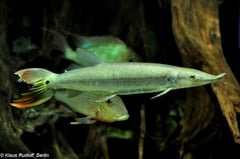
Boulengerella cuvieri
Ctenoluciidae · Spix & Agassiz, 1829
Boulengerella cuvieri is a pelagic ctenoluciid characin from much of the Amazon basin, the Río Orinoco and coastal drainages of the Guianas. The largest officially recorded specimen measured 675 mm, but it appears to grow larger, possibly beyond 800 mm. Given that size and its natural behaviour it is largely unsuitable for the home aquarium. Its entire dorsal-fin base lies ahead of the anal-fin origin, a character shared only with B. lucius and B. xyrekes among ctenoluciids.
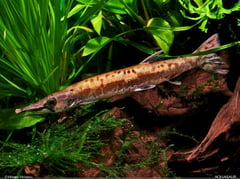
Boulengerella lucius
Ctenoluciidae · Cuvier, 1816
Boulengerella lucius is a large, pelagic ctenoluciid from the central Amazon region in Brazil and the Río Orinoco in Venezuela. Named for its resemblance to the northern pike, it grows to 420 mm and is largely unsuitable for the home aquarium. Juveniles and subadults are sometimes available in the trade, often misidentified as B. maculata. Dark patches between the median caudal-fin rays and random dark spots on the lower flanks separate it from B. cuvieri and B. xyrekes.
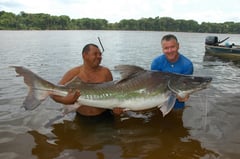
Brachyplatystoma filamentosumPiraíba
Pimelodidae · Lichtenstein, 1819
The piraíba, Brachyplatystoma filamentosum, is the largest catfish of the Amazon basin, also found in the Orinoco and river systems of the Guianas. Adults typically measure 2 to 2.5 m and weigh over 150 kg. In the Amazon only fish over around 160 cm are called 'Piraíba', and smaller ones 'filhote'. It is suitable only for public aquaria and a very small minority of private aquarists.
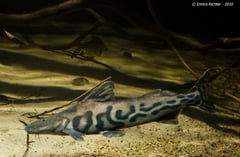
Brachyplatystoma juruenseGold Zebra Catfish
Pimelodidae · Boulenger, 1898
The gold zebra catfish, Brachyplatystoma juruense, is a large pimelodid from the middle Amazon and Orinoco basins, described from the rio Juruá. Adults have broad dark vertical, oblique or branching bands on a pale yellowish body and grow to at least 600 mm. It is sometimes confused with B. tigrinum, especially when young, but has a much less defined pattern, a deeper body and shorter barbels. It suits only public aquaria and a very small minority of private aquarists.
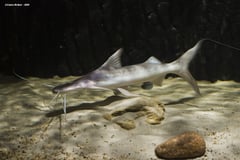
Brachyplatystoma platynemumSlobbering Catfish
Pimelodidae · Boulenger, 1898
The slobbering catfish, Brachyplatystoma platynemum, is a large migratory pimelodid catfish from the Amazon and Orinoco basins. The name refers to its relatively thick barbels, which give the impression that the fish is drooling. It travels considerable distances along deeper, flowing channels, and sexually mature adults have been observed in the upper rio Madeira basin, some 3000 km from the estuary. It grows to 1000 mm SL.
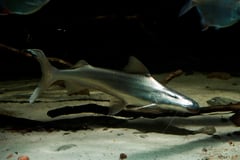
Brachyplatystoma rousseauxiiDourada
Pimelodidae · Castelnau, 1855
The dourada, Brachyplatystoma rousseauxii, is a large migratory pimelodid catfish from the Amazon and Orinoco drainages and rivers of the Guianas. Juveniles feed in the Amazon delta, while sexually mature adults are found only in the western Amazon. Some populations cover as much as 5500 km during migration from the delta, the longest known in any freshwater fish, and it is heavily fished during its upstream movement. It grows to 1900 mm SL.
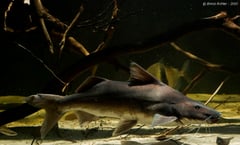
Brachyplatystoma vaillantiiPiramutaba
Pimelodidae · Valenciennes, 1840
The piramutaba, Brachyplatystoma vaillantii, is a large migratory pimelodid catfish from the Amazon and Orinoco watersheds and rivers of the Guianas. Juveniles feed in the Amazon delta before migrating upstream in massive numbers, when they are subject to intensive capture by commercial and artisanal fisheries. Sexually mature adults have been observed in the rio Caquetá basin, some 3500 km from the estuary. It grows to 1050 mm SL.
Cichla orinocensisOrinoco Peacock bass
Cichlidae · authority not recorded
The Orinoco peacock bass, Cichla orinocensis, is a predatory cichlid from the Orinoco basin in Venezuela and Colombia and the Rio Negro in Brazil. One of the smaller peacock bass, it still grows to around 60 cm and needs a tank of at least 8 x 3 x 3 feet as an adult. It is territorial and moderately aggressive and will eat any tankmate small enough to be considered food.
Cichla temensisSpeckled Pavon
Cichlidae · authority not recorded
The speckled pavon, Cichla temensis, is a large peacock bass from the Rio Negro, Uatumã and Orinoco basins in Colombia, Venezuela, Guyana and Brazil. One of the largest Cichla species at up to 99 cm, it is more suited to public aquaria and needs a tank of at least 10 x 3 x 4 feet as an adult. Often sold as small juveniles, it is also fished as a sport fish.
Hemiancistrus subviridisGreen Phantom Plec
Loricariidae · Werneke, Sabaj Pérez, Lujan & Armbruster, 2005
Hemiancistrus subviridis is a suckermouth catfish from the upper Orinoco and Casiquiare drainages in southern Venezuela, where it lives in cracks between granite rocks in flowing water. Known in the hobby as the green phantom plec, it shares the code L200 with Baryancistrus demantoides. Only B. demantoides has a membrane joining its dorsal and adipose fins. It looks very like L128, the blue phantom plec, and along the Orinoco the two fish grade into each other in colour.
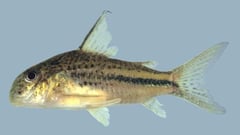
Hoplisoma bondiBlackstripe Cory
Callichthyidae · (Gosline, 1940)
The blackstripe cory, Hoplisoma bondi, long known as Corydoras bondi, is an armoured catfish from Venezuela, Guyana and Suriname, including the Essequibo and Courantyne systems. It was once considered common in the hobby, but many fish traded under the name may be the similar H. sipaliwini or H. coppenamense. H. sipaliwini has larger body spots and a dark marking on the first dorsal-fin rays, while H. coppenamense is more orangish.
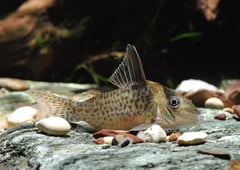
Hoplisoma brevirostreSpotted Cory
Callichthyidae · (Fraser-Brunner, 1947)
The spotted cory, Hoplisoma brevirostre, long known as Corydoras brevirostris, is an armoured catfish usually said to occur in the Orinoco system in Venezuela and coastal Suriname. It was described from an aquarium specimen and its wider distribution is somewhat vague. It belongs to a group of similar congeners, including H. melanistium, Brochis delphax and B. ephippifera, that are widely misidentified, and is generally identified by a short, rounded snout and dark bars in the caudal fin.
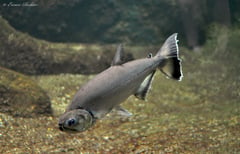
Hydrolycus armatusPayara
Cynodontidae · Jardine, 1841
The payara, Hydrolycus armatus, is a large, predatory dogtooth characin from the eastern Amazon, the Orinoco and the Essequibo in Guyana. Given its eventual size and natural behaviour it probably should not be considered a home aquarium subject at all, though juveniles are sometimes sold. It is regularly confused with the smaller H. scomberoides, and no other member of the genus has white margins to the anal and caudal fins.
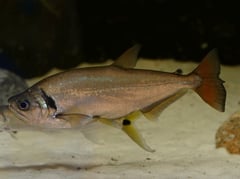
Hydrolycus tatauaia
Cynodontidae · Toledo-Piza, Menezes & Santos, 1999
Hydrolycus tatauaia is a large, predatory dogtooth characin from the lower and central Amazon, the upper Orinoco and coastal drainages of Guyana. A pelagic species of flowing main river channels, it performs long upstream migrations to spawn. Its adult size and natural behaviour mean only a handful of private aquarists have the facilities to house it long-term.

Laetacara fulvipinnis
Cichlidae · Staeck & Schindler, 2007
Laetacara fulvipinnis is a cichlid from the Orinoco, the Casiquiare and the upper and middle rio Negro in Venezuela and Brazil. Known in the hobby as L. sp. 'orangeflossen' before it was described, it takes its name from the reddish-yellow anal and caudal fins. It has been collected among leaf litter and submerged vegetation in very shallow, soft, acidic blackwater, and grows to around 74 mm SL. A biparental substrate-spawner, it lays its eggs on a solid surface such as a plant leaf.
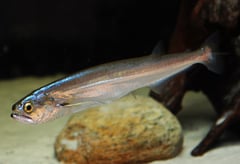
Rhaphiodon vulpinusBiara
Cynodontidae · Spix & Agassiz, 1829
The biara, Rhaphiodon vulpinus, is a dogtooth characin found from the Orinoco and Amazon basins south to the Río de la Plata in Argentina. The only member of its genus, it grows to 600 to 800 mm and is an obligate piscivore, and it is suitable only for public installations or the very largest private aquaria. Juveniles are seen for sale quite regularly, most often without adequate information on their long-term care.
Tatia galaxias
Auchenipteridae · Mees, 1974
Tatia galaxias is a wood catfish from the Orinoco river basin in Venezuela and Colombia, dark with small, round white spots like stars. It is sometimes confused with Tatia intermedia, in which the spots are longer and oval.
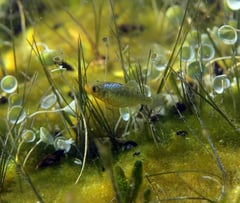
Cyprinodon variegatusSheepshead 'Minnow'
Cyprinodontidae · Lacepède, 1803
The sheepshead 'minnow', Cyprinodon variegatus, is a pupfish ranging from the northeastern U.S.A. to northeastern Mexico, the Bahamas and Antilles. It tends to be most common in brackish to hypersaline environments such as coastal salt marshes, lagoons and estuaries. On San Salvador Island in the Bahamas it appears to be the parent of a group of species living in sympatry and exploiting diverse but specific resources.
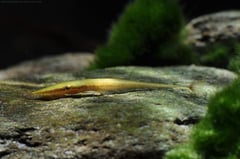
Acestridium dichromumGreen Whiptail
Loricariidae · Retzer, Nico & Provenzano, 1999
The green whiptail, Acestridium dichromum, is a small loricariid catfish from the upper rio Negro in Brazil and the upper Orinoco in Venezuela. It is known only from those two basins and the drainages between them, including the Casiquiare Canal.
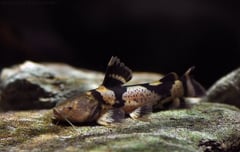
Pseudopimelodus bufoniusGiant Bumblebee Catfish
Pseudopimelodidae · Valenciennes, 1840
The giant bumblebee catfish, Pseudopimelodus bufonius, is distributed throughout northeastern South America, from Venezuela to eastern Brazil. Its range extends from the Lake Maracaibo basin, and it grows to 245 mm SL. The type locality is uncertain but probably Cayenne, French Guiana.