Country · Asia
Turkey
Only species with a profile on Seriously Fish are counted, whether native or introduced.
- Species
- 11
- Families
- 2
- Genera
- 6
- Found only here
- 7
- Photographed
- 11 of 11
Shares its fishes withspecies recorded in both
Found only here7
7 of the species on this page are recorded in Turkey and in no other country. This is not the same as being endemic.

Anatolichthys anatoliaeAnatolian Toothcarp
Aphaniidae · Leidenfrost, 1912
The Anatolian toothcarp, Anatolichthys anatoliae, is a small killifish from central and western Anatolia in Turkey. The most widely distributed of the Anatolian species, it lives in fresh and mildly saline waters, and around Lake Tuz several populations have disappeared through pollution and water extraction. It needs a cold winter period, and given its conservation status it is best kept on its own, in a group with two or three females to each male.
Anatolichthys danfordiiDanford's Toothcarp
Aphaniidae · Boulenger, 1890
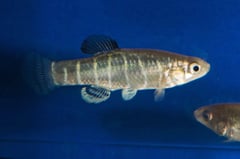
Danford's toothcarp, Anatolichthys danfordii, is endemic to Turkey, in the middle and lower Kızıl, lower Yeşil and upper Seyhan river systems. It has a confused history, having been treated as a synonym of both A. sophiae and A. fasciatus, and A. chantrei is now known to be a junior synonym of it. Colour and pattern vary with locality, and forms such as 'Soysallı' and 'Kırşehir' are labelled to preserve bloodlines.
Anatolichthys saldaeSalda Toothcarp
Aphaniidae · Akşiray, 1955
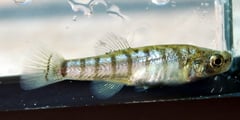
The Salda toothcarp, Anatolichthys saldae, is endemic to Lake Salda in the Turkish Lakes region of southwestern Anatolia, Turkey. Lake Salda is a highly alkaline, magnesium-rich soda lake. The fish has an elongated, slender body, an angular lower jaw and reduced scalation that varies between individuals. It has been considered Critically Endangered by the IUCN since 1996.
Anatolichthys sureyanusBurdur Toothcarp
Aphaniidae · Neu, 1937
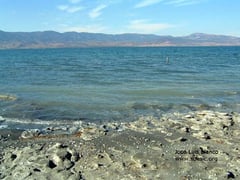
The Burdur toothcarp, Anatolichthys sureyanus, is endemic to Lake Burdur in the Turkish Lakes region of southwestern Anatolia, Turkey. The only fish in this extremely alkaline, saline lake, it has a slender body, an angular lower jaw and variable scalation. It has also gone by A. transgrediens, A. burdurensis and A. burduricus, and appears twice on the IUCN Red List as a result.
Anatolichthys villwockiSakarya Toothcarp
Aphaniidae · Hrbek & Wildekamp, 2003
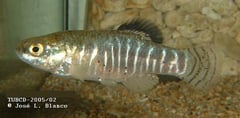
The Sakarya toothcarp, Anatolichthys villwocki, is endemic to the Sakarya River basin, including Lake Çavuşçu, in western central Turkey. Formerly treated as a form of A. anatoliae, it has been shown to be the sister group to all other Anatolian Aphanius. It occupies habitats from clear, spring-fed freshwater to hypersaline Lake Çavuşçu, and colour and pattern vary with locality.
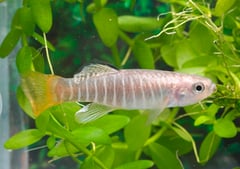
Aphanius fasciatusMediterranean Toothcarp
Aphaniidae · Valenciennes, 1821
The Mediterranean toothcarp, Aphanius fasciatus, occurs around much of the Mediterranean coast, from France and the Adriatic to Syria and Egypt. It mostly inhabits shallow lagoons, salt marshes and first order streams, and tolerates anything from freshwater to hypersaline conditions. Populations differ in colour and pattern but relatively little genetically, the exception being the isolated population in Lake Bafa, Turkey.
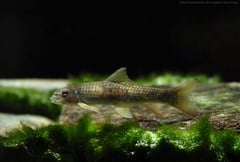
Garra rufaDoctor Fish
Cyprinidae · Heckel, 1843
The doctor fish (Garra rufa) is a cyprinid from the eastern Mediterranean and Middle East, from Turkey and Israel to the Tigris-Euphrates in Iran. Fish sold as G. rufa are marketed worldwide for their questionable ability to remove dead skin, but the species likely represents a complex of closely-related taxa and it is unclear which the traded fish are. Strictly not a tropical species, it is kept at 14-20 °C.
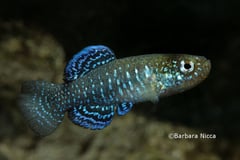
Paraphanius mentoIridescent Toothcarp
Aphaniidae · Heckel, 1843
The iridescent toothcarp, Paraphanius mento, occurs in eastern Mediterranean and Middle Eastern countries from Turkey and Israel to Iraq and Iran. Most aquarium fish come from Turkey's Mediterranean coast and the Ceyhan and Seyhan basins. One of the more ancient Aphanius, it has found greater popularity in the hobby than its relatives. Males are the most aggressive in the genus and will often fight to the death.

Ctenopharyngodon idellaGrass Carp
Cyprinidae · Valenciennes, 1844
The grass carp, Ctenopharyngodon idella, is a large cyprinid native to the Amur River system in eastern Russia and northeastern China. Adults typically reach 800 to 1200 mm, making it a wholly unsuitable aquarium subject, though an albino form is traded. Widely introduced for aquaculture and weed control, it has caused serious damage to natural waters, and unwanted fish should never be released.

Kosswigichthys asquamatusHazar Toothcarp
Aphaniidae · Sözer, 1942
The Hazar toothcarp, Kosswigichthys asquamatus, is a relict species endemic to Lake Hazar in southeastern Anatolia, Turkey. It has a more elongate body than other Aphanius, almost no scales and conical teeth. The lake water is hard, alkaline and rich in magnesium chloride, and in aquaria it seems to need certain salts for proper egg and fry development. Outside the spawning season it forms schools.
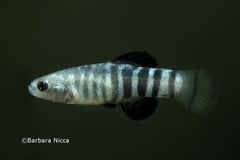
Anatolichthys transgrediensAcı Toothcarp
Aphaniidae · Ermin, 1946
The Acı toothcarp, Anatolichthys transgrediens, is endemic to the Lake Acı basin in the Turkish Lakes region of southwestern Anatolia, Turkey. The lake's extreme chemistry and fluctuating level mean it is mostly found in fresh and slightly brackish springs around the margins. In scalation, body form and jaw it is intermediate between A. anatoliae and A. splendens/sureyanus. It has been considered critically endangered by the IUCN since 1996.