Country · Asia
Israel
Only species with a profile on Seriously Fish are counted, whether native or introduced.
- Species
- 6
- Families
- 3
- Genera
- 6
- Found only here
- 0
- Photographed
- 5 of 6
Shares its fishes withspecies recorded in both
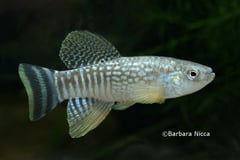
Aphaniops disparArabian Toothcarp
Aphaniidae · (Rüppell, 1829)
The Arabian toothcarp, Aphaniops dispar, is found around the coasts of the Red Sea and the Gulf of Aden. Inland populations also exist, and it tolerates anything from pure freshwater to hypersaline conditions. A 2003 phylogenetic study found it paraphyletic, and several populations once included in it have since been described as separate species, so forms are labelled by locality, such as 'Lake Assal'.
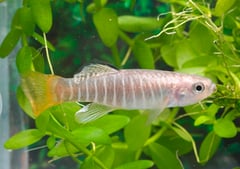
Aphanius fasciatusMediterranean Toothcarp
Aphaniidae · (Valenciennes, 1821)
The Mediterranean toothcarp, Aphanius fasciatus, occurs around much of the Mediterranean coast, from France and the Adriatic to Syria and Egypt. It mostly inhabits shallow lagoons, salt marshes and first order streams, and tolerates anything from freshwater to hypersaline conditions. Populations differ in colour and pattern but relatively little genetically, the exception being the isolated population in Lake Bafa, Turkey.
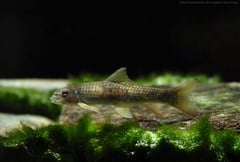
Garra rufaDoctor Fish
Cyprinidae · (Heckel, 1843)
The doctor fish (Garra rufa) is a cyprinid from the eastern Mediterranean and Middle East, from Turkey and Israel to the Tigris-Euphrates in Iran. Fish sold as G. rufa are marketed worldwide for their questionable ability to remove dead skin, but the species likely represents a complex of closely-related taxa and it is unclear which the traded fish are. Strictly not a tropical species, it is kept at 14-20 °C.
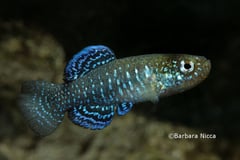
Paraphanius mentoIridescent Toothcarp
Aphaniidae · (Heckel, 1843)
The iridescent toothcarp, Paraphanius mento, occurs in eastern Mediterranean and Middle Eastern countries from Turkey and Israel to Iraq and Iran. Most aquarium fish come from Turkey's Mediterranean coast and the Ceyhan and Seyhan basins. One of the more ancient Aphanius, it has found greater popularity in the hobby than its relatives. Males are the most aggressive in the genus and will often fight to the death.
Xiphophorus helleriiGreen Swordtail
Poeciliidae · Heckel, 1848
The green swordtail, Xiphophorus hellerii, is a livebearer native to southeastern Mexico, Guatemala, Belize and Honduras. Among the world's most recognisable aquarium fishes, it is ubiquitous in the trade, where selective breeding and hybridisation with X. maculatus and X. variatus have produced a bewildering array of ornamental forms. The name is often misspelled X. helleri.

Ctenopharyngodon idellaGrass Carp
Cyprinidae · (Valenciennes, 1844)
The grass carp, Ctenopharyngodon idella, is a large cyprinid native to the Amur River system in eastern Russia and northeastern China. Adults typically reach 800 to 1200 mm, making it a wholly unsuitable aquarium subject, though an albino form is traded. Widely introduced for aquaculture and weed control, it has caused serious damage to natural waters, and unwanted fish should never be released.