Country · Asia
Iran
Only species with a profile on Seriously Fish are counted, whether native or introduced.
- Species
- 8
- Families
- 4
- Genera
- 6
- Found only here
- 3
- Photographed
- 7 of 8
Shares its fishes withspecies recorded in both
Found only here3
3 of the species on this page are recorded in Iran and in no other country. This is not the same as being endemic.

Channa gachuaDwarf Snakehead
Channidae · Hamilton, 1822
The dwarf snakehead, Channa gachua, is a snakehead recorded across an enormous range from Iran to Taiwan and Bali. There is significant evidence that C. gachua as currently understood is a complex of similar-looking species in need of taxonomic review. A mouthbrooder bred regularly in captivity, it can share a well-chosen community with peaceful fishes too large to be prey, but populations should not be mixed as some may hybridise.
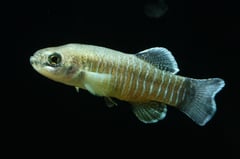
Esmaeilius arakensisArak Toothcarp
Aphaniidae · Teimori, Esmaeili, Gholami, Zarei, & Reichenbacher, 2012
The Arak toothcarp, Esmaeilius arakensis, appears to be endemic to a handful of natural springs near Arak in the Namak Lake basin, northern Iran. It was in the hobby for several years before its description, as Aphanius sp. 'Namak' or 'Namak River'. Externally it looks very similar to its closest relatives A. farsicus and A. sophiae. Aggressive spawning behaviour and its water requirements make it a poor choice for the community aquarium.
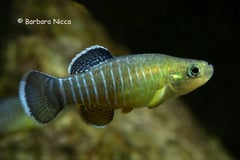
Esmaeilius persicusFarsi Toothcarp
Aphaniidae · Jenkins, 1910
The Farsi toothcarp, Esmaeilius persicus, is endemic to the Lake Maharlu basin near Shiraz in Fars Province, southern Iran. The hypersaline lake supports no fish, so it lives in the surrounding springs, pools, lagoons and marshes of fresh to brackish water. Males look very like those of its close relative E. sophiae, but females have stripes on the flanks where E. sophiae has spots. Most fish in the hobby come from Barm-e-shur spring.
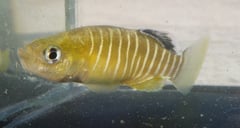
Esmaeilius vladykoviZagros Toothcarp
Aphaniidae · Coad, 1988
The Zagros toothcarp, Esmaeilius vladykovi, is restricted to a small area of the Zagros mountains in Chahārmahāl o Bakhtiyārī province, Iran. It lives over 2000 m above sea level in slow freshwater streams, pools and marshes of the upper Karun River basin. The dark dorsal fin of males separates it from its closest relative A. sophiae. Males are relatively peaceful towards one another, and it swims in large schools in nature.
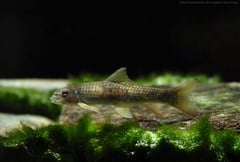
Garra rufaDoctor Fish
Cyprinidae · Heckel, 1843
The doctor fish (Garra rufa) is a cyprinid from the eastern Mediterranean and Middle East, from Turkey and Israel to the Tigris-Euphrates in Iran. Fish sold as G. rufa are marketed worldwide for their questionable ability to remove dead skin, but the species likely represents a complex of closely-related taxa and it is unclear which the traded fish are. Strictly not a tropical species, it is kept at 14-20 °C.
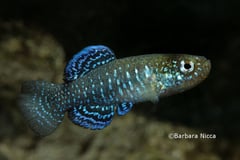
Paraphanius mentoIridescent Toothcarp
Aphaniidae · Heckel, 1843
The iridescent toothcarp, Paraphanius mento, occurs in eastern Mediterranean and Middle Eastern countries from Turkey and Israel to Iraq and Iran. Most aquarium fish come from Turkey's Mediterranean coast and the Ceyhan and Seyhan basins. One of the more ancient Aphanius, it has found greater popularity in the hobby than its relatives. Males are the most aggressive in the genus and will often fight to the death.
Xiphophorus helleriiGreen Swordtail
Poeciliidae · Heckel, 1848
The green swordtail, Xiphophorus hellerii, is a livebearer native to southeastern Mexico, Guatemala, Belize and Honduras. Among the world's most recognisable aquarium fishes, it is ubiquitous in the trade, where selective breeding and hybridisation with X. maculatus and X. variatus have produced a bewildering array of ornamental forms. The name is often misspelled X. helleri.

Ctenopharyngodon idellaGrass Carp
Cyprinidae · Valenciennes, 1844
The grass carp, Ctenopharyngodon idella, is a large cyprinid native to the Amur River system in eastern Russia and northeastern China. Adults typically reach 800 to 1200 mm, making it a wholly unsuitable aquarium subject, though an albino form is traded. Widely introduced for aquaculture and weed control, it has caused serious damage to natural waters, and unwanted fish should never be released.