Country · South America
Uruguay
Only species with a profile on Seriously Fish are counted, whether native or introduced.
- Species
- 11
- Families
- 8
- Genera
- 11
- Found only here
- 0
- Photographed
- 11 of 11
Shares its fishes withspecies recorded in both
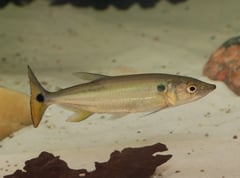
Acestrorhynchus pantaneiroPantanal Barracuda Tetra
Acestrorhynchidae · Menezes, 1992
The Pantanal barracuda tetra, Acestrorhynchus pantaneiro, is a predatory acestrorhynchid from the Paraná, Uruguay and de la Plata basins. It also occurs in the rio Mamoré in Bolivia. A member of the A. lacustris group with a round humeral spot, it is virtually impossible to tell from its relatives in the trade unless collection data is known. It lives in open water, and a group must be of comparable size because acestrorhynchids are cannibalistic.

Aphyocharax rathbuniGreen Fire Tetra
Characidae · Eigenmann, 1907
The green fire tetra, or Rathbun's bloodfin, Aphyocharax rathbuni, is a characid endemic to the Paraguay, Paraná and Uruguay river drainages. It is found in Brazil, Paraguay, Argentina and Uruguay, in streams and rivers shaded by floating or overhanging vegetation. Although suitable for a community aquarium, it has a reputation as a fin-nipper, and long-finned species such as many cichlids and anabantoids should be avoided as tankmates.

Apistogramma borelliiBorelli's Dwarf Cichlid
Cichlidae · (Regan, 1906)
Borelli's dwarf cichlid, Apistogramma borellii, is from southern Brazil, Paraguay, Argentina and Uruguay. Also known as the umbrella or yellow dwarf cichlid, it occurs in creeks and tributaries of the rio Paraguay, lower rio Paraná and Uruguay systems. Captive-raised fish are the recommended choice for the community aquarium, while wild examples are best kept alone or with small dither fishes.

Astronotus ocellatusOscar
Cichlidae · (Agassiz, 1831)
The oscar, Astronotus ocellatus, is a large cichlid widely distributed in the Amazon region, recorded from Colombia and Venezuela south to Argentina. It grows to 350 mm SL and typically lives 10 to 20 years, both of which need taking into account before purchase. Most fish on sale come from commercial breeders in Eastern Europe or the Far East, in numerous ornamental strains, and genetic analyses suggest the genus contains additional, morphologically cryptic species.

'Geophagus' brasiliensisPearl Cichlid
Cichlidae · (Quoy & Gaimard, 1824)
The pearl cichlid, Geophagus brasiliensis, comes from Atlantic-draining river systems of eastern and southern Brazil and Uruguay. It belongs to the 'G.' brasiliensis group, which still needs definitive classification. Colour and body shape vary with locality, and some coastal lagoon populations have evolved a degree of salt tolerance. Fish sold as Gymnogeophagus australis in Europe are more often this species, and non-native populations exist in several countries.

Hyphessobrycon anisitsiBuenos Aires Tetra
Characidae · (Eigenmann, 1907)
The Buenos Aires tetra, Hyphessobrycon anisitsi, is a characid from the Paraná and Uruguay river systems in Brazil, Paraguay, Argentina and Uruguay. A popular and hardy aquarium fish, it is also available as a line-bred albino strain, sometimes traded as 'golden'. It has a reputation for fin-nipping, though mostly when too few are kept or space is limited, and a group of at least 8-10 is the minimum.
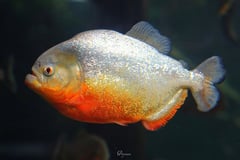
Pygocentrus nattereriRed Bellied Piranha
Serrasalmidae · Kner, 1858
The red bellied piranha, Pygocentrus nattereri, occurs through much of the Amazon basin and south into the Paraná and Uruguay river systems. Famed as a rapacious predator, it is among the most notorious freshwater fishes in the world. According to Herbert Axelrod (1976), the myth began with a feeding frenzy staged for Theodore Roosevelt in Brazil in 1913. Usually only juveniles form aggregations, and the species is relatively easy to breed in the aquarium.

Ctenopharyngodon idellaGrass Carp
Cyprinidae · (Valenciennes, 1844)
The grass carp, Ctenopharyngodon idella, is a large cyprinid native to the Amur River system in eastern Russia and northeastern China. Adults typically reach 800 to 1200 mm, making it a wholly unsuitable aquarium subject, though an albino form is traded. Widely introduced for aquaculture and weed control, it has caused serious damage to natural waters, and unwanted fish should never be released.
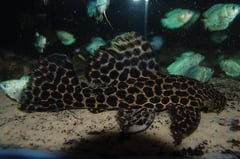
Megalancistrus parananusL113
Loricariidae · (Peters, 1881)
L113, Megalancistrus parananus, is a large suckermouth catfish from the rios Paraná, Paraguay and Uruguay in Brazil, Paraguay, Uruguay and Argentina. It was formerly thought to include L234, but only L113 appears native to these drainages, while L234 comes from the rio São Francisco. The largest recorded specimen measured 588 mm, and it can behave very aggressively in confined surroundings.
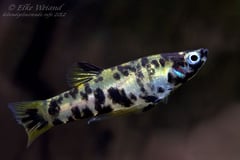
Phalloceros caudimaculatusDusky Millions Fish
Poeciliidae · (Hensel, 1868)
The dusky millions fish, Phalloceros caudimaculatus, is a small livebearer native to Brazil, Paraguay, Uruguay and Argentina. Feral populations in Australia, New Zealand, Ethiopia and Malawi were purportedly introduced for mosquito control and are now considered invasive. Highly variable in colour pattern, it is known in the hobby in spotted and golden ornamental forms. P. caudimaculatus is the type species of a genus that was monotypic until 21 new species were described in 2008.
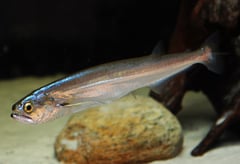
Rhaphiodon vulpinusBiara
Cynodontidae · Spix & Agassiz, 1829
The biara, Rhaphiodon vulpinus, is a dogtooth characin found from the Orinoco and Amazon basins south to the Río de la Plata in Argentina. The only member of its genus, it grows to 600 to 800 mm and is an obligate piscivore, and it is suitable only for public installations or the very largest private aquaria. Juveniles are seen for sale quite regularly, most often without adequate information on their long-term care.