Genus
Channa
- Species
- 21
- Photographed
- 20 of 21
- Difficulty rated
- 21 of 21
Where the name comes fromEdit
from the Latin channe, used to refer to an unspecified species of sea perch.

Channa andraoLal Cheng
Britz, 2013
Traded for years as 'Lal Cheng', Channa andrao is a snakehead endemic to the Brahmaputra River basin in northeastern India. It stays at a manageable size while showing much of the behaviour and colour of larger members of the genus. It lacks pelvic fins and is most often confused with C. bleheri, from which it differs in fin markings and in being a paternal mouthbrooder.
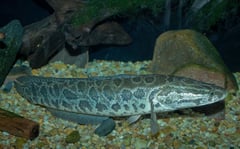
Channa argusNorthern Snakehead
Cantor, 1842
The northern snakehead, Channa argus, is a large snakehead native to eastern China, southeastern Russia and the Korean peninsula. Growing to 850 mm, it is largely unsuitable for the home aquarium given its size and natural behaviour. Introduced populations, first intended for aquaculture, are now established in Japan, the United States, central Asia and parts of eastern Europe.
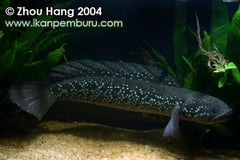
Channa asiaticaChinese Snakehead
Linnaeus, 1758
The Chinese snakehead, Channa asiatica, is a snakehead native to central and southern China and northern Vietnam. One of several Channa lacking pelvic fins, it is told apart from them by vertical black bars on a brownish body and numerous white spots on the body and fins. It is best kept in a species tank. Pairs build no bubble nest, and both parents defend several thousand floating eggs and the fry.

Channa aurantimaculataOrange-spotted Snakehead
Musikasinthorn, 2000
The orange-spotted snakehead, Channa aurantimaculata, is a snakehead endemic to the Brahmaputra basin in Assam and Arunachal Pradesh, India. Also traded as 'golden cobra snakehead', it has seven or eight large, irregular orange blotches on a dark upper body. Aggressively territorial towards its own kind, it needs a species tank, and violence can break out suddenly even in pairs kept together for a long time.
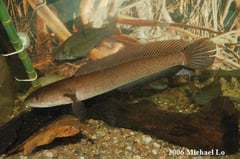
Channa baramensisBaram Snakehead
Steindachner, 1901
The Baram snakehead, Channa baramensis, is a snakehead endemic to Borneo, known from Sarawak, western Sabah and Brunei. It was treated as a synonym of C. melasoma until its revalidation by Ng et al. (1996). A black spot in the centre of many body scales and, in fish over 120 mm SL, a barred caudal fin separate it from C. melasoma and the similar C. cyanospilos.

Channa barca
Hamilton, 1822
Channa barca is a large snakehead from the Brahmaputra basin in Assam and Nagaland, northeastern India, where it is scarce. Rarely available but considered highly desirable in the hobby, it grows to 800-900 mm. In the wild it lives in vertical burrows around the margins of wetlands that dry out in winter, and its restricted range and specialised habitat have led to it being recommended as a concern for conservation.

Channa bleheriRainbow snakehead
Vierke, 1991
The rainbow snakehead, Channa bleheri, is a snakehead endemic to the Brahmaputra basin in Assam and Arunachal Pradesh, northeastern India. A popular aquarium fish, it lacks pelvic fins and has reddish orange markings on the caudal fin. Both parents guard the floating eggs. It has been recommended as a concern for conservation because of its restricted range and burrow habitat, though it is unclear whether collection for the trade affects wild populations.

Channa burmanica
Chaudhuri, 1919
Channa burmanica is a snakehead that appears endemic to the headwaters of the Ayeyarwady in northern Myanmar, known only from the Mali Hka drainage. It is exceptionally rare in the aquarium trade, and its name has been applied to other snakeheads, including an unidentified fish known as C. sp. 'fire and ice'. It lacks pelvic fins, and aquarium specimens suggest orangey-brown patches between the eye and upper lip are typical.

Channa diplogrammaMalabar Snakehead
Day, 1865
The Malabar snakehead, Channa diplogramma, is a large snakehead endemic to the southern Western Ghats in Kerala and Tamil Nadu, India. Treated as a synonym of the Indochinese C. micropeltes for over a century, it was revalidated in 2011 and has 103-105 lateral line scales, more than any other Channa. Its colour pattern changes markedly with age, and unlike most snakeheads it is pelagic and needs plenty of room to swim.

Channa gachuaDwarf Snakehead
Hamilton, 1822
The dwarf snakehead, Channa gachua, is a snakehead recorded across an enormous range from Iran to Taiwan and Bali. There is significant evidence that C. gachua as currently understood is a complex of similar-looking species in need of taxonomic review. A mouthbrooder bred regularly in captivity, it can share a well-chosen community with peaceful fishes too large to be prey, but populations should not be mixed as some may hybridise.

Channa luciusForest Snakehead
Cuvier, 1831
The forest snakehead, Channa lucius, is a predatory snakehead from Indochina, Peninsular Malaysia and the Greater Sunda Islands. Also referred to as the 'splendid' or 'shiny' snakehead, it occurs on Sumatra, Borneo and Java, grows to 400 mm SL and favours forest swamps and tributaries. Like others in the genus it breathes atmospheric air, and it needs a dimly-lit tank with plenty of cover and a tightly-fitting lid, since Channa spp. are notorious for their ability to escape.
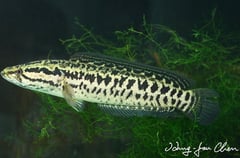
Channa maculataBlotched Snakehead
Lacepède, 1801
The blotched snakehead, Channa maculata, is a snakehead from coastal drainages of southeastern China, including Hong Kong, and northern Vietnam. It is frequently confused with C. argus but has fewer fin rays and lateral line scales and carries 2-3 rounded blotches on the caudal peduncle. An important food fish, it has become established in Japan, Taiwan, the Philippines, Madagascar and Hawaii, and hybrids with C. argus appear to be quite common in aquaculture.
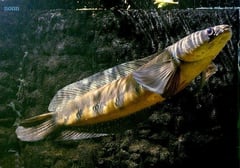
Channa marulioidesEmperor Snakehead
Bleeker, 1851
The emperor snakehead, Channa marulioides, is a large snakehead from southern Thailand, Malaysia and Indonesia, including Borneo and Sumatra. Colour pattern varies with locality, and it is often confused with C. marulius and C. melanoptera, all three presenting taxonomic problems. Growing to 650 mm SL, it is pelagic, turns aggressive towards its own kind at sexual maturity and is suitable only for public installations or the very largest private aquaria.

Channa maruliusBullseye Snakehead
Hamilton, 1822
The bullseye snakehead, Channa marulius, is a large snakehead recorded from Pakistan across southern Asia to southern China, Laos and Vietnam. Also called the 'giant', 'cobra' or 'Indian' snakehead, it is widely accepted to represent a complex of related species in need of further research. Reports of 120-180 cm remain to be proven, with 500-600 mm a more common adult size, and it is suitable only for public installations or the very largest private aquaria.
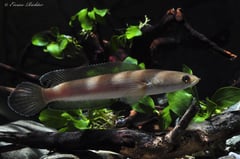
Channa melasomaBlack Snakehead
Bleeker, 1851
The black snakehead, Channa melasoma, is a snakehead from southern Thailand, Peninsular Malaysia, Singapore, Borneo, Sumatra and the Philippines. It can be told apart from the similar C. baramensis, once considered a synonym, by lacking a black spot in the centre of many body scales and a barred caudal fin. In nature it appears to favour clear forest streams with mud and leaf litter, but it has also been recorded from acidic blackwater in peat swamp forest.

Channa micropeltesGiant Snakehead
Cuvier, 1831
The giant snakehead, Channa micropeltes, is a predatory fish from Southeast Asia that grows to well over a metre. Juveniles are sold as 'red' or 'redline' snakehead, but it is suitable only for public installations or the very largest private aquaria. Unlike most Channa species it is pelagic and needs plenty of room to swim, and adults become aggressive at sexual maturity.
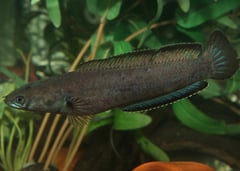
Channa orientalisCeylon snakehead
Bloch & Schneider, 1801
The Ceylon snakehead, Channa orientalis, is a small snakehead without pelvic fins, endemic to the wet zone of southwestern Sri Lanka. Its name has been widely misapplied to Channa populations elsewhere in South and Southeast Asia, most of them now considered C. gachua. Probably endangered in the wild, it is a paternal mouthbrooder that forms lasting pair bonds, and captive breeding should be the priority when keeping it.
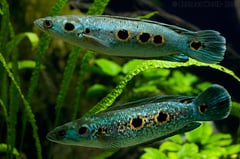
Channa pleurophthalmaOcellated Snakehead
Bleeker, 1851
The ocellated snakehead, Channa pleurophthalma, is a snakehead native to southeastern Sumatra and the Kapuas and Barito basins of Indonesian Borneo. It lives in streams and mangroves and is among the few snakeheads known to form aggregations throughout its life. Unlike most Channa spp. it is pelagic and needs plenty of swimming room, with a tank of at least 240 x 60 cm recommended for a fish reaching 350 mm SL.

Channa sp. 'fire and ice'
authority not recorded
Channa sp. 'fire and ice' is an unidentified snakehead apparently collected in the border region between Myanmar and western Thailand. Named for the red and blue colour pattern on its head, it first appeared in the aquarium trade in 2009 and has also been sold as C. sp. 'cherry'. A paternal mouthbrooder, it has been bred in captivity, and young fish turn highly aggressive towards one another as they mature.

Channa sp. 'five stripe'
authority not recorded
Channa sp. 'five stripe' is an unidentified snakehead apparently collected near Alipurduar in West Bengal, close to India's border with Bhutan. It carries a series of five oblique dark bars on the upper flank and has also been traded as C. sp. 'Kerala', a misnomer since Kerala is in southwestern India. It must not be kept at a constant temperature but given defined winter and summer periods, and it is a paternal mouthbrooder bred fairly regularly in captivity.
Channa stewartiiAssamese Snakehead
(Playfair, 1867)
The Assamese snakehead, Channa stewartii, is a snakehead of the C. gachua group from the Brahmaputra and Ganges basins of India, Bangladesh and Nepal. It is also listed from Bhutan and Myanmar and grows to about 30 cm TL. Keepers give it a cooler winter of about 16-18 °C, it is aggressive towards its own kind, and the male broods the eggs in his mouth.