Channa burmanica
Last revised 2014Edit this page
On this page10 sections
Quick factsEdit
Difficulty5 of 8 measures
- Space
- large tank
- Water
- flexible
- Temp
- needs cool water
- Diet
- unknown
- Temperament
- unknown
- Social
- best in a pair
- Compatibility
- choose tankmates carefully
Other demands
Each of these can raise the rating on its own, whatever the measures above say.
- Hardiness
- unknown
Before you buy
Needs a tight-fitting lid as this species is known to jump
It's essential to use a tightly-fitting hood since Channa spp.
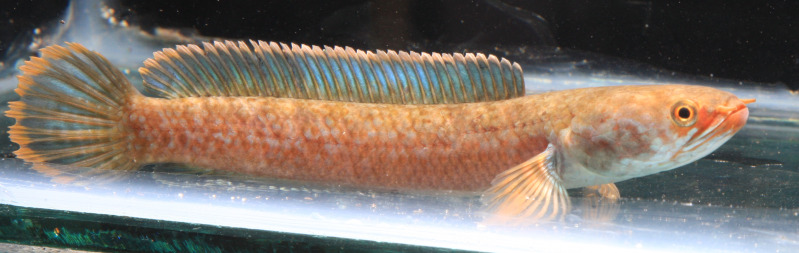
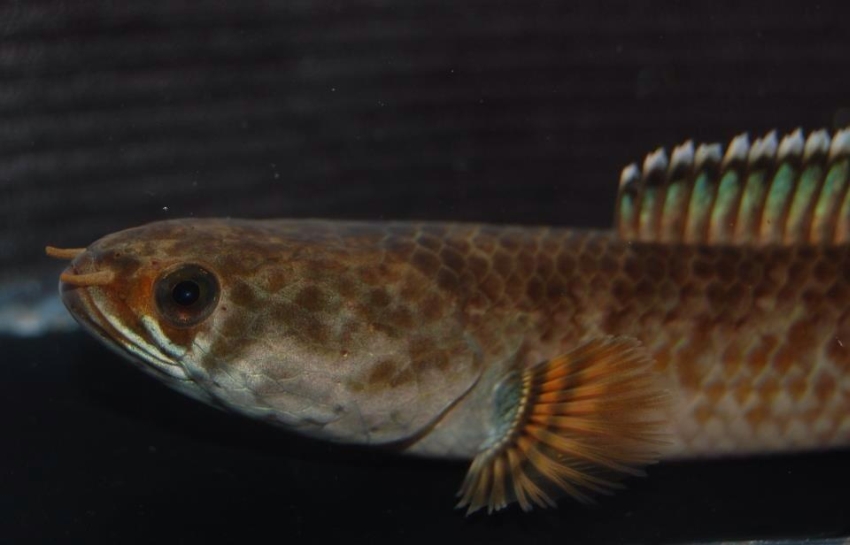
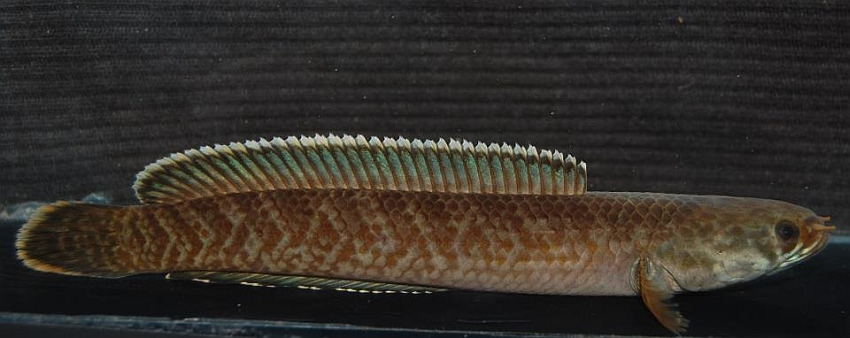
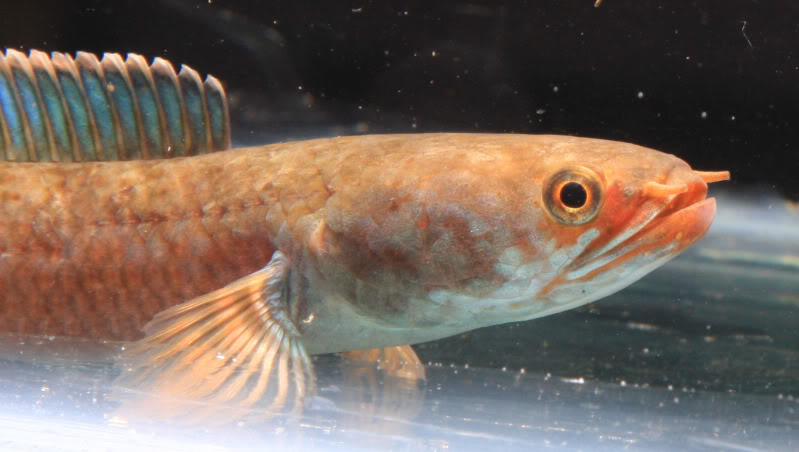
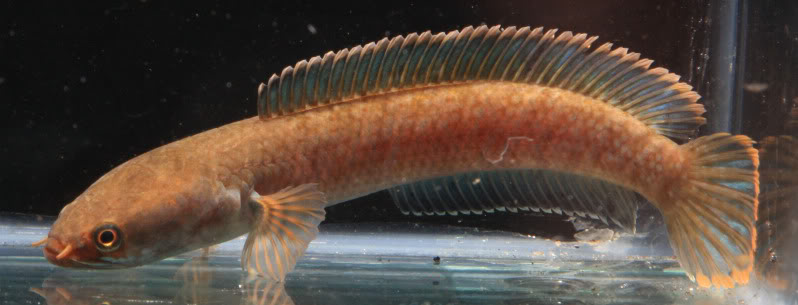
Channa burmanica is a snakehead that appears endemic to the headwaters of the Ayeyarwady in northern Myanmar, known only from the Mali Hka drainage. It is exceptionally rare in the aquarium trade, and its name has been applied to other snakeheads, including an unidentified fish known as C. sp. 'fire and ice'. It lacks pelvic fins, and aquarium specimens suggest orangey-brown patches between the eye and upper lip are typical.
Etymology
EditChanna: from the Latin channe, used to refer to an unspecified species of sea perch.
burmanica: named for Burma, the historic name for the Republic of the Union of Myanmar.
Distribution
EditAppears endemic to headwaters of the of the Ayeyarwaddy/Irrawaddy River in northern Myanmar, between the Kumon and Shan-ngaw mountain ranges, although the full extent of its range is unclear.
Records exist only from the Mali Hka drainage, one of two principal tributaries which join to form the Ayeyarwaddy north of Myitkyina, capital of Kachin state in the far north of the country.
Type locality is 'Sen-Bin-Ti River, Putao plains, Tibetan frontier, northeastern Myanmar', referring to Putao township in Kachin.
Habitat
Write a noteEditFew details are available but Putao is in northern Myanmar, close to the eastern tip of the Himalayas, and surrounded by snow-capped mountains with a monsoon-influenced, humid, subtropical climate.
Average air temperatures range from 13.1 – 25.9 °C56 – 79 °F and there is a pronounced annual wet season between the months of April and October.
Aquarium size
Write a noteEditAn aquarium with base dimensions of at least 120 ∗ 45 cm48 ∗ 18 in is recommended.
Water depth is less important but should not be less than 30 cm.
Maintenance
Write a noteEditPrefers a dimly-lit aquarium with a layer of surface vegetation such as Ceratopteris spp. plus some submerged cover.
It's essential to use a tightly-fitting hood since Channa spp. are notorious for their ability to escape, and a gap should be left between this and the water surface as they require access to a layer of humid air.
Water conditions
EditThese recommendations come from this profile’s own figures. They contain affiliate links, so we may earn a commission.
Diet
Write a noteEditAn obligate predator which probably feeds on smaller fishes and insects in nature but in most cases adapts well to dead alternatives in captivity.
Some specimens even accept dried foods though these should never form the staple diet.
Young fish can be offered chironomid larvae (bloodworm), small earthworms, chopped prawn and suchlike while adults will accept strips of fish flesh, whole prawns/shrimp, mussels, live river shrimp, larger earthworms, etc.
This species should not be fed mammalian or avian meat such as beef heart or chicken since some of the lipids contained in these cannot be properly metabolised by the fish and may cause excess fat deposits and even organ degeneration.
Similarly there is no benefit in the use of 'feeder' fish such as livebearers or small goldfish which carry with them the risk of parasite or disease introduction and at any rate tend not have a high nutritional value unless properly conditioned beforehand.
Notes
EditThis species is exceptionally rare in the aquarium trade although its name has been applied to other members of the genus including an unidentified fish also known as C. sp. 'fire and ice'.
It's one of several genus members to lack pelvic fins and following Chaudhuri (1919) also has 51 lateral line scales, 38 dorsal-fin rays, 28 anal-fin rays, 12 caudal-fin rays, 15 predorsal scales, pectoral-fins with alternating dark and light bands, and white-tipped dorsal and anal fin rays.
Observation of aquarium specimens also suggests that possession of orangey-brown patches of colour between the eye and upper lip on either side of the head is also a typical character in this species.
Members of the family Channidae are commonly referred to as 'snakeheads' due to possession of large scales on the head of most species which are reminiscent of the epidermal scales (cephalic plates) on the heads of snakes.
There currently exist over 30 valid species but diversity within the group is likely to prove significantly greater.
The existence of distinct phylogenetic groups has been proposed with the putative C. gachua species assemblage of Britz (2008) containing C. orientalis, C. gachua, C. bleheri, C. burmanica, C. barca, C. aurantimaculata, and C. stewartii.
Species from northeastern India have also been divided into the C. marulius and C. gachua groups (Vishwanath and Geetakumari, 2009)[3], but C. burmanica was not included in the analysis.
All Channa spp. possess supplementary breathing apparatus in the form of paired suprabranchial chambers located behind and above the gills, although these are not labyrinthic but lined with respiratory epithelium.
These chambers allow the fish to breathe atmospheric air and survive in hypoxic conditions or even out of the water for a considerable period of time, and in aquaria they are often seen rising to the surface to take gulps of air.
References
- Chaudhuri, B. L. (1919). Report on a small collection of fish from Putao (Hkamti Long) on the northern frontier of Burma. Records of the Indian Museum (Calcutta) v. 16 (pt 4), 271-287
- Courtenay, W. R., Jr. and J. D. Williams (2004). Snakeheads (Pisces, Channidae) - a biological synopsis and risk assessment. Circular, U. S. Department of the Interior, Geological Survey No. 1251, i-v + 1-143
- Vishwanath, W. and Kh. Geetakumari (2009). Diagnosis and interrelationships of fishes of the genus Channa Scopoli (Teleostei: Channidae) of northeastern India. Journal of Threatened Taxa 1(2), 97- 105
- Britz, R. (2008). Channa ornatipinnis and C. pulchra, two new species of dwarf snakeheads from Myanmar (Teleostei: Channidae). Ichthyological Exploration of Freshwaters 8(4) [for 2007], 335-344
- Brede, N. and P. Antler (2009). Schlangenkopffische—Die Gattungen Channa und Parachanna. Natur und Tier Verlag, Münster, 62 pp.
Species images · 5
These photographs are used with each photographer's permission.
Send a photographDistribution
Profile completeness18 of 24
75% complete
Also missing: a common name, water condition notes, behaviour and compatibility, sexual dimorphism, reproduction.
Community
Questions about Channa burmanica?
Ask on Discord