Hobbyist group · Other groups
Gymnotiformes
Gymnotiformes spans 2 families.
- Species
- 4
- Families
- 2
- Genera
- 3
- Photographed
- 4 of 4
- Difficulty rated
- 4 of 4
Families
Where they come fromnative records only
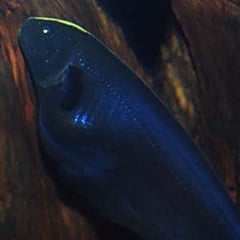
Apteronotus albifronsBlack Ghost Knifefish
Apteronotidae · (Linnaeus, 1766)
The black ghost knifefish, Apteronotus albifrons, is a weakly electric knifefish from the upper half of South America, from Colombia to Paraguay. Usually sold at around 4 inches, it grows to 50 cm and needs a long-term housing plan. Its eyesight is very poor, and it navigates, finds prey and communicates using a weak electric field. In the wild it lives in swiftly flowing streams and rivers over sand.
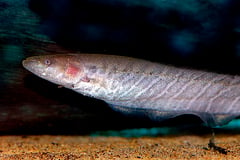
Gymnotus carapoBanded Knifefish
Gymnotidae · authority not recorded
The banded knifefish, Gymnotus carapo, is a gymnotid knifefish recorded across Central and South America, from Mexico to Argentina. Several species once considered G. carapo have been described since 1994, and its massive natural range will likely turn out to be far more restricted. It uses a weak electric field to navigate and communicate, and a modified swimbladder acts as an accessory breathing organ. It grows to 60 cm and is sensitive to many medications, particularly copper.
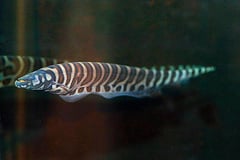
Gymnotus pedanopterusZebra Knifefish
Gymnotidae · authority not recorded
The zebra knifefish, Gymnotus pedanopterus, is a gymnotid knifefish from Peru and Brazil, one of over 20 Gymnotus species described since 1994. It grows to at least 28 cm and inhabits sluggish or still, turbid waters. Like other gymnotids it produces a weak electric field that it uses to navigate and communicate, and it is sensitive to many aquarium medications, particularly those containing copper.
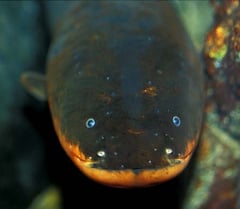
Electrophorus electricusElectric Eel
Gymnotidae · authority not recorded
The electric eel, Electrophorus electricus, is a nocturnal predator from Venezuela, Guyana, Suriname, French Guiana, Peru and Brazil. Up to 80% of its body holds electricity-producing organs: a weak field lets it navigate and locate prey despite very poor eyesight, and bursts of over 600 volts stun prey and can disable a human. It grows to 250 cm and is best kept singly and alone.