Country · South America
Ecuador
Only species with a profile on Seriously Fish are counted, whether native or introduced.
- Species
- 44
- Families
- 22
- Genera
- 37
- Found only here
- 0
- Photographed
- 43 of 44
Shares its fishes withspecies recorded in both
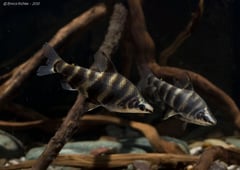
Abramites hypselonotusMarbled Headstander
Anostomidae · Günther, 1868
The marbled headstander, Abramites hypselonotus, is an anostomid from the Amazon, Orinoco and Paraguay-Paraná basins in South America. An ecological generalist, it occurs in turbid main river channels, minor tributaries and backwaters, and enters inundated zones during the annual floods. Best kept as a group in a large tank alongside cichlids, characins and catfishes, it may nip long or trailing fins and eat soft-leaved plants.
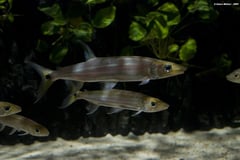
Acestrorhynchus falcirostrisBig-Eyed Cachorro
Acestrorhynchidae · Cuvier, 1819
The big-eyed cachorro, Acestrorhynchus falcirostris, is a large predatory acestrorhynchid from northern Amazon drainages and the Orinoco. The two dark body stripes of the A. nasutus group appear only in its juveniles, and at 320 to 350 mm SL it grows far larger than the other members. A black fringe to the rear of the operculum gives it a 'collared' look. It needs open water, and a group must be of comparable size because acestrorhynchids are cannibalistic.
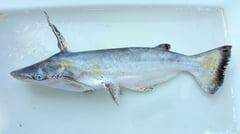
Ageneiosus inermisManduba
Auchenipteridae · Linnaeus, 1766
The manduba, Ageneiosus inermis, is a large auchenipterid catfish found throughout much of South America east of the Andes. At around 470 mm SL it would need an aquarium in excess of 400 x 120 cm as an adult and is largely unsuitable for private aquaria. An obligate carnivore, it can take surprisingly large prey, and the larger Ageneiosus species are often used as food fishes in their native countries.
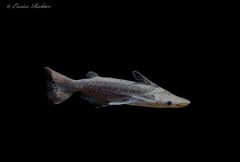
Ageneiosus marmoratusBottlenose Catfish
Auchenipteridae · Eigenmann, 1912
The bottlenose catfish, Ageneiosus marmoratus, is a predatory auchenipterid catfish from Guyana, Suriname and the upper Amazon in Peru and Ecuador. Also sold as 'Guyana slopehead', 'dolphin' or 'hammerhead' catfish, it loses much of its black-blotched juvenile patterning as it grows. Surprisingly peaceful with anything too large to swallow, it is active and sometimes skittish, and needs a tank of at least 150 x 60 cm.
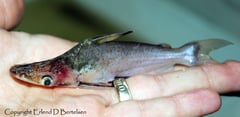
Ageneiosus ucayalensisDuck Catfish
Auchenipteridae · Castelnau, 1855
The duck catfish, Ageneiosus ucayalensis, is an auchenipterid catfish described from Peru and recorded across the Amazon, Orinoco and Guianas. Body patterning apparently varies with locality, and fish from black water habitats, particularly on the Guiana Shield, tend to be darker. Growing to around 290 mm SL and capable of taking large prey, it is safe only with similarly sized catfishes or large pelagic characins, mostly a combination for public aquaria.

Andinoacara rivulatusGreen Terror Cichlid
Cichlidae · Günther, 1860
The green terror cichlid, Andinoacara rivulatus, is a large cichlid from extreme northern Peru and the coastal drainages of western Ecuador. Generally aggressive and territorial, it is best kept alone or as a mated pair unless the tank is enormous. Males grow substantially larger than females and develop a nuchal hump when mature. Fish from the northern end of its range may represent a different species.
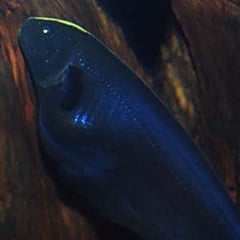
Apteronotus albifronsBlack Ghost Knifefish
Apteronotidae · (Linnaeus, 1766)
The black ghost knifefish, Apteronotus albifrons, is a weakly electric knifefish from the upper half of South America, from Colombia to Paraguay. Usually sold at around 4 inches, it grows to 50 cm and needs a long-term housing plan. Its eyesight is very poor, and it navigates, finds prey and communicates using a weak electric field. In the wild it lives in swiftly flowing streams and rivers over sand.
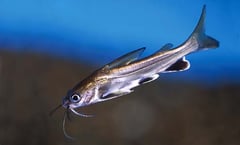
Ariopsis seemanniColombian Shark Catfish
Ariidae · Günther, 1864
The Colombian shark catfish, Ariopsis seemanni, is an ariid catfish from river mouths along the Pacific coast of the Americas, from Mexico to Peru. Usually sold as a silvery 2 to 3 inch juvenile, it grows to 350 mm SL and lives mostly in brackish water, so it is not recommended to those lacking the facilities to house it for life. Venom glands at the base of the first dorsal spine can cause a painful swelling.

Astronotus ocellatusOscar
Cichlidae · Agassiz, 1831
The oscar, Astronotus ocellatus, is a large cichlid widely distributed in the Amazon region, recorded from Colombia and Venezuela south to Argentina. It grows to 350 mm SL and typically lives 10 to 20 years, both of which need taking into account before purchase. Most fish on sale come from commercial breeders in Eastern Europe or the Far East, in numerous ornamental strains, and genetic analyses suggest the genus contains additional, morphologically cryptic species.

Astyanax bimaculatusTwo Spot Astyanax
Characidae · Linnaeus, 1758
The two spot astyanax, Astyanax bimaculatus, is a characid ranging from Panama through most of the Amazon and Orinoco basins. It lives in a wide variety of biotopes, from swiftly-flowing rivers and streams to ponds, ditches and reservoirs. The name is currently applied to what is considered a species complex of at least four taxa, and aquarium fish most often arrive as contaminants among shipments of other species.
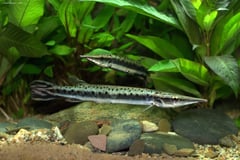
Boulengerella maculata
Ctenoluciidae · Valenciennes, 1850
Boulengerella maculata is a pelagic ctenoluciid found throughout much of the Amazon, Orinoco and Tocantins river systems. Colour pattern varies considerably, with some specimens much paler than others, and this may be correlated with water type. Random dark spots on the upper body, and a dark stripe only behind the eye when one is present, separate it from the similar B. lateristriga. It reaches 329 mm SL and needs an aquarium with base dimensions of 240 by 90 cm or more.
Brochis leopardusLeopard Cory
Callichthyidae · (Myers, 1933)
The leopard cory, Brochis leopardus, long known as Corydoras leopardus, is a spotted armoured catfish from the western Amazon basin in Peru, Ecuador, Bolivia and Brazil. It looks very like Hoplisoma julii and H. trilineatum, but has a longer, more pointed snout and grows larger. Dias et al. (2024) moved it to the genus Brochis and put the two lookalikes in Hoplisoma, so the resemblance does not reflect a close relationship. The type specimens were aquarium imports.
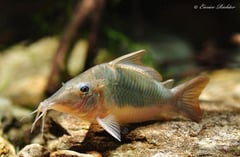
Brochis multiradiataHognose 'Brochis'
Callichthyidae · (Orcés V., 1960)
Known in the hobby as the hognose 'Brochis', Brochis multiradiata, long known as Corydoras multiradiatus, is an armoured catfish from the northwestern Amazon basin in Ecuador and Peru. Formerly placed in Brochis, it has an extended snout and 17-18 dorsal-fin rays, against 6-8 in other Corydoras. Little is known of its habitat, but it is likely to live in smaller tributaries and still waters such as backwaters and oxbows, as closely related species do.
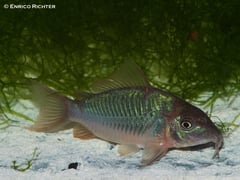
Brochis splendensEmerald 'Brochis'
Callichthyidae · (Castelnau, 1855)
The emerald 'brochis', Brochis splendens, long known as Corydoras splendens, is an armoured catfish recorded throughout much of the Amazon basin in Brazil, Peru, Ecuador and Colombia. It is sometimes called the 'common brochis', and juveniles are sometimes traded as 'hi-fin cory' for their enlarged dorsal fin. Its 10 to 12 dorsal-fin rays separate it from B. britskii and B. multiradiata, the other two species long kept in Brochis, and certain populations are thought likely to represent distinct species.
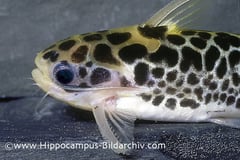
Centromochlus perugiaeOil Catfish
Auchenipteridae · authority not recorded
The oil catfish, Centromochlus perugiae, is a small auchenipterid catfish from Peru and Ecuador. It lives around the shorelines of swift-flowing rivers with sandy substrates and no aquatic plants. By day it squeezes into spaces little bigger than itself, emerging in the evening to feed close to the surface in the flow. It breeds quite easily given strong flow and plenty of small crevices.
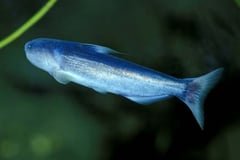
Cetopsis coecutiensBlue Whale Catfish
Cetopsidae · authority not recorded
The blue whale catfish, Cetopsis coecutiens, is a cetopsid catfish from the Amazon, Tocantins and Orinoco river basins. In the wild it swims in voracious feeding groups, homing in on weakened fish by smell and burrowing into prey. It will bite chunks out of tankmates much bigger than itself, so it is best kept alone, and at up to 26.5 cm it needs a large tank with strong water flow and dim lighting.
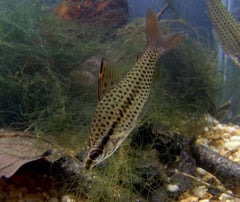
Chilodus punctatusSpotted Headstander
Chilodontidae · Müller & Troschel, 1844
The spotted headstander, Chilodus punctatus, is a headstander from much of the Amazon, the western Orinoco and coastal rivers of Guyana and Suriname. Also called the 'checkered headstander', it lives in slow-moving rivers, oxbows and floodplain lakes, and its colour pattern appears to vary with locality. Shy and peaceful, it is sensitive to dissolved organic wastes and should never be introduced to a biologically-immature aquarium.

Cichlasoma festaeRed Terror
Cichlidae · authority not recorded
The red terror, Cichlasoma festae, is a large, territorial cichlid from the Rio Esmeraldas in Ecuador and the Rio Tumbes in Peru. Males reach around 20 inches and females 12, and anything the fish can fit in its large mouth will be seen as food. Pairing is troublesome, since the weaker fish of an incompatible pair is likely to be killed, so a pair is best grown on from six juveniles. An introduced population also exists in Singapore.

Colomesus asellusAmazon Puffer
Tetraodontidae · Müller & Troschel, 1849
The Amazon puffer, Colomesus asellus, is a freshwater puffer found throughout much of the Amazon basin, with records north to Guyana and Venezuela. Also traded as the South American puffer or 'SAP', it is told from congeners by a transverse row of dermal flaps across the chin. It lives mostly in well-oxygenated river habitats, is intolerant of organic waste, and forms loose aggregations, so a group of 6 or more is best, away from the general community.
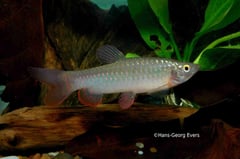
Copeina guttataRed-spotted Tetra
Lebiasinidae · Steindachner, 1876
The red-spotted tetra, Copeina guttata, is a lebiasinid from the middle and upper Amazon basin in Brazil, Peru, Ecuador and Colombia. Reaching 76 mm, it needs a tank of at least 120 x 30 cm. The eggs are apparently deposited in a shallow depression dug in the substrate and guarded by the male. Like many fishes from pristine environments it is intolerant of organic pollutants and requires spotless water.
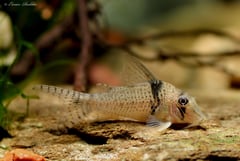
Corydoras pastazensisPastaza Cory
Callichthyidae · Weitzman, 1963
The Pastaza cory, Corydoras pastazensis, is an armoured catfish from the upper Río Pastaza basin in Ecuador and the ríos Ucayali and Puinahua in Peru. The Río Tigre form was raised to species status as C. orcesi, a decision not followed by all authorities. The two are relatively easy to tell apart: in C. pastazensis the dark vertical bar breaks up or tapers off low on the body, and the body is peppered with numerous small dark spots.
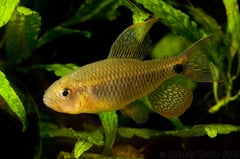
Crenuchus spilurusSailfin Characin
Crenuchidae · Günther, 1863
The sailfin characin, Crenuchus spilurus, is a crenuchid from much of the Amazon and Orinoco drainages and coastal rivers of the Guianas. The only described member of its genus, it varies considerably in colour pattern and morphology across that range. It lives in tea-stained forest streams, and its timid, predominantly benthic nature means it does not always make an ideal community fish. Males guard eggs laid on the roof of a small cave, often formed from leaf litter.
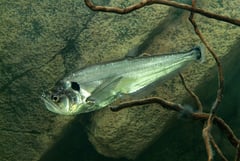
Cynodon gibbus
Cynodontidae · Agassiz, 1829
Cynodon gibbus is a cynodontid from much of the Amazon basin, the middle and lower Orinoco, and the Rupununi River in Guyana. A pelagic fish of main river channels and larger tributaries, it grows to around 280 mm SL. It is rare in the trade but arguably more suitable for the home aquarium than some of its better-known relatives, given its size and relatively docile behaviour. Being easily dominated, it is best kept alone or with similarly sized, non-aggressive fishes.
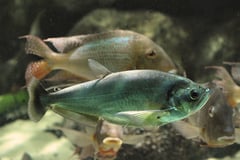
Hydrolycus scomberoidesVampire Tetra
Cynodontidae · Cuvier, 1819
The vampire tetra, Hydrolycus scomberoides, is a predatory dogtooth characin from the central and upper Amazon in Brazil, Bolivia, Peru and Ecuador. Also sold as 'scomb' and 'sabre tooth tetra', it is regularly confused with the much larger payara, H. armatus. At up to 300 mm it still needs a huge tank and specialist care, and newly-imported specimens often refuse anything but live food.

Hyphessobrycon loretoensisLoreto Tetra
Characidae · Ladiges, 1938
The Loreto tetra, Hyphessobrycon loretoensis, is a small characid from the upper Amazon basin in Colombia, Peru and Ecuador. It is relatively popular in the hobby, but most traded fish are wild-caught, so availability can be sporadic. Most records are from forest streams and minor tributaries with tea-coloured water, overhanging vegetation and leaf litter.

Iguanodectes spilurusGreen Line Lizard Tetra
Iguanodectidae · Günther, 1864
The green line lizard tetra, Iguanodectes spilurus, is a characin found throughout the Amazon, Orinoco, Essequibo and Tocantins river systems. The most widespread Iguanodectes species, it has also been called the 'slender', 'spindle' or 'iguana' tetra, and differs from its congeners in its translucent dorsal and anal fins, lack of a red lateral stripe and prominent dark caudal-fin marking. It is sensitive to poor water conditions.
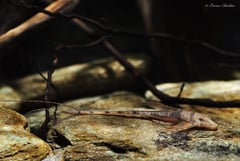
Lamontichthys filamentosusSturgeon Catfish
Loricariidae · La Monte, 1935
The sturgeon catfish, Lamontichthys filamentosus, is a loricariid from the central and western Amazon in Brazil, Peru, Ecuador and Bolivia. Above 60 mm SL the pectoral-fin spine extends into a filament that can be over four times the length of the first branched ray, and the dorsal-fin spine carries a similar extension. Relatively common in the hobby but not easy to maintain, it needs clean, well-oxygenated water and a mature aquarium with plenty of algae-covered surfaces.
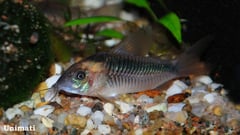
Osteogaster zygataBlack Band Cory
Callichthyidae · (Eigenmann & Allen, 1942)
The black band cory, Osteogaster zygata, long known as Corydoras zygatus, is an armoured catfish from the middle Río Marañón watershed in eastern Ecuador and northern Peru. Also known in the trade as the 'zygus cory', it looks very similar to O. rabauti. In O. zygata the broad dark stripe on the upper body stops short of the lower caudal peduncle, and in O. rabauti it extends onto it.
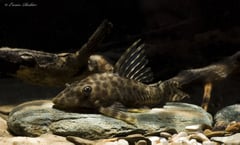
Peckoltichthys bachiL146
Loricariidae · (Boulenger, 1898)
The bola pleco, Peckoltichthys bachi, is a loricariid catfish from the upper Amazon region in Brazil, Colombia, Ecuador and Peru. It has been assigned several L-numbers, including L146 from Colombia and L232 from the Río Putumayo/Içá, and has been exported under other generic names including Hemiancistrus and Sophiancistrus. Its mottled colour pattern separates it from most Peckoltia species, and it lives among submerged grasses and branches in flowing water along the margins of medium to large rivers.
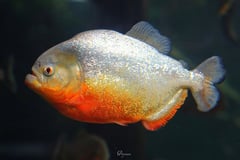
Pygocentrus nattereriRed Bellied Piranha
Serrasalmidae · Kner, 1858
The red bellied piranha, Pygocentrus nattereri, occurs through much of the Amazon basin and south into the Paraná and Uruguay river systems. Famed as a rapacious predator, it is among the most notorious freshwater fishes in the world. According to Herbert Axelrod (1976), the myth began with a feeding frenzy staged for Theodore Roosevelt in Brazil in 1913. Usually only juveniles form aggregations, and the species is relatively easy to breed in the aquarium.

Satanoperca jurupariDemon Eartheater
Cichlidae · Heckel, 1840
The demon eartheater, Satanoperca jurupari, is a cichlid recorded throughout much of the Amazon basin in Brazil, Bolivia, Peru, Ecuador and Colombia. In aquarium literature it is frequently confused with S. leucosticta, which has prominent white spots or vermiform markings on the sides of the head. Its precise identity is a confusing issue, and populations from the Tapajós, Xingu, Araguaia and Paraná are genetically distinct and may represent separate species.
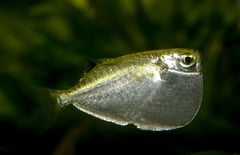
Thoracocharax stellatusSpotfin Hatchetfish
Gasteropelecidae · Kner, 1858
The spotfin hatchetfish, Thoracocharax stellatus, is the most widespread neotropical hatchetfish, recorded from much of South America. It is told from its only congener, T. securis, by a prominent dark spot in the dorsal fin, and is sometimes traded as 'platinum hatchetfish'. It feeds almost entirely on insects, and a tightly fitting cover is needed because it can clear several metres in one jump.

Aequidens tetramerusSaddle Cichlid
Cichlidae · Heckel, 1840
The saddle cichlid, Aequidens tetramerus, is a cichlid found across much of northern South America, from the Amazon and Orinoco basins to the Guianas. The type species of its genus, it occurs in several colour forms, and fish from Ecuador and Peru are sought after for the red or orange colouration on the lower head and belly. As currently recognised it is likely to represent a group of related fishes, some of which may be described as distinct species.
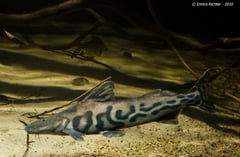
Brachyplatystoma juruenseGold Zebra Catfish
Pimelodidae · Boulenger, 1898
The gold zebra catfish, Brachyplatystoma juruense, is a large pimelodid from the middle Amazon and Orinoco basins, described from the rio Juruá. Adults have broad dark vertical, oblique or branching bands on a pale yellowish body and grow to at least 600 mm. It is sometimes confused with B. tigrinum, especially when young, but has a much less defined pattern, a deeper body and shorter barbels. It suits only public aquaria and a very small minority of private aquarists.
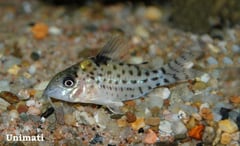
Brochis ambiacus
Callichthyidae · (Cope, 1872)
Brochis ambiacus, long known as Corydoras ambiacus, is an armoured catfish from the upper Amazon tributaries of Peru, Brazil, Colombia and Ecuador, described from the Río Ampiyacu. Its name is commonly misapplied to similar-looking fishes, particularly B. agassizii, and the colour pattern is variable. Cope described a large black spot covering the front half of the dorsal fin, and fish matching this are far more common in the trade than those matching B. agassizii.
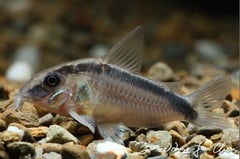
Brochis arcuataSkunk Cory; C020
Callichthyidae · (Elwin, 1938)
The skunk cory, Brochis arcuata, long known as Corydoras arcuatus, is an armoured catfish from the upper Amazon region in Brazil, Peru, Ecuador and Colombia. It is among the more popular Corydoras in the hobby and is also known as the 'arched cory' or C020. Several similar-looking congeners exist, particularly Hoplisoma urucu, in which the black body stripe ends behind the eye, and the larger C. narcissus from the rio Purus.
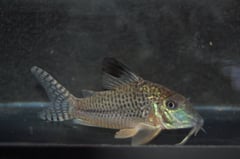
Corydoras acutusBlacktop Cory
Callichthyidae · Cope, 1872
The blacktop cory, Corydoras acutus, is an armoured catfish from the upper Amazon basin in Brazil, Peru, Ecuador and possibly Bolivia. It can be confused with three similar fishes known as C024, C077 and C109. C024 and C109 occur thousands of kilometres outside its range, but C077 lives alongside it in the rio Abunã and is only known to differ in growing smaller. Some specimens lack the dark marking in the dorsal fin.
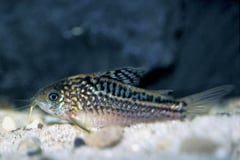
Gastrodermus elegansElegant Cory
Callichthyidae · (Steindachner, 1876)
The elegant cory, Gastrodermus elegans, long known as Corydoras elegans, is an armoured catfish from the western Amazon basin in Peru, Ecuador and Brazil. Unlike most congeners it spends a fair amount of time away from the substrate, often forming groups in midwater. It gives its name to the unofficial 'C. elegans group' of similar species, which includes G. nanus and G. undulatus plus many C- and CW-numbered fishes of uncertain status.
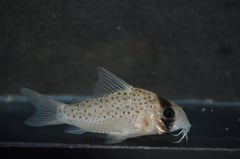
Hoplisoma atropersonatumFairy Cory
Callichthyidae · (Weitzman & Nijssen, 1970)
The fairy cory, Hoplisoma atropersonatum, long known as Corydoras atropersonatus, is an armoured catfish known only from the Tigre and Nanay drainages in Ecuador and Peru. It is sometimes confused with Brochis sychri, a more elongate fish with a longer snout, and more closely with C097, traded as C. sychri 'longnose'. C097 has a snout of intermediate length and better-defined, more widely spaced dark spots.
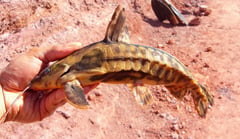
Megalodoras uranoscopusGiant Raphael Catfish
Doradidae · authority not recorded
The giant Raphael catfish, Megalodoras uranoscopus, is a large doradid recorded from the Essequibo, Tocantins and Amazon river systems. It is also known in the US as the 'ripsaw catfish', and older literature often refers to it as M. irwini, now a junior synonym. Growing to 600 to 700 mm, it is very peaceful and can be combined with many other species in suitably sized systems.
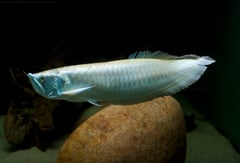
Osteoglossum bicirrhosumSilver Arowana
Osteoglossidae · Cuvier, 1829
The silver arowana, Osteoglossum bicirrhosum, is a large predator from the Amazon basin, plus river systems in Guyana and French Guiana. Reaching 80 cm, it is largely unsuitable for the home aquarium, and although juveniles are readily available, few private aquarists can house an adult long-term. Juveniles have a single dark lateral stripe, while in those of its only congener, O. ferreirai, most of the body and fins are dark.
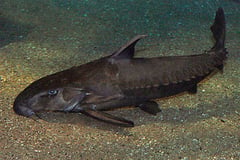
Oxydoras nigerRipsaw Catfish
Doradidae · authority not recorded
The ripsaw catfish, Oxydoras niger, is a large doradid catfish from many of the major river systems of northern South America. Reaching 90 cm, it is only for the experienced fishkeeper and best suited to public aquaria. Much more peaceful than its common name suggests, it takes that name from the spines along the lateral line. It was previously referred to Pseudodoras niger.
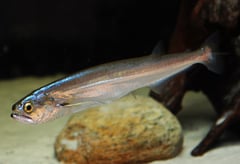
Rhaphiodon vulpinusBiara
Cynodontidae · Spix & Agassiz, 1829
The biara, Rhaphiodon vulpinus, is a dogtooth characin found from the Orinoco and Amazon basins south to the Río de la Plata in Argentina. The only member of its genus, it grows to 600 to 800 mm and is an obligate piscivore, and it is suitable only for public installations or the very largest private aquaria. Juveniles are seen for sale quite regularly, most often without adequate information on their long-term care.
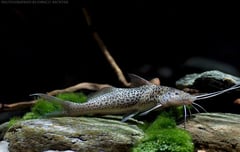
Aguarunichthys torosusBolt Catfish
Pimelodidae · Stewart, 1986
The bolt catfish, Aguarunichthys torosus, is a pimelodid catfish known only from the Río Marañón in the upper Amazon basin of Peru. It probably also occurs in some tributaries draining into Peru from Ecuador. Also traded as 'Jello Band' or 'Yellow Band' catfish, it eats fishes small enough to fit in its mouth and is aggressively territorial towards conspecifics, so is best kept singly among larger, ideally fluvial, species.