Hobbyist group · Other groups
Osteoglossiformes
Osteoglossiformes spans 5 families.
- Species
- 16
- Families
- 5
- Genera
- 10
- Photographed
- 14 of 16
- Difficulty rated
- 16 of 16
Families
Where they come fromnative records only
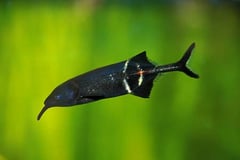
Gnathonemus petersiiElephantnose Fish
Mormyridae · authority not recorded
The elephantnose fish, Gnathonemus petersii, is a mormyrid with a vast African range, recorded in ten countries from Mali and Benin to Zambia. It uses its 'trunk' to find food hidden in the substrate, so it needs a soft substrate, and it needs dim lighting. Like other mormyrids it produces a weak electric field that it uses to navigate, hunt and communicate. It is very sensitive to deteriorating water conditions and to many medications, including salt.
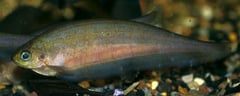
Xenomystus nigriAfrican Knifefish
Notopteridae · authority not recorded
The African knifefish, Xenomystus nigri, is a notopterid recorded from numerous African rivers, including the Nile, Congo and Niger systems. Its swim bladder acts as an accessory breathing organ, and it rises to the surface periodically to gulp air, often with a bell-like sound. Often confused with the far more aggressive Asian knifefish, Notopterus notopterus, it lacks the dorsal fin present in its Asian relative. A scaleless species, it is very sensitive to medications.
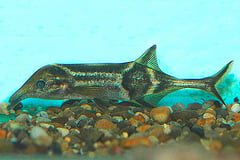
Campylomormyrus tamanduaWorm-Jawed Mormyrid
Mormyridae · authority not recorded
The worm-jawed mormyrid, Campylomormyrus tamandua, is a benthic mormyrid recorded from nine countries in West and Central Africa. It sometimes arrives among imports of the elephant fish, Gnathonemus petersii, but has both jaws extended into a beak-like shape. It needs pristine soft, acidic water, generally refuses standard foods and grows to 400 mm SL. Like other mormyrids it produces a weak electric field, used to navigate and to communicate.
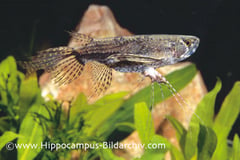
Pantodon buchholziAfrican Butterfly Fish
Pantodontidae · authority not recorded
The African butterfly fish, Pantodon buchholzi, is a surface-dwelling osteoglossiform from still and slow waters in West and Central Africa. The only member of its genus and family, it takes its name from the large pectoral fins, which make it look like a dead leaf at the surface and power leaps of several metres. It is quite inactive when not feeding, will eat any fish it can fit in its mouth, and needs a tightly fitting cover.
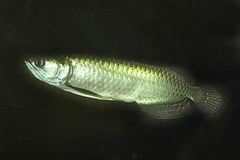
Scleropages jardiniiAustralian Arowana
Osteoglossidae · authority not recorded
The Australian arowana, Scleropages jardinii, is an osteoglossid from still and slow-moving waters in Australia, Papua New Guinea and Indonesia. Known in Australia as the gulf saratoga or northern-spotted barramundi, it has smaller scales, a bronze base colour and duller patterning than the Asian species. It is widely considered the most aggressive arowana in aquaria, and some individuals will not tolerate any tankmates.
Scleropages leichardtiSpotted Australian Arowana
Osteoglossidae · authority not recorded
The spotted Australian arowana, Scleropages leichardti, is an osteoglossid endemic to the Fitzroy River system of north-eastern Queensland, Australia. Known there as the spotted or southern saratoga, it differs from S. jardinii in its spotted scales, forward-pointing barbels, unpatterned gill covers and silver base colour. Indonesia classes it as protected even though it has never been recorded there, probably through misidentified S. jardinii. The species is rare in the hobby.
Gymnarchus niloticusAba Aba
Gymnarchidae · authority not recorded
The aba aba, Gymnarchus niloticus, is a large predatory fish from much of the northern half of Africa, and the only species in its genus. An extended dorsal fin gives it the alternative name upside-down knifefish, although it is more closely related to the mormyrids, and it uses a weak electrical discharge to navigate and communicate. Growing to 165 cm and extremely aggressive, it is simply not suited to the home aquarium in any respect.
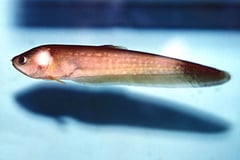
Papyrocranus aferArowana Knifefish
Notopteridae · authority not recorded
The arowana knifefish, Papyrocranus afer, is a notopterid knifefish widespread over much of western and central Africa, from Senegal to Sudan. Its anal and caudal fins are fused into one long, undulating fin. Infrequently imported, it grows to 80 cm and becomes increasingly territorial as it matures, so it is recommended only to the experienced fishkeeper and best kept as a single specimen.

Chitala blanciRoyal Featherback
Notopteridae · d'Aubenton, 1965
The royal featherback, Chitala blanci, is a very large notopterid endemic to the Mekong drainage in Laos, Thailand, Vietnam and Cambodia. Also sold as the 'royal knifefish', it reaches 1200 mm SL and arguably has no place in the ornamental hobby, being suitable only for public installations or the very largest private aquaria. Many small dark spots on the front of the body merge into oblique stripes, and it is thought to be threatened by dam construction.

Chitala chitalaIndian Featherback
Notopteridae · Hamilton, 1822
The Indian featherback, Chitala chitala, is a very large notopterid probably restricted to Pakistan, India, Nepal and Bangladesh. Its name has been widely misapplied in the trade, most often to the Southeast Asian C. ornata, but it is very rarely exported for aquaria and is fished and cultured for food in India. Growing to 1220 mm SL, it has non-ocellated black spots above the anal fin and is the only Chitala normally showing gold or silver bars on the back.

Chitala lopisGiant Featherback
Notopteridae · Bleeker, 1851
The giant featherback, Chitala lopis, is a notopterid accepted to range from the Mekong basin to Peninsular Malaysia, Sumatra, Borneo and Java. That range appears to require confirmation: it may already be extinct on Java, and the species may comprise several closely-related taxa. Older juveniles and adults lack the dark body markings of other Chitala and have a more pronounced jaw, and at up to 1500 mm SL it is suitable only for public installations or the very largest private aquaria.

Chitala ornataClown Featherback
Notopteridae · Gray, 1831
The clown featherback, Chitala ornata, is a large notopterid native to the Mae Klong, Chao Phraya and Mekong river systems of Thailand and Indochina. Also traded as the 'clown knifefish', it has rows of large ocellated spots above the anal-fin base and is regularly misidentified as C. chitala. It grows to 1000 mm SL and arguably has no place in the ornamental hobby, yet it remains popular, with albino and leucistic forms line-bred for the purpose.

Notopterus notopterusBronze Featherback
Notopteridae · Pallas, 1769
The bronze featherback, Notopterus notopterus, is an air-breathing notopterid from the Indian subcontinent and Southeast Asia. Also called 'Asian knifefish' or 'ghost knifefish' in the trade, it grows to 600 mm and arguably has no place in the ornamental hobby given its adult size and specialised requirements. The single species in Notopterus is likely to represent a complex of closely-related species.
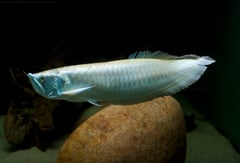
Osteoglossum bicirrhosumSilver Arowana
Osteoglossidae · Cuvier, 1829
The silver arowana, Osteoglossum bicirrhosum, is a large predator from the Amazon basin, plus river systems in Guyana and French Guiana. Reaching 80 cm, it is largely unsuitable for the home aquarium, and although juveniles are readily available, few private aquarists can house an adult long-term. Juveniles have a single dark lateral stripe, while in those of its only congener, O. ferreirai, most of the body and fins are dark.

Scleropages formosusAsian Arowana
Osteoglossidae · Müller & Schlegel, 1840
The Asian arowana, Scleropages formosus, is an osteoglossid from the Mekong system, eastern Thailand, Peninsular Malaysia, Sumatra and Borneo. Highly valued in the aquarium trade since the 1970s and listed on Appendix I of CITES since 1975, it is now extirpated across much of its range. It occurs in several colour forms, such as the 'super red' of the upper Kapuas, and three were described as species in 2003, though the majority view treats all of them as S. formosus pending review.

Scleropages inscriptus
Osteoglossidae · Roberts, 2012
Scleropages inscriptus is an osteoglossid said to come from the Tenasserim river basin in Tananthayi Region, southern Myanmar. Its distribution is unclear, and the type specimens were obtained dead from an aquarium fish vendor. Distinctive angulated linear markings on the head and flanks separate it from other members of the genus. The largest of the type series measured 385 mm, but it can apparently attain about 600 mm.