River
Chittar
Only species with a profile on Seriously Fish are counted.
- Species
- 4
- Families
- 4
- Photographed
- 4 of 4
- Difficulty rated
- 4 of 4
Shares fishes withspecies recorded from both
Runs through

Barilius bakeri
Cyprinidae · Day, 1865
Barilius bakeri is a fast-swimming cyprinid endemic to the Western Ghats of southwestern India, with records from many rivers in Kerala and Karnataka. It is traded as 'royal danio', 'blue-spotted hill trout' and 'blue-dotted mirror fish', and has a single row of bluish-green spots that get smaller with age. Its well-oxygenated, fast-flowing rivers are being polluted and degraded by exotic species and sand mining.

Batasio travancoriaMalabar Batasio
Bagridae · Hora & Law, 1941
The Malabar batasio, Batasio travancoria, is a bagrid catfish endemic to southern Kerala, India, in the Pamba, Chittar and Kallada drainages. Its darkish midlateral stripe and poorly-defined post-opercular spot separate it from B. sharavtiensis, the only other described member of the genus in southwestern India. Like its congeners it is an obligate inhabitant of shallow, fast-flowing, highly-oxygenated headwater streams.
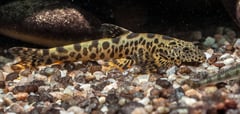
Bhavania australis
Balitoridae · Jerdon, 1849
Bhavania australis is a balitorid loach endemic to the Western Ghats mountains of southern India, recorded from Kerala, Tamil Nadu and Karnataka. An obligate dweller of shallow, fast-flowing, highly-oxygenated headwaters and minor tributaries, it has a flattened head and body and horizontally extended paired fins that form a powerful sucking cup for clinging to rocks. It is very rarely seen in the international aquarium trade but is maintained by a number of Indian aquarists.

Channa diplogrammaMalabar Snakehead
Channidae · Day, 1865
The Malabar snakehead, Channa diplogramma, is a large snakehead endemic to the southern Western Ghats in Kerala and Tamil Nadu, India. Treated as a synonym of the Indochinese C. micropeltes for over a century, it was revalidated in 2011 and has 103-105 lateral line scales, more than any other Channa. Its colour pattern changes markedly with age, and unlike most snakeheads it is pelagic and needs plenty of room to swim.