River
Danau Sentarum
Only species with a profile on Seriously Fish are counted.
- Species
- 16
- Families
- 7
- Photographed
- 16 of 16
- Difficulty rated
- 16 of 16
Shares fishes withspecies recorded from both

Channa luciusForest Snakehead
Channidae · (Cuvier, 1831)
The forest snakehead, Channa lucius, is a predatory snakehead from Indochina, Peninsular Malaysia and the Greater Sunda Islands. Also referred to as the 'splendid' or 'shiny' snakehead, it occurs on Sumatra, Borneo and Java, grows to 400 mm SL and favours forest swamps and tributaries. Like others in the genus it breathes atmospheric air, and it needs a dimly-lit tank with plenty of cover and a tightly-fitting lid, since Channa spp. are notorious for their ability to escape.
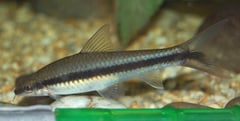
Crossocheilus nigriloba
Cyprinidae · Popta, 1904
Crossocheilus nigriloba is a cyprinid endemic to Borneo, known from the Kapuas, Belayan and Mahakam rivers in Indonesian Kalimantan. Rarely seen, it is among the near-identical congeners traded as 'Siamese algae-eater' or 'SAE' but is simple to identify: the lower caudal-fin lobe carries dark pigment suffused with red, which gave rise to the trade name 'penguin flying fox'. The lateral stripe breaks into blotches when the fish are sparring, stressed or sleeping.

Cyclocheilichthys apogonBeardless Barb
Cyprinidae · (Valenciennes, 1842)
The beardless barb, Cyclocheilichthys apogon, is a cyprinid ranging from Myanmar to Vietnam and south via Peninsular Malaysia to Borneo and Sumatra. Also sold as 'skinhead barb', it lacks barbels and has a black blotch at the caudal-fin base plus rows of dark spots along the scale rows. It favours slower-moving or still water and grazes the biofilm on submerged roots and branches. Rarely imported in numbers, it most often arrives as bycatch.
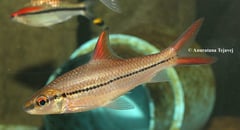
Cyclocheilichthys janthochir
Cyprinidae · (Bleeker, 1854)
Cyclocheilichthys janthochir is a cyprinid endemic to Borneo, known from West and Central Kalimantan in Indonesia. It inhabits black water streams and rivers associated with ancient forest peat swamps, where the water is very soft and acidic. Red markings in the dorsal and caudal fins plus a dark lateral stripe make it easy to identify. Specialised shops stock it from time to time, and it also turns up as bycatch among wild fish from Kalimantan.

Helostoma temminkiiKissing Gourami
Helostomatidae · Cuvier, 1829
The kissing gourami, Helostoma temminkii, is an anabantoid from southern Indochina and the Malay Archipelago, and the sole member of its family. The widely traded pinkish-white form is a leucistic variant bred for ornamental purposes, and the 'balloon' variety is intentionally disfigured and much shorter-lived. Its often belligerent behaviour, adult size and life span of over 20 years make it unsuitable for most home aquaria. The 'kissing' appears at least in part related to establishing social dominance.
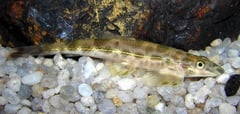
Homalopteroides stephensoni
Balitoridae · (Hora, 1932)
Homalopteroides stephensoni is a hillstream loach from Borneo, recorded from Kalimantan in Indonesia and from Sabah and Sarawak in Malaysia. Poorly known in the aquarium hobby, it may never have been exported for the ornamental trade. Originally described in Homaloptera, it was placed in Balitoropsis by Kottelat (2012), who subsequently followed Randall and Page (2012) in treating it as a Homalopteroides. Like its congeners it inhabits swiftly-flowing, clear, oxygen-saturated streams.
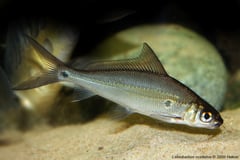
Labiobarbus ocellatus
Cyprinidae · (Heckel, 1843)
Labiobarbus ocellatus is a cyprinid from Peninsular Malaysia, Sumatra and Borneo, with a black spot on the shoulder and one on the caudal peduncle. It is occasionally available in the ornamental trade, typically under a name such as 'Bornean eye-spot silver shark' or the invalid scientific name Cirrhinus chinensis. A pelagic species of rivers and some lakes, it moves into seasonally inundated floodplains and forest during the wet season, and grows to 180 mm SL.

Mystacoleucus obtusirostris
Cyprinidae · (Valenciennes, 1842)
Mystacoleucus obtusirostris is a riverine cyprinid found from Myanmar and southwestern China to Vietnam, Borneo, Sumatra and Java. Referred to as M. marginatus for decades, it is the most widely distributed member of the genus, and populations vary somewhat in colour pattern. It is occasionally marketed as 'Burmese rainbow barb'. A group of six or more is the smallest to consider, and like all Mystacoleucus it has a forward-pointing predorsal spine that can snag in a net.
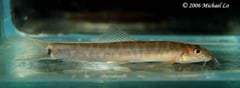
Nemacheilus saravacensis
Nemacheilidae · Boulenger, 1894
Nemacheilus saravacensis is a nemacheilid loach from Borneo, recorded from drainages in Sarawak (Malaysia) and West Kalimantan (Indonesia). It inhabits clear, tea-coloured forest streams with low mineral hardness and pH. Rare in the aquarium hobby, it may only have appeared as bycatch, and it carries 13-17 irregular dark blotches along the lateral line with a similar number of saddles across the back.
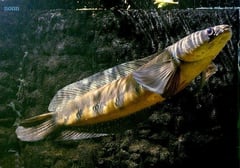
Channa marulioidesEmperor Snakehead
Channidae · (Bleeker, 1851)
The emperor snakehead, Channa marulioides, is a large snakehead from southern Thailand, Malaysia and Indonesia, including Borneo and Sumatra. Colour pattern varies with locality, and it is often confused with C. marulius and C. melanoptera, all three presenting taxonomic problems. Growing to 650 mm SL, it is pelagic, turns aggressive towards its own kind at sexual maturity and is suitable only for public installations or the very largest private aquaria.

Crossocheilus cobitis
Cyprinidae · (Bleeker, 1854)
Crossocheilus cobitis is a cyprinid ranging from the Mekong drainage in Laos, Vietnam and Thailand south to Sumatra, Borneo and Java. Primarily a lowland species, it lives in the turbid lower reaches of rivers over mud, close to submerged logs and similar objects. Given its wide range it has probably reached the trade as the invalid 'Crossocheilus siamensis', and it is likely to represent a group of similar-looking, closely related species.
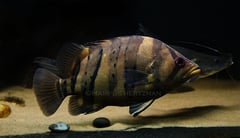
Datnioides microlepisIndonesian Tiger Perch
Datnioididae · Bleeker, 1854
The Indonesian tiger perch, Datnioides microlepis, is a large tiger perch from Peninsular Malaysia, Sumatra and Indonesian Borneo. It has 6 to 7 wide dark bars and small body scales, lives only in large, deep lowland rivers, and grows to 500 mm SL. Juveniles may form groups, but adults are not gregarious and respond aggressively to conspecifics and similarly-shaped fishes.

Hampala macrolepidotaHampala Barb
Cyprinidae · Kuhl & van Hasselt, 1823
The hampala barb, Hampala macrolepidota, is a cyprinid ranging from Myanmar through Thailand to the Mekong, and south to Borneo, Sumatra and Java. Also known as 'jungle perch' or 'sidebar barb', it can grow to over 2 feet and 5 kg and is a powerful, pelagic predator and not an aquarium subject in all but the most extreme circumstances. Prized as a food and sport fish, it has been introduced to numerous water bodies.
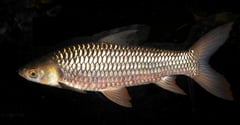
Leptobarbus hoeveniiMad Barb
Cyprinidae · (Bleeker, 1851)
The mad barb, Leptobarbus hoevenii, is a large pelagic cyprinid apparently native to Peninsular Malaysia, Borneo, Sumatra and Java. A popular sport fish growing to 800 to 1000 mm, it is wholly unsuitable for private aquaria but is readily available at 100 to 150 mm. The congener L. rubripinna was referred to as L. hoevenii for decades and both are traded under the same name. L. hoevenii lacks the broad dark midlateral stripe and has dark grey pelvic and anal fins.

Macrochirichthys macrochirusGiant Sword Minnow
Cyprinidae · (Valenciennes, 1844)
The giant sword minnow, Macrochirichthys macrochirus, is a large pelagic cyprinid widespread in Southeast Asia, from the Mekong to Borneo and Sumatra. Growing to 600 to 800 mm and becoming increasingly piscivorous as it grows, it is unsuitable for the majority of private aquaria, although juveniles are traded on occasion. It is thought to have been extirpated from the Chao Phraya, Mae Klong, Lake Songkhla and Java, and the Mekong populations have been drastically reduced.

Scleropages formosusAsian Arowana
Osteoglossidae · (Müller & Schlegel, 1840)
The Asian arowana, Scleropages formosus, is an osteoglossid from the Mekong system, eastern Thailand, Peninsular Malaysia, Sumatra and Borneo. Highly valued in the aquarium trade since the 1970s and listed on Appendix I of CITES since 1975, it is now extirpated across much of its range. It occurs in several colour forms, such as the 'super red' of the upper Kapuas, and three were described as species in 2003, though the majority view treats all of them as S. formosus pending review.