River
Gin
Only species with a profile on Seriously Fish are counted.
- Species
- 7
- Families
- 5
- Photographed
- 7 of 7
- Difficulty rated
- 7 of 7
Shares fishes withspecies recorded from both
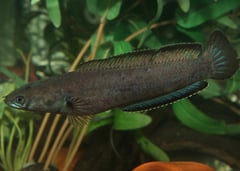
Channa orientalisCeylon snakehead
Channidae · Bloch & Schneider, 1801
The Ceylon snakehead, Channa orientalis, is a small snakehead without pelvic fins, endemic to the wet zone of southwestern Sri Lanka. Its name has been widely misapplied to Channa populations elsewhere in South and Southeast Asia, most of them now considered C. gachua. Probably endangered in the wild, it is a paternal mouthbrooder that forms lasting pair bonds, and captive breeding should be the priority when keeping it.
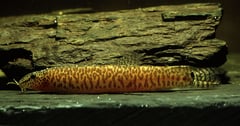
Lepidocephalichthys jonklaasi
Cobitidae · Deraniyagala, 1956
Lepidocephalichthys jonklaasi is a cobitid loach endemic to the 'wet zone' of south-western Sri Lanka, known from at least five localities. Records exist from the Gin, Kalu, Nilwala and Bentota river basins plus a small blackwater creek near the Kottawa Forest Reserve. Its conservation status perhaps precludes its suitability for the hobby. Broad dark bars on the caudal fin and large, vertically elongated black spots on the flanks identify it.

Malpulutta kretseriOrnate Paradisefish
Osphronemidae · Deraniyagala, 1937
The ornate paradisefish, Malpulutta kretseri, is a labyrinth fish from the 'wet zone' of southwestern Sri Lanka. It has been recorded from the Gin, Kelani, Kalu, Nilwala and Bentota river basins. The only member of its genus, it is protected by law in Sri Lanka although it still appears in the aquarium trade from time to time. Three colour forms exist, differing in the amount of reddish, violet or bluish pigmentation in the fins.
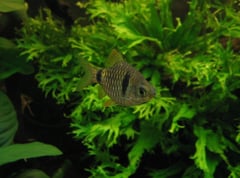
Pethia cumingiiCuming's Barb
Cyprinidae · Günther, 1868
Cuming's barb, Pethia cumingii, is a small cyprinid endemic to southwestern Sri Lanka, apparently only in the Bentara and Gin river drainages. It was long thought to occur in yellow- and red-finned forms, and the red-finned fish are now recognised as P. reval, a smaller species of sluggish lowland rivers. Reports suggest the more brightly-coloured fish are becoming scarcer, and selective collection for the aquarium trade may have altered wild populations.
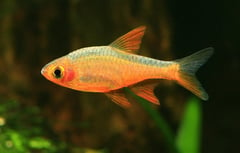
Rasboroides vateriflorisFire Rasbora
Cyprinidae · Deraniyagala, 1930
The fire rasbora, Rasboroides vaterifloris, is a small cyprinid endemic to the Kalu, Bentota, Gin and Nilwala river basins of southwestern Sri Lanka. Colour varies with locality, and red, orange and yellow-finned forms are known. Its delicate nature causes problems in shipping, and reports suggest the more highly coloured fish are becoming scarcer in the wild, possibly because selective collection for the trade has altered the structure of wild populations.

Etroplus suratensisGreen Chromide
Cichlidae · Bloch, 1790
The green chromide, Etroplus suratensis, is a euryhaline cichlid from peninsular India and Sri Lanka, growing to 350 mm SL. It mostly inhabits brackish estuaries, coastal lagoons and lower river reaches. Not especially popular in the hobby, it is an important food fish, and some populations have crashed through over-exploitation. In Sri Lanka's Negombo Lagoon Pseudetroplus maculatus has been seen acting as its cleaner while also eating its eggs and fry.

Puntius kamalikaKami's Barb
Cyprinidae · Silva, Maduwage & Pethiyagoda, 2008
Kami's barb, Puntius kamalika, is a cyprinid endemic to Sri Lanka, widespread in the southwestern 'wet zone' between the Kelani and Gin basins. Common throughout its range, it has been collected from rivers, streams and marshland. Before its description it was referred to as P. amphibius, a putatively valid species probably restricted to western India, and it lacks prominent markings on the body and fins.