River
Kalu
Only species with a profile on Seriously Fish are counted.
- Species
- 7
- Families
- 3
- Photographed
- 7 of 7
- Difficulty rated
- 7 of 7
Basin
Shares fishes withspecies recorded from both
Runs through

Belontia signataCeylonese Combtail
Osphronemidae · Günther, 1861
The Ceylonese combtail, Belontia signata, is a labyrinth fish endemic to the central and southern river systems of Sri Lanka. Also referred to as the 'Ceylon fighting fish', it differs from B. hasselti in its reddish body and the absence of mosaic patterning in the unpaired fins. At least three putative phenotypes have been recorded, one described as the questionably valid subspecies B. s. jonklaasi. It is not recommended for the average community aquarium.
Lepidocephalichthys jonklaasi
Cobitidae · Deraniyagala, 1956
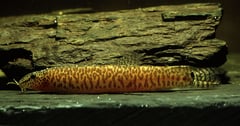
Lepidocephalichthys jonklaasi is a cobitid loach endemic to the 'wet zone' of south-western Sri Lanka, known from at least five localities. Records exist from the Gin, Kalu, Nilwala and Bentota river basins plus a small blackwater creek near the Kottawa Forest Reserve. Its conservation status perhaps precludes its suitability for the hobby. Broad dark bars on the caudal fin and large, vertically elongated black spots on the flanks identify it.

Malpulutta kretseriOrnate Paradisefish
Osphronemidae · Deraniyagala, 1937
The ornate paradisefish, Malpulutta kretseri, is a labyrinth fish from the 'wet zone' of southwestern Sri Lanka. It has been recorded from the Gin, Kelani, Kalu, Nilwala and Bentota river basins. The only member of its genus, it is protected by law in Sri Lanka although it still appears in the aquarium trade from time to time. Three colour forms exist, differing in the amount of reddish, violet or bluish pigmentation in the fins.
Pethia reval
Cyprinidae · Meegaskumbura, Silva, Maduwage & Pethiyagoda, 2008
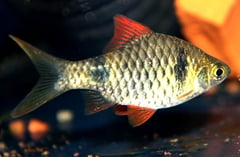
Pethia reval is a small cyprinid endemic to western Sri Lanka, known from the Kelani and Maha Oya river systems and the drainages between them. Considered a red-finned colour form of P. cumingii before its description, it is a smaller fish, to 33.6 mm SL, with red dorsal, anal and pelvic fins (pale yellow in the Kalu River population). The Mahaweli River population appears to have been introduced.

Pseudosphromenus cupanusSpiketail Paradisefish
Osphronemidae · Cuvier, 1831
The spiketail paradisefish, Pseudosphromenus cupanus, is a small labyrinth fish restricted to southern India and Sri Lanka. It lives in sluggish and still waters such as rice paddies, swamps and weedy ponds. It lacks the two dark lateral stripes of its only congener, P. dayi. A secretive bubble nester, it is peaceful but too small and timid for most community aquaria.
Rasboroides vateriflorisFire Rasbora
Cyprinidae · Deraniyagala, 1930
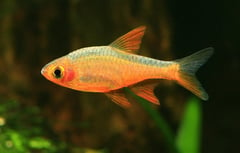
The fire rasbora, Rasboroides vaterifloris, is a small cyprinid endemic to the Kalu, Bentota, Gin and Nilwala river basins of southwestern Sri Lanka. Colour varies with locality, and red, orange and yellow-finned forms are known. Its delicate nature causes problems in shipping, and reports suggest the more highly coloured fish are becoming scarcer in the wild, possibly because selective collection for the trade has altered the structure of wild populations.

Puntius kamalikaKami's Barb
Cyprinidae · Silva, Maduwage & Pethiyagoda, 2008
Kami's barb, Puntius kamalika, is a cyprinid endemic to Sri Lanka, widespread in the southwestern 'wet zone' between the Kelani and Gin basins. Common throughout its range, it has been collected from rivers, streams and marshland. Before its description it was referred to as P. amphibius, a putatively valid species probably restricted to western India, and it lacks prominent markings on the body and fins.