River
Kahang
Only species with a profile on Seriously Fish are counted.
- Species
- 7
- Families
- 5
- Photographed
- 7 of 7
- Difficulty rated
- 7 of 7
Shares fishes withspecies recorded from both
Runs through

Betta pugnax
Osphronemidae · Cantor, 1849
Betta pugnax is a paternal mouthbrooding labyrinth fish from much of Peninsular Malaysia and Singapore, described from Penang. It lends its name to the B. pugnax complex. Populations inhabit shallow, flowing clear-water hill streams as well as stiller forest swamps. It is not among the more aggressive members of the genus and can be maintained in a pair or group.
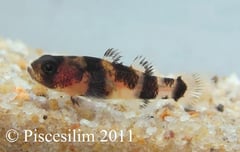
Brachygobius xanthomelas
Gobiidae · Herre, 1937
Brachygobius xanthomelas is a small bumblebee goby recorded throughout much of Peninsular Malaysia and southern Thailand. It lives in lowland freshwater swamps, streams and forest peat swamps and, unlike most congeners, does not appear to occur in brackish water. The name is widely misapplied to an unidentified member of the genus, the fish in most online images, which has a dark marking at the front of the first dorsal-fin base where B. xanthomelas is colourless.

Channa luciusForest Snakehead
Channidae · Cuvier, 1831
The forest snakehead, Channa lucius, is a predatory snakehead from Indochina, Peninsular Malaysia and the Greater Sunda Islands. Also referred to as the 'splendid' or 'shiny' snakehead, it occurs on Sumatra, Borneo and Java, grows to 400 mm SL and favours forest swamps and tributaries. Like others in the genus it breathes atmospheric air, and it needs a dimly-lit tank with plenty of cover and a tightly-fitting lid, since Channa spp. are notorious for their ability to escape.
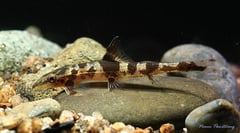
Homaloptera ogilviei
Balitoridae · Alfred, 1967
Homaloptera ogilviei is a small 'lizard' loach recorded through much of the Malay Peninsula in both Malaysia and southern Thailand. Quite rare in the trade, it is sometimes imported as bycatch and sold as 'lizard' or 'gecko' loach. Its paired fins are orientated vertically, unlike those of other members of the genus, and in aquaria it perches on the tips of its fins at rest. It favours slower stretches among plants, roots or leaf litter.
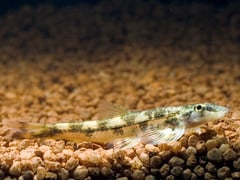
Homalopteroides nebulosus
Balitoridae · Alfred, 1969
Homalopteroides nebulosus is a small hillstream loach described from the Sok River in northern Peninsular Malaysia and since recorded from Borneo. Poorly known in the aquarium hobby, it may never have been exported for the ornamental trade. Its eyes sit in a comparatively raised position on the head, as in H. tweediei, but it has more lateral line scales. Little is known of its habitat, which is presumed to be swiftly-flowing streams and headwaters.
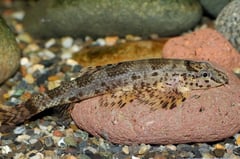
Homalopteroides tweediei
Balitoridae · Herre, 1940
Homalopteroides tweediei is a small hillstream loach from Peninsular Malaysia, the Mekong system and West Kalimantan in Indonesian Borneo. It is often confused with the congener H. smithi. Rainboth (1996) found it less likely to occur in riffles or runs than other members of the genus, and it shows a preference for moderately-flowing stretches of clear, oxygen-rich streams among patches of live or dead vegetation.

Mystacoleucus obtusirostris
Cyprinidae · Valenciennes, 1842
Mystacoleucus obtusirostris is a riverine cyprinid found from Myanmar and southwestern China to Vietnam, Borneo, Sumatra and Java. Referred to as M. marginatus for decades, it is the most widely distributed member of the genus, and populations vary somewhat in colour pattern. It is occasionally marketed as 'Burmese rainbow barb'. A group of six or more is the smallest to consider, and like all Mystacoleucus it has a forward-pointing predorsal spine that can snag in a net.