River
Kok
Only species with a profile on Seriously Fish are counted.
- Species
- 4
- Families
- 4
- Photographed
- 4 of 4
- Difficulty rated
- 4 of 4
Basin
Also in the Mekong basinspecies recorded from both
Shares fishes with rivers elsewherespecies recorded from both
Runs through
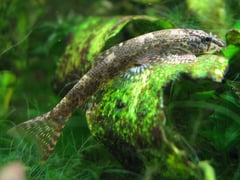
Homalopteroides smithi
Balitoridae · Hora, 1932
Homalopteroides smithi is a hillstream loach from Thailand, Peninsular Malaysia and parts of the Mekong basin in Laos, Cambodia and Vietnam. Perhaps the best-known member of the genus, it is relatively common in the aquarium hobby, and Rainboth (1996) considered it 'probably the commonest member of the genus in the Mekong'. An obligate dweller of swiftly-flowing streams and headwaters, it needs clean, well-oxygenated water.

Rhinogobius mekongianus
Gobiidae · Pellegrin & Fang, 1940
Rhinogobius mekongianus is a goby from the middle and upper Mekong basin in Laos, Vietnam and Thailand. Its name has been misapplied in the aquarium trade to the congener R. chiengmaiensis, and it does not appear to have been on the market itself. It has 7-8 irregular dark markings on the body (vs. 5 in R. chiengmaiensis), and records from the Chao Phraya drainage most likely refer to that species.

Trichopsis pumilaSparkling Gourami
Osphronemidae · Arnold, 1936
The sparkling gourami, Trichopsis pumila, is a small labyrinth fish from the lower Mekong basin and central and southern Thailand. Also known as the pygmy gourami, it has a solid dark midlateral stripe topped by a row of dark blotches, which with its small size separates it from T. schalleri. Both sexes produce audible 'croaking' sounds with a specialised pectoral mechanism, and most traded fish are produced commercially.

Mystacoleucus chilopterus
Cyprinidae · Fowler, 1935
Mystacoleucus chilopterus is a pelagic cyprinid from the middle Mekong, Chao Phraya and Mae Klong basins in Laos and Thailand. It favours flowing lowland rivers and swiftly-flowing forest streams with rock and gravel. The anal fin has a concave margin and the dorsal and caudal fins black margins, and like all Mystacoleucus it has a forward-pointing predorsal spine that can become entangled in an aquarium net.