Basin
Mekong basin
Only species with a profile on Seriously Fish are counted.
- Species
- 155
- Rivers
- 20
- Photographed
- 155 of 155
- Difficulty rated
- 155 of 155
Rivers in this basinspecies recorded from each
- Mekong153 species
- Tonlé Sap41 species
- Mun29 species
- Xe Bang Fai27 species
- Sekong14 species
- Nam Theun10 species
- Srepok8 species
- Nam Ou7 species
- Songkhram7 species
- Chi6 species
- Lancang5 species
- Kok4 species
- Nam Ngum4 species
- Xe Kaman4 species
- Nam Khan2 species
- Xe Don2 species
- Banghiang1 species
- Loei1 species
- Mae Nam Ing1 species
- Xe Namnoy1 species
Runs through
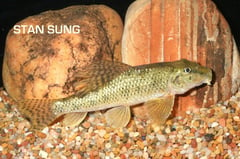
Abbottina rivularisChinese False Gudgeon
Cyprinidae · Basilewsky, 1855
The Chinese false gudgeon, Abbottina rivularis, is a small bottom-dwelling cyprinid native to China, the Korean peninsula and southern Japan. It has been widely introduced elsewhere, including the Mekong and Salween basins, Taiwan, Turkmenistan and Kyrgyzstan, and is considered invasive. It has started to appear in the aquarium trade and should never be released into natural waters outside its native range.
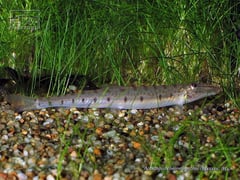
Acantopsis dialuzonaHorseface Loach
Cobitidae · van Hasselt, 1823
The horseface loach, Acantopsis dialuzona, is a cobitid loach from Sumatra, Borneo, Java and Peninsular Malaysia, and possibly Thailand. Most literature lists it as A. choirorhynchos, which Kottelat treats as a junior synonym, and few if any fish in the trade come from near the type locality, so they may represent an unidentified species. Juveniles are exported in large numbers but adults are uncommon in the hobby, and it needs soft sand to bury in.

Akysis variusVariable Stream Catfish
Akysidae · Ng & Kottelat, 1998
The variable stream catfish, Akysis varius, is a small akysid catfish from the Mekong drainage in Laos, Thailand and Cambodia. The number of serrations on its pectoral spine varies, and in contrast to other Akysis with serrated spines, the larger specimens examined had fewer or none. Members of the genus live almost exclusively in swiftly flowing streams and rivers over sand, gravel and rocks.
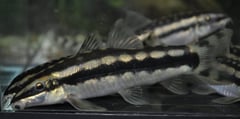
Ambastaia nigrolineataBlack-Lined Loach
Botiidae · Kottelat & Chu, 1987
The black-lined loach, Ambastaia nigrolineata, is a botiid loach from the Mekong drainage in southern China and Laos, and the Nan River in Thailand. It resembles its only congener A. sidthimunki but has a solid dark lateral stripe and another along the dorsal mid-line, with the vertical bars between them much less prominent. In Thailand it is considered endangered and appears in the national Red Book of threatened species.

Amblypharyngodon chulabhornaePrincess Carplet
Cyprinidae · Vidthayanon & Kottelat, 1990
The princess carplet, Amblypharyngodon chulabhornae, is a small cyprinid from Thailand and the Mekong system in Laos, Vietnam and Cambodia. It favours wetlands and marginal zones with little water movement and plenty of aquatic and floating vegetation,. Almost unknown in the hobby, it turns up as occasional bycatch among shipments of other fishes. A very peaceful schooling fish, it should be kept in a group of at least 8 to 10.
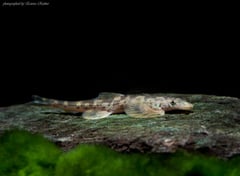
Annamia normaniVietnamese Giraffe Loach
Gastromyzontidae · Hora, 1931
The Vietnamese giraffe loach, Annamia normani, is a hillstream loach from Mekong tributaries in Vietnam, Laos and Cambodia and from coastal Vietnam. An obligate resident of riffles and rapids, it has been traded as the 'Vietnamese lizard loach' and 'Vietnamese Homaloptera'. Adults studied in the Duc My River were specialised grazers of cyanobacteria. Many of its known habitats are threatened by planned hydroelectric projects.

Bagrichthys majusculusWhite-Whisker Lancer
Bagridae · Ng, 2002
The white-whisker lancer, Bagrichthys majusculus, is a bagrid catfish from the Mekong and Chao Phraya river systems in Thailand and Laos. Described from the Mun River in eastern Thailand, it is most similar to B. macracanthus and B. vaillantii and differs from both in its longer pectoral-fin spines. It inhabits large, turbid, slow rivers and moves into flooded riparian zones to spawn in the wet season. A shy, nocturnal fish, it is territorial towards other bottom-dwellers, especially its own kind.

Bagrichthys obscurus
Bagridae · Ng, 1999
Bagrichthys obscurus is a bagrid catfish from the Chao Phraya, Bang Pakong and Mekong watersheds in Thailand, Cambodia and Vietnam. One of the lancers, named for the extended dorsal spine in several members of the genus, it has a uniformly brown body with no pale stripe or blotches, a small mouth and a relatively short dorsal spine. It inhabits large, turbid rivers with slow flow, and is shy, nocturnal and territorial towards other bottom-dwellers.
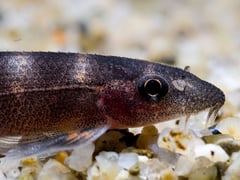
Balitoropsis zollingeri
Balitoridae · Bleeker, 1853
Balitoropsis zollingeri is a balitorid loach described from Java and recorded from Sumatra, Borneo, Peninsular Malaysia, Thailand, Laos and Cambodia. An obligate dweller of swiftly flowing streams and headwaters, it lives on riffles and runs over gravel, rocks and bedrock carpeted with biofilm. It needs clean, well-oxygenated water with strong turnover in the aquarium. It lives in aggregations in nature and is less bold when kept singly or in small numbers, so a group of six or more is best.

Barbodes aurotaeniatus
Cyprinidae · Tirant, 1885
Barbodes aurotaeniatus is a small cyprinid from the middle and lower Mekong basin in Laos, Vietnam, Cambodia and Thailand. Uncommon in the aquarium trade, it has a single pair of maxillary barbels, lacking the rostral barbels of other Barbodes, and usually four small vertical black markings on the flanks. It inhabits streams, irrigation canals and ditches, and is apparently very peaceful, best kept in a mixed-sex group of 6 to 10.

Barbodes binotatusSpotted Barb
Cyprinidae · Valenciennes, 1842
The spotted barb, Barbodes binotatus, is a cyprinid ranging from Myanmar and Thailand through the Greater Sunda Islands to the Philippines. So ubiquitous across its range that it's often called simply 'common barb', it occurs from sea level to at least 2000 m in habitats from fast-flowing hill streams to irrigation canals and floodplain ponds. The basic pattern of a dark spot at the dorsal-fin origin and another on the caudal peduncle varies with origin.

Barbonymus altusRed-tailed Tinfoil Barb
Cyprinidae · Günther, 1868
The red-tailed tinfoil barb, Barbonymus altus, is a large cyprinid from Thailand, Laos, Cambodia and Vietnam. One of two species traded as 'tinfoil barb', it is usually sold at 50 to 75 mm with little information on its eventual size, and long-term care is beyond the resources of most hobbyists. Natural fish lack the black stripe along each caudal-fin lobe seen in B. schwanefeldii, and adults have a golden or bronze hue.

Barbonymus gonionotus
Cyprinidae · Bleeker, 1849
Barbonymus gonionotus is a large cyprinid with an enormous distribution across Southeast Asia, from the Mekong to Java and Sumatra. It inhabits larger, slow-moving rivers and their floodplains, moving into flooded forest to feed and spawn, and is increasingly found in man-made canals and lakes. Plain grey caudal and dorsal fins and pale yellow pelvic and anal fins separate it from congeners. Populations in Peninsular Malaysia appear to be introduced.

Barbonymus schwanefeldiiTinfoil barb
Cyprinidae · Bleeker, 1854
The tinfoil barb, Barbonymus schwanefeldii, is a large cyprinid found across much of Southeast Asia, from the Mekong to Borneo and Sumatra. Usually sold at 50 to 75 mm, it grows to 355 mm SL, and tinfoil barbs are among the species most often returned to shops having outgrown their aquarium. Selectively-bred 'golden' and 'blushing' strains exist, and the species has also been subjected to artificial dyeing.

Betta prima
Osphronemidae · Kottelat, 1994
Betta prima is a paternal mouthbrooding labyrinth fish from south-eastern Thailand and the Mekong basin in Cambodia and Laos. Before its description it was widely misidentified as B. pugnax or B. taeniata, and not all authors place it in the B. pugnax complex. It inhabits clear-water forest swamps and streams that can be still or swift, sheltering among marginal roots, leaf litter and vegetation.

Betta siamorientalis
Osphronemidae · Kowasupat, Panijpan, Ruenwongsa & Jeenthong, 2012
Betta siamorientalis is a small bubble-nesting labyrinth fish from eastern Thailand, western Cambodia and Vietnam. It lives among submerged vegetation in marshes, flooded fields and rice paddies. Before its description in 2012 it was considered a colour form of B. imbellis known as 'black imbellis', and it has also been confused with B. splendens, but DNA analysis showed it to be distinct. Males have a dark brown to black body and a black opercle with two reddish vertical bars.

Betta smaragdinaEmerald Betta
Osphronemidae · Ladiges, 1972
The emerald betta, Betta smaragdina, is a bubble-nesting labyrinth fish from the Khorat Plateau in eastern Thailand and Mekong tributaries in Laos. It inhabits still and sluggish waters such as rice paddies, swamps and roadside ditches. It has been line-bred for aggression in eastern Thailand, and selectively bred and hybridised for the ornamental trade into colour forms that do not occur naturally. Wild populations vary in the extent of red or green patterning and are often labelled by locality.

Boraras micros
Cyprinidae · Kottelat & Vidthayanon, 1993
Boraras micros is a tiny cyprinid from the Mekong basin in northeastern Thailand, recorded in Nong Khai, Udon Thani and Sakon Nakhon provinces. Growing to only 13 mm SL, it inhabits shallow, clear, densely vegetated swamps, marshes, floodplains and rice paddies. Poorly documented and rarely seen in the trade, it has a rather plain pattern, and fish sold as B. micros var. 'red' or 'strawberry rasbora' are always B. maculatus, B. brigittae or B. naevus.

Brachygobius mekongensisMekong Bumblebee Goby
Gobiidae · Larson & Vidthayanon, 2000
The Mekong bumblebee goby, Brachygobius mekongensis, is a tiny goby from the central and lower Mekong, including the Tonlé Sap system. It is apparently restricted to slow-moving or standing fresh water such as marshes, seasonal swamps and floodplains with dense aquatic vegetation. Narrow, often broken dark bars on a pale background separate it from the most similar species, B. nunus. It is poorly known in the hobby, and other species are sold under its name.

Butis butisCrazy Fish
Butidae · Hamilton, 1822
The crazy fish, Butis butis, is a flathead gudgeon of coastal and brackish waters across the Indo-Pacific, from eastern Africa to Fiji. The most commonly traded member of the genus, it has many other names, including crocodile fish, duckbill sleeper and upside-down sleeper. A nocturnal ambush predator, it often swims upside-down, and it is territorial and not sociable with conspecifics, so is best kept singly.

Carinotetraodon lortetiRedeye Puffer
Tetraodontidae · Tirant, 1885
The redeye puffer, Carinotetraodon lorteti, is a small freshwater puffer from the lower Mekong basin and the Chao Phraya watershed in Indochina. It inhabits slow-moving to standing water in shady forest streams, minor tributaries and floodplains, often among dense vegetation. It tends to bite the fins of tankmates and is territorially aggressive, so is best kept alone, though a group can be kept with enough space and a suitable layout.

Channa gachuaDwarf Snakehead
Channidae · Hamilton, 1822
The dwarf snakehead, Channa gachua, is a snakehead recorded across an enormous range from Iran to Taiwan and Bali. There is significant evidence that C. gachua as currently understood is a complex of similar-looking species in need of taxonomic review. A mouthbrooder bred regularly in captivity, it can share a well-chosen community with peaceful fishes too large to be prey, but populations should not be mixed as some may hybridise.

Channa luciusForest Snakehead
Channidae · Cuvier, 1831
The forest snakehead, Channa lucius, is a predatory snakehead from Indochina, Peninsular Malaysia and the Greater Sunda Islands. Also referred to as the 'splendid' or 'shiny' snakehead, it occurs on Sumatra, Borneo and Java, grows to 400 mm SL and favours forest swamps and tributaries. Like others in the genus it breathes atmospheric air, and it needs a dimly-lit tank with plenty of cover and a tightly-fitting lid, since Channa spp. are notorious for their ability to escape.

Crossocheilus atrilimesSiamese Algae Eater
Cyprinidae · Kottelat, 2000
Crossocheilus atrilimes is one of several near-identical cyprinids traded as the Siamese algae eater, native to the Mekong and Chao Phraya drainages. Telling it apart from C. langei and the undescribed C. sp. 'citripinnis' takes a combination of characters, including a black stripe running to the tip of the caudal fin that broadens and pales when the fish spar. A shoaling fish of flowing streams, it needs spotless, well-oxygenated water and a group of six or more.

Crossocheilus reticulatus
Cyprinidae · Fowler, 1934
Usually offered as the reticulated or fishnet flying fox, Crossocheilus reticulatus is a cyprinid from the Chao Phraya and Mekong basins. A silvery body, dark-edged scales and a dark caudal peduncle blotch set it apart from similar congeners. Patterning varies with collection locality, which led to several names now treated as synonyms. A fish of flowing streams, it is best kept in a group of six or more, since weaker individuals can be bullied in smaller numbers.

Cyclocheilichthys apogonBeardless Barb
Cyprinidae · Valenciennes, 1842
The beardless barb, Cyclocheilichthys apogon, is a cyprinid ranging from Myanmar to Vietnam and south via Peninsular Malaysia to Borneo and Sumatra. Also sold as 'skinhead barb', it lacks barbels and has a black blotch at the caudal-fin base plus rows of dark spots along the scale rows. It favours slower-moving or still water and grazes the biofilm on submerged roots and branches. Rarely imported in numbers, it most often arrives as bycatch.

Cyclocheilichthys armatus
Cyprinidae · Valenciennes, 1842
Cyclocheilichthys armatus is a cyprinid ranging from the Mekong region through Thailand and Peninsular Malaysia to Borneo, Sumatra and Java. It forages from mid-water to the bottom of rivers in the dry season and is thought to migrate into flooded forest to breed. Rarely imported in numbers and most often arriving as bycatch, it makes a peaceful, unusual addition to larger aquaria in a group of at least six.

Cyclocheilichthys heteronema
Cyprinidae · Bleeker, 1854
Cyclocheilichthys heteronema is a cyprinid ranging from Myanmar east to Vietnam and south to Peninsular Malaysia, Borneo and Sumatra. Its fimbriated barbels, extended downwards while it browses, are unique in the genus. It doesn't appear to be common in nature, with most records from Peninsular Malaysia, and it reaches the trade only as occasional bycatch. Very peaceful but retiring, it is easily outcompeted by boisterous tankmates.

Cyclocheilichthys lagleri
Cyprinidae · Sontirat, 1985
Cyclocheilichthys lagleri is a cyprinid from the Chao Phraya river system in central Thailand and the lower Mekong basin in Thailand and Cambodia. It is observed mostly on low-altitude floodplains and may migrate into inundated areas to spawn. Lacking barbels entirely and with 20 circumpeduncular scales, it makes a peaceful, unusual addition to larger aquaria in a group of at least six.

Cyclocheilichthys repasson
Cyprinidae · Bleeker, 1853
Cyclocheilichthys repasson is a cyprinid with an enormous range, from the Mekong region and Myanmar through Peninsular Malaysia to Borneo and Sumatra. It grows to around 280 mm SL and favours slower-moving or still water, grazing the biofilm on submerged roots and branches. It is not often seen in the hobby. Most populations have a dark caudal peduncle spot, stripes formed by dark markings on the scales, and two pairs of barbels.

Danio albolineatusPearl Danio
Cyprinidae · (Blyth, 1860)
The pearl danio, Danio albolineatus, is a small cyprinid recorded from Myanmar and Indochina south to Peninsular Malaysia and Sumatra. Colour and patterning differ between localities, and doubts remain whether it is a single species or a group of closely related fish. Wild examples are rare in the trade, with most produced commercially in South East Asia or eastern Europe, and some of the fish traded are likely to be hybrids with D. roseus.

Danio roseusRosy Danio
Cyprinidae · Fang & Kottelat, 2000
The rosy danio, Danio roseus, is a small cyprinid from the Mekong basin in northern Thailand and Laos, also recorded in northern Myanmar. Colourful, hardy and usually cheap, it has proved very popular and is sometimes sold as 'purple passion danio'. It is very similar to D. albolineatus sensu stricto but has a slimmer body, shorter rostral barbels and no dark stripes on the rear half of the body. Many fish in the hobby are thought to be hybrids of the two.

Datnioides polotaSilver Tiger Perch
Datnioididae · Hamilton, 1822
The silver tiger perch, Datnioides polota, is a tiger perch widely distributed in southeastern Asia, from India and Bangladesh east to Indonesia. Mostly found in brackish habitats such as estuaries, mangroves and coastal lagoons, it has a highly variable colour pattern with up to 7 dark bars. The name D. quadrifasciatus is sometimes applied to it, but that name is a junior homonym and polota takes precedence.

Datnioides undecimradiatusMekong Tiger Perch
Datnioididae · Roberts & Kottelat, 1994
The Mekong tiger perch, Datnioides undecimradiatus, is known only from the middle and lower Mekong basin in Thailand, Laos, Cambodia and Vietnam. An efficient, largely piscivorous predator of large, deep lowland rivers, it is marked with 4 relatively thin dark bars. The names 'Siamese tiger fish' and 'gold datnoid' are sometimes applied to it, but more typically belong to D. pulcher.

Devario acrostomus
Cyprinidae · (Fang & Kottelat, 1999)
Devario acrostomus is a devario from the Nam Leuk drainage in Vientiane Province, Laos, and has also been recorded in northeastern Thailand. It first appeared in the hobby in early 2011. It looks like D. aequipinnatus and allies at first glance, but has a sharp, upwardly-pointing mouth, a snout longer than the eye diameter, long rostral barbels and strongly pigmented body patterning. Above Tad Leuk falls its habitats have clear water under forest cover.

Devario chrysotaeniatus
Cyprinidae · (Chu, 1981)
Devario chrysotaeniatus is a devario from the upper Mekong watershed in Yunnan, southwestern China, northern Laos and northern Thailand. It first appeared in the hobby in 2005 and is rarely seen, probably because its natural waters lie outside the range of most commercial collectors. Its flank pattern is indistinct: a few short, thin horizontal stripes, a dark stripe along the back and a spot behind the gill opening.

Devario laoensis
Cyprinidae · (Pellegrin & Fang, 1940)
Devario laoensis is a devario from the upper Mekong watershed in northwestern Laos and northern Thailand. Its dark P stripe starts faint around mid-body and becomes thicker and darker towards the caudal-fin base. Among congeners it is most similar to D. chrysotaeniatus, in which the P stripe extends to the end of the caudal-fin rays. Its habitats lie at relatively high altitude and are likely to be hill streams and small rivers.

Discherodontus ashmeadi
Cyprinidae · Fowler, 1937
Discherodontus ashmeadi is a cyprinid apparently native to the Mae Klong and Mekong river basins in Thailand, Laos and Cambodia. The type species of its genus, it inhabits clear, fast-flowing minor rivers and forest streams. Like its congeners it is notoriously delicate and difficult to ship: it goes into shock and loses scales very easily when removed from the water, and damaged areas tend to become infected.

Epalzeorhynchos frenatumRainbow Shark
Cyprinidae · Fowler, 1934
The rainbow shark, Epalzeorhynchos frenatum, is a cyprinid reportedly native to Thailand, Laos and Cambodia. Recorded from the Mae Klong, Chao Phraya and Mekong basins, many of its wild populations have dwindled or vanished, and large numbers are farmed for the trade, including an albino and an anerythristic form sometimes misidentified as E. munense. It becomes increasingly territorial as it grows and can live for over 15 years.

Epalzeorhynchos munense
Cyprinidae · Smith, 1934
Epalzeorhynchos munense is a cyprinid from the Mun river and other tributaries of the middle Mekong in Thailand and Laos. It resembles E. bicolor and E. frenatum but has a black head, body and anal fin, red caudal and dorsal fins, and black margins on the pelvic and pectoral fins. A record from the Tonlé Sap system may refer to E. frenatum.

Esomus longimanusMekong Flying Barb
Cyprinidae · Lunel, 1881
The Mekong flying barb, Esomus longimanus, is a cyprinid from the Mekong basin in Thailand, Laos, Cambodia and Vietnam, and the Tonlé Sap system. It favours shallow, slow-moving and standing waters with dense aquatic vegetation, such as ditches, marshes and rice paddies. Like other Esomus it has greatly enlarged pectoral fins and very long maxillary barbels, and it jumps well enough to escape through the tiniest gaps.

Esomus metallicusStriped Flying Barb
Cyprinidae · Ahl, 1923
The striped flying barb, Esomus metallicus, is a cyprinid found from the Salween basin in Myanmar east across Thailand to Laos and Cambodia. It is abundant over most of this range and moves into rice paddies and other flooded ground at the onset of the wet season, returning to permanent water when the flooding recedes. Its lateral stripe grows more intense towards the tail and ends at the caudal-fin base.

Folifer brevifilis
Cyprinidae · Peters, 1881
Folifer brevifilis is a large cyprinid from the Mekong, Salween and Ayeyarwady systems of southern China, Myanmar, Thailand, Laos and Vietnam. It has also been recorded from Hainan and Hong Kong. Growing to 300 mm SL, it is unsuitable for the majority of home aquaria and extremely rare in the ornamental trade. It inhabits flowing middle and lower sections of major rivers and may migrate seasonally to spawn.

Garra cambodgiensisFalse SAE
Cyprinidae · Tirant, 1883
The false SAE, Garra cambodgiensis, is a cyprinid from the Mekong, Chao Phraya and Mae Klong basins and northern Peninsular Malaysia. It is still traded as Garra taeniata and is often confused with the Crossocheilus species sold as 'Siamese algae eater'. In this species the dark lateral stripe ends at the caudal peduncle, and a sucker formed by the lower lip is present. It inhabits swiftly-flowing headwaters and tributaries.

Garra fasciacauda
Cyprinidae · Fowler, 1937
Garra fasciacauda is a cyprinid native to the Mekong river system in Thailand, Laos, Vietnam and Cambodia, including the Tonlé Sap basin. It has a black submarginal stripe on both caudal lobes and a plain dorsal fin. It inhabits swiftly-flowing water and migrates seasonally, with many fish moving from the Tonlé Sap system to the Khone Falls in the dry season.

Gyrinocheilus aymonieriSucking 'Loach'
Gyrinocheilidae · Tirant, 1883
The sucking 'loach', Gyrinocheilus aymonieri, is a stream fish from the Mae Klong, Chao Phraya, Mekong and Dong Nai basins in Indochina. Often sold as a loach, or as the 'Indian' or 'Chinese' algae eater, it is neither a loach nor native to either country. It can live for more than 15 years and is largely unsuitable for the general community aquarium. It is farmed in large numbers, including albino, 'golden', 'piebald' and 'short-bodied' forms.

Hampala disparSpotted Hampala Barb
Cyprinidae · Smith, 1934
The spotted hampala barb, Hampala dispar, is a cyprinid endemic to the Mekong basin in northern Laos, Thailand and Cambodia. It needs plenty of space but, at up to 350 mm SL, makes a more suitable aquarium fish than the larger and more commonly traded H. macrolepidota. It has a single dark blotch on the body and less well-defined marginal stripes on the caudal lobes, although juveniles of the two can appear very similar.

Helostoma temminkiiKissing Gourami
Helostomatidae · Cuvier, 1829
The kissing gourami, Helostoma temminkii, is an anabantoid from southern Indochina and the Malay Archipelago, and the sole member of its family. The widely traded pinkish-white form is a leucistic variant bred for ornamental purposes, and the 'balloon' variety is intentionally disfigured and much shorter-lived. Its often belligerent behaviour, adult size and life span of over 20 years make it unsuitable for most home aquaria. The 'kissing' appears at least in part related to establishing social dominance.
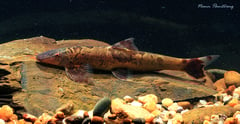
Homaloptera confuzona
Balitoridae · Kottelat, 2000
Homaloptera confuzona is a 'lizard' loach mostly recorded from the Mekong basin in Laos and Cambodia, and from smaller drainages in southern Thailand. It appears in the trade from time to time, though not always identified correctly. It resembles H. orthogoniata and H. parclitella, but its saddle-shaped markings are more irregular, up to four in number, and often restricted to the upper half of the body.
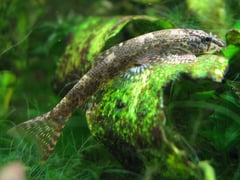
Homalopteroides smithi
Balitoridae · Hora, 1932
Homalopteroides smithi is a hillstream loach from Thailand, Peninsular Malaysia and parts of the Mekong basin in Laos, Cambodia and Vietnam. Perhaps the best-known member of the genus, it is relatively common in the aquarium hobby, and Rainboth (1996) considered it 'probably the commonest member of the genus in the Mekong'. An obligate dweller of swiftly-flowing streams and headwaters, it needs clean, well-oxygenated water.
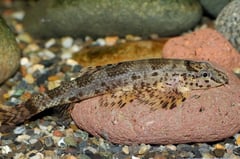
Homalopteroides tweediei
Balitoridae · Herre, 1940
Homalopteroides tweediei is a small hillstream loach from Peninsular Malaysia, the Mekong system and West Kalimantan in Indonesian Borneo. It is often confused with the congener H. smithi. Rainboth (1996) found it less likely to occur in riffles or runs than other members of the genus, and it shows a preference for moderately-flowing stretches of clear, oxygen-rich streams among patches of live or dead vegetation.

Hypsibarbus lagleri
Cyprinidae · Rainboth, 1996
Hypsibarbus lagleri is a large cyprinid endemic to the middle Mekong basin in Laos, eastern Thailand and Cambodia. It migrates seasonally, living in larger river channels in the dry season and moving into smaller tributaries and flooded forests in the wetter months. Growing to 350 mm, it is a valued food fish, and like most of its congeners is thought to be in decline because of the damming of rivers and agriculture.

Hypsibarbus vernayi
Cyprinidae · Norman, 1925
Hypsibarbus vernayi is a cyprinid widespread in mainland Southeast Asia, from the Mekong basin in southern China to northern Peninsular Malaysia. Very similar to H. wetmorei, it has yellow pectoral, pelvic and anal fins (orange to red in H. wetmorei), so yellow-finned fish sold as H. wetmorei or 'lemon fin barb' appear likely to be this species. It prefers flowing water with abundant riparian vegetation and migrates seasonally.

Hypsibarbus wetmorei
Cyprinidae · Smith, 1931
Hypsibarbus wetmorei is a cyprinid widespread in mainland Southeast Asia, from the lower Mekong basin south to the Pahang River in Malaysia. Its orange to red pectoral, pelvic and anal fins separate it from the very similar H. vernayi (yellow), and yellow-finned fish traded as H. wetmorei or 'lemon fin barb' appear likely to be that species. It prefers flowing water with abundant riparian vegetation and grows to 250 mm.

Kryptopterus bicirrhis
Siluridae · Valenciennes, 1840
Kryptopterus bicirrhis is a silurid catfish from much of Southeast Asia, including the Mekong and Chao Phraya and the Greater Sunda Islands. Uncommon in the aquarium trade, its name was widely misapplied to K. vitreolus in older literature, but the two are easily told apart because K. bicirrhis does not have a transparent body in life. It tends to form schools, so four or more should be kept.

Kryptopterus geminus
Siluridae · Ng, 2003
Kryptopterus geminus is a silurid catfish from the lower and middle Mekong in Thailand, Laos, Cambodia and Vietnam, and the lower Chao Phraya. Wild populations were formerly considered K. cryptopterus, and it is likely to be traded as that very similar species. It differs in having a narrower head, a longer snout and anal fin and more laterally-placed eyes, and inhabits flowing rivers and larger streams with turbid water.

Kryptopterus limpok
Siluridae · Bleeker, 1852
Kryptopterus limpok is a silurid catfish widely distributed through Southeast Asia, including the Mekong and the Greater Sunda Islands. It can be told from its congeners by an extremely long mental barbel extending beyond the tip of the pectoral fin. It inhabits flowing rivers and larger streams with turbid water, grows to 260 mm and is almost unheard of in the ornamental trade.

Labiobarbus leptocheilus
Cyprinidae · Valenciennes, 1842
Labiobarbus leptocheilus is a large cyprinid widespread in Southeast Asia, from the Mekong and Salween to the Greater Sunda Islands. Different populations vary somewhat in appearance, and it may turn out to represent a group of closely-related species. The Cambodian Mekong population has been considered a distinct species, Labiobarbus lineatus, and that name is widely used in the ornamental trade although it is currently a synonym. It grows to 260 mm SL and needs spotless, well-oxygenated water.

Laubuka caeruleostigmataFlying Minnow
Cyprinidae · Smith, 1931
The flying minnow, Laubuka caeruleostigmata, is a cyprinid from the Mekong system in Laos, Thailand and Cambodia, and the Chao Phraya and Mae Klong. Also known as 'leaping barb', it was once quite common in the ornamental trade and has apparently become scarce in the wild. It schools near the surface in main river channels, has a bright blue spot on top of the head, and is an accomplished jumper that needs a tightly-fitting cover.

Laubuka siamensis
Cyprinidae · Fowler, 1939
Laubuka siamensis is a cyprinid from the Mekong, the Chao Phraya and Mae Klong in Thailand, and smaller drainages south to Peninsular Malaysia. Long considered synonymous with L. laubuca, it seems likely to be the species behind many of the fish entering the trade under that name. A conspicuous dark stripe, iridescent blue in life, runs uninterrupted along the rear of the body to an oval blotch on the caudal peduncle. It swims in groups at or just below the surface and is an accomplished jumper.
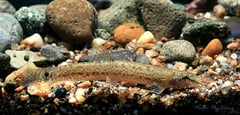
Lepidocephalichthys berdmorei
Cobitidae · Blyth, 1860
Lepidocephalichthys berdmorei is a cobitid loach found across Myanmar, Thailand, Laos, north-eastern India and Bangladesh. One of the most frequently-traded members of the genus, it is an excellent choice for those new to keeping loaches. Unlike most congeners it shows a preference for headwaters and streams with clear, flowing water, and its larger adult size separates it from the similar L. thermalis.
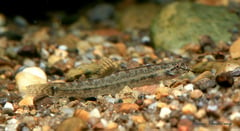
Lepidocephalichthys hasselti
Cobitidae · Valenciennes, 1846
Lepidocephalichthys hasselti is a cobitid loach described from Java and recorded from Myanmar to Vietnam, Peninsular Malaysia, Sumatra and Borneo. Its wide distribution makes it relatively common in the aquarium hobby. Colour and pattern vary with locality and have led to problems with identification, and the flanks usually show a row of dark blotches or a solid stripe with a light, unpigmented stripe above.
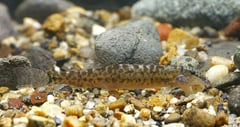
Lepidocephalichthys kranos
Cobitidae · Havird & Page, 2010
Lepidocephalichthys kranos is a cobitid loach from the Chao Phraya system in Thailand and the Mekong in Thailand, Laos and Vietnam. Some private collectors have kept it. Its colour pattern tends to form a mosaic, unlike the irregular spotting of most congeners, and the body deepens steeply behind the snout to give a 'hunched' appearance. It can often be found living with L. hasselti.
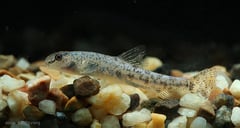
Lepidocephalichthys zeppelini
Cobitidae · Havird & Tangjitjaroen, 2010
Lepidocephalichthys zeppelini is a tiny cobitid loach from the Mekong system in Thailand and Vietnam and the Chao Phraya drainage in central Thailand. Adults reach only 25.8 mm SL, and the lamina circularis of mature males forms a large, finely serrated flange. Many adults at the type locality were collected from remnant ephemeral pools in otherwise dry agricultural land.

Lobocheilos melanotaenia
Cyprinidae · Fowler, 1935
Lobocheilos melanotaenia is a grazing cyprinid from the Mekong in Laos, Thailand, Cambodia and Vietnam, plus the Dong Nai, Chao Phraya and Mae Klong. One of the most abundant species in the seasonal cyprinid migrations of the mainstream Mekong, it is available on a sporadic basis. It is told from L. rhabdoura by its deeper body, narrower mouth and a dark area in the dorsal-fin. It can be aggressive at feeding times and is not particularly tolerant of conspecifics.

Lobocheilos rhabdoura
Cyprinidae · Fowler, 1934
Lobocheilos rhabdoura is a grazing cyprinid from Indochina, found in the Mekong, Chao Phraya and Mae Klong systems and south to Peninsular Malaysia. One of the most abundant species in the seasonal cyprinid migrations of the mainstream Mekong, it is available on a sporadic basis. It differs from L. melanotaenia in its shallower body, wider mouth and larger snout tubercules. It can be aggressive at feeding times and is not particularly tolerant of conspecifics.

Luciosoma bleekeri
Cyprinidae · Steindachner, 1878
Luciosoma bleekeri is a slender, pike-like cyprinid from the Mekong in Laos, Thailand, Cambodia and Vietnam, and from central and western Thailand. Subadults are traded regularly as 'apollo shark' or 'shark minnow' and it is frequently confused with L. setigerum, which has a series of black spots on the lateral line scales that this species lacks. It needs the largest private aquaria, and feeds mainly on terrestrial insects taken at the surface.

Luciosoma setigerumApollo Shark
Cyprinidae · Valenciennes, 1842
The apollo shark, Luciosoma setigerum, is a slender cyprinid found across much of Southeast Asia, from the Mekong basin to Borneo, Sumatra and Java. Subadults are traded regularly and are frequently confused with L. bleekeri, which lacks the series of black spots on the lateral line scales. A similar fish of unknown origin with no stripe on the front of the body is also common in the trade, listed as L. cf. setigerum. It needs the largest private aquaria.

Macropodus opercularisParadise Fish
Osphronemidae · Linnaeus, 1758
The paradise fish, Macropodus opercularis, is a labyrinth fish from China south of the Yangtze, including Taiwan and Hainan, plus Vietnam and Laos. Imported to France in 1869, it was among the very first ornamental fish brought to Europe. Wild examples are uncommon in the hobby since it is farmed extensively, and xanthic, albino, red, blue and stripeless strains exist. Males are territorially aggressive, especially when breeding, and should not be housed together unless the aquarium is very large.
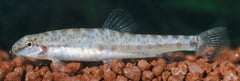
Microcobitis misgurnoides
Cobitidae · Rendahl, 1944
Microcobitis misgurnoides is a small cobitid loach from central Vietnam and the Mekong system in eastern Laos, growing to 41 mm SL. It was described in Cobitis and stayed there for over 60 years until Bohlen and Harant (2011) moved it to the new genus Microcobitis. It apparently lives in groups, and a soft, sandy substrate probably suits it best.

Mystacoleucus greenwayi
Cyprinidae · Pellegrin & Fang, 1940
Mystacoleucus greenwayi is a riverine cyprinid from the middle Mekong basin in Thailand and Laos and the Chao Phraya watershed. It favours clear, well-oxygenated running water over sand or gravel, often in rock and boulder-filled headwater streams. A schooling fish, it should be kept in a group of six or more alongside similarly-sized cyprinids, loaches and other riverine fishes, and like all Mystacoleucus it has a forward-pointing predorsal spine that can snag in a net.

Mystacoleucus obtusirostris
Cyprinidae · Valenciennes, 1842
Mystacoleucus obtusirostris is a riverine cyprinid found from Myanmar and southwestern China to Vietnam, Borneo, Sumatra and Java. Referred to as M. marginatus for decades, it is the most widely distributed member of the genus, and populations vary somewhat in colour pattern. It is occasionally marketed as 'Burmese rainbow barb'. A group of six or more is the smallest to consider, and like all Mystacoleucus it has a forward-pointing predorsal spine that can snag in a net.
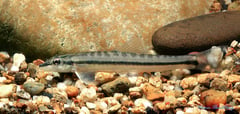
Nemacheilus longistriatusLaos Blackline Torpedo Loach
Nemacheilidae · Kottelat, 1990
The Laos blackline torpedo loach, Nemacheilus longistriatus, is a nemacheilid loach from the Mekong in Thailand and Laos. It has been collected from the main river channel and from backwaters over bedrock or sand. It is occasionally exported for the aquarium hobby and is told apart from the similar N. binotatus by the dark saddles along its back. A naturally reclusive loach, it becomes more confident alongside schools of peaceful, open water-dwelling cyprinids.

Nemacheilus pallidus
Nemacheilidae · Kottelat, 1990
Nemacheilus pallidus is a nemacheilid loach from the Mae Klong, Chao Phraya and Mekong systems in Thailand, Laos, Cambodia and Vietnam. It inhabits streams and small rivers with clear to turbid water and substrates of mud, sand or small rocks. The similar-looking N. masyae is sometimes traded under this name, but N. pallidus has a deeper body and dark bars and saddles thinner than the light interspaces between them.
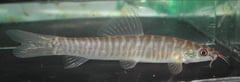
Nemacheilus platiceps
Nemacheilidae · Kottelat, 1990
Nemacheilus platiceps is a nemacheilid loach native to the Mekong basin in Laos, Thailand, Cambodia and Vietnam, and the Dong Nai system. It has been collected from shallow, slow-moving hill stream pools where leaf litter collects, and from faster-flowing stretches over gravel. It is only occasionally available in the aquarium trade and has 12-16 dark, irregular body bars, usually split vertically.

Opsarius caudiocellatus
Cyprinidae · Chu, 1984
Opsarius caudiocellatus is a cyprinid known only from the Salween in southern China, Myanmar and western Thailand, and the upper Mekong in Yunnan. It is named for the black round spot at the caudal-fin base, which with its black dorsal-fin rays separates it from similar congeners. It may have appeared in the aquarium trade, though probably not under the correct name, and inhabits well-oxygenated, moderate to fast-flowing rivers and streams.

Opsarius infrafasciatus
Cyprinidae · Fowler, 1934
Opsarius infrafasciatus is a cyprinid from the Ping river in Thailand, the Ataran and Salween in Myanmar and China, and Mekong tributaries in China. Once considered synonymous with both O. ornatus and O. pulchellus, it has been treated as distinct since Tejavej (2012). It typically inhabits headwaters and minor rivers and streams with moderate to fast flow, and a small caudal spot is among the characters separating it from congeners.

Opsarius koratensis
Cyprinidae · Smith, 1931
Opsarius koratensis is a cyprinid of the middle and lower Mekong in Thailand, Laos and Cambodia, and the Chao Phraya, Mae Klong and Dong Nai systems. It apparently inhabits larger, deeper and more turbid rivers than many congeners. Genetic evidence from Tang et al. (2010) suggests it may represent a distinct genus, and it occasionally appears in the ornamental trade.

Opsarius pulchellus
Cyprinidae · Smith, 1931
Traded as 'butterfly barb' or 'mackerel barb', Opsarius pulchellus is a cyprinid from the Chao Phraya and mid-to-lower Mekong basins. It occurs in Thailand, Laos, Cambodia and Vietnam, typically in submontane headwaters and fast-flowing minor rivers and streams. Also sold as 'royal opsarius', it carries 7-10 elongate vertical bars on each flank, and like its congeners is too fast and vigorous a feeder for the general community.

Oryzias mekongensisMekong Ricefish
Adrianichthyidae · Uwa & Magtoon, 1986
Oryzias mekongensis, the Mekong ricefish, is endemic to the Mekong River system in northeastern Thailand, Laos and Cambodia. It reaches about 21 mm SL and is known only from fresh water, mainly clear water swamps, canals, ditches and ponds with dense fine-leaved plants. Males have bright orange-red marginal bands on the caudal-fin lobes, and it may be sold as the 'Mekong redfin lampeye killifish'.

Oryzias songkhramensis
Adrianichthyidae · Magtoon, 2010
Oryzias songkhramensis is a small ricefish known only from the Songkhram River basin in northeastern Thailand and the Mekong drainage in Laos. It lives only in fresh, normally standing water such as shallow pools, ditches, rice paddies and clear water swamps. Males have black and yellow or orange marginal bands on the caudal-fin lobes, and there is a black spot at the base of the pectoral fins. It resembles O. mekongensis, which has been available in the hobby.
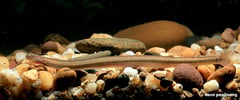
Pangio anguillaris
Cobitidae · Vaillant, 1902
Traded as 'eel loach', Pangio anguillaris is a cobitid loach from Borneo, Sumatra, Peninsular Malaysia and the Chao Phraya and Mekong basins. It has an extremely elongated, worm-like body with 69-71 vertebrae and no nasal barbels, and is most commonly available as bycatch among shipments of other fishes. The species as currently recognised appears to represent a complex of closely-related taxa.
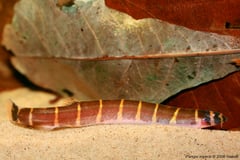
Pangio myersiGiant Kuhli Loach
Cobitidae · Harry, 1949
The giant kuhli loach, Pangio myersi, is a barred cobitid loach from the lower Mekong basin in Laos, Cambodia, Vietnam and Thailand. Traded regularly and also known as 'Myer's loach', it has 8-11 very broad dark bars on an orange body. A submarginal dark bar or row of spots on the caudal-fin separates young or undernourished imports from P. kuhlii and P. semicincta. Albino and leucistic forms are also available, though it is unclear whether these occur naturally.

Pethia stoliczkana
Cyprinidae · Day, 1871
Pethia stoliczkana is a small cyprinid that appears to range from Manipur state in northeastern India through Myanmar and Thailand to western Laos. Much of the literature confuses it with P. ticto, but the two do not occur in the same waters and the lateral line is complete in this species and incomplete in P. ticto. The form from Mandalay division in Myanmar is sometimes sold as Puntius sp. 'pearlscale'. It mostly inhabits shady, flowing streams and tributaries.
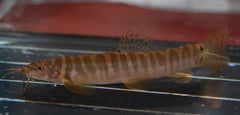
Pogonoschistura kohchangensisOrnate Tiger Sand Loach
Nemacheilidae · (Smith, 1933)
The ornate tiger sand loach, Pogonoschistura kohchangensis, is a nemacheilid loach from southeastern Thailand and southwestern Cambodia. Described from a waterfall stream on Koh Chang island, it appears in the trade from time to time but is not well known in the hobby. It has 10-12 dark brown vertical bars, usually split vertically, and inhabits shallow, often high-gradient streams with moderate to fast flow, surviving the dry months in isolated pools at some localities.

Puntigrus partipentazona
Cyprinidae · Fowler, 1934
Puntigrus partipentazona is a small cyprinid recorded from numerous river basins in Vietnam, Cambodia, Laos, Thailand and Peninsular Malaysia. It is easily told from congeners because the dark blotch on its dorsal fin extends onto the body. Typically found in heavily vegetated parts of rivers and sluggish streams, it is generally peaceful, though rival males continually battle for position within the group.
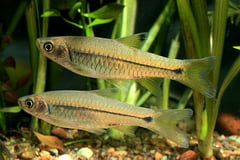
Rasbora dorsinotata
Cyprinidae · Kottelat, 1987
Rasbora dorsinotata is a small rasbora from the Mekong and upper Chao Phraya river basins in northern Thailand and northern Laos. It shows a preference for smaller tributaries containing clear, flowing water and is apparently abundant in such habitats. Poorly documented in the aquarium literature, it can be told from similar species by the black tip to its dorsal fin and a black lateral stripe ending in a rounded spot on the caudal peduncle.
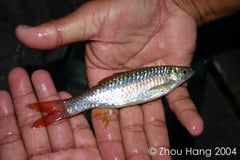
Rasbora tornieri
Cyprinidae · Ahl, 1922
Rasbora tornieri is a cyprinid from Sumatra, Borneo, Peninsular Malaysia and the Mekong drainage in Cambodia. Its identity was unclear for decades before its redescription by Ng and Kottelat (2013). It is very similar to R. dusonensis, which shares the Musi river with it, but its caudal fin is carmine red, against bright yellow in R. dusonensis. It lives in flowing streams and peat swamp blackwaters alike.

Rhinogobius mekongianus
Gobiidae · Pellegrin & Fang, 1940
Rhinogobius mekongianus is a goby from the middle and upper Mekong basin in Laos, Vietnam and Thailand. Its name has been misapplied in the aquarium trade to the congener R. chiengmaiensis, and it does not appear to have been on the market itself. It has 7-8 irregular dark markings on the body (vs. 5 in R. chiengmaiensis), and records from the Chao Phraya drainage most likely refer to that species.
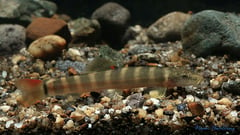
Schistura kengtungensis
Nemacheilidae · Fowler, 1936
Schistura kengtungensis is a nemacheilid loach from the middle Mekong basin in Thailand, Myanmar, Laos and Yunnan Province, southern China. It has 9-13 vertical bars as wide as or wider than the interspaces, and specimens from China differ from those in Thailand and Myanmar in several morphological characters. It inhabits shallow, narrow branches of streams over gravel or stone.
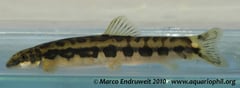
Schistura kloetzliae
Nemacheilidae · Kottelat, 2000
Schistura kloetzliae is a nemacheilid loach known only from the Mengla River system in Yunnan, China, and Luang Namtha province, northern Laos. It appears restricted to highly-oxygenated, fast-flowing riffles of small to medium streams with clear water and no aquatic plants. A series of large black blotches along the lateral line, each connected with blotches on the dorsal midline, separates it from congeners.
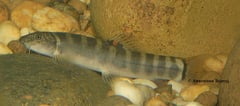
Schistura nicholsi
Nemacheilidae · Smith, 1933
Schistura nicholsi is a nemacheilid loach widespread in the Mekong basin in Laos and Thailand, and it may also occur in Cambodia. It is sometimes traded for aquaria, but its name also appears to have been widely misapplied to other fishes. It has 8-10 quite regular dark bars wider than the light interspaces. It has been bred in an aquarium, although the adults seem to consume both eggs and fry.
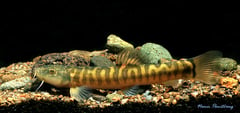
Schistura schultzi
Nemacheilidae · Smith, 1945
Schistura schultzi is a nemacheilid loach from Mekong tributaries in northern Thailand, and probably also Bokeo province in Laos. The full extent of its range is unclear. It grows to at least 93 mm and has 13-18 relatively thin dark body bars. Its aquarium behaviour is unknown, but slow-moving, long-finned or very placid tankmates are not recommended.
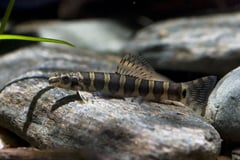
Serpenticobitis octozona
Serpenticobitidae · Roberts, 1997
Serpenticobitis octozona is a small loach apparently endemic to the Sekong River basin in southern Laos, part of the lower Mekong system. Sometimes sold as 'serpent loach', it shows a degree of social interaction and can cling to vertical or overhanging surfaces. The type species of its genus, it has 7-8 dark bars on each flank, much wider than the pale interspaces. It lives in shallow, fast-flowing, highly-oxygenated headwaters and minor tributaries.
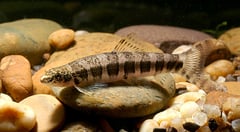
Serpenticobitis zonata
Serpenticobitidae · Kottelat, 1998
Serpenticobitis zonata is a small loach from the Xe Bangfai and Xe Bang Hiang drainages in Laos, and Chanthaburi province in south-eastern Thailand. Fish sold under this name are sporadically available, but the majority appear to be the congener S. octozona. S. zonata has a pale body with 7-8 regular dark vertical bars, sometimes with thin dark bars on the interspaces. It inhabits shallow, fast-flowing, highly-oxygenated headwaters and minor tributaries.
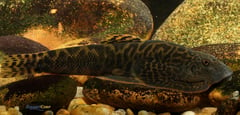
Sewellia elongata
Gastromyzontidae · Roberts, 1998
Sewellia elongata is a hillstream loach from the Bolovens plateau in southern Laos, also recorded in the upper Se Kong drainage in central Vietnam. The largest described Sewellia, growing to at least 73 mm SL, it is most similar to S. diardi but has a relatively slender, elongate body. It appeared in the aquarium trade during 2010 and inhabits shallow, fast-flowing, highly-oxygenated headwaters with riffles and runs.
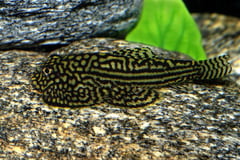
Sewellia lineolataTiger Hillstream Loach
Gastromyzontidae · Valenciennes, 1846
The tiger hillstream loach, Sewellia lineolata, is a gastromyzontid loach from fast-flowing headwaters in Vietnam and on the Mekong in Laos. Three to five dark stripes on the body make it difficult to confuse with any other member of the genus. The water must be clean, fast-flowing and well-oxygenated, and Sewellia species are arguably the easiest of all loaches to breed in aquaria.
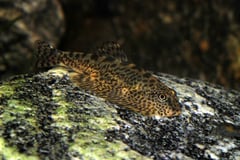
Sewellia speciosa
Gastromyzontidae · Roberts, 1998
Sewellia speciosa is a hillstream loach that appears endemic to the Xe Kong river drainage in central Vietnam and southern Laos. It first became available in early 2010 and sometimes appears on trade lists as 'Laos sucker' or 'Laos Sakura sucker'. The spotted body without stripes separates it from the morphologically similar S. lineolata, which is striped, and it inhabits shallow, fast-flowing, highly-oxygenated headwaters.
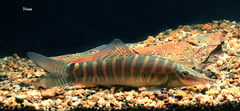
Syncrossus helodesBanded Tiger Loach
Botiidae · Sauvage, 1876
The banded tiger loach, Syncrossus helodes, is a botiid loach from the Mekong in Laos, Cambodia, Vietnam and Thailand, and the Chao Phraya. Reaching 250-300 mm, it lives in flowing waters from headwater streams to main channels and migrates into flooded areas in the wet season to feed and spawn. It is sometimes confused with S. hymenophysa but has small dark markings on the lower body, no dark spot in the dorsal fin and 10-12 bars without bluish borders.

Systomus orphoides
Cyprinidae · Valenciennes, 1842
Systomus orphoides is a large cyprinid ranging from Myanmar to Vietnam and south through Peninsular Malaysia to Borneo, Sumatra and Java. It mostly inhabits flowing tributaries and large streams, moving onto inundated farmland and forest in the wet season to feed and spawn. Not often available in the trade and usually seen as bycatch, it grows to 250 mm SL, is quite boisterous, and needs more-or-less spotless water.

Trichopsis pumilaSparkling Gourami
Osphronemidae · Arnold, 1936
The sparkling gourami, Trichopsis pumila, is a small labyrinth fish from the lower Mekong basin and central and southern Thailand. Also known as the pygmy gourami, it has a solid dark midlateral stripe topped by a row of dark blotches, which with its small size separates it from T. schalleri. Both sexes produce audible 'croaking' sounds with a specialised pectoral mechanism, and most traded fish are produced commercially.

Trichopsis schalleri
Osphronemidae · Ladiges, 1962
Trichopsis schalleri is a croaking gourami from the lower Mekong basin and the Chao Phraya watershed in Thailand, Laos, Cambodia and Vietnam. Sometimes called the Mekong croaking gourami or three-stripe gourami, it is larger than the similar T. pumila, and its upper body stripe varies with mood and sometimes fades entirely. Peaceful unless breeding, it can be kept in a pair or a group.

Trichopsis vittataCroaking gourami
Osphronemidae · Cuvier, in Cuvier & Valenciennes, 1831
The croaking gourami, Trichopsis vittata, is a labyrinth fish found through much of Indochina, Peninsular Malaysia and Singapore. The largest of its genus, it produces audible sounds with a specialised pectoral mechanism unique within the Osphronemidae. Wild populations vary in colour pattern, and records from Borneo, Sumatra and Java might refer to a distinct species.

Xenentodon cancilaFreshwater Needlefish
Belonidae · Hamilton, 1822
The freshwater needlefish, Xenentodon cancila, is a belonid from Pakistan east through India, Bangladesh, Nepal, Sri Lanka, Myanmar and Thailand. Often called 'freshwater garfish', it only superficially resembles the true gars, and most of its relatives in the Belonidae are marine or estuarine. A near-exclusive inhabitant of the upper water column, it is surprisingly peaceful with anything too large to swallow and is best kept in numbers of four or more, in a tank of 180 ∗ 60 cm or more.

Xenentodon canciloides
Belonidae · Bleeker, 1854
Xenentodon canciloides is a freshwater needlefish from Borneo, Sumatra, Peninsular Malaysia and Thailand, and is considered to occur in the Mekong. Rarely seen in the ornamental trade, it is far less common there than its congener X. cancila, from which it differs in its slender, delicate jaws and smaller size, not exceeding 30 cm TL. A near-exclusive inhabitant of the upper water column, it is surprisingly peaceful with anything too large to swallow and is best kept in numbers of four or more.
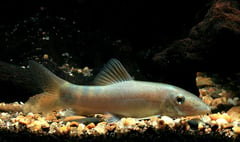
Yasuhikotakia caudipunctataSpeckle-tailed Loach
Botiidae · Taki & Doi, 1995
The speckle-tailed loach, Yasuhikotakia caudipunctata, is a botiid loach described from the Mekong drainage in Laos, near Pakse and Vientiane. Relatively rare in the aquarium trade and much sought after, it looks similar to Y. splendida but has numerous small blackish spots in the dorsal and caudal fins. SF members report it milder in temperament than some congeners, and it needs an aquarium with a base of at least 120 ∗ 30 cm.
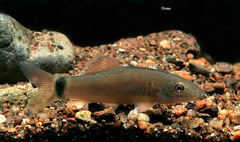
Yasuhikotakia eosSun Loach
Botiidae · Taki, 1972
The sun loach, Yasuhikotakia eos, is a botiid loach from the middle and lower Mekong in Laos, Cambodia and Thailand, and the Dong Nai in Vietnam. Its yellow to reddish brown body with a metallic sheen and a large dark marking on each side of the caudal peduncle make it difficult to confuse with any congener. It has a reputation for aggression and can be fiercely territorial where space or shelter is limited, so it suits only larger, well-structured aquaria with other sturdy fishes.
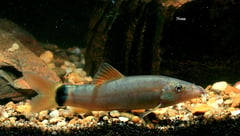
Yasuhikotakia leconteiSilver Loach
Botiidae · Fowler, 1937
The silver loach, Yasuhikotakia lecontei, is a botiid loach from the middle and lower Mekong and the Chao Phraya and Mae Klong drainages of Thailand. Sometimes confused with Y. modesta, it is a slimmer, more elongate fish, usually brownish with a gold/green sheen, and its roundish caudal peduncle markings do not meet on the ventral surface. It forages under cover of dusk and darkness, and SF members report it milder in temperament than Y. eos and Y. morleti.
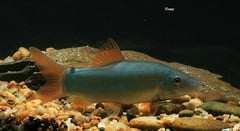
Yasuhikotakia modestaRedtail Loach
Botiidae · Bleeker, 1864
The redtail loach, Yasuhikotakia modesta, is a botiid loach from the middle and lower Mekong and the Chao Phraya and Mae Klong drainages of Thailand. One of the more commonly encountered botiids in the hobby, it is also sold as 'blue', 'orange-finned' or 'red-finned' botia. Some fish are dyed and sold as 'blueberry' or 'raspberry' loach, and their health is normally compromised by the process. Deeper-bodied than the similar Y. lecontei, it grows to 250 mm and needs an aquarium with a base of at least 150 ∗ 45 cm.
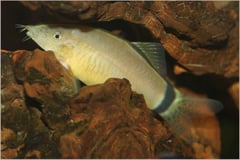
Yasuhikotakia morletiSkunk Loach
Botiidae · Tirant, 1855
The skunk loach, Yasuhikotakia morleti, is a botiid loach from the middle and lower Mekong and the Chao Phraya and Mae Klong drainages of Thailand. Common in the hobby, where most fish are farmed commercially, it is also sold as 'skunk botia' or 'Hora's loach'. The dark stripe over its dorsal surface separates it from the similar Y. longidorsalis. It can be combative, nipping fins and harassing tankmates, especially when kept in smaller groups.

Allenbatrachus grunniensFreshwater Toadfish
Batrachoididae · Linnaeus, 1758
The freshwater toadfish, Allenbatrachus grunniens, is a euryhaline toadfish from the Ganges delta in India and Bangladesh east to the Philippines. It is relatively common in the hobby and, contrary to popular belief, not venomous, but its dorsal and opercular spines can pierce the skin, so it needs netting with extreme caution. It rarely does well when kept in freshwater for prolonged periods.

Anabas testudineusClimbing Perch
Anabantidae · Bloch, 1792
The climbing perch, Anabas testudineus, is a labyrinth fish found from Pakistan and Sri Lanka east to southern China, Indonesia and Singapore. It lives in almost every kind of lowland water from rice paddies to main river channels, and can cross several hundred metres of land provided it stays moist. Its taxonomy is confused, and additional taxa probably exist. Its size and predatory nature make it unsuitable for the general community.

Bagarius suchusCrocodile Catfish
Sisoridae · Roberts, 1983
The crocodile catfish, Bagarius suchus, is a sisorid catfish from the Mekong system in Thailand, Laos and Cambodia and the Chao Phraya in Thailand. Reaching 650 to 700 mm SL, it is clearly unsuitable for the home aquarium. An exposed, rugose cranium, sharp ridges on the predorsal plate and a row of prominent humps along the back separate it from congeners. It is mostly collected from turbulent rapids in larger rivers, where it shelters among boulders and large rocks.

Bagarius yarrelliGoonch
Sisoridae · Sykes, 1839
The goonch, Bagarius yarrelli, is a very large sisorid catfish recorded from the Indus in Pakistan east through Indochina to Sumatra and Borneo. Also known as the 'giant devil catfish' and 'sand shark', it reaches 1300 to 2000 mm and is fished for food across much of its range. That wide distribution appears doubtful, and Indian and Southeast Asian populations may prove not to be conspecific. It lives among boulders in the fast, turbulent rapids of large rivers.

Brachygobius aggregatusSchooling Bumblebee Goby
Gobiidae · Herre, 1940
The schooling bumblebee goby, Brachygobius aggregatus, is a small goby described from the Philippines and recorded from the lower Mekong in Vietnam. The name appears on ornamental trade lists quite often but seems to be routinely misapplied to other species, particularly B. doriae-type fishes. It is very similar to B. kabiliensis, and both are best considered nominal taxa for now since several species might be involved. Small live foods are probably essential.

Channa maruliusBullseye Snakehead
Channidae · Hamilton, 1822
The bullseye snakehead, Channa marulius, is a large snakehead recorded from Pakistan across southern Asia to southern China, Laos and Vietnam. Also called the 'giant', 'cobra' or 'Indian' snakehead, it is widely accepted to represent a complex of related species in need of further research. Reports of 120-180 cm remain to be proven, with 500-600 mm a more common adult size, and it is suitable only for public installations or the very largest private aquaria.

Channa micropeltesGiant Snakehead
Channidae · Cuvier, 1831
The giant snakehead, Channa micropeltes, is a predatory fish from Southeast Asia that grows to well over a metre. Juveniles are sold as 'red' or 'redline' snakehead, but it is suitable only for public installations or the very largest private aquaria. Unlike most Channa species it is pelagic and needs plenty of room to swim, and adults become aggressive at sexual maturity.

Chitala blanciRoyal Featherback
Notopteridae · d'Aubenton, 1965
The royal featherback, Chitala blanci, is a very large notopterid endemic to the Mekong drainage in Laos, Thailand, Vietnam and Cambodia. Also sold as the 'royal knifefish', it reaches 1200 mm SL and arguably has no place in the ornamental hobby, being suitable only for public installations or the very largest private aquaria. Many small dark spots on the front of the body merge into oblique stripes, and it is thought to be threatened by dam construction.

Chitala lopisGiant Featherback
Notopteridae · Bleeker, 1851
The giant featherback, Chitala lopis, is a notopterid accepted to range from the Mekong basin to Peninsular Malaysia, Sumatra, Borneo and Java. That range appears to require confirmation: it may already be extinct on Java, and the species may comprise several closely-related taxa. Older juveniles and adults lack the dark body markings of other Chitala and have a more pronounced jaw, and at up to 1500 mm SL it is suitable only for public installations or the very largest private aquaria.

Chitala ornataClown Featherback
Notopteridae · Gray, 1831
The clown featherback, Chitala ornata, is a large notopterid native to the Mae Klong, Chao Phraya and Mekong river systems of Thailand and Indochina. Also traded as the 'clown knifefish', it has rows of large ocellated spots above the anal-fin base and is regularly misidentified as C. chitala. It grows to 1000 mm SL and arguably has no place in the ornamental hobby, yet it remains popular, with albino and leucistic forms line-bred for the purpose.

Crossocheilus cobitis
Cyprinidae · Bleeker, 1854
Crossocheilus cobitis is a cyprinid ranging from the Mekong drainage in Laos, Vietnam and Thailand south to Sumatra, Borneo and Java. Primarily a lowland species, it lives in the turbid lower reaches of rivers over mud, close to submerged logs and similar objects. Given its wide range it has probably reached the trade as the invalid 'Crossocheilus siamensis', and it is likely to represent a group of similar-looking, closely related species.

Cyclocheilos enoplos
Cyprinidae · Bleeker, 1849
Cyclocheilos enoplos is a large cyprinid from the Mekong region and Thailand south through Peninsular Malaysia to Borneo, Sumatra and Java. Growing to around 750 mm SL, it is clearly unsuitable for aquaria and scarce to non-existent in the ornamental trade. In the Mekong it makes long seasonal migrations, and adults move upstream above Khone Falls in what appear to be spawning migrations.

Datnioides pulcherSiamese Tiger Perch
Datnioididae · Kottelat, 1998
The Siamese tiger perch, Datnioides pulcher, is a large tiger perch from the Mae Klong, Chao Phraya, Mekong and Dong Nai river systems. Wild populations are hypothesised to have declined by more than 90% since the mid-1980s, and it has been locally extinct in Thailand since the 1990s. Highly sought after by aquarists, it usually has 4 broad dark bars, and D. microlepis is sometimes sold as D. pulcher to raise prices.

Garra fuliginosa
Cyprinidae · Fowler, 1934
Garra fuliginosa is a cyprinid from the Mekong basin in Thailand, Laos, Vietnam and Cambodia, and the Chao Phraya and Mae Klong in Thailand. It tends to inhabit swiftly-flowing headwaters and tributaries with clear, oxygen-saturated water. Like other Garra it has a lower lip modified to form a mental adhesive disc for clinging to surfaces. The body is dark with random lighter scales.

Hampala macrolepidotaHampala Barb
Cyprinidae · Kuhl & van Hasselt, 1823
The hampala barb, Hampala macrolepidota, is a cyprinid ranging from Myanmar through Thailand to the Mekong, and south to Borneo, Sumatra and Java. Also known as 'jungle perch' or 'sidebar barb', it can grow to over 2 feet and 5 kg and is a powerful, pelagic predator and not an aquarium subject in all but the most extreme circumstances. Prized as a food and sport fish, it has been introduced to numerous water bodies.

Hemibagrus spilopterus
Bagridae · Ng & Rainboth, 1999
Hemibagrus spilopterus is a bagrid catfish from the Mekong and several other river systems in Laos, Vietnam, Cambodia and Thailand. Relatively common in the ornamental trade, it has been widely misidentified as H. nemurus, a Javan species that may never have been exported for aquaria. Given its size of up to 500 mm SL, its aggressive nature and a lifespan of several decades, it shouldn't be considered a home aquarium subject in all but the most exceptional circumstances.

Hemibagrus wyckiiCrystal-eyed Catfish
Bagridae · Bleeker, 1858
The crystal-eyed catfish, Hemibagrus wyckii, is a bagrid with an enormous distribution across central Indochina and western Indonesia. Juveniles are sometimes available in the aquarium trade, but buying them is strongly discouraged: it reaches 710 mm SL, is aggressively territorial and can live for several decades. Despite the common name, the blue eye is not given as a distinguishing character in any diagnosis we've seen.

Hemibagrus wyckioidesAsian Red Tailed Catfish
Bagridae · Fang & Chaux, 1949
The Asian red tailed catfish, Hemibagrus wyckioides, is a bagrid from the Mekong system in China, Laos, Vietnam, Cambodia and Thailand. It also occurs in the Chao Phraya drainage. The largest bagrid in central Indochina, it reaches at least 900–1000 mm and 70–80 kg, and the largest specimen known measured 1300 mm. Juveniles are sometimes sold, but buying them is strongly discouraged given its size, aggression and a lifespan of several decades.

Hypsibarbus malcolmiGoldfin Tinfoil Barb
Cyprinidae · Smith, 1945
The goldfin tinfoil barb, Hypsibarbus malcolmi, is a large cyprinid from Thailand, Laos, Cambodia and Peninsular Malaysia. It occurs throughout the Mekong system and in the Chao Phraya and Maeklong drainages, and in the Mekong migrates seasonally between larger river channels and flooded forests. Reaching 400 to 500 mm, it is suitable only for public aquaria or the very largest private set-ups.

Incisilabeo behri
Cyprinidae · Fowler, 1937
Incisilabeo behri is a large cyprinid native to the Mekong river system in southern China, Laos, Thailand, Vietnam and Cambodia. Growing to 450 to 550 mm, it is patently unsuitable for the home aquarium, though juveniles are available on a relatively regular basis. The only member of its genus, it is separated from Bangana by a conspicuous transverse notch across the top of the head, and migrates seasonally up the Sekong, Sesan and Srepok rivers.

Labeo chrysophekadionBlack Shark
Cyprinidae · Bleeker, 1849
The black shark, Labeo chrysophekadion, is a large cyprinid from Southeast Asia, including the Mekong, Chao Phraya and the Greater Sunda Islands. Also known as the black sharkminnow, it reaches 600 mm and is aggressively territorial towards conspecifics and similarly-shaped fishes. It continues to be sold despite its patent unsuitability for the home aquarium, and an albino form has been selectively bred for the trade.

Leptobarbus rubripinnaRed-finned Cigar Shark
Cyprinidae · Fowler, 1937
The red-finned cigar shark, Leptobarbus rubripinna, is a large pelagic cyprinid from the Mekong, Chao Phraya and Mae Klong river systems of Indochina. For decades it was referred to as its congener L. hoevenii, and both are still traded under the same name. A popular sport fish growing to 800 to 1000 mm, it is wholly unsuitable for private aquaria despite being readily available at 100 to 150 mm. It has a broad dark midlateral stripe and orange to red pelvic and anal fins.

Macrochirichthys macrochirusGiant Sword Minnow
Cyprinidae · Valenciennes, 1844
The giant sword minnow, Macrochirichthys macrochirus, is a large pelagic cyprinid widespread in Southeast Asia, from the Mekong to Borneo and Sumatra. Growing to 600 to 800 mm and becoming increasingly piscivorous as it grows, it is unsuitable for the majority of private aquaria, although juveniles are traded on occasion. It is thought to have been extirpated from the Chao Phraya, Mae Klong, Lake Songkhla and Java, and the Mekong populations have been drastically reduced.

Mekongina erythrospila
Cyprinidae · Fowler, 1937
Mekongina erythrospila is a large cyprinid endemic to the middle and lower Mekong River system in Laos, Thailand, Cambodia and Vietnam. It tends to inhabit medium to large river channels with fast-flowing water and rocky beds. Occasionally in the ornamental trade, it grows to 400 to 450 mm and is unsuitable for most private aquaria. It can be aggressively territorial towards conspecifics and similarly-shaped fishes.

Notopterus notopterusBronze Featherback
Notopteridae · Pallas, 1769
The bronze featherback, Notopterus notopterus, is an air-breathing notopterid from the Indian subcontinent and Southeast Asia. Also called 'Asian knifefish' or 'ghost knifefish' in the trade, it grows to 600 mm and arguably has no place in the ornamental hobby given its adult size and specialised requirements. The single species in Notopterus is likely to represent a complex of closely-related species.

Phalacronotus apogon
Siluridae · Bleeker, 1851
Phalacronotus apogon is a large silurid catfish from much of Southeast Asia, including Thailand, the Mekong basin and the Greater Sunda Islands. It reaches 700 mm and arguably should not be considered a home aquarium subject at all, but juveniles are sometimes sold as 'blue neon sheatfish' or 'metallic cheatfish' without adequate information on long-term care. It is an important food fish across much of its native range.

Scleropages formosusAsian Arowana
Osteoglossidae · Müller & Schlegel, 1840
The Asian arowana, Scleropages formosus, is an osteoglossid from the Mekong system, eastern Thailand, Peninsular Malaysia, Sumatra and Borneo. Highly valued in the aquarium trade since the 1970s and listed on Appendix I of CITES since 1975, it is now extirpated across much of its range. It occurs in several colour forms, such as the 'super red' of the upper Kapuas, and three were described as species in 2003, though the majority view treats all of them as S. formosus pending review.

Amblyrhynchichthys micracanthus
Cyprinidae · Ng & Kottelat, 2004
Amblyrhynchichthys micracanthus is a riverine cyprinid from the Mekong catchment in Laos, Thailand, Cambodia and Vietnam, and the Chao Phraya system. It moves into inundated forest during the wet season, and wild fish feed on periphyton, plankton and benthic algae. Older records of A. truncatus from mainland Indochina all refer to this species, which has a straighter snout profile, a shorter dorsal-fin spine and fewer gill rakers.

Garra imberba
Cyprinidae · Garman, 1912
Garra imberba is a cyprinid without barbels from the upper Yangtze, Mekong and Red River basins in southern China, and the upper Red in Vietnam. Records from the Salween system result from confusion with the similarly-named G. imberbis. With G. micropulvinus it is placed in the Semilabeoina, for which the name Ageneiogarra has been suggested. It tends to inhabit swiftly-flowing headwaters and tributaries.

Garra mirofrontis
Cyprinidae · Chu & Cui, 1987
Garra mirofrontis is a cyprinid native to the upper Mekong (Lancangjiang) basin in Yunnan province, China. It is characterised by a transverse groove on the snout directly in front of the eyes, and a bifurcate proboscis with a conical keratinised tubercle at each tip. A typical habitat is a strongly-flowing river about 25 m across with a predominantly rocky substrate.

Garra theunensis
Cyprinidae · Kottelat, 1998
Garra theunensis is a large cyprinid from the Nam Theun and Nam Gnouang systems of the Mekong watershed in Laos, and the Nan River in Thailand. It grows to 300 mm SL and has a plain brown body and fins, sometimes with 6-8 faint longitudinal stripes. It tends to inhabit swiftly-flowing headwaters and tributaries with clear, oxygen-saturated water.

Gymnostomus lineatus
Cyprinidae · Smith, 1945
Gymnostomus lineatus is a riverine cyprinid from the middle to lower Mekong basin and the Chao Phraya, in China, Laos, Thailand and Cambodia. It is most often collected in mid-to-large channels, although in the Mekong basin it also enters smaller tributaries and inundated fields. It has a pair of small maxillary barbels and 5-6 faint, thin stripes along each flank, and has been placed in Henicorhynchus, Cirrhinus, Bangana and Labeo in the last few decades.

Gymnostomus lobatus
Cyprinidae · Smith, 1945
Gymnostomus lobatus is a cyprinid from the middle to lower Mekong basin in Laos, Thailand and Cambodia, and the Chao Phraya and Mae Klong in Thailand. It is considered one of the most abundant species in the massive seasonal migrations of cyprinids in the mainstream Mekong, and enters inundated forests in the wet season. The body is relatively slender and plain silver, with no dark marking on the caudal peduncle, and the snout often projects strongly.

Gymnostomus ornatapinnis
Cyprinidae · Roberts, 1997
Gymnostomus ornatapinnis is a small cyprinid known only from the Mekong River system in Laos, Thailand and Cambodia. It appears to favour still or slow-moving, often temporarily-inundated, marginal habitats away from the major river channels. Barbels are completely absent, the caudal peduncle is very deep, and the pectoral, pelvic and anal fins are usually reddish-orange or rose-tinted.

Gymnostomus siamensisSiamese Mud Carp
Cyprinidae · Sauvage, 1881
The Siamese mud carp, Gymnostomus siamensis, is a cyprinid from the Mekong, Chao Phraya and Mae Klong basins in Laos, Thailand, Cambodia and Vietnam. Common in the Mekong main channel and larger tributaries, it moves into inundated zones to spawn in the wet season and is abundant in the massive seasonal migrations of cyprinids. It has a relatively deep, plain silver body and a large, broad head.

Hemibagrus filamentus
Bagridae · Fang & Chaux, 1949
Hemibagrus filamentus is a bagrid catfish from the middle and lower Mekong river system in Laos, Cambodia and Thailand. It appears to be unknown in the aquarium trade but is a valued food fish within its native range, growing to 420 mm SL. It inhabits slowly-flowing or standing waters, including main river channels and lakes, and riverine populations typically migrate into flooded forest during the wet season.

Hypsibarbus pierreiYellow Eyed Silver Barb
Cyprinidae · Sauvage, 1880
The yellow eyed silver barb, Hypsibarbus pierrei, is a large cyprinid from the middle and lower Mekong basin in Laos, Thailand, Cambodia and Vietnam. It also occurs in the Dong Nai drainage, and migrates seasonally from larger river channels in the dry season to spawning grounds that remain unknown. Reaching at least 300 mm, it is a valued food fish, and most Hypsibarbus species are thought to be in decline because of the damming of rivers and agriculture.

Labeo pierrei
Cyprinidae · Sauvage, 1880
Labeo pierrei is a large cyprinid from the Mekong river system in southern China, Laos, Thailand, Cambodia and Vietnam, and the Dong Nai in Vietnam. It grows to 800 mm and inhabits main river channels and large, deep tributaries. It migrates seasonally, moving upstream into the Sekong, Sesan and Srepok rivers at the onset of the wet season and returning downstream in the dry months.

Labiobarbus siamensis
Cyprinidae · Sauvage, 1881
Labiobarbus siamensis is a cyprinid from the Mekong in Laos, Thailand and Cambodia, and the Chao Phraya and Bang Pakong in central Thailand. It inhabits rivers and streams of all sizes and moves into inundated floodplains and forests during the wet season. Wild fish feed on small items including phytoplankton, zooplankton, periphyton and benthic algae. Relatively long maxillary barbels, reaching well beyond the eye, help separate it from congeners.

Metzia bounthobi
Cyprinidae · Shibukawa, Phousavanh, Phongsa & Iwata, 2012
Metzia bounthobi is a cyprinid known only from the Nam Ou River basin, a Mekong tributary in northern Laos. It has been collected from hill streams with clear, slow to moderately fast-flowing water. It differs from all its congeners in having more branched anal-fin rays and more lateral line scales, and the genus itself remains unresolved in taxonomic terms.

Mystacoleucus atridorsalis
Cyprinidae · Fowler, 1937
Mystacoleucus atridorsalis is a pelagic cyprinid considered endemic to the lower Mekong basin in Laos, Thailand and Cambodia. It favours flowing lowland river channels and moves into flooded forest during the wet season. A triangular blotch at the tip of the dorsal fin helps separate it from congeners, and like all Mystacoleucus it has a forward-pointing predorsal spine that can become entangled in an aquarium net.

Mystacoleucus chilopterus
Cyprinidae · Fowler, 1935
Mystacoleucus chilopterus is a pelagic cyprinid from the middle Mekong, Chao Phraya and Mae Klong basins in Laos and Thailand. It favours flowing lowland rivers and swiftly-flowing forest streams with rock and gravel. The anal fin has a concave margin and the dorsal and caudal fins black margins, and like all Mystacoleucus it has a forward-pointing predorsal spine that can become entangled in an aquarium net.

Mystacoleucus ectypus
Cyprinidae · Kottelat, 2000
Mystacoleucus ectypus is a pelagic cyprinid from the middle Mekong basin in Laos and Thailand, and may be endemic to the Khorat Plateau. It inhabits flowing lowland rivers and swift tributary streams with rock and gravel. It has a triangular blotch at the tip of the dorsal fin but no black fin margins or crescent-shaped scale markings, and like all Mystacoleucus it has a forward-pointing predorsal spine that can snag in a net.

Mystacoleucus lepturus
Cyprinidae · Huang, 1979
Mystacoleucus lepturus is a riverine cyprinid known only from the upper Mekong basin in southern China, Laos and Thailand. It favours clear, well-oxygenated running water over sand or gravel. The body is relatively slender, with a black margin on the dorsal fin and many crescent-marked scales. Records from Vietnam and Hainan Island refer to other species. Like all Mystacoleucus it has a forward-pointing predorsal spine that can snag in a net.

Bagarius bagarius
Sisoridae · Hamilton, 1822
Bagarius bagarius is a sisorid catfish with a wide but disjointed recorded range, from the Indus in Pakistan east to the Mekong and Malay Peninsula. Its identity is confused: the name has been widely applied to a small fish said to reach only 200 mm SL, but it may be the only Bagarius in the Indian subcontinent, in which case it can reach 2 metres. It is mostly collected from fast, turbulent rapids in larger rivers, where it shelters among boulders, and is best kept alone.