River
Krishna
Only species with a profile on Seriously Fish are counted.
- Species
- 15
- Families
- 7
- Photographed
- 15 of 15
- Difficulty rated
- 15 of 15
Shares fishes withspecies recorded from both

Barilius bendelisis
Cyprinidae · Hamilton, 1807
Barilius bendelisis is a large, fast-swimming cyprinid from India, Bangladesh, Nepal and probably Bhutan. Occasionally sold as 'Indian hill trout' or 'Hamilton's baril', it has 8 to 12 bluish vertical bars and, in adults, a blue-black spot on each scale. It grows to around 200 mm SL and inhabits well-oxygenated, fast-flowing rivers and streams, and its speed and vigorous feeding make it unsuitable for the general community.
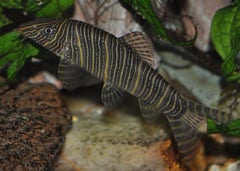
Botia striataZebra Loach
Botiidae · Narayan Rao, 1920
The zebra loach, Botia striata, is a botiid loach from the Krishna River system in southern India, described from the Tunga River in Karnataka. Its yellow to golden body with blue, green, grey or black bars and typically red mouthparts make it one of the most easily recognised in the genus, although the bars break up entirely in some specimens. Given its adult size and peaceable nature it is perhaps the best choice of Botia for the general community.

Devario malabaricusGiant 'Danio'
Cyprinidae · (Jerdon, 1849)
The giant 'danio', Devario malabaricus, is a deep-bodied devario from peninsular India, living in hill streams and upper parts of small rivers. Most older aquarium literature labels it D. aequipinnatus, but genetic and morphological data have shown the traded fish to be D. malabaricus. It has a blue-and-yellow colour pattern and a P stripe extending to the fork of the caudal-fin. Its true range is uncertain and may be confined to western-flowing drainages of India.

Garra bicornutaRhino Garra
Cyprinidae · Narayan Rao, 1920
The rhino garra, Garra bicornuta, is a cyprinid from the Tunga River in the upper Krishna drainage, Karnataka, southern India. No other Garra is known to have a pair of rostral processes, which males develop and hold erect when sparring. A blue opercular spot ringed with gold blotches also identifies it. It is traded as 'Tunga garra' or 'lionhead garra', and can be territorial, especially at feeding time.

Labeo bogaViolet Shark
Cyprinidae · Hamilton, 1822
The violet shark, Labeo boga, is a cyprinid from most major river systems in India, Pakistan, Nepal, Bangladesh and Myanmar. It inhabits major river channels and larger tributaries and grows to 250 mm, needing a tank of at least 240 x 60 cm. It is unsuitable for most home aquaria but turns up in the trade irregularly, also as the 'violet-gilled shark' or 'blushing violet shark'. L. boga as currently recognised probably represents a complex of closely-related species.
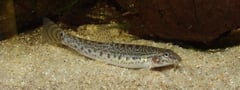
Lepidocephalichthys thermalis
Cobitidae · Valenciennes, 1846
Lepidocephalichthys thermalis is a cobitid loach from Sri Lanka and Peninsular India, described from the hot waters of Cania, Sri Lanka. Available sporadically, it makes an excellent choice for those new to keeping loaches. Unlike most of the genus it shows a preference for headwaters and clear, flowing streams. It was for a number of years included in Lepidocephalus until Havird and Page (2010) placed it in Lepidocephalichthys.
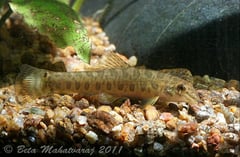
Paracanthocobitis mooreh
Nemacheilidae · Sykes, 1839
Paracanthocobitis mooreh is a nemacheilid loach known only from the Godavari, Krishna and Kaveri (Cauvery) systems in western and southern India. An incomplete lateral line ending near the pelvic-fin origin, with small, mostly vertical blotches along it connected to the dorsal saddles, separates it from congeners. It favours stretches of streams and small rivers where leaf litter collects over sand, cobbles and boulders, and is generally non-aggressive.

Pethia tictoTicto Barb
Cyprinidae · Hamilton, 1822
The ticto barb, Pethia ticto, is a small cyprinid widely distributed through most of the Indian subcontinent, from Pakistan and Nepal to Bangladesh. Its name is frequently misapplied to P. padamya in aquarium literature, though P. ticto is much the less colourful fish and males lack reddish-orange pigmentation on the body. Morphology and colour pattern vary by population, and some populations have already been described as distinct species.

Pseudetroplus maculatusOrange Chromide
Cichlidae · (Bloch, 1795)
The orange chromide, Pseudetroplus maculatus, is a euryhaline cichlid native to peninsular India and Sri Lanka. It mostly inhabits brackish estuaries, coastal lagoons and the lower reaches of rivers, and can be kept in fresh or brackish water so long as acidic conditions are avoided. Wild examples are rarely seen in the hobby, where selectively bred strains traded as 'red' or 'yellow' chromide are widely available.

Puntius sahyadriensisMaharaja Barb
Cyprinidae · Silas, 1953
The maharaja barb, Puntius sahyadriensis, is a cyprinid endemic to the northern and central Western Ghats mountains of India. It lives in hill streams shaded by the forest canopy and dense marginal vegetation, over boulders, stones, sand or gravel. The angular body, colour pattern and enlarged male dorsal fin make it difficult to confuse with any other member of the genus, and it is occasionally traded as the 'Khavli' barb.

Bagarius yarrelliGoonch
Sisoridae · Sykes, 1839
The goonch, Bagarius yarrelli, is a very large sisorid catfish recorded from the Indus in Pakistan east through Indochina to Sumatra and Borneo. Also known as the 'giant devil catfish' and 'sand shark', it reaches 1300 to 2000 mm and is fished for food across much of its range. That wide distribution appears doubtful, and Indian and Southeast Asian populations may prove not to be conspecific. It lives among boulders in the fast, turbulent rapids of large rivers.

Notopterus notopterusBronze Featherback
Notopteridae · Pallas, 1769
The bronze featherback, Notopterus notopterus, is an air-breathing notopterid from the Indian subcontinent and Southeast Asia. Also called 'Asian knifefish' or 'ghost knifefish' in the trade, it grows to 600 mm and arguably has no place in the ornamental hobby given its adult size and specialised requirements. The single species in Notopterus is likely to represent a complex of closely-related species.

Garra mullya
Cyprinidae · Sykes, 1839
Garra mullya is a cyprinid endemic to and widespread within peninsular India, in rivers including the Tapti, Narmada, Godavari, Krishna and Cauvery. It has been recorded from flowing headwater streams to low altitude main river channels, including polluted stretches, and at least some populations migrate upstream to breed. Wild fish feed on algae, diatoms and organic detritus.

Gymnostomus ariza
Cyprinidae · Hamilton, 1807
Gymnostomus ariza is a cyprinid widely distributed from the Indus basin in Pakistan through India, Bangladesh and Myanmar. Growing to around 300 mm SL, it inhabits flowing streams and tributaries with clear water. It has a confusing taxonomic history, having been placed in Bangana, Cirrhinus and Labeo in recent years. It breeds in temporarily-inundated zones in the wet season and is also produced commercially for food.

Labeo calbasuOrangefin Labeo
Cyprinidae · Hamilton, 1822
The orangefin labeo, Labeo calbasu, is a large cyprinid from Pakistan, Nepal, India, Bangladesh, Myanmar and southern China. Growing to 800 mm, it is an important food and game fish across its native range and is not a suitable subject for the home aquarium. It is known as 'black rohu' in parts of India and Bangladesh, and inhabits the lower reaches of major rivers, lakes and reservoirs.