River
Mahanadi
Only species with a profile on Seriously Fish are counted.
- Species
- 10
- Families
- 5
- Photographed
- 10 of 10
- Difficulty rated
- 10 of 10
Shares fishes withspecies recorded from both

Badis badisBadis
Badidae · Hamilton, 1822
The badis, Badis badis, is a small badid from the Ganges river system in India, Nepal and Bangladesh, with further records in Assam and the Mahanadi. Sometimes sold as the 'chameleon fish' for its ability to change colour rapidly, especially when breeding or stressed, it was one of only two badids popular in the hobby before 2002. Several congeners share its dark cleithral spot and can be hard to tell apart. It is sluggish and retiring, and rival males can be quite aggressive towards one another in confined spaces.

Barilius bendelisis
Cyprinidae · Hamilton, 1807
Barilius bendelisis is a large, fast-swimming cyprinid from India, Bangladesh, Nepal and probably Bhutan. Occasionally sold as 'Indian hill trout' or 'Hamilton's baril', it has 8 to 12 bluish vertical bars and, in adults, a blue-black spot on each scale. It grows to around 200 mm SL and inhabits well-oxygenated, fast-flowing rivers and streams, and its speed and vigorous feeding make it unsuitable for the general community.

Datnioides polotaSilver Tiger Perch
Datnioididae · Hamilton, 1822
The silver tiger perch, Datnioides polota, is a tiger perch widely distributed in southeastern Asia, from India and Bangladesh east to Indonesia. Mostly found in brackish habitats such as estuaries, mangroves and coastal lagoons, it has a highly variable colour pattern with up to 7 dark bars. The name D. quadrifasciatus is sometimes applied to it, but that name is a junior homonym and polota takes precedence.

Opsarius barna
Cyprinidae · Hamilton, 1822
Traded as 'striped hill trout' or 'banded hill trout', Opsarius barna is a cyprinid from the Ganges and Brahmaputra basins in northern India. It is thought to also occur in the Mahanadi and in river systems in Nepal, Bhutan, Bangladesh and Rakhine State, Myanmar, in well-oxygenated, fast-flowing rivers over gravel, cobbles and boulders. An extremely fast swimmer and vigorous feeder, it is unsuitable for the general community.
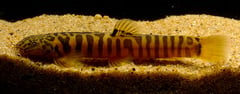
Schistura sp. 4Grizzled Loach
Nemacheilidae · authority not recorded
The grizzled loach, Schistura sp. 4, is a nemacheilid loach from a hill stream in the Siwalik hills around Darjeeling, West Bengal, northern India. Its identity is unclear, and though collected close to the type locality of S. multifasciata it does not match the description of that species. The stream is small, shallow and clear, well over 1000 m AMSL, and the fish is likely to attain 90-100 mm.

Chitala chitalaIndian Featherback
Notopteridae · Hamilton, 1822
The Indian featherback, Chitala chitala, is a very large notopterid probably restricted to Pakistan, India, Nepal and Bangladesh. Its name has been widely misapplied in the trade, most often to the Southeast Asian C. ornata, but it is very rarely exported for aquaria and is fished and cultured for food in India. Growing to 1220 mm SL, it has non-ocellated black spots above the anal fin and is the only Chitala normally showing gold or silver bars on the back.

Notopterus notopterusBronze Featherback
Notopteridae · Pallas, 1769
The bronze featherback, Notopterus notopterus, is an air-breathing notopterid from the Indian subcontinent and Southeast Asia. Also called 'Asian knifefish' or 'ghost knifefish' in the trade, it grows to 600 mm and arguably has no place in the ornamental hobby given its adult size and specialised requirements. The single species in Notopterus is likely to represent a complex of closely-related species.

Garra mullya
Cyprinidae · Sykes, 1839
Garra mullya is a cyprinid endemic to and widespread within peninsular India, in rivers including the Tapti, Narmada, Godavari, Krishna and Cauvery. It has been recorded from flowing headwater streams to low altitude main river channels, including polluted stretches, and at least some populations migrate upstream to breed. Wild fish feed on algae, diatoms and organic detritus.

Gymnostomus ariza
Cyprinidae · Hamilton, 1807
Gymnostomus ariza is a cyprinid widely distributed from the Indus basin in Pakistan through India, Bangladesh and Myanmar. Growing to around 300 mm SL, it inhabits flowing streams and tributaries with clear water. It has a confusing taxonomic history, having been placed in Bangana, Cirrhinus and Labeo in recent years. It breeds in temporarily-inundated zones in the wet season and is also produced commercially for food.

Labeo angra
Cyprinidae · Hamilton, 1822
Labeo angra is a benthic cyprinid from Pakistan, Nepal, northern India, Bangladesh and Myanmar, described from the Brahmaputra. It can be identified by a brownish back, yellowish flanks and belly, and a black to bluish stripe from the eye to the caudal-fin base. It undertakes annual spawning migrations within its native river systems.