River
Magdalena
Only species with a profile on Seriously Fish are counted.
- Species
- 3
- Families
- 3
- Photographed
- 3 of 3
- Difficulty rated
- 3 of 3
Basin
Also in the Magdalena basinspecies recorded from both
Shares fishes with rivers elsewherespecies recorded from both
Runs through
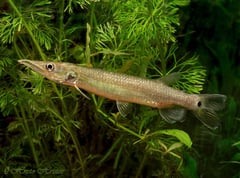
Ctenolucius hujetaGar Characin
Ctenoluciidae · Valenciennes, 1850
The gar characin, Ctenolucius hujeta, is a predatory pike characid from the Lake Maracaibo basin in Venezuela west to the Río Sinú in Colombia. Also traded as 'freshwater barracuda' and 'hujeta gar', it is surprisingly peaceful with anything too large to swallow. Juveniles school readily, and it is best kept in numbers of four or more with placid fishes that feed from the substrate. It is much the commoner of the two Ctenolucius in the hobby.

'Geophagus' steindachneriRed Hump Eartheater
Cichlidae · Eigenmann & Hildebrand, 1922
The red hump eartheater, Geophagus steindachneri, is a cichlid from the Magdalena and Sinú drainages in Colombia and the Río Limón basin in Venezuela. It lends its name to the 'G.' steindachneri group, whose taxonomic placement is unresolved. Colour forms vary with locality, and some appear on trade lists under the synonym Geophagus hondae. The species is an ovophilous, maternal mouthbrooder, and territorial males are best kept with three or more females.
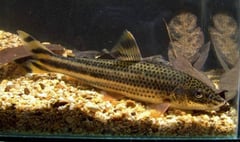
Leporellus vittatus
Anostomidae · Valenciennes, 1850
Leporellus vittatus is an anostomid with a huge natural range across the Amazon, Paraná-Paraguay, São Francisco and Orinoco river systems. Unlike most anostomids it is adapted to a benthic existence in flowing water and spends most of its time on or around the substrate. Occasionally exported, it requires quite specialised conditions, an aquarium of at least 210 by 60 cm and ideally a group of six or more.