River
Apure
Only species with a profile on Seriously Fish are counted.
- Species
- 17
- Families
- 12
- Photographed
- 16 of 17
- Difficulty rated
- 17 of 17
Basin
Also in the Orinoco basinspecies recorded from both
Shares fishes with rivers elsewherespecies recorded from both
Runs through
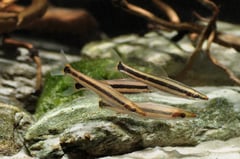
Anostomus ternetziGold-Striped Headstander
Anostomidae · Fernández-Yépez, 1949
The gold-striped headstander, Anostomus ternetzi, is an anostomid from the Río Orinoco system and coastal Guyana, Suriname and French Guiana. It lives in rocky areas at the edge of fast-flowing rivers and streams, grazing algae and small invertebrates. Like A. anostomus, it is quarrelsome with conspecifics when only a few are kept. Its distribution in Brazil is unclear, with patchy records from the Araguaia and Xingu basins.

Apistogramma hoignei
Cichlidae · Meinken, 1965
Apistogramma hoignei is a dwarf cichlid from the Río Orinoco basin in Venezuela, including the Apure, Arauca and Caura drainages. It is also known from much of the lower Orinoco mainstream. Coded A116 under the DATZ system, it has similar-looking, possibly conspecific populations referred to as A117 or A118, and inhabits slower-moving tributaries, backwaters and creeks where leaf litter collects.
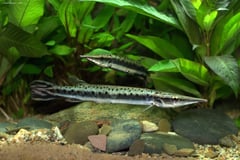
Boulengerella maculata
Ctenoluciidae · Valenciennes, 1850
Boulengerella maculata is a pelagic ctenoluciid found throughout much of the Amazon, Orinoco and Tocantins river systems. Colour pattern varies considerably, with some specimens much paler than others, and this may be correlated with water type. Random dark spots on the upper body, and a dark stripe only behind the eye when one is present, separate it from the similar B. lateristriga. It reaches 329 mm SL and needs an aquarium with base dimensions of 240 by 90 cm or more.
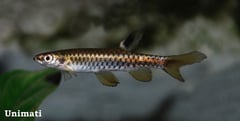
Copella eigenmanni
Lebiasinidae · Regan, 1912
Copella eigenmanni is a small lebiasinid from the Orinoco system in the llanos of Colombia and Venezuela, including the Meta, Caroní and Apure. It turns up in the trade from time to time among wild-caught fishes from the Orinoco basin. Colombian populations were formerly called C. metae until Zarske (2011) synonymised the two. A broad dark stripe runs from the snout to the eye, and the eggs are laid among vegetation and guarded by the male.
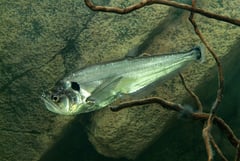
Cynodon gibbus
Cynodontidae · Agassiz, 1829
Cynodon gibbus is a cynodontid from much of the Amazon basin, the middle and lower Orinoco, and the Rupununi River in Guyana. A pelagic fish of main river channels and larger tributaries, it grows to around 280 mm SL. It is rare in the trade but arguably more suitable for the home aquarium than some of its better-known relatives, given its size and relatively docile behaviour. Being easily dominated, it is best kept alone or with similarly sized, non-aggressive fishes.

Geophagus abalios
Cichlidae · López-Fernández & Taphorn, 2004
Geophagus abalios is a cichlid from black and clear water tributaries of the río Orinoco in Venezuela, across the Llanos and south to the Casiquiare. One of the more commonly-traded members of the genus, it is rarely sold under the correct name and usually misidentified as G. altifrons or G. surinamensis. Juveniles are available cheaply because it is one of the few Geophagus bred commercially. Vertically split anterior flank bars separate it from the very similar G. brokopondo.
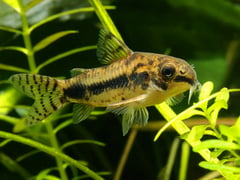
Hoplisoma habrosumSalt and Pepper Cory
Callichthyidae · (Weitzman, 1960)
The salt and pepper cory, Hoplisoma habrosum, long known as Corydoras habrosus, is a tiny armoured catfish from left bank tributaries of the upper Orinoco in Colombia and Venezuela. Most records come from the Río Apure watershed in the Llanos, where it apparently favours lagoons, streams, inundated forest and grassland with little flow. Also called 'dainty cory' and 'Venezuelan pygmy cory', it has 2-3 dark markings along the side of the body, against 4-5 in the similar H. cochui.

Iguanodectes spilurusGreen Line Lizard Tetra
Iguanodectidae · Günther, 1864
The green line lizard tetra, Iguanodectes spilurus, is a characin found throughout the Amazon, Orinoco, Essequibo and Tocantins river systems. The most widespread Iguanodectes species, it has also been called the 'slender', 'spindle' or 'iguana' tetra, and differs from its congeners in its translucent dorsal and anal fins, lack of a red lateral stripe and prominent dark caudal-fin marking. It is sensitive to poor water conditions.
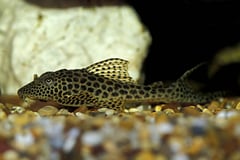
Isorineloricaria acuariusBlue Fin Thresher Pleco
Loricariidae · Ray & Armbruster, 2016
Isorineloricaria acuarius is a suckermouth catfish from the Apure and middle Orinoco drainages in the Venezuelan Llanos, where it lives on sandy runs in whitewater rivers. Traded as L093 and L195, the blue fin thresher pleco, it was sold as Hypostomus villarsi until it was described in 2016. I. villarsi is a different fish from the Lake Maracaibo basin, with a sharp ridge on each side of the head where I. acuarius has a rounded one.
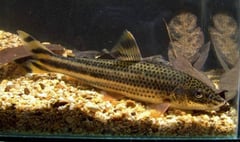
Leporellus vittatus
Anostomidae · Valenciennes, 1850
Leporellus vittatus is an anostomid with a huge natural range across the Amazon, Paraná-Paraguay, São Francisco and Orinoco river systems. Unlike most anostomids it is adapted to a benthic existence in flowing water and spends most of its time on or around the substrate. Occasionally exported, it requires quite specialised conditions, an aquarium of at least 210 by 60 cm and ideally a group of six or more.

Megalamphodus sweglesiRed Phantom Tetra
Characidae · Géry, 1961
The red phantom tetra, Megalamphodus sweglesi, is a small characid endemic to the upper and middle Río Orinoco watershed in Colombia and Venezuela. It apparently favours minor tributaries, oxbows and flooded forests, and in Venezuela is often found in morichals. Bred commercially in several countries, it has been traded in more than one colour form, and Zarske (2014) concluded that the particularly red form sold as 'red' or 'var. rubra' is conspecific.
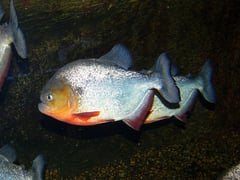
Pygocentrus caribaBlack Spot Piranha
Serrasalmidae · Humboldt, 1821
The black spot piranha, Pygocentrus cariba, is restricted to the Río Orinoco basin in Colombia and Venezuela. Many of its habitats lie within the llanos, and it has been recorded from river channels, tributaries and floodplain lakes, many of them acidic blackwater environments. Specimens over 100 mm SL have a large humeral spot and few spots on the body, which separates it from P. nattereri. It is best maintained alone.
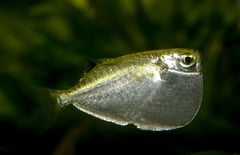
Thoracocharax stellatusSpotfin Hatchetfish
Gasteropelecidae · Kner, 1858
The spotfin hatchetfish, Thoracocharax stellatus, is the most widespread neotropical hatchetfish, recorded from much of South America. It is told from its only congener, T. securis, by a prominent dark spot in the dorsal fin, and is sometimes traded as 'platinum hatchetfish'. It feeds almost entirely on insects, and a tightly fitting cover is needed because it can clear several metres in one jump.

Aequidens tetramerusSaddle Cichlid
Cichlidae · Heckel, 1840
The saddle cichlid, Aequidens tetramerus, is a cichlid found across much of northern South America, from the Amazon and Orinoco basins to the Guianas. The type species of its genus, it occurs in several colour forms, and fish from Ecuador and Peru are sought after for the red or orange colouration on the lower head and belly. As currently recognised it is likely to represent a group of related fishes, some of which may be described as distinct species.

Andinoacara pulcherBlue Acara
Cichlidae · Gill, 1858
The blue acara, Andinoacara pulcher, is a cichlid native to Trinidad and Tobago and parts of Venezuela. It occupies a variety of habitats, from murky still waters to clear streams. A mainstay of the hobby for many years, it is one of the easiest substrate-spawning cichlids to breed. Captive breeding has narrowed the gene pool, so most fish in the hobby are pale imitations of wild ones, and some are hybrids with related species. It was previously known as 'Aequidens' pulcher.
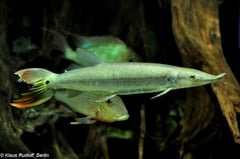
Boulengerella cuvieri
Ctenoluciidae · Spix & Agassiz, 1829
Boulengerella cuvieri is a pelagic ctenoluciid characin from much of the Amazon basin, the Río Orinoco and coastal drainages of the Guianas. The largest officially recorded specimen measured 675 mm, but it appears to grow larger, possibly beyond 800 mm. Given that size and its natural behaviour it is largely unsuitable for the home aquarium. Its entire dorsal-fin base lies ahead of the anal-fin origin, a character shared only with B. lucius and B. xyrekes among ctenoluciids.
Tatia galaxias
Auchenipteridae · Mees, 1974
Tatia galaxias is a wood catfish from the Orinoco river basin in Venezuela and Colombia, dark with small, round white spots like stars. It is sometimes confused with Tatia intermedia, in which the spots are longer and oval.