River
Nan
Only species with a profile on Seriously Fish are counted.
- Species
- 8
- Families
- 6
- Photographed
- 8 of 8
- Difficulty rated
- 8 of 8
Basin
Also in the Chao Phraya basinspecies recorded from both
Shares fishes with rivers elsewherespecies recorded from both
Runs through
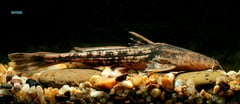
Acrochordonichthys gyrinusFalcate Chameleon Catfish
Akysidae · Vidthayanon & Ng, 2003
The falcate chameleon catfish, Acrochordonichthys gyrinus, is an akysid catfish known only from the Yom River, Chao Phraya basin, northern Thailand. A concave rear margin to the pectoral fins separates it from the rest of the A. ischnosoma group. When stressed it can secrete a milky substance from the axillary pore that quickly kills other fishes in an aquarium, and smaller tankmates will be eaten.
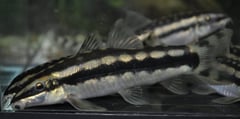
Ambastaia nigrolineataBlack-Lined Loach
Botiidae · Kottelat & Chu, 1987
The black-lined loach, Ambastaia nigrolineata, is a botiid loach from the Mekong drainage in southern China and Laos, and the Nan River in Thailand. It resembles its only congener A. sidthimunki but has a solid dark lateral stripe and another along the dorsal mid-line, with the vertical bars between them much less prominent. In Thailand it is considered endangered and appears in the national Red Book of threatened species.
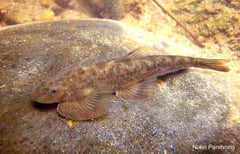
Hemimyzon nanensis
Balitoridae · Doi & Kottelat, 1998
Hemimyzon nanensis is a balitorid loach known only from the upper Mae Nam Nan river basin, part of the Chao Phraya system in northern Thailand. It was the first member of the genus recorded outside China and Taiwan. At the type locality it was collected in shallow riffles over algae-covered stones, and in the aquarium it needs clean, well-oxygenated water and a biologically mature set-up.

Hypsibarbus vernayi
Cyprinidae · Norman, 1925
Hypsibarbus vernayi is a cyprinid widespread in mainland Southeast Asia, from the Mekong basin in southern China to northern Peninsular Malaysia. Very similar to H. wetmorei, it has yellow pectoral, pelvic and anal fins (orange to red in H. wetmorei), so yellow-finned fish sold as H. wetmorei or 'lemon fin barb' appear likely to be this species. It prefers flowing water with abundant riparian vegetation and migrates seasonally.

Mystacoleucus greenwayi
Cyprinidae · Pellegrin & Fang, 1940
Mystacoleucus greenwayi is a riverine cyprinid from the middle Mekong basin in Thailand and Laos and the Chao Phraya watershed. It favours clear, well-oxygenated running water over sand or gravel, often in rock and boulder-filled headwater streams. A schooling fish, it should be kept in a group of six or more alongside similarly-sized cyprinids, loaches and other riverine fishes, and like all Mystacoleucus it has a forward-pointing predorsal spine that can snag in a net.

Datnioides pulcherSiamese Tiger Perch
Datnioididae · Kottelat, 1998
The Siamese tiger perch, Datnioides pulcher, is a large tiger perch from the Mae Klong, Chao Phraya, Mekong and Dong Nai river systems. Wild populations are hypothesised to have declined by more than 90% since the mid-1980s, and it has been locally extinct in Thailand since the 1990s. Highly sought after by aquarists, it usually has 4 broad dark bars, and D. microlepis is sometimes sold as D. pulcher to raise prices.
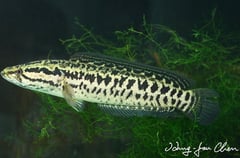
Channa maculataBlotched Snakehead
Channidae · Lacepède, 1801
The blotched snakehead, Channa maculata, is a snakehead from coastal drainages of southeastern China, including Hong Kong, and northern Vietnam. It is frequently confused with C. argus but has fewer fin rays and lateral line scales and carries 2-3 rounded blotches on the caudal peduncle. An important food fish, it has become established in Japan, Taiwan, the Philippines, Madagascar and Hawaii, and hybrids with C. argus appear to be quite common in aquaculture.

Garra theunensis
Cyprinidae · Kottelat, 1998
Garra theunensis is a large cyprinid from the Nam Theun and Nam Gnouang systems of the Mekong watershed in Laos, and the Nan River in Thailand. It grows to 300 mm SL and has a plain brown body and fins, sometimes with 6-8 faint longitudinal stripes. It tends to inhabit swiftly-flowing headwaters and tributaries with clear, oxygen-saturated water.