River
Ping
Only species with a profile on Seriously Fish are counted.
- Species
- 11
- Families
- 4
- Photographed
- 11 of 11
- Difficulty rated
- 11 of 11
Basin
Also in the Chao Phraya basinspecies recorded from both
Shares fishes with rivers elsewherespecies recorded from both
Runs through

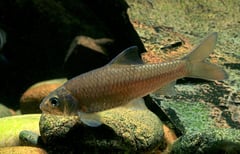
Crossocheilus reticulatus
Cyprinidae · Fowler, 1934
Usually offered as the reticulated or fishnet flying fox, Crossocheilus reticulatus is a cyprinid from the Chao Phraya and Mekong basins. A silvery body, dark-edged scales and a dark caudal peduncle blotch set it apart from similar congeners. Patterning varies with collection locality, which led to several names now treated as synonyms. A fish of flowing streams, it is best kept in a group of six or more, since weaker individuals can be bullied in smaller numbers.
Discherodontus schroederi
Cyprinidae · Smith, 1945
Discherodontus schroederi is a cyprinid native to the Mae Klong and Chao Phraya river basins in Thailand. Said to be the hardiest member of the genus, it is rarely collected for the aquatic trade, presumably because it is the least colourful of the Thai species. Juveniles can be confused with D. ashmeadi, but its dark dorsal blotch fades to a thin distal band with age, and its barbels are noticeably longer than in other members of the genus.
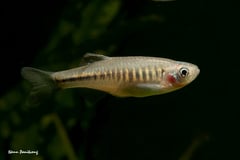
'Inlecypris' maetaengensisFire Bar 'Danio'
Cyprinidae · Fang, 1997
The fire bar 'danio', Inlecypris maetaengensis, is a small cyprinid endemic to the Mae Nam Ping drainage in northern Thailand. Also traded as 'tiger danio', it is most easily confused with 'I.' shanensis and Devario interruptus, and has a complete lateral line with 31 to 35 pored scales and a P stripe of contiguous blotches. It inhabits small, clear, moderate-to-swiftly-flowing streams with no aquatic vegetation.

Lobocheilos melanotaenia
Cyprinidae · Fowler, 1935
Lobocheilos melanotaenia is a grazing cyprinid from the Mekong in Laos, Thailand, Cambodia and Vietnam, plus the Dong Nai, Chao Phraya and Mae Klong. One of the most abundant species in the seasonal cyprinid migrations of the mainstream Mekong, it is available on a sporadic basis. It is told from L. rhabdoura by its deeper body, narrower mouth and a dark area in the dorsal-fin. It can be aggressive at feeding times and is not particularly tolerant of conspecifics.

Lobocheilos rhabdoura
Cyprinidae · Fowler, 1934
Lobocheilos rhabdoura is a grazing cyprinid from Indochina, found in the Mekong, Chao Phraya and Mae Klong systems and south to Peninsular Malaysia. One of the most abundant species in the seasonal cyprinid migrations of the mainstream Mekong, it is available on a sporadic basis. It differs from L. melanotaenia in its shallower body, wider mouth and larger snout tubercules. It can be aggressive at feeding times and is not particularly tolerant of conspecifics.

Mystacoleucus greenwayi
Cyprinidae · Pellegrin & Fang, 1940
Mystacoleucus greenwayi is a riverine cyprinid from the middle Mekong basin in Thailand and Laos and the Chao Phraya watershed. It favours clear, well-oxygenated running water over sand or gravel, often in rock and boulder-filled headwater streams. A schooling fish, it should be kept in a group of six or more alongside similarly-sized cyprinids, loaches and other riverine fishes, and like all Mystacoleucus it has a forward-pointing predorsal spine that can snag in a net.

Mystacoleucus obtusirostris
Cyprinidae · Valenciennes, 1842
Mystacoleucus obtusirostris is a riverine cyprinid found from Myanmar and southwestern China to Vietnam, Borneo, Sumatra and Java. Referred to as M. marginatus for decades, it is the most widely distributed member of the genus, and populations vary somewhat in colour pattern. It is occasionally marketed as 'Burmese rainbow barb'. A group of six or more is the smallest to consider, and like all Mystacoleucus it has a forward-pointing predorsal spine that can snag in a net.

Opsarius infrafasciatus
Cyprinidae · Fowler, 1934
Opsarius infrafasciatus is a cyprinid from the Ping river in Thailand, the Ataran and Salween in Myanmar and China, and Mekong tributaries in China. Once considered synonymous with both O. ornatus and O. pulchellus, it has been treated as distinct since Tejavej (2012). It typically inhabits headwaters and minor rivers and streams with moderate to fast flow, and a small caudal spot is among the characters separating it from congeners.
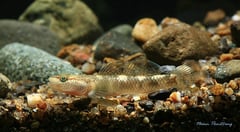
Rhinogobius chiengmaiensisChiangmai Stream Goby
Gobiidae · Fowler, 1934
The Chiangmai stream goby, Rhinogobius chiengmaiensis, is a small goby from the middle and upper Chao Phraya river system in central Thailand. It has been exported for the ornamental trade, often labelled as the congener R. mekongianus, but has five irregular dark markings on the body against seven or eight in that species. The male guards eggs laid on the ceiling of a cave or crevice, and it is among the less problematic members of the genus to breed.
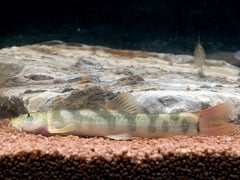
Schistura spilota
Nemacheilidae · Fowler, 1934
Schistura spilota is a nemacheilid loach known only from tributaries of the upper Ping River basin in Chiang Mai Province, northern Thailand. The species turns up sporadically in shipments of wild fishes from Thailand. Its body bars tend to form roundish blotches along the flanks, and the caudal-fin is reddish with two vertical rows of dark spots. Feisty and reaching 90-100 mm, it is largely unsuitable for the general community aquarium.

Datnioides pulcherSiamese Tiger Perch
Datnioididae · Kottelat, 1998
The Siamese tiger perch, Datnioides pulcher, is a large tiger perch from the Mae Klong, Chao Phraya, Mekong and Dong Nai river systems. Wild populations are hypothesised to have declined by more than 90% since the mid-1980s, and it has been locally extinct in Thailand since the 1990s. Highly sought after by aquarists, it usually has 4 broad dark bars, and D. microlepis is sometimes sold as D. pulcher to raise prices.