River
Orteguaza
Only species with a profile on Seriously Fish are counted.
- Species
- 3
- Families
- 2
- Photographed
- 2 of 3
- Difficulty rated
- 3 of 3
Basin
Also in the Amazon basinspecies recorded from both
Shares fishes with rivers elsewherespecies recorded from both
Runs through
Apistogramma alacrinaRedspot Dwarf Cichlid
Cichlidae · Kullander, 2004
The redspot dwarf cichlid, Apistogramma alacrina, is from the Río Guaviare (Orinoco) and Río Orteguaza (Amazon) drainages in Colombia. It differs from all other described members of the genus in having dark blotches at the dorsal and ventral base of the pectoral fins. Three very similar fishes coded A106, A107 and A108 may or may not be conspecific with it, since they show some differences in colour pattern and morphology.
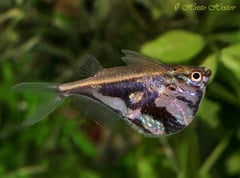
Carnegiella strigataMarbled Hatchetfish
Gasteropelecidae · Günther, 1864
The marbled hatchetfish, Carnegiella strigata, is a hatchetfish from the Amazon and Orinoco basins and coastal rivers of Guyana and Suriname. Popular in the hobby, it is collected for the trade mostly in the rio Negro basin in Brazil. Its larger size and dark, marbled pattern set it apart from congeners, though the pattern varies and the wide range may be open to question. It appears to live only in blackwater.

Aequidens tetramerusSaddle Cichlid
Cichlidae · Heckel, 1840
The saddle cichlid, Aequidens tetramerus, is a cichlid found across much of northern South America, from the Amazon and Orinoco basins to the Guianas. The type species of its genus, it occurs in several colour forms, and fish from Ecuador and Peru are sought after for the red or orange colouration on the lower head and belly. As currently recognised it is likely to represent a group of related fishes, some of which may be described as distinct species.