River
Caquetá
Only species with a profile on Seriously Fish are counted.
- Species
- 11
- Families
- 9
- Photographed
- 10 of 11
- Difficulty rated
- 11 of 11
Shares fishes withspecies recorded from both
Apistogramma alacrinaRedspot Dwarf Cichlid
Cichlidae · Kullander, 2004
The redspot dwarf cichlid, Apistogramma alacrina, is from the Río Guaviare (Orinoco) and Río Orteguaza (Amazon) drainages in Colombia. It differs from all other described members of the genus in having dark blotches at the dorsal and ventral base of the pectoral fins. Three very similar fishes coded A106, A107 and A108 may or may not be conspecific with it, since they show some differences in colour pattern and morphology.

Astyanax bimaculatusTwo Spot Astyanax
Characidae · Linnaeus, 1758
The two spot astyanax, Astyanax bimaculatus, is a characid ranging from Panama through most of the Amazon and Orinoco basins. It lives in a wide variety of biotopes, from swiftly-flowing rivers and streams to ponds, ditches and reservoirs. The name is currently applied to what is considered a species complex of at least four taxa, and aquarium fish most often arrive as contaminants among shipments of other species.
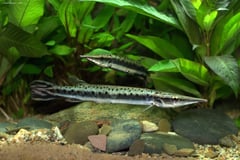
Boulengerella maculata
Ctenoluciidae · Valenciennes, 1850
Boulengerella maculata is a pelagic ctenoluciid found throughout much of the Amazon, Orinoco and Tocantins river systems. Colour pattern varies considerably, with some specimens much paler than others, and this may be correlated with water type. Random dark spots on the upper body, and a dark stripe only behind the eye when one is present, separate it from the similar B. lateristriga. It reaches 329 mm SL and needs an aquarium with base dimensions of 240 by 90 cm or more.
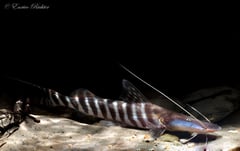
Brachyplatystoma tigrinumZebra Shovelnose
Pimelodidae · Britski, 1981
The zebra shovelnose, Brachyplatystoma tigrinum, is a pimelodid catfish from the upper Amazon basin in Brazil, Colombia and Peru. Adults appear to be obligate inhabitants of main river channels with strong flow, often around cataracts and rapids, and most aquarium fish are juveniles collected around Iquitos in Peru. It is sometimes confused with B. juruense, especially when young, but has a more well-defined colour pattern, a slenderer body and longer barbels.
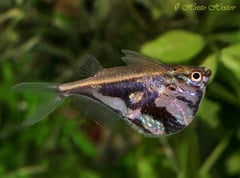
Carnegiella strigataMarbled Hatchetfish
Gasteropelecidae · Günther, 1864
The marbled hatchetfish, Carnegiella strigata, is a hatchetfish from the Amazon and Orinoco basins and coastal rivers of Guyana and Suriname. Popular in the hobby, it is collected for the trade mostly in the rio Negro basin in Brazil. Its larger size and dark, marbled pattern set it apart from congeners, though the pattern varies and the wide range may be open to question. It appears to live only in blackwater.

Colomesus asellusAmazon Puffer
Tetraodontidae · Müller & Troschel, 1849
The Amazon puffer, Colomesus asellus, is a freshwater puffer found throughout much of the Amazon basin, with records north to Guyana and Venezuela. Also traded as the South American puffer or 'SAP', it is told from congeners by a transverse row of dermal flaps across the chin. It lives mostly in well-oxygenated river habitats, is intolerant of organic waste, and forms loose aggregations, so a group of 6 or more is best, away from the general community.
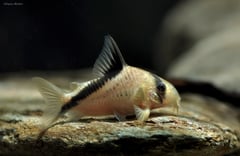
Hoplisoma meliniFalse Bandit Cory
Callichthyidae · (Lönnberg & Rendahl, 1930)
The false bandit cory, Hoplisoma melini, long known as Corydoras melini, is an armoured catfish from tributaries of the rios Negro, Caquetá and Orinoco in Brazil and Colombia. Its oblique dark bar along the back splits into two above the caudal peduncle, a feature shared only with H. davidsandsi, from which the dark markings on its flanks separate it. The rio Tiquié population is known in the hobby as 'C084', and a similar, slightly larger form from Peru as 'C085'.
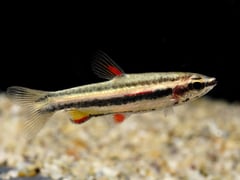
Nannostomus marginatusDwarf Pencilfish
Lebiasinidae · Eigenmann, 1909
The dwarf pencilfish, Nannostomus marginatus, is a lebiasinid of Guyana, Suriname and the middle-to-lower Amazon in Peru, Colombia and Brazil. Enduringly popular, it lacks the red body colour of males of the related N. mortenthaleri and N. rubrocaudatus, showing three dark lateral stripes with no red or purple between them. Colour varies between populations, and its small size and timid nature make it a poor community fish.
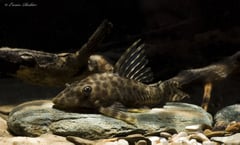
Peckoltichthys bachiL146
Loricariidae · (Boulenger, 1898)
The bola pleco, Peckoltichthys bachi, is a loricariid catfish from the upper Amazon region in Brazil, Colombia, Ecuador and Peru. It has been assigned several L-numbers, including L146 from Colombia and L232 from the Río Putumayo/Içá, and has been exported under other generic names including Hemiancistrus and Sophiancistrus. Its mottled colour pattern separates it from most Peckoltia species, and it lives among submerged grasses and branches in flowing water along the margins of medium to large rivers.
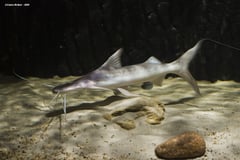
Brachyplatystoma platynemumSlobbering Catfish
Pimelodidae · Boulenger, 1898
The slobbering catfish, Brachyplatystoma platynemum, is a large migratory pimelodid catfish from the Amazon and Orinoco basins. The name refers to its relatively thick barbels, which give the impression that the fish is drooling. It travels considerable distances along deeper, flowing channels, and sexually mature adults have been observed in the upper rio Madeira basin, some 3000 km from the estuary. It grows to 1000 mm SL.
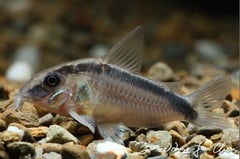
Brochis arcuataSkunk Cory; C020
Callichthyidae · (Elwin, 1938)
The skunk cory, Brochis arcuata, long known as Corydoras arcuatus, is an armoured catfish from the upper Amazon region in Brazil, Peru, Ecuador and Colombia. It is among the more popular Corydoras in the hobby and is also known as the 'arched cory' or C020. Several similar-looking congeners exist, particularly Hoplisoma urucu, in which the black body stripe ends behind the eye, and the larger C. narcissus from the rio Purus.