River
Essequibo
Only species with a profile on Seriously Fish are counted.
- Species
- 37
- Families
- 17
- Photographed
- 37 of 37
- Difficulty rated
- 37 of 37
Basin
Also in the Essequibo basinspecies recorded from both
Shares fishes with rivers elsewherespecies recorded from both
Runs through
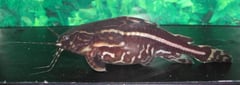
Acanthodoras cataphractusChocolate Talking Catfish
Doradidae · Linnaeus, 1758
The chocolate talking catfish, Acanthodoras cataphractus, is a doradid catfish from the northern Amazon basin and Atlantic drainages of the Guianas. It is most often exported as bycatch among Platydoras armatulus and is sold under the same trade names as A. spinosissimus, which has pale blotches on the back between the dorsal and caudal fins where this species has pale lines or no markings. Largely nocturnal and gregarious, it is best kept in a group of at least four.
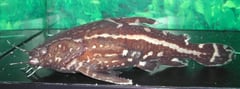
Acanthodoras spinosissimusChocolate Talking Catfish
Doradidae · Eigenmann & Eigenmann, 1888
The chocolate talking catfish, Acanthodoras spinosissimus, is a doradid catfish from the northern Amazon basin and the Essequibo in Guyana. Usually exported as bycatch among Platydoras armatulus, it is sold under the same trade names as A. cataphractus, and the most useful difference is the pale blotches on its back between the dorsal and caudal fins. Largely nocturnal and gregarious, it is best kept in a group of at least four.
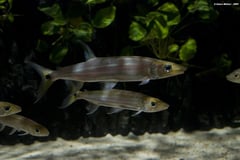
Acestrorhynchus falcirostrisBig-Eyed Cachorro
Acestrorhynchidae · Cuvier, 1819
The big-eyed cachorro, Acestrorhynchus falcirostris, is a large predatory acestrorhynchid from northern Amazon drainages and the Orinoco. The two dark body stripes of the A. nasutus group appear only in its juveniles, and at 320 to 350 mm SL it grows far larger than the other members. A black fringe to the rear of the operculum gives it a 'collared' look. It needs open water, and a group must be of comparable size because acestrorhynchids are cannibalistic.
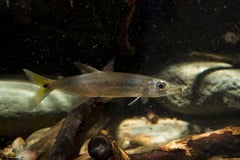
Acestrorhynchus microlepisPike Tetra
Acestrorhynchidae · Jardine, 1841
The pike tetra, Acestrorhynchus microlepis, is a predatory acestrorhynchid from northern Amazon drainages and the Orinoco. It also occurs in coastal rivers of Guyana, Suriname and French Guiana. A member of the A. microlepis group, it has a small blackish spot behind the gill cover and is separable from the very similar A. grandoculis only by counts. It tends to take smaller prey such as tetras, and acestrorhynchids are cannibalistic, so a group must be of comparable size.
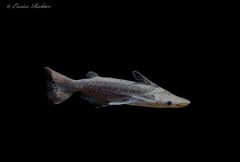
Ageneiosus marmoratusBottlenose Catfish
Auchenipteridae · Eigenmann, 1912
The bottlenose catfish, Ageneiosus marmoratus, is a predatory auchenipterid catfish from Guyana, Suriname and the upper Amazon in Peru and Ecuador. Also sold as 'Guyana slopehead', 'dolphin' or 'hammerhead' catfish, it loses much of its black-blotched juvenile patterning as it grows. Surprisingly peaceful with anything too large to swallow, it is active and sometimes skittish, and needs a tank of at least 150 x 60 cm.
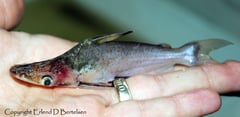
Ageneiosus ucayalensisDuck Catfish
Auchenipteridae · Castelnau, 1855
The duck catfish, Ageneiosus ucayalensis, is an auchenipterid catfish described from Peru and recorded across the Amazon, Orinoco and Guianas. Body patterning apparently varies with locality, and fish from black water habitats, particularly on the Guiana Shield, tend to be darker. Growing to around 290 mm SL and capable of taking large prey, it is safe only with similarly sized catfishes or large pelagic characins, mostly a combination for public aquaria.
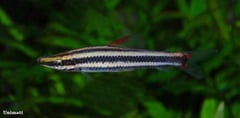
Anostomus anostomusStriped Headstander
Anostomidae · Linnaeus, 1758
The striped headstander, Anostomus anostomus, is an anostomid from the Amazon and Orinoco river systems in Peru, Brazil, Venezuela and Guyana. It lives along rocky shores of fast-flowing rivers, grazing algae and small invertebrates from the rocks. Although it shoals in nature, it is very quarrelsome with conspecifics when only a few are kept, so it is best kept singly or in a group of 6 or more in a larger tank.
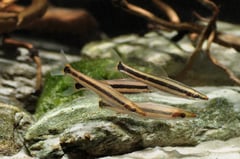
Anostomus ternetziGold-Striped Headstander
Anostomidae · Fernández-Yépez, 1949
The gold-striped headstander, Anostomus ternetzi, is an anostomid from the Río Orinoco system and coastal Guyana, Suriname and French Guiana. It lives in rocky areas at the edge of fast-flowing rivers and streams, grazing algae and small invertebrates. Like A. anostomus, it is quarrelsome with conspecifics when only a few are kept. Its distribution in Brazil is unclear, with patchy records from the Araguaia and Xingu basins.

Apistogramma steindachneriSteindachner's Apisto
Cichlidae · Regan, 1908
Steindachner's apisto, Apistogramma steindachneri, is a dwarf cichlid from the Essequibo, Demerara and other river systems of Guyana and Suriname. It lives in slower-moving tributaries and streams with leaf litter and submerged wood. The form from the Demerara drainage carries the DATZ code A138, and a very similar fish from the Cuyuni basin in eastern Venezuela (A139) may or may not be conspecific.
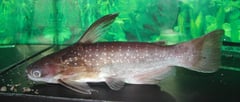
Auchenipterichthys coracoideusMidnight Catfish
Auchenipteridae · Eigenmann & Allen, 1942
The midnight catfish, Auchenipterichthys coracoideus, is an auchenipterid catfish from the Peruvian and Brazilian Amazon and the Essequibo drainage. Also known as the 'Zamora woodcat', it has often been misidentified as A. thoracatus, and the two differ principally in anal-fin ray count. By day it shelters among submerged roots, tree stumps or vegetation in turbid rivers and flooded areas, emerging to feed in open water at night.

Biotodoma cupidoCupid Cichlid
Cichlidae · Heckel, 1840
The cupid cichlid, Biotodoma cupido, is a geophagine cichlid from much of the Amazon basin, north to the Essequibo in Guyana and south to Bolivia. Also traded as the 'green-streaked eartheater', it varies in colour pattern and shape by locality, and most traded fish come from around Santarém in Pará state. Unless breeding it is surprisingly peaceful. Its relatively compact body and a dark flank blotch above the upper lateral line separate it from B. wavrini.

Brachychalcinus orbicularisDiscus Tetra
Characidae · Valenciennes, 1850
The discus tetra, Brachychalcinus orbicularis, is a deep-bodied characid generally considered endemic to coastal watersheds of Guyana and Suriname. Recent records suggest it, or a similar congener, may also occur in the Orinoco and Negro drainages. The genus is often referred to collectively as 'silver dollar tetras', and although B. orbicularis is normally said to be the species in the trade, identification is challenging.
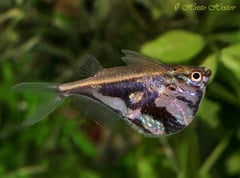
Carnegiella strigataMarbled Hatchetfish
Gasteropelecidae · Günther, 1864
The marbled hatchetfish, Carnegiella strigata, is a hatchetfish from the Amazon and Orinoco basins and coastal rivers of Guyana and Suriname. Popular in the hobby, it is collected for the trade mostly in the rio Negro basin in Brazil. Its larger size and dark, marbled pattern set it apart from congeners, though the pattern varies and the wide range may be open to question. It appears to live only in blackwater.
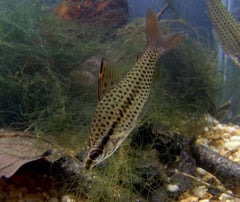
Chilodus punctatusSpotted Headstander
Chilodontidae · Müller & Troschel, 1844
The spotted headstander, Chilodus punctatus, is a headstander from much of the Amazon, the western Orinoco and coastal rivers of Guyana and Suriname. Also called the 'checkered headstander', it lives in slow-moving rivers, oxbows and floodplain lakes, and its colour pattern appears to vary with locality. Shy and peaceful, it is sensitive to dissolved organic wastes and should never be introduced to a biologically-immature aquarium.

Colomesus asellusAmazon Puffer
Tetraodontidae · Müller & Troschel, 1849
The Amazon puffer, Colomesus asellus, is a freshwater puffer found throughout much of the Amazon basin, with records north to Guyana and Venezuela. Also traded as the South American puffer or 'SAP', it is told from congeners by a transverse row of dermal flaps across the chin. It lives mostly in well-oxygenated river habitats, is intolerant of organic waste, and forms loose aggregations, so a group of 6 or more is best, away from the general community.
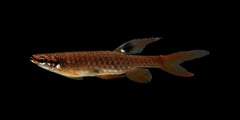
Copella arnoldiSplash Tetra
Lebiasinidae · Regan, 1912
The splash tetra, Copella arnoldi, is a lebiasinid from the lower Amazon basin in Brazil and coastal drainages of Guyana, Suriname and French Guiana. It spawns out of the water: a pair leap together onto overhanging vegetation and cling there while the eggs are laid. Zarske (2011) treats the Guianas populations as C. carsevennensis, restricting C. arnoldi sensu stricto to the lower Amazon, though Mol (2012) considers the two synonymous.
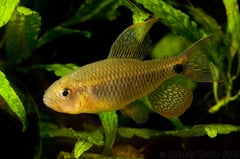
Crenuchus spilurusSailfin Characin
Crenuchidae · Günther, 1863
The sailfin characin, Crenuchus spilurus, is a crenuchid from much of the Amazon and Orinoco drainages and coastal rivers of the Guianas. The only described member of its genus, it varies considerably in colour pattern and morphology across that range. It lives in tea-stained forest streams, and its timid, predominantly benthic nature means it does not always make an ideal community fish. Males guard eggs laid on the roof of a small cave, often formed from leaf litter.
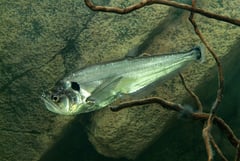
Cynodon gibbus
Cynodontidae · Agassiz, 1829
Cynodon gibbus is a cynodontid from much of the Amazon basin, the middle and lower Orinoco, and the Rupununi River in Guyana. A pelagic fish of main river channels and larger tributaries, it grows to around 280 mm SL. It is rare in the trade but arguably more suitable for the home aquarium than some of its better-known relatives, given its size and relatively docile behaviour. Being easily dominated, it is best kept alone or with similarly sized, non-aggressive fishes.
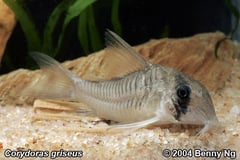
Hoplisoma griseum
Callichthyidae · (Holly, 1940)
Hoplisoma griseum, long known as Corydoras griseus, is an armoured catfish from Guyana, where it may be restricted to the Potaro River in the Essequibo watershed. It was described from aquarium specimens said to come from 'very small water courses of the Amazon', and the type locality was later corrected to the Potaro by Nijssen and Isbrücker (1980). Similar-looking fishes from Rondônia state, Brazil, carry the 'C' numbers C040 and C073, and C134 from Amapá state is also comparable.

Iguanodectes spilurusGreen Line Lizard Tetra
Iguanodectidae · Günther, 1864
The green line lizard tetra, Iguanodectes spilurus, is a characin found throughout the Amazon, Orinoco, Essequibo and Tocantins river systems. The most widespread Iguanodectes species, it has also been called the 'slender', 'spindle' or 'iguana' tetra, and differs from its congeners in its translucent dorsal and anal fins, lack of a red lateral stripe and prominent dark caudal-fin marking. It is sensitive to poor water conditions.
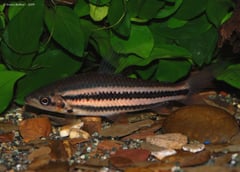
Leporinus arcusLipstick Leporinus
Anostomidae · Eigenmann, 1912
The lipstick leporinus, Leporinus arcus, is an anostomid from the Orinoco, Essequibo and upper Courantyne basins in Venezuela and the Guianas. It grows to 250 to 300 mm and needs an aquarium with base dimensions of at least 210 by 60 cm.
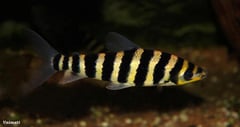
Leporinus fasciatusBanded Leporinus
Anostomidae · Bloch, 1794
The banded leporinus, Leporinus fasciatus, is an anostomid from the Amazon and Orinoco systems and coastal Guyana, Suriname and French Guiana. Young fish are often sold without warning of their size and requirements, and it is fairly ubiquitous in public aquarium displays. It is frequently confused with L. affinis, and its dark body bars multiply with age, from five in young fish to around ten in adults.
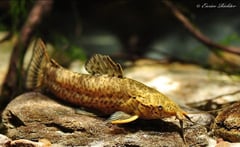
Megalechis pictaBar-tailed Hoplo
Callichthyidae · Müller & Troschel, 1849
The bar-tailed hoplo, Megalechis picta, is a callichthyid catfish widely distributed east of the Andes in Brazil, Venezuela and Guyana. It is recorded from the Amazon, Orinoco and upper Essequibo systems. Previously referred to as M. thoracata, it can be told from that species by a dark vertical bar in the caudal-fin and a longer dorsal-fin spine. Peaceful and hardy, it can even tolerate hypoxic conditions, and the male builds a nest.
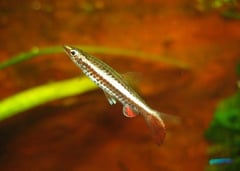
Nannostomus equesHockeystick Pencilfish
Lebiasinidae · Steindachner, 1876
The hockeystick pencilfish, Nannostomus eques, is a lebiasinid from the central and upper Amazon, the Orinoco drainage and rivers of Guyana. It swims at an oblique angle, a trait shared only with N. unifasciatus among congeners, and is also known as the 'rocket', 'diptail' or 'tubemouth' pencilfish. Genetic research on rio Negro populations raises the possibility that the species may be a complex of cryptic taxa.
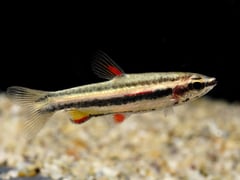
Nannostomus marginatusDwarf Pencilfish
Lebiasinidae · Eigenmann, 1909
The dwarf pencilfish, Nannostomus marginatus, is a lebiasinid of Guyana, Suriname and the middle-to-lower Amazon in Peru, Colombia and Brazil. Enduringly popular, it lacks the red body colour of males of the related N. mortenthaleri and N. rubrocaudatus, showing three dark lateral stripes with no red or purple between them. Colour varies between populations, and its small size and timid nature make it a poor community fish.
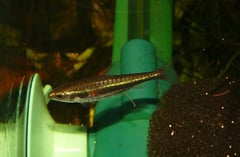
Nannostomus minimusLeast Pencilfish
Lebiasinidae · Eigenmann, 1909
The least pencilfish, Nannostomus minimus, is a tiny lebiasinid from the Potaro and Mazaruni systems of the Essequibo basin in Guyana. The second-smallest member of the genus after N. anduzei, it is poorly known in the hobby and has been exported under the name N. marilynae. In the Mazaruni it occurs with N. espei in sluggish blackwater habitats but tends to keep to marginal zones with abundant cover.

Pterophyllum leopoldiRoman Nose Angelfish
Cichlidae · Gosse, 1963
The roman nose angelfish, Pterophyllum leopoldi, is a cichlid from the lower Rio Negro in Brazil and the Rupununi and Essequibo basins of Guyana. It can be told from other members of the genus by up to 11 vertical stripes, a dark patch over the operculum and the roman nose that gives it its name. Reportedly one of the more aggressive species in the genus towards conspecifics, it should be kept in a group of four or more to prevent bullying.
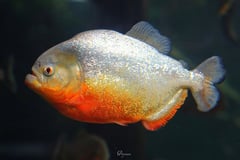
Pygocentrus nattereriRed Bellied Piranha
Serrasalmidae · Kner, 1858
The red bellied piranha, Pygocentrus nattereri, occurs through much of the Amazon basin and south into the Paraná and Uruguay river systems. Famed as a rapacious predator, it is among the most notorious freshwater fishes in the world. According to Herbert Axelrod (1976), the myth began with a feeding frenzy staged for Theodore Roosevelt in Brazil in 1913. Usually only juveniles form aggregations, and the species is relatively easy to breed in the aquarium.

Satanoperca leucostictaWhitespot Eartheater
Cichlidae · Müller & Troschel, 1849
The whitespot eartheater, Satanoperca leucosticta, is a cichlid from the Guiana Shield in Guyana, Suriname, eastern Venezuela and northern Brazil. Farmed in several countries, it is frequently available in the ornamental trade. It is often confused with S. jurupari but is easily recognised by the prominent white spots or vermiform markings on the sides of the head. A larvophilous maternal mouthbrooder, it has been bred in aquaria.
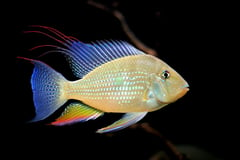
Acarichthys heckeliiThreadfin Acara
Cichlidae · Müller & Troschel, 1849
The threadfin acara, Acarichthys heckelii, is a cichlid from the northern Amazon basin in Colombia, Peru and Brazil and the Essequibo in Guyana. The only member of its genus, it grows to around 200 mm and digs incessantly, and it is susceptible to deteriorating water quality. Some adults show sudden, extreme aggression towards conspecifics that can kill weaker fish, and the problem decreases as tank and group size increase.

Aequidens tetramerusSaddle Cichlid
Cichlidae · Heckel, 1840
The saddle cichlid, Aequidens tetramerus, is a cichlid found across much of northern South America, from the Amazon and Orinoco basins to the Guianas. The type species of its genus, it occurs in several colour forms, and fish from Ecuador and Peru are sought after for the red or orange colouration on the lower head and belly. As currently recognised it is likely to represent a group of related fishes, some of which may be described as distinct species.
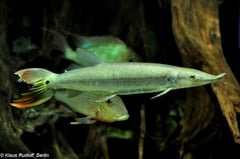
Boulengerella cuvieri
Ctenoluciidae · Spix & Agassiz, 1829
Boulengerella cuvieri is a pelagic ctenoluciid characin from much of the Amazon basin, the Río Orinoco and coastal drainages of the Guianas. The largest officially recorded specimen measured 675 mm, but it appears to grow larger, possibly beyond 800 mm. Given that size and its natural behaviour it is largely unsuitable for the home aquarium. Its entire dorsal-fin base lies ahead of the anal-fin origin, a character shared only with B. lucius and B. xyrekes among ctenoluciids.
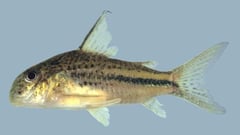
Hoplisoma bondiBlackstripe Cory
Callichthyidae · (Gosline, 1940)
The blackstripe cory, Hoplisoma bondi, long known as Corydoras bondi, is an armoured catfish from Venezuela, Guyana and Suriname, including the Essequibo and Courantyne systems. It was once considered common in the hobby, but many fish traded under the name may be the similar H. sipaliwini or H. coppenamense. H. sipaliwini has larger body spots and a dark marking on the first dorsal-fin rays, while H. coppenamense is more orangish.
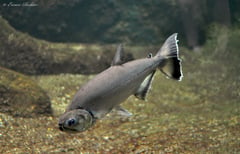
Hydrolycus armatusPayara
Cynodontidae · Jardine, 1841
The payara, Hydrolycus armatus, is a large, predatory dogtooth characin from the eastern Amazon, the Orinoco and the Essequibo in Guyana. Given its eventual size and natural behaviour it probably should not be considered a home aquarium subject at all, though juveniles are sometimes sold. It is regularly confused with the smaller H. scomberoides, and no other member of the genus has white margins to the anal and caudal fins.
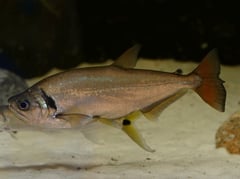
Hydrolycus tatauaia
Cynodontidae · Toledo-Piza, Menezes & Santos, 1999
Hydrolycus tatauaia is a large, predatory dogtooth characin from the lower and central Amazon, the upper Orinoco and coastal drainages of Guyana. A pelagic species of flowing main river channels, it performs long upstream migrations to spawn. Its adult size and natural behaviour mean only a handful of private aquarists have the facilities to house it long-term.
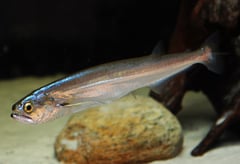
Rhaphiodon vulpinusBiara
Cynodontidae · Spix & Agassiz, 1829
The biara, Rhaphiodon vulpinus, is a dogtooth characin found from the Orinoco and Amazon basins south to the Río de la Plata in Argentina. The only member of its genus, it grows to 600 to 800 mm and is an obligate piscivore, and it is suitable only for public installations or the very largest private aquaria. Juveniles are seen for sale quite regularly, most often without adequate information on their long-term care.
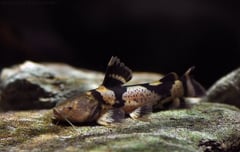
Pseudopimelodus bufoniusGiant Bumblebee Catfish
Pseudopimelodidae · Valenciennes, 1840
The giant bumblebee catfish, Pseudopimelodus bufonius, is distributed throughout northeastern South America, from Venezuela to eastern Brazil. Its range extends from the Lake Maracaibo basin, and it grows to 245 mm SL. The type locality is uncertain but probably Cayenne, French Guiana.