River
Solimões
Only species with a profile on Seriously Fish are counted.
- Species
- 61
- Families
- 18
- Photographed
- 61 of 61
- Difficulty rated
- 61 of 61
Shares fishes withspecies recorded from both
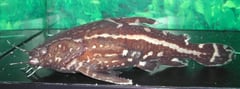
Acanthodoras spinosissimusChocolate Talking Catfish
Doradidae · (Eigenmann & Eigenmann, 1888)
The chocolate talking catfish, Acanthodoras spinosissimus, is a doradid catfish from the northern Amazon basin and the Essequibo in Guyana. Usually exported as bycatch among Platydoras armatulus, it is sold under the same trade names as A. cataphractus, and the most useful difference is the pale blotches on its back between the dorsal and caudal fins. Largely nocturnal and gregarious, it is best kept in a group of at least four.
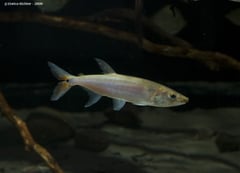
Acestrorhynchus falcatusRed-Tailed Freshwater Barracuda
Acestrorhynchidae · (Bloch, 1794)
The red-tailed freshwater barracuda, Acestrorhynchus falcatus, is a predatory acestrorhynchid from the northern Amazon and Orinoco basins. It also occurs in coastal rivers of Guyana, Suriname and French Guiana. Its large humeral spot, shaped like an inverted tear drop, separates it from other Acestrorhynchus. Reaching 250 to 275 mm, it needs plenty of open water, and a group must be of comparable size because acestrorhynchids are cannibalistic.
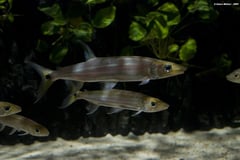
Acestrorhynchus falcirostrisBig-Eyed Cachorro
Acestrorhynchidae · (Cuvier, 1819)
The big-eyed cachorro, Acestrorhynchus falcirostris, is a large predatory acestrorhynchid from northern Amazon drainages and the Orinoco. The two dark body stripes of the A. nasutus group appear only in its juveniles, and at 320 to 350 mm SL it grows far larger than the other members. A black fringe to the rear of the operculum gives it a 'collared' look. It needs open water, and a group must be of comparable size because acestrorhynchids are cannibalistic.
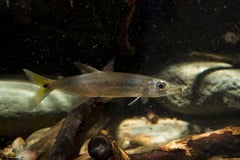
Acestrorhynchus microlepisPike Tetra
Acestrorhynchidae · (Jardine, 1841)
The pike tetra, Acestrorhynchus microlepis, is a predatory acestrorhynchid from northern Amazon drainages and the Orinoco. It also occurs in coastal rivers of Guyana, Suriname and French Guiana. A member of the A. microlepis group, it has a small blackish spot behind the gill cover and is separable from the very similar A. grandoculis only by counts. It tends to take smaller prey such as tetras, and acestrorhynchids are cannibalistic, so a group must be of comparable size.
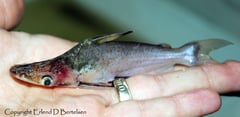
Ageneiosus ucayalensisDuck Catfish
Auchenipteridae · Castelnau, 1855
The duck catfish, Ageneiosus ucayalensis, is an auchenipterid catfish described from Peru and recorded across the Amazon, Orinoco and Guianas. Body patterning apparently varies with locality, and fish from black water habitats, particularly on the Guiana Shield, tend to be darker. Growing to around 290 mm SL and capable of taking large prey, it is safe only with similarly sized catfishes or large pelagic characins, mostly a combination for public aquaria.

Apistogramma agassiziiAgassiz's Dwarf Cichlid
Cichlidae · (Steindachner, 1875)
Apistogramma agassizii is a dwarf cichlid found through much of the Amazon/Solimões basin, from the Río Ucayali in Peru to the Capim River in Brazil. Colour and pattern vary considerably with locality, and numerous ornamental forms have been selectively bred for the trade. It inhabits slower-moving tributaries and creeks where leaf litter collects. Captive-raised fish suit the community aquarium, while wild fish are best kept alone or with small dither fishes.

Apistogramma bitaeniataTwo-Striped Dwarf Cichlid
Cichlidae · Pellegrin, 1936
The two-striped dwarf cichlid, Apistogramma bitaeniata, ranges across the Peruvian, Colombian and Brazilian Amazon, from the Marañón to the Tapajós. Also known as the banded dwarf cichlid, it occurs in several colour forms depending on locality, loosely grouped as 'red', 'blue', 'orange' and 'yellow' in the hobby. Many locality names are in use for these forms, and several are regularly applied incorrectly.

Apistogramma cacatuoidesCockatoo Cichlid
Cichlidae · Hoedeman, 1951
The cockatoo cichlid, Apistogramma cacatuoides, is a small cichlid from the upper Amazon basin, from the Ucayali in Peru to the Solimões in Brazil. It lives in slow tributaries, backwaters and creeks where leaf litter collects. Numerous line-bred forms such as 'double red' and 'orange flash' are traded, and captive-raised fish suit a community aquarium, while wild fish are best kept alone or with small dither fishes.

Apistogramma eunotus
Cichlidae · Kullander, 1981
Apistogramma eunotus is a dwarf cichlid from the Río Ucayali in Peru and the Solimões/Amazon in Colombia and Brazil, as far east as the Japurá. Coded A73 under the DATZ system, it has similar-looking, possibly conspecific populations referred to as A74 to A77 depending on locality. It inhabits slow-moving streams, creeks and tributaries, and captive-raised fish are the recommended choice for the community aquarium.

Apistogramma sp. 'Kelleri'
Cichlidae · authority not recorded
Apistogramma sp. 'Kelleri' is an undescribed dwarf cichlid known only from minor jungle tributaries near Leticia, Amazonas department, Colombia. First collected in 2008, it was exported again in 2009 and 2010 as A. sp. 'Jutai' and A. sp. 'diamond face', with a Brazilian collection site the exporter later corrected to Leticia. It has also appeared on trade lists as A. sp. 'Leticia', and belongs to the A. barlowi complex.

Astronotus ocellatusOscar
Cichlidae · (Agassiz, 1831)
The oscar, Astronotus ocellatus, is a large cichlid widely distributed in the Amazon region, recorded from Colombia and Venezuela south to Argentina. It grows to 350 mm SL and typically lives 10 to 20 years, both of which need taking into account before purchase. Most fish on sale come from commercial breeders in Eastern Europe or the Far East, in numerous ornamental strains, and genetic analyses suggest the genus contains additional, morphologically cryptic species.
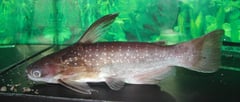
Auchenipterichthys coracoideusMidnight Catfish
Auchenipteridae · (Eigenmann & Allen, 1942)
The midnight catfish, Auchenipterichthys coracoideus, is an auchenipterid catfish from the Peruvian and Brazilian Amazon and the Essequibo drainage. Also known as the 'Zamora woodcat', it has often been misidentified as A. thoracatus, and the two differ principally in anal-fin ray count. By day it shelters among submerged roots, tree stumps or vegetation in turbid rivers and flooded areas, emerging to feed in open water at night.

Axelrodia stigmatias
Characidae · (Fowler, 1913)
Axelrodia stigmatias is a tiny characid from the western Amazon region in Brazil and Peru, sometimes traded as the 'white star' or 'pepper' tetra. It resembles A. riesei but has a more elongate body and is silvery yellow in life where that species is red. It is said to inhabit blackwater environments, and given its small size and somewhat specialised requirements it is best kept alone or with diminutive, non-aggressive characids and small catfishes.
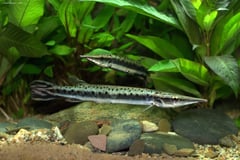
Boulengerella maculata
Ctenoluciidae · (Valenciennes, 1850)
Boulengerella maculata is a pelagic ctenoluciid found throughout much of the Amazon, Orinoco and Tocantins river systems. Colour pattern varies considerably, with some specimens much paler than others, and this may be correlated with water type. Random dark spots on the upper body, and a dark stripe only behind the eye when one is present, separate it from the similar B. lateristriga. It reaches 329 mm SL and needs an aquarium with base dimensions of 240 by 90 cm or more.
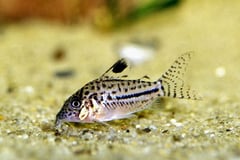
Brochis gomezi
Callichthyidae · (Castro, 1986)
Brochis gomezi, long known as Corydoras gomezi, is an armoured catfish from the western Amazon basin in Colombia and Peru, including the 'Tres Fronteras' region. Collection records are scarce and its range is unclear. It resembles B. leopardus, B. orphnopterus, C018 and C131, but has separate, distinct spots on the upper body, six bands on the caudal fin and a relatively slender body.
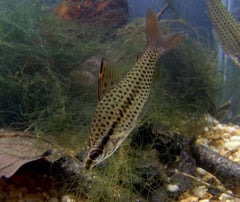
Chilodus punctatusSpotted Headstander
Chilodontidae · Müller & Troschel, 1844
The spotted headstander, Chilodus punctatus, is a headstander from much of the Amazon, the western Orinoco and coastal rivers of Guyana and Suriname. Also called the 'checkered headstander', it lives in slow-moving rivers, oxbows and floodplain lakes, and its colour pattern appears to vary with locality. Shy and peaceful, it is sensitive to dissolved organic wastes and should never be introduced to a biologically-immature aquarium.

Colomesus asellusAmazon Puffer
Tetraodontidae · (Müller & Troschel, 1849)
The Amazon puffer, Colomesus asellus, is a freshwater puffer found throughout much of the Amazon basin, with records north to Guyana and Venezuela. Also traded as the South American puffer or 'SAP', it is told from congeners by a transverse row of dermal flaps across the chin. It lives mostly in well-oxygenated river habitats, is intolerant of organic waste, and forms loose aggregations, so a group of 6 or more is best, away from the general community.
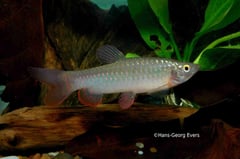
Copeina guttataRed-spotted Tetra
Lebiasinidae · (Steindachner, 1876)
The red-spotted tetra, Copeina guttata, is a lebiasinid from the middle and upper Amazon basin in Brazil, Peru, Ecuador and Colombia. Reaching 76 mm, it needs a tank of at least 120 x 30 cm. The eggs are apparently deposited in a shallow depression dug in the substrate and guarded by the male. Like many fishes from pristine environments it is intolerant of organic pollutants and requires spotless water.
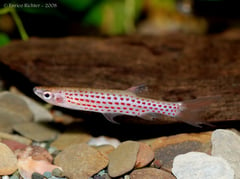
Copella meinkeniSpotted Splashing Tetra
Lebiasinidae · Zarske & Géry, 2006
The spotted splashing tetra, Copella meinkeni, is a small lebiasinid from the central Amazon region, with most records from the rio Negro and Orinoco. It has been widely referred to as C. nattereri in aquarium literature, but lacks that species' dark lateral stripe and has 5-6 rows of bright red spots on the body. The similar C. callolepis is also traded. It inhabits forest streams with tea-coloured water and lays its eggs among vegetation.
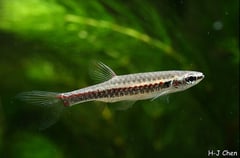
Copella nattereri
Lebiasinidae · (Steindachner, 1876)
Copella nattereri is a small lebiasinid widespread in the middle and upper Amazon drainage in Peru and Brazil. It is sometimes traded as C. sp. 'red line', 'spotted tetra' or C. nigrofasciata, and its name was long applied to C. callolepis and C. meinkeni. Of the three it alone has a dark lateral stripe, and it has no more than three rows of red spots on the flanks. It inhabits forest streams and flooded forest.
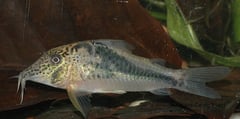
Corydoras fowleriFowler's Cory
Callichthyidae · Böhlke, 1950
Fowler's cory, Corydoras fowleri, is a long-snouted armoured catfish from the Amazon basin in Peru. Also known as the 'huanta cory' and 'milegros cory', it is often confused with C. coriatae and C. semiaquilus, and aquarium fish are regularly misidentified. Most long-snouted cories grow larger and are more aggressive than other Corydoras, and this one is suitable only for larger community aquaria.
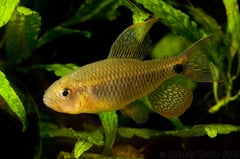
Crenuchus spilurusSailfin Characin
Crenuchidae · Günther, 1863
The sailfin characin, Crenuchus spilurus, is a crenuchid from much of the Amazon and Orinoco drainages and coastal rivers of the Guianas. The only described member of its genus, it varies considerably in colour pattern and morphology across that range. It lives in tea-stained forest streams, and its timid, predominantly benthic nature means it does not always make an ideal community fish. Males guard eggs laid on the roof of a small cave, often formed from leaf litter.
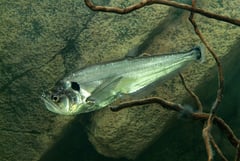
Cynodon gibbus
Cynodontidae · (Agassiz, 1829)
Cynodon gibbus is a cynodontid from much of the Amazon basin, the middle and lower Orinoco, and the Rupununi River in Guyana. A pelagic fish of main river channels and larger tributaries, it grows to around 280 mm SL. It is rare in the trade but arguably more suitable for the home aquarium than some of its better-known relatives, given its size and relatively docile behaviour. Being easily dominated, it is best kept alone or with similarly sized, non-aggressive fishes.
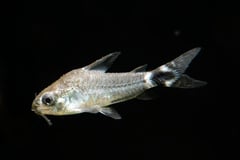
Gastrodermus hastatusTail-spot Pygmy Cory
Callichthyidae · (Eigenmann & Eigenmann, 1888)
The tail-spot pygmy cory, Gastrodermus hastatus, long known as Corydoras hastatus, is a tiny armoured catfish with a wide range across the Amazon and Río Paraguay basins. It is known from Brazil, Bolivia, Paraguay and northeastern Argentina. Unlike most congeners it swims in midwater, forming mixed schools with similarly patterned small characids such as Serrapinnus kriegi. It is frequently confused with G. pygmaeus, but has a dark, roughly diamond-shaped spot on the caudal peduncle where G. pygmaeus has a dark lateral stripe.

Geophagus proximus
Cichlidae · (Castelnau, 1855)
Geophagus proximus is a large cichlid from the Amazon system in Peru and Brazil, from the río Ucayali along the Solimões-Amazon to the rio Trombetas. Rare in the hobby, its name is often attached to shipments of other Geophagus species. It has a dark preopercular marking, no bars on the flanks and a large, roughly oblong midlateral marking. It is found mostly in the lower reaches of rivers and in floodplain lakes, favouring clear and black water.
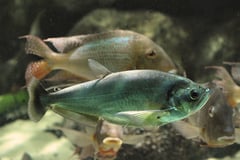
Hydrolycus scomberoidesVampire Tetra
Cynodontidae · (Cuvier, 1819)
The vampire tetra, Hydrolycus scomberoides, is a predatory dogtooth characin from the central and upper Amazon in Brazil, Bolivia, Peru and Ecuador. Also sold as 'scomb' and 'sabre tooth tetra', it is regularly confused with the much larger payara, H. armatus. At up to 300 mm it still needs a huge tank and specialist care, and newly-imported specimens often refuse anything but live food.

Hyphessobrycon loretoensisLoreto Tetra
Characidae · Ladiges, 1938
The Loreto tetra, Hyphessobrycon loretoensis, is a small characid from the upper Amazon basin in Colombia, Peru and Ecuador. It is relatively popular in the hobby, but most traded fish are wild-caught, so availability can be sporadic. Most records are from forest streams and minor tributaries with tea-coloured water, overhanging vegetation and leaf litter.

Hyphessobrycon peruvianusPeruvian Tetra
Characidae · Ladiges, 1938
The Peruvian tetra, Hyphessobrycon peruvianus, is a characid known only from the upper Amazon basin in Peru. Popular in the trade, it is sometimes confused with H. loretoensis and H. metae and has repeatedly appeared under the latter name in aquarium literature. A more elongate body, a dark band reaching the tips of the median caudal-fin rays and red markings at the base of both caudal lobes set it apart.
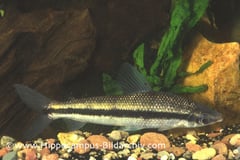
Laemolyta taeniataStriped Headstander
Anostomidae · (Kner, 1858)
The striped headstander, Laemolyta taeniata, is an anostomid from the central Amazon basin, also recorded from the Orinoco system in Venezuela. The largest-growing member of the genus, to 288 mm SL, it is rarely seen in the aquarium trade. Something of a habitat generalist, it migrates into flooded forest in the wet season and has been seen in large migratory shoals with Leporinus fasciatus and L. agassizii. Water quality is of the utmost importance, and anostomids are prodigious jumpers.
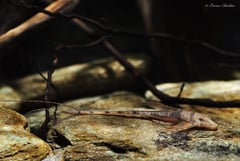
Lamontichthys filamentosusSturgeon Catfish
Loricariidae · (La Monte, 1935)
The sturgeon catfish, Lamontichthys filamentosus, is a loricariid from the central and western Amazon in Brazil, Peru, Ecuador and Bolivia. Above 60 mm SL the pectoral-fin spine extends into a filament that can be over four times the length of the first branched ray, and the dorsal-fin spine carries a similar extension. Relatively common in the hobby but not easy to maintain, it needs clean, well-oxygenated water and a mature aquarium with plenty of algae-covered surfaces.
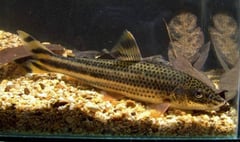
Leporellus vittatus
Anostomidae · (Valenciennes, 1850)
Leporellus vittatus is an anostomid with a huge natural range across the Amazon, Paraná-Paraguay, São Francisco and Orinoco river systems. Unlike most anostomids it is adapted to a benthic existence in flowing water and spends most of its time on or around the substrate. Occasionally exported, it requires quite specialised conditions, an aquarium of at least 210 by 60 cm and ideally a group of six or more.
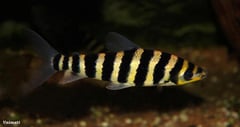
Leporinus fasciatusBanded Leporinus
Anostomidae · (Bloch, 1794)
The banded leporinus, Leporinus fasciatus, is an anostomid from the Amazon and Orinoco systems and coastal Guyana, Suriname and French Guiana. Young fish are often sold without warning of their size and requirements, and it is fairly ubiquitous in public aquarium displays. It is frequently confused with L. affinis, and its dark body bars multiply with age, from five in young fish to around ten in adults.
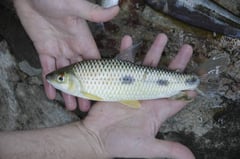
Leporinus fridericiThreespot Leporinus
Anostomidae · (Bloch, 1794)
The threespot leporinus, Leporinus friderici, is an anostomid from much of the Amazon system, with further records from the Guianas and Trinidad. It grows to 350 to 400 mm and needs an aquarium with base dimensions of at least 240 by 90 cm. Across this enormous range the fish differ in morphology and, especially, colour pattern.

Megalamphodus erythrostigmaBleeding Heart Tetra
Characidae · (Fowler, 1943)
The bleeding heart tetra, Megalamphodus erythrostigma, is a characid from the upper Amazon basin where the borders of Brazil, Peru and Colombia meet. The best-known of three similar species in the 'bleeding heart' subgroup, it has the reddish humeral spot found in no other characid. Generally peaceful, although adult males are territorial to an extent, it mostly inhabits sluggish tributaries, side arms and forest lakes.
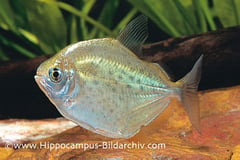
Metynnis lippincottianus
Serrasalmidae · (Cope, 1870)
Metynnis lippincottianus is a spotted silver dollar from Brazil and French Guiana, found in the lower and middle Amazon and the Oyapock system. It is occasionally seen for sale, sometimes as 'silver dollar', and its spotted pattern tells it apart from M. argenteus and M. hypsauchen. The spots are less pronounced than in M. maculatus, with which it shares a common name. The precise extent of its range is unclear.
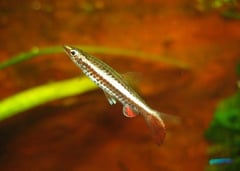
Nannostomus equesHockeystick Pencilfish
Lebiasinidae · Steindachner, 1876
The hockeystick pencilfish, Nannostomus eques, is a lebiasinid from the central and upper Amazon, the Orinoco drainage and rivers of Guyana. It swims at an oblique angle, a trait shared only with N. unifasciatus among congeners, and is also known as the 'rocket', 'diptail' or 'tubemouth' pencilfish. Genetic research on rio Negro populations raises the possibility that the species may be a complex of cryptic taxa.
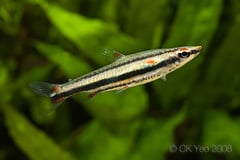
Nannostomus trifasciatusThree-lined Pencilfish
Lebiasinidae · Steindachner, 1876
The three-lined pencilfish, Nannostomus trifasciatus, is a lebiasinid widespread in the western Amazon basin in Brazil, Peru, Colombia and Bolivia. Fairly ubiquitous in the trade, it is less demanding than many congeners and a good choice for a newcomer to pencilfishes. Many fish on sale are farmed, and wild populations vary in colour pattern, one being marketed as 'super red' for its unusually long red stripe.
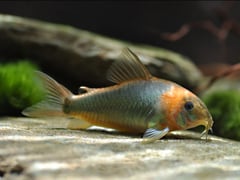
Osteogaster eques
Callichthyidae · (Steindachner, 1876)
Osteogaster eques, long known as Corydoras eques, is an armoured catfish described from the Amazon at Codajás, on the rio Solimões main channel in western Brazil. Its wider range is unclear, although similar-looking fish have been exported from Peru on occasion. It is sometimes confused with C. venezuelanus, and two similar unidentified fishes from Peru carry the codes CW007 and CW043.
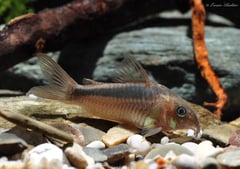
Osteogaster rabautiRusty Cory
Callichthyidae · (La Monte, 1941)
The rusty cory, Osteogaster rabauti, long known as Corydoras rabauti, is an armoured catfish known mostly from the rio Javarí, which forms much of the border between Brazil and Peru. It possibly also occurs in Colombia, but the full extent of its range is somewhat unclear. Often confused with the very similar O. zygata, it can be told apart by the broad dark stripe on the upper body, which extends onto the lower part of the caudal peduncle. An albino form is available on occasion.
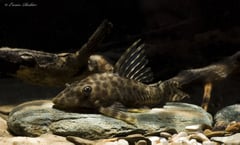
Peckoltichthys bachiL146
Loricariidae · (Boulenger, 1898)
The bola pleco, Peckoltichthys bachi, is a loricariid catfish from the upper Amazon region in Brazil, Colombia, Ecuador and Peru. It has been assigned several L-numbers, including L146 from Colombia and L232 from the Río Putumayo/Içá, and has been exported under other generic names including Hemiancistrus and Sophiancistrus. Its mottled colour pattern separates it from most Peckoltia species, and it lives among submerged grasses and branches in flowing water along the margins of medium to large rivers.
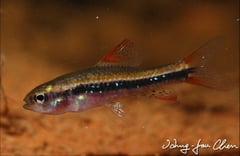
Poecilocharax weitzmaniBlack Darter Tetra
Crenuchidae · Géry, 1965
The black darter tetra, Poecilocharax weitzmani, is a crenuchid recorded from Brazil, Colombia, Peru and Venezuela. It has been collected from the upper Río Negro, Río Orinoco and Río Solimões drainages. Also traded as 'Black Morpho' tetra, it requires specialist care and is notoriously reluctant to accept dried foods. Unlike most small characids it does not form schools, and males are aggressively territorial towards one another. The Peruvian populations may apparently represent an undescribed species.

Pterophyllum leopoldiRoman Nose Angelfish
Cichlidae · (Gosse, 1963)
The roman nose angelfish, Pterophyllum leopoldi, is a cichlid from the lower Rio Negro in Brazil and the Rupununi and Essequibo basins of Guyana. It can be told from other members of the genus by up to 11 vertical stripes, a dark patch over the operculum and the roman nose that gives it its name. Reportedly one of the more aggressive species in the genus towards conspecifics, it should be kept in a group of four or more to prevent bullying.
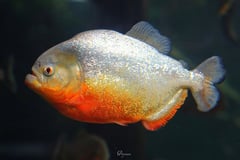
Pygocentrus nattereriRed Bellied Piranha
Serrasalmidae · Kner, 1858
The red bellied piranha, Pygocentrus nattereri, occurs through much of the Amazon basin and south into the Paraná and Uruguay river systems. Famed as a rapacious predator, it is among the most notorious freshwater fishes in the world. According to Herbert Axelrod (1976), the myth began with a feeding frenzy staged for Theodore Roosevelt in Brazil in 1913. Usually only juveniles form aggregations, and the species is relatively easy to breed in the aquarium.

Satanoperca acuticepsSharphead Eartheater
Cichlidae · (Heckel, 1840)
The sharphead eartheater, Satanoperca acuticeps, is a cichlid from the central Amazon basin in Brazil, including the lower rio Negro and rio Branco. Relatively rare in the trade, it is sometimes confused with S. daemon and S. lilith but has three dark flank blotches (vs. two in S. daemon, one in S. lilith). Unless breeding it is surprisingly peaceful, and it is very rarely bred in aquaria.

Satanoperca jurupariDemon Eartheater
Cichlidae · (Heckel, 1840)
The demon eartheater, Satanoperca jurupari, is a cichlid recorded throughout much of the Amazon basin in Brazil, Bolivia, Peru, Ecuador and Colombia. In aquarium literature it is frequently confused with S. leucosticta, which has prominent white spots or vermiform markings on the sides of the head. Its precise identity is a confusing issue, and populations from the Tapajós, Xingu, Araguaia and Paraná are genetically distinct and may represent separate species.

Satanoperca lilith
Cichlidae · Kullander & Ferreira, 1988
Satanoperca lilith is an eartheater cichlid known only from Brazil, where it is widely distributed along the Solimões/Amazon main channel. Despite that extensive range it is uncommon in the ornamental trade, where it is sometimes called 'one-spotted demon fish' or 'one spot eartheater'. A single dark blotch on the flank separates it from the closely similar S. daemon, which has two.
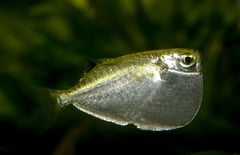
Thoracocharax stellatusSpotfin Hatchetfish
Gasteropelecidae · (Kner, 1858)
The spotfin hatchetfish, Thoracocharax stellatus, is the most widespread neotropical hatchetfish, recorded from much of South America. It is told from its only congener, T. securis, by a prominent dark spot in the dorsal fin, and is sometimes traded as 'platinum hatchetfish'. It feeds almost entirely on insects, and a tightly fitting cover is needed because it can clear several metres in one jump.

Trochilocharax ornatusHummingbird Tetra
Characidae · Zarske, 2010
The hummingbird tetra, Trochilocharax ornatus, is a tiny characid from Amazonian Peru, reaching only 17 mm. Traded as 'crystal rainbow tetra' and 'orange-tailed glass tetra', it is much sought after. The type series came from an aquarium import out of Iquitos, and sources conflict over whether it comes from the río Ampiyacu or the rio Nanay.

Aequidens tetramerusSaddle Cichlid
Cichlidae · (Heckel, 1840)
The saddle cichlid, Aequidens tetramerus, is a cichlid found across much of northern South America, from the Amazon and Orinoco basins to the Guianas. The type species of its genus, it occurs in several colour forms, and fish from Ecuador and Peru are sought after for the red or orange colouration on the lower head and belly. As currently recognised it is likely to represent a group of related fishes, some of which may be described as distinct species.
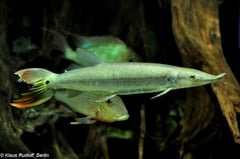
Boulengerella cuvieri
Ctenoluciidae · (Spix & Agassiz, 1829)
Boulengerella cuvieri is a pelagic ctenoluciid characin from much of the Amazon basin, the Río Orinoco and coastal drainages of the Guianas. The largest officially recorded specimen measured 675 mm, but it appears to grow larger, possibly beyond 800 mm. Given that size and its natural behaviour it is largely unsuitable for the home aquarium. Its entire dorsal-fin base lies ahead of the anal-fin origin, a character shared only with B. lucius and B. xyrekes among ctenoluciids.
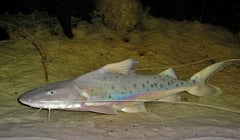
Brachyplatystoma capapretum
Pimelodidae · Lundberg & Akama, 2005
Brachyplatystoma capapretum is a large, piscivorous pimelodid catfish found throughout much of the Amazon basin, from near Belém to Iquitos in Peru. The largest recorded specimen measured 880 mm, and it is suitable only for public aquaria and a very small minority of private aquarists. It is very similar to B. filamentosum but smaller, with shorter maxillary barbels, a moderately forked caudal-fin with lobes of equal size, and adults very dark above.
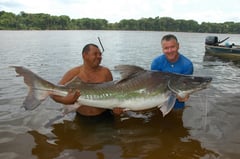
Brachyplatystoma filamentosumPiraíba
Pimelodidae · (Lichtenstein, 1819)
The piraíba, Brachyplatystoma filamentosum, is the largest catfish of the Amazon basin, also found in the Orinoco and river systems of the Guianas. Adults typically measure 2 to 2.5 m and weigh over 150 kg. In the Amazon only fish over around 160 cm are called 'Piraíba', and smaller ones 'filhote'. It is suitable only for public aquaria and a very small minority of private aquarists.
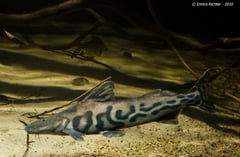
Brachyplatystoma juruenseGold Zebra Catfish
Pimelodidae · (Boulenger, 1898)
The gold zebra catfish, Brachyplatystoma juruense, is a large pimelodid from the middle Amazon and Orinoco basins, described from the rio Juruá. Adults have broad dark vertical, oblique or branching bands on a pale yellowish body and grow to at least 600 mm. It is sometimes confused with B. tigrinum, especially when young, but has a much less defined pattern, a deeper body and shorter barbels. It suits only public aquaria and a very small minority of private aquarists.
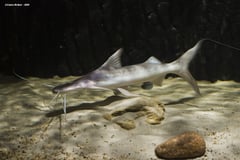
Brachyplatystoma platynemumSlobbering Catfish
Pimelodidae · Boulenger, 1898
The slobbering catfish, Brachyplatystoma platynemum, is a large migratory pimelodid catfish from the Amazon and Orinoco basins. The name refers to its relatively thick barbels, which give the impression that the fish is drooling. It travels considerable distances along deeper, flowing channels, and sexually mature adults have been observed in the upper rio Madeira basin, some 3000 km from the estuary. It grows to 1000 mm SL.
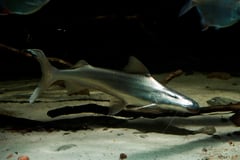
Brachyplatystoma rousseauxiiDourada
Pimelodidae · (Castelnau, 1855)
The dourada, Brachyplatystoma rousseauxii, is a large migratory pimelodid catfish from the Amazon and Orinoco drainages and rivers of the Guianas. Juveniles feed in the Amazon delta, while sexually mature adults are found only in the western Amazon. Some populations cover as much as 5500 km during migration from the delta, the longest known in any freshwater fish, and it is heavily fished during its upstream movement. It grows to 1900 mm SL.
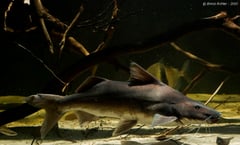
Brachyplatystoma vaillantiiPiramutaba
Pimelodidae · (Valenciennes, 1840)
The piramutaba, Brachyplatystoma vaillantii, is a large migratory pimelodid catfish from the Amazon and Orinoco watersheds and rivers of the Guianas. Juveniles feed in the Amazon delta before migrating upstream in massive numbers, when they are subject to intensive capture by commercial and artisanal fisheries. Sexually mature adults have been observed in the rio Caquetá basin, some 3500 km from the estuary. It grows to 1050 mm SL.
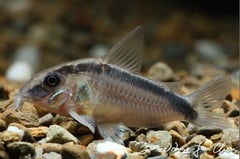
Brochis arcuataSkunk Cory; C020
Callichthyidae · (Elwin, 1938)
The skunk cory, Brochis arcuata, long known as Corydoras arcuatus, is an armoured catfish from the upper Amazon region in Brazil, Peru, Ecuador and Colombia. It is among the more popular Corydoras in the hobby and is also known as the 'arched cory' or C020. Several similar-looking congeners exist, particularly Hoplisoma urucu, in which the black body stripe ends behind the eye, and the larger C. narcissus from the rio Purus.
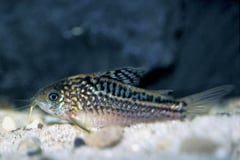
Gastrodermus elegansElegant Cory
Callichthyidae · (Steindachner, 1876)
The elegant cory, Gastrodermus elegans, long known as Corydoras elegans, is an armoured catfish from the western Amazon basin in Peru, Ecuador and Brazil. Unlike most congeners it spends a fair amount of time away from the substrate, often forming groups in midwater. It gives its name to the unofficial 'C. elegans group' of similar species, which includes G. nanus and G. undulatus plus many C- and CW-numbered fishes of uncertain status.

Laetacara thayeri
Cichlidae · (Steindachner, 1875)
Laetacara thayeri is a cichlid from the middle and upper Amazon basin in western Brazil and northern Peru. It is relatively rare in the aquarium trade. Ctenoid scales on the sides of the head and the lack of a dark spot at the caudal-fin base separate it from all congeners. Males grow larger than females and develop more-extended dorsal, anal and caudal fins.
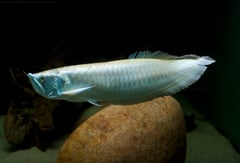
Osteoglossum bicirrhosumSilver Arowana
Osteoglossidae · (Cuvier, 1829)
The silver arowana, Osteoglossum bicirrhosum, is a large predator from the Amazon basin, plus river systems in Guyana and French Guiana. Reaching 80 cm, it is largely unsuitable for the home aquarium, and although juveniles are readily available, few private aquarists can house an adult long-term. Juveniles have a single dark lateral stripe, while in those of its only congener, O. ferreirai, most of the body and fins are dark.
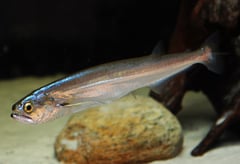
Rhaphiodon vulpinusBiara
Cynodontidae · Spix & Agassiz, 1829
The biara, Rhaphiodon vulpinus, is a dogtooth characin found from the Orinoco and Amazon basins south to the Río de la Plata in Argentina. The only member of its genus, it grows to 600 to 800 mm and is an obligate piscivore, and it is suitable only for public installations or the very largest private aquaria. Juveniles are seen for sale quite regularly, most often without adequate information on their long-term care.