River · also known as Javari
Yavarí
Only species with a profile on Seriously Fish are counted.
- Species
- 29
- Families
- 12
- Photographed
- 28 of 29
- Difficulty rated
- 29 of 29
Shares fishes withspecies recorded from both
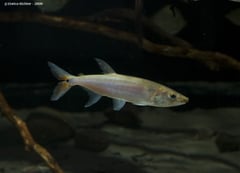
Acestrorhynchus falcatusRed-Tailed Freshwater Barracuda
Acestrorhynchidae · Bloch, 1794
The red-tailed freshwater barracuda, Acestrorhynchus falcatus, is a predatory acestrorhynchid from the northern Amazon and Orinoco basins. It also occurs in coastal rivers of Guyana, Suriname and French Guiana. Its large humeral spot, shaped like an inverted tear drop, separates it from other Acestrorhynchus. Reaching 250 to 275 mm, it needs plenty of open water, and a group must be of comparable size because acestrorhynchids are cannibalistic.
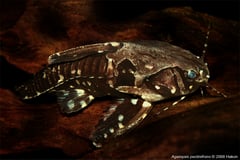
Agamyxis pectinifronsSpotted Talking Catfish
Doradidae · Cope, 1870
The spotted talking catfish, Agamyxis pectinifrons, is a doradid catfish from the Amazon basin in Bolivia, Brazil, Colombia and Peru. Very common in the trade, it is hardy and relatively long-lived, and recommended to beginners and experienced aquarists alike despite its adult size. It closely resembles A. albomaculatus, known only from the Río Orinoco drainage in Venezuela, and the two are probably sold under the same trade names.

Apistogramma cacatuoidesCockatoo Cichlid
Cichlidae · Hoedeman, 1951
The cockatoo cichlid, Apistogramma cacatuoides, is a small cichlid from the upper Amazon basin, from the Ucayali in Peru to the Solimões in Brazil. It lives in slow tributaries, backwaters and creeks where leaf litter collects. Numerous line-bred forms such as 'double red' and 'orange flash' are traded, and captive-raised fish suit a community aquarium, while wild fish are best kept alone or with small dither fishes.

Apistogramma eunotus
Cichlidae · Kullander, 1981
Apistogramma eunotus is a dwarf cichlid from the Río Ucayali in Peru and the Solimões/Amazon in Colombia and Brazil, as far east as the Japurá. Coded A73 under the DATZ system, it has similar-looking, possibly conspecific populations referred to as A74 to A77 depending on locality. It inhabits slow-moving streams, creeks and tributaries, and captive-raised fish are the recommended choice for the community aquarium.

Apistogramma nijsseni
Cichlidae · Kullander, 1979
Known in the trade as the 'panda dwarf cichlid', Apistogramma nijsseni is from tributaries of the Río Ucayali in Loreto Region, northern Peru. Coded A180 under the DATZ system, it inhabits slow-moving blackwater streams and creeks where the pH can drop as low as 4.0 or 5.0 and the substrate is littered with branches and a deep layer of rotting leaves.

Astyanax bimaculatusTwo Spot Astyanax
Characidae · Linnaeus, 1758
The two spot astyanax, Astyanax bimaculatus, is a characid ranging from Panama through most of the Amazon and Orinoco basins. It lives in a wide variety of biotopes, from swiftly-flowing rivers and streams to ponds, ditches and reservoirs. The name is currently applied to what is considered a species complex of at least four taxa, and aquarium fish most often arrive as contaminants among shipments of other species.
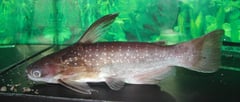
Auchenipterichthys coracoideusMidnight Catfish
Auchenipteridae · Eigenmann & Allen, 1942
The midnight catfish, Auchenipterichthys coracoideus, is an auchenipterid catfish from the Peruvian and Brazilian Amazon and the Essequibo drainage. Also known as the 'Zamora woodcat', it has often been misidentified as A. thoracatus, and the two differ principally in anal-fin ray count. By day it shelters among submerged roots, tree stumps or vegetation in turbid rivers and flooded areas, emerging to feed in open water at night.
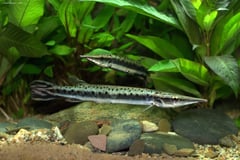
Boulengerella maculata
Ctenoluciidae · Valenciennes, 1850
Boulengerella maculata is a pelagic ctenoluciid found throughout much of the Amazon, Orinoco and Tocantins river systems. Colour pattern varies considerably, with some specimens much paler than others, and this may be correlated with water type. Random dark spots on the upper body, and a dark stripe only behind the eye when one is present, separate it from the similar B. lateristriga. It reaches 329 mm SL and needs an aquarium with base dimensions of 240 by 90 cm or more.
Brochis leopardusLeopard Cory
Callichthyidae · (Myers, 1933)
The leopard cory, Brochis leopardus, long known as Corydoras leopardus, is a spotted armoured catfish from the western Amazon basin in Peru, Ecuador, Bolivia and Brazil. It looks very like Hoplisoma julii and H. trilineatum, but has a longer, more pointed snout and grows larger. Dias et al. (2024) moved it to the genus Brochis and put the two lookalikes in Hoplisoma, so the resemblance does not reflect a close relationship. The type specimens were aquarium imports.
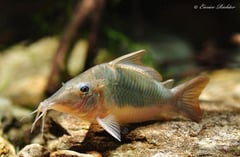
Brochis multiradiataHognose 'Brochis'
Callichthyidae · (Orcés V., 1960)
Known in the hobby as the hognose 'Brochis', Brochis multiradiata, long known as Corydoras multiradiatus, is an armoured catfish from the northwestern Amazon basin in Ecuador and Peru. Formerly placed in Brochis, it has an extended snout and 17-18 dorsal-fin rays, against 6-8 in other Corydoras. Little is known of its habitat, but it is likely to live in smaller tributaries and still waters such as backwaters and oxbows, as closely related species do.
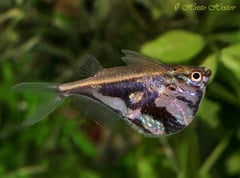
Carnegiella strigataMarbled Hatchetfish
Gasteropelecidae · Günther, 1864
The marbled hatchetfish, Carnegiella strigata, is a hatchetfish from the Amazon and Orinoco basins and coastal rivers of Guyana and Suriname. Popular in the hobby, it is collected for the trade mostly in the rio Negro basin in Brazil. Its larger size and dark, marbled pattern set it apart from congeners, though the pattern varies and the wide range may be open to question. It appears to live only in blackwater.

Colomesus asellusAmazon Puffer
Tetraodontidae · Müller & Troschel, 1849
The Amazon puffer, Colomesus asellus, is a freshwater puffer found throughout much of the Amazon basin, with records north to Guyana and Venezuela. Also traded as the South American puffer or 'SAP', it is told from congeners by a transverse row of dermal flaps across the chin. It lives mostly in well-oxygenated river habitats, is intolerant of organic waste, and forms loose aggregations, so a group of 6 or more is best, away from the general community.
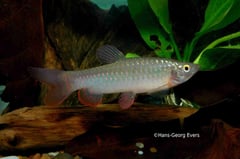
Copeina guttataRed-spotted Tetra
Lebiasinidae · Steindachner, 1876
The red-spotted tetra, Copeina guttata, is a lebiasinid from the middle and upper Amazon basin in Brazil, Peru, Ecuador and Colombia. Reaching 76 mm, it needs a tank of at least 120 x 30 cm. The eggs are apparently deposited in a shallow depression dug in the substrate and guarded by the male. Like many fishes from pristine environments it is intolerant of organic pollutants and requires spotless water.
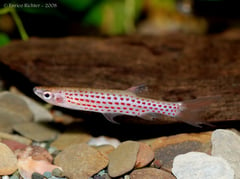
Copella meinkeniSpotted Splashing Tetra
Lebiasinidae · Zarske & Géry, 2006
The spotted splashing tetra, Copella meinkeni, is a small lebiasinid from the central Amazon region, with most records from the rio Negro and Orinoco. It has been widely referred to as C. nattereri in aquarium literature, but lacks that species' dark lateral stripe and has 5-6 rows of bright red spots on the body. The similar C. callolepis is also traded. It inhabits forest streams with tea-coloured water and lays its eggs among vegetation.
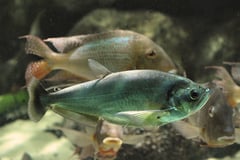
Hydrolycus scomberoidesVampire Tetra
Cynodontidae · Cuvier, 1819
The vampire tetra, Hydrolycus scomberoides, is a predatory dogtooth characin from the central and upper Amazon in Brazil, Bolivia, Peru and Ecuador. Also sold as 'scomb' and 'sabre tooth tetra', it is regularly confused with the much larger payara, H. armatus. At up to 300 mm it still needs a huge tank and specialist care, and newly-imported specimens often refuse anything but live food.

Megalamphodus erythrostigmaBleeding Heart Tetra
Characidae · (Fowler, 1943)
The bleeding heart tetra, Megalamphodus erythrostigma, is a characid from the upper Amazon basin where the borders of Brazil, Peru and Colombia meet. The best-known of three similar species in the 'bleeding heart' subgroup, it has the reddish humeral spot found in no other characid. Generally peaceful, although adult males are territorial to an extent, it mostly inhabits sluggish tributaries, side arms and forest lakes.
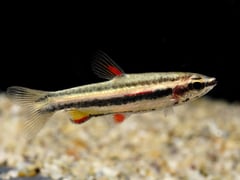
Nannostomus marginatusDwarf Pencilfish
Lebiasinidae · Eigenmann, 1909
The dwarf pencilfish, Nannostomus marginatus, is a lebiasinid of Guyana, Suriname and the middle-to-lower Amazon in Peru, Colombia and Brazil. Enduringly popular, it lacks the red body colour of males of the related N. mortenthaleri and N. rubrocaudatus, showing three dark lateral stripes with no red or purple between them. Colour varies between populations, and its small size and timid nature make it a poor community fish.
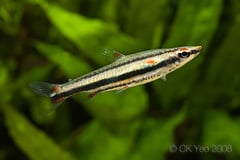
Nannostomus trifasciatusThree-lined Pencilfish
Lebiasinidae · Steindachner, 1876
The three-lined pencilfish, Nannostomus trifasciatus, is a lebiasinid widespread in the western Amazon basin in Brazil, Peru, Colombia and Bolivia. Fairly ubiquitous in the trade, it is less demanding than many congeners and a good choice for a newcomer to pencilfishes. Many fish on sale are farmed, and wild populations vary in colour pattern, one being marketed as 'super red' for its unusually long red stripe.
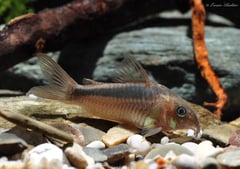
Osteogaster rabautiRusty Cory
Callichthyidae · (La Monte, 1941)
The rusty cory, Osteogaster rabauti, long known as Corydoras rabauti, is an armoured catfish known mostly from the rio Javarí, which forms much of the border between Brazil and Peru. It possibly also occurs in Colombia, but the full extent of its range is somewhat unclear. Often confused with the very similar O. zygata, it can be told apart by the broad dark stripe on the upper body, which extends onto the lower part of the caudal peduncle. An albino form is available on occasion.

Satanoperca jurupariDemon Eartheater
Cichlidae · Heckel, 1840
The demon eartheater, Satanoperca jurupari, is a cichlid recorded throughout much of the Amazon basin in Brazil, Bolivia, Peru, Ecuador and Colombia. In aquarium literature it is frequently confused with S. leucosticta, which has prominent white spots or vermiform markings on the sides of the head. Its precise identity is a confusing issue, and populations from the Tapajós, Xingu, Araguaia and Paraná are genetically distinct and may represent separate species.
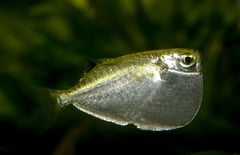
Thoracocharax stellatusSpotfin Hatchetfish
Gasteropelecidae · Kner, 1858
The spotfin hatchetfish, Thoracocharax stellatus, is the most widespread neotropical hatchetfish, recorded from much of South America. It is told from its only congener, T. securis, by a prominent dark spot in the dorsal fin, and is sometimes traded as 'platinum hatchetfish'. It feeds almost entirely on insects, and a tightly fitting cover is needed because it can clear several metres in one jump.

Aequidens tetramerusSaddle Cichlid
Cichlidae · Heckel, 1840
The saddle cichlid, Aequidens tetramerus, is a cichlid found across much of northern South America, from the Amazon and Orinoco basins to the Guianas. The type species of its genus, it occurs in several colour forms, and fish from Ecuador and Peru are sought after for the red or orange colouration on the lower head and belly. As currently recognised it is likely to represent a group of related fishes, some of which may be described as distinct species.
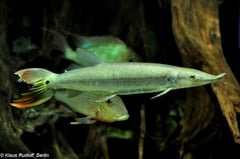
Boulengerella cuvieri
Ctenoluciidae · Spix & Agassiz, 1829
Boulengerella cuvieri is a pelagic ctenoluciid characin from much of the Amazon basin, the Río Orinoco and coastal drainages of the Guianas. The largest officially recorded specimen measured 675 mm, but it appears to grow larger, possibly beyond 800 mm. Given that size and its natural behaviour it is largely unsuitable for the home aquarium. Its entire dorsal-fin base lies ahead of the anal-fin origin, a character shared only with B. lucius and B. xyrekes among ctenoluciids.
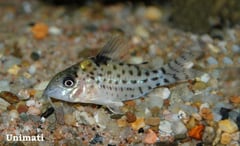
Brochis ambiacus
Callichthyidae · (Cope, 1872)
Brochis ambiacus, long known as Corydoras ambiacus, is an armoured catfish from the upper Amazon tributaries of Peru, Brazil, Colombia and Ecuador, described from the Río Ampiyacu. Its name is commonly misapplied to similar-looking fishes, particularly B. agassizii, and the colour pattern is variable. Cope described a large black spot covering the front half of the dorsal fin, and fish matching this are far more common in the trade than those matching B. agassizii.
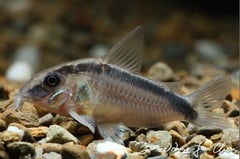
Brochis arcuataSkunk Cory; C020
Callichthyidae · (Elwin, 1938)
The skunk cory, Brochis arcuata, long known as Corydoras arcuatus, is an armoured catfish from the upper Amazon region in Brazil, Peru, Ecuador and Colombia. It is among the more popular Corydoras in the hobby and is also known as the 'arched cory' or C020. Several similar-looking congeners exist, particularly Hoplisoma urucu, in which the black body stripe ends behind the eye, and the larger C. narcissus from the rio Purus.
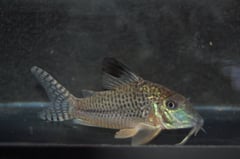
Corydoras acutusBlacktop Cory
Callichthyidae · Cope, 1872
The blacktop cory, Corydoras acutus, is an armoured catfish from the upper Amazon basin in Brazil, Peru, Ecuador and possibly Bolivia. It can be confused with three similar fishes known as C024, C077 and C109. C024 and C109 occur thousands of kilometres outside its range, but C077 lives alongside it in the rio Abunã and is only known to differ in growing smaller. Some specimens lack the dark marking in the dorsal fin.
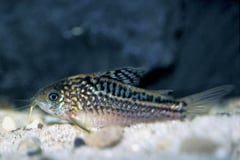
Gastrodermus elegansElegant Cory
Callichthyidae · (Steindachner, 1876)
The elegant cory, Gastrodermus elegans, long known as Corydoras elegans, is an armoured catfish from the western Amazon basin in Peru, Ecuador and Brazil. Unlike most congeners it spends a fair amount of time away from the substrate, often forming groups in midwater. It gives its name to the unofficial 'C. elegans group' of similar species, which includes G. nanus and G. undulatus plus many C- and CW-numbered fishes of uncertain status.

Laetacara thayeri
Cichlidae · Steindachner, 1875
Laetacara thayeri is a cichlid from the middle and upper Amazon basin in western Brazil and northern Peru. It is relatively rare in the aquarium trade. Ctenoid scales on the sides of the head and the lack of a dark spot at the caudal-fin base separate it from all congeners. Males grow larger than females and develop more-extended dorsal, anal and caudal fins.
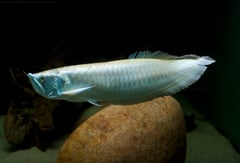
Osteoglossum bicirrhosumSilver Arowana
Osteoglossidae · Cuvier, 1829
The silver arowana, Osteoglossum bicirrhosum, is a large predator from the Amazon basin, plus river systems in Guyana and French Guiana. Reaching 80 cm, it is largely unsuitable for the home aquarium, and although juveniles are readily available, few private aquarists can house an adult long-term. Juveniles have a single dark lateral stripe, while in those of its only congener, O. ferreirai, most of the body and fins are dark.