River
Madeira
Only species with a profile on Seriously Fish are counted.
- Species
- 50
- Families
- 15
- Photographed
- 50 of 50
- Difficulty rated
- 50 of 50
Shares fishes withspecies recorded from both
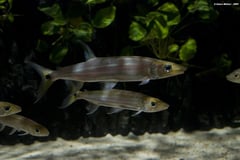
Acestrorhynchus falcirostrisBig-Eyed Cachorro
Acestrorhynchidae · (Cuvier, 1819)
The big-eyed cachorro, Acestrorhynchus falcirostris, is a large predatory acestrorhynchid from northern Amazon drainages and the Orinoco. The two dark body stripes of the A. nasutus group appear only in its juveniles, and at 320 to 350 mm SL it grows far larger than the other members. A black fringe to the rear of the operculum gives it a 'collared' look. It needs open water, and a group must be of comparable size because acestrorhynchids are cannibalistic.
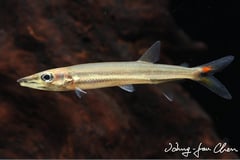
Acestrorhynchus isalineaeStriped Barracuda Tetra
Acestrorhynchidae · Menezes & Géry, 1983
The striped barracuda tetra, Acestrorhynchus isalineae, is a small predatory acestrorhynchid from the rio Madeira basin in the Brazilian Amazon. Most records come from the type locality, a tributary of the rio dos Marmelos. Like others in the A. nasutus group it keeps two dark longitudinal stripes into adulthood and stays around 100 mm. Acestrorhynchids are cannibalistic given the opportunity, so a group must be of comparable size.
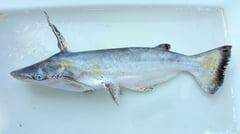
Ageneiosus inermisManduba
Auchenipteridae · (Linnaeus, 1766)
The manduba, Ageneiosus inermis, is a large auchenipterid catfish found throughout much of South America east of the Andes. At around 470 mm SL it would need an aquarium in excess of 400 x 120 cm as an adult and is largely unsuitable for private aquaria. An obligate carnivore, it can take surprisingly large prey, and the larger Ageneiosus species are often used as food fishes in their native countries.

Apistogramma bitaeniataTwo-Striped Dwarf Cichlid
Cichlidae · Pellegrin, 1936
The two-striped dwarf cichlid, Apistogramma bitaeniata, ranges across the Peruvian, Colombian and Brazilian Amazon, from the Marañón to the Tapajós. Also known as the banded dwarf cichlid, it occurs in several colour forms depending on locality, loosely grouped as 'red', 'blue', 'orange' and 'yellow' in the hobby. Many locality names are in use for these forms, and several are regularly applied incorrectly.

Apistogramma commbraeA93
Cichlidae · (Regan, 1906)
The Corumbá dwarf cichlid, Apistogramma commbrae, is widespread in the Paraguay River watershed of Argentina, Bolivia, Brazil and Paraguay. One of the smallest members of the genus, it is told apart with the rest of the A. commbrae complex by a conspicuous double caudal peduncle spot. Its habitats cool seasonally to as low as 16 °C, and it should be kept cooler over winter.

Astronotus ocellatusOscar
Cichlidae · (Agassiz, 1831)
The oscar, Astronotus ocellatus, is a large cichlid widely distributed in the Amazon region, recorded from Colombia and Venezuela south to Argentina. It grows to 350 mm SL and typically lives 10 to 20 years, both of which need taking into account before purchase. Most fish on sale come from commercial breeders in Eastern Europe or the Far East, in numerous ornamental strains, and genetic analyses suggest the genus contains additional, morphologically cryptic species.

Astyanax bimaculatusTwo Spot Astyanax
Characidae · (Linnaeus, 1758)
The two spot astyanax, Astyanax bimaculatus, is a characid ranging from Panama through most of the Amazon and Orinoco basins. It lives in a wide variety of biotopes, from swiftly-flowing rivers and streams to ponds, ditches and reservoirs. The name is currently applied to what is considered a species complex of at least four taxa, and aquarium fish most often arrive as contaminants among shipments of other species.

Biotodoma cupidoCupid Cichlid
Cichlidae · (Heckel, 1840)
The cupid cichlid, Biotodoma cupido, is a geophagine cichlid from much of the Amazon basin, north to the Essequibo in Guyana and south to Bolivia. Also traded as the 'green-streaked eartheater', it varies in colour pattern and shape by locality, and most traded fish come from around Santarém in Pará state. Unless breeding it is surprisingly peaceful. Its relatively compact body and a dark flank blotch above the upper lateral line separate it from B. wavrini.

Biotoecus opercularis
Cichlidae · (Steindachner, 1875)
Biotoecus opercularis is a small geophagine cichlid from the middle Amazon basin in Brazil, including the lower Madeira, Tapajós and Negro. It favours shallow, slow-flowing water over sand with leaf litter and submerged wood, often stained with tannins. Several populations are traded, among them B. sp. 'rio Negro' from the rio Jauaperi and B. sp. 'Santarém' or 'Tapajós', though no scientific evidence shows them to be more than one species. It should not be mixed with other Biotoecus species or populations.
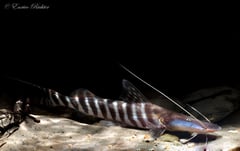
Brachyplatystoma tigrinumZebra Shovelnose
Pimelodidae · (Britski, 1981)
The zebra shovelnose, Brachyplatystoma tigrinum, is a pimelodid catfish from the upper Amazon basin in Brazil, Colombia and Peru. Adults appear to be obligate inhabitants of main river channels with strong flow, often around cataracts and rapids, and most aquarium fish are juveniles collected around Iquitos in Peru. It is sometimes confused with B. juruense, especially when young, but has a more well-defined colour pattern, a slenderer body and longer barbels.
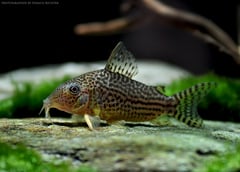
Brochis haraldschultziMosaic Cory
Callichthyidae · (Knaack, 1962)
The mosaic cory, Brochis haraldschultzi, long known as Corydoras haraldschultzi, is an armoured catfish endemic to the rio Guaporé (Río Iténez) in northeastern Bolivia and western Brazil. It resembles Hoplisoma sterbai but has a more extended snout and grows larger, to 85 mm SL. Its head carries dark vermiculations and spots on a light background, where H. sterbai has light markings on dark. The type locality was once modified to the rio Tocantins, well over 1000 km away, but the original Guaporé locality appears to be correct.
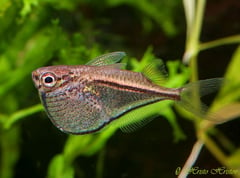
Carnegiella marthaeBlackwing Hatchetfish
Gasteropelecidae · Myers, 1927
The blackwing hatchetfish, Carnegiella marthae, is a small freshwater hatchetfish from the upper Orinoco in Venezuela and the rio Negro in Brazil. It appears to be a stenotypic inhabitant of blackwater, found in igapó and igarapé habitats with overhanging vegetation and leaf litter. Very peaceful but small and timid, it is best kept in a group of 10 or more with similarly sized, peaceful fishes.
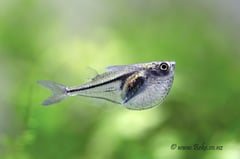
Carnegiella myersiPygmy Hatchetfish
Gasteropelecidae · Fernandez-Yepes, 1950
The pygmy hatchetfish, Carnegiella myersi, is a tiny freshwater hatchetfish from the Peruvian Amazon basin, with a second population in Bolivia. The smallest and most delicate of the nominal hatchetfishes, it has a shallower, rounded keel that gives it an elongate profile. It lives in small, shaded, shallow forest streams and must be kept in a group of at least six, away from active tankmates.

Colomesus asellusAmazon Puffer
Tetraodontidae · (Müller & Troschel, 1849)
The Amazon puffer, Colomesus asellus, is a freshwater puffer found throughout much of the Amazon basin, with records north to Guyana and Venezuela. Also traded as the South American puffer or 'SAP', it is told from congeners by a transverse row of dermal flaps across the chin. It lives mostly in well-oxygenated river habitats, is intolerant of organic waste, and forms loose aggregations, so a group of 6 or more is best, away from the general community.

Gastrodermus gracilis
Callichthyidae · (Nijssen & Isbrücker, 1976)
Gastrodermus gracilis, long known as Corydoras gracilis, is a small armoured catfish from the central Amazon basin in Brazil, known from the rio Juriti in Pará to the rio Juma in Amazonas. Sometimes called 'shy cory' in the hobby, it has a lightish body with a dark arched stripe along the upper flank, a pattern shared with Brochis arcuata, C. narcissus and Hoplisoma urucu. Only in G. gracilis does the stripe end at the base of the upper caudal-fin rays. It apparently favours minor tributaries with dense riparian vegetation and acidic, tannin-stained water.
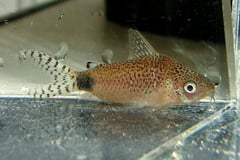
Gastrodermus guaporeGuaporé Cory
Callichthyidae · (Knaack, 1961)
The Guaporé cory, Gastrodermus guapore, long known as Corydoras guapore, is an armoured catfish endemic to the rio Guaporé (Río Iténez) in northeastern Bolivia and western Brazil. Unlike most congeners it forms aggregations in midwater and spends much of its time away from the substrate, with a large eye, a more terminal mouth and a strongly forked caudal fin to match. It partly feeds on pelagic zooplankton, so live Daphnia and Artemia belong in its diet. Similar species such as Hoplisoma simile lack these adaptations.
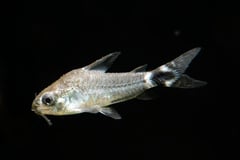
Gastrodermus hastatusTail-spot Pygmy Cory
Callichthyidae · (Eigenmann & Eigenmann, 1888)
The tail-spot pygmy cory, Gastrodermus hastatus, long known as Corydoras hastatus, is a tiny armoured catfish with a wide range across the Amazon and Río Paraguay basins. It is known from Brazil, Bolivia, Paraguay and northeastern Argentina. Unlike most congeners it swims in midwater, forming mixed schools with similarly patterned small characids such as Serrapinnus kriegi. It is frequently confused with G. pygmaeus, but has a dark, roughly diamond-shaped spot on the caudal peduncle where G. pygmaeus has a dark lateral stripe.

Geophagus altifrons
Cichlidae · Heckel, 1840
Geophagus altifrons is a large cichlid from the middle-to-lower Amazon basin in Brazil, including the Xingu, Tapajós, Madeira, Negro and Purus. Despite being the type species it is among the most frequently-misidentified members of the genus, partly because populations from the Orinoco, the Guianas and the Tocantins are now species in their own right. In adults the dark midlateral marking is reduced to 1-2 scales or absent, a feature unique to the species, but juveniles are very difficult to identify.

Geophagus megasema
Cichlidae · Heckel, 1840
Geophagus megasema is a cichlid from the upper rio Madeira basin, recorded from the Mamoré and Guaporé drainages in Bolivia and Brazil. Very rare in the aquarium hobby, it has been collected, bred and distributed by some private collectors. It has no dark preopercular or infraorbital markings, no bars on the flanks and a relatively large, roundish midlateral marking.
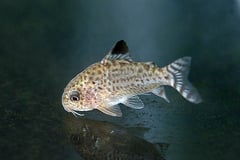
Hoplisoma cruzienseSanta Cruz Cory
Callichthyidae · (Knaack, 2002)
The Santa Cruz cory, Hoplisoma cruziense, long known as Corydoras cruziensis, is an armoured catfish from the Bolivian portion of the Río Madeira basin. The precise extent of its range is unclear and may include the Mamoré and Beni drainages. It is not well documented, but is said to differ from C. punctatus in having larger dark body markings, which form an irregular midlateral stripe in some specimens.
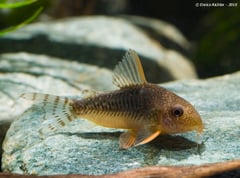
Hoplisoma gosseiPalespotted Cory
Callichthyidae · (Nijssen, 1972)
The palespotted cory, Hoplisoma gossei, long known as Corydoras gossei, is an armoured catfish from the rio Mamoré watershed in Rondônia state, northwestern Brazil. It is also likely to occur in northern Bolivia, since the Mamoré forms the border between the two countries at the type locality. Also known as 'smokey cory' and 'Gosse's cory', it shares its colour pattern with Brochis seussi from the same river, which has a noticeably prolonged snout. A form referred to as 'CW069' appears intermediate between the two.
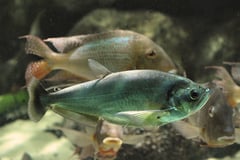
Hydrolycus scomberoidesVampire Tetra
Cynodontidae · (Cuvier, 1819)
The vampire tetra, Hydrolycus scomberoides, is a predatory dogtooth characin from the central and upper Amazon in Brazil, Bolivia, Peru and Ecuador. Also sold as 'scomb' and 'sabre tooth tetra', it is regularly confused with the much larger payara, H. armatus. At up to 300 mm it still needs a huge tank and specialist care, and newly-imported specimens often refuse anything but live food.

Hyphessobrycon agulha
Characidae · Fowler, 1913
Hyphessobrycon agulha is a small tetra known with certainty only from the rio Madeira system in the Amazon basin of Brazil, Peru and Bolivia. Relatively rare in the hobby, it is occasionally traded as the 'red-tailed flag tetra'. It lends its name to a group of closely-related species with a dark lower half of the body, especially above the anal fin, and it is very peaceful.

Iguanodectes geisleri
Iguanodectidae · Géry, 1970
Iguanodectes geisleri is a characin from the rios Madeira and Negro in Brazil and the upper Río Orinoco in Venezuela. Traded with the similar-looking I. adujai as the 'red line lizard tetra', it differs in having a black lateral stripe beneath the red stripe and 20 to 25 anal-fin rays (28 to 34 in I. adujai). Adult males carry red markings in the pectoral, pelvic, anal and caudal fins.
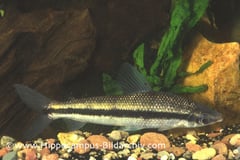
Laemolyta taeniataStriped Headstander
Anostomidae · (Kner, 1858)
The striped headstander, Laemolyta taeniata, is an anostomid from the central Amazon basin, also recorded from the Orinoco system in Venezuela. The largest-growing member of the genus, to 288 mm SL, it is rarely seen in the aquarium trade. Something of a habitat generalist, it migrates into flooded forest in the wet season and has been seen in large migratory shoals with Leporinus fasciatus and L. agassizii. Water quality is of the utmost importance, and anostomids are prodigious jumpers.
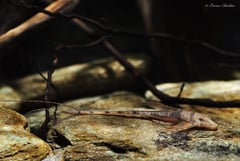
Lamontichthys filamentosusSturgeon Catfish
Loricariidae · (La Monte, 1935)
The sturgeon catfish, Lamontichthys filamentosus, is a loricariid from the central and western Amazon in Brazil, Peru, Ecuador and Bolivia. Above 60 mm SL the pectoral-fin spine extends into a filament that can be over four times the length of the first branched ray, and the dorsal-fin spine carries a similar extension. Relatively common in the hobby but not easy to maintain, it needs clean, well-oxygenated water and a mature aquarium with plenty of algae-covered surfaces.
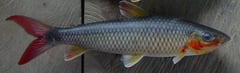
Leporinus brunneus
Anostomidae · Myers, 1950
Leporinus brunneus is an anostomid from the rios Madeira and Negro in Brazil, the Orinoco in Venezuela and Colombia, and the Casiquiare canal. The largest officially recorded specimen measured 256 mm, and an aquarium with base dimensions of at least 210 by 60 cm is needed.
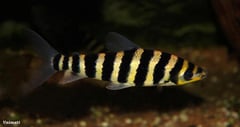
Leporinus fasciatusBanded Leporinus
Anostomidae · (Bloch, 1794)
The banded leporinus, Leporinus fasciatus, is an anostomid from the Amazon and Orinoco systems and coastal Guyana, Suriname and French Guiana. Young fish are often sold without warning of their size and requirements, and it is fairly ubiquitous in public aquarium displays. It is frequently confused with L. affinis, and its dark body bars multiply with age, from five in young fish to around ten in adults.

Megalamphodus megalopterusBlack Phantom Tetra
Characidae · Eigenmann, 1915
The black phantom tetra, Megalamphodus megalopterus, is a characid from the upper rio Madeira and upper rio Paraguai in Bolivia and Brazil. Most records are from the rio Guaporé (Río Iténez in Bolivia). Popular in the hobby and bred commercially in several countries, it is also available as a 'long-finned' strain. Adult males have black fins with the pelvic, dorsal and anal enlarged, while females are deeper-bodied with reddish pelvic, anal and adipose fins.
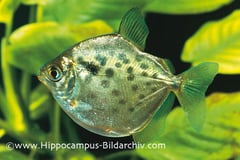
Metynnis maculatusSpotted Metynnis
Serrasalmidae · (Kner, 1858)
The spotted metynnis, Metynnis maculatus, is a silver dollar probably confined to the upper rio Madeira and upper rio Paraguai in Bolivia and Brazil. It is most often confused with M. argenteus and M. lippincottianus, but it has more midlateral scales and more spines on the ventral keel than either. It schools in nature and needs a very large tank with a group of six or more.
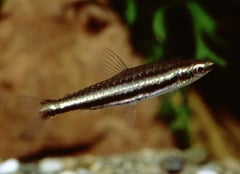
Nannostomus digrammusTwostripe Pencilfish
Lebiasinidae · (Fowler, 1913)
The twostripe pencilfish, Nannostomus digrammus, is a lebiasinid from the central Amazon basin in Brazil and the Rupununi basin in Guyana. Rare in the hobby, it usually arrives as bycatch among shipments of other fishes. It is most similar to N. bifasciatus but has an adipose-fin, and its small size and timid nature make it a poor community fish.
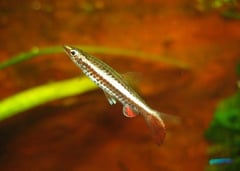
Nannostomus equesHockeystick Pencilfish
Lebiasinidae · Steindachner, 1876
The hockeystick pencilfish, Nannostomus eques, is a lebiasinid from the central and upper Amazon, the Orinoco drainage and rivers of Guyana. It swims at an oblique angle, a trait shared only with N. unifasciatus among congeners, and is also known as the 'rocket', 'diptail' or 'tubemouth' pencilfish. Genetic research on rio Negro populations raises the possibility that the species may be a complex of cryptic taxa.
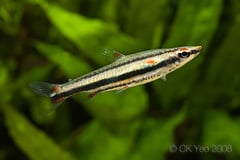
Nannostomus trifasciatusThree-lined Pencilfish
Lebiasinidae · Steindachner, 1876
The three-lined pencilfish, Nannostomus trifasciatus, is a lebiasinid widespread in the western Amazon basin in Brazil, Peru, Colombia and Bolivia. Fairly ubiquitous in the trade, it is less demanding than many congeners and a good choice for a newcomer to pencilfishes. Many fish on sale are farmed, and wild populations vary in colour pattern, one being marketed as 'super red' for its unusually long red stripe.
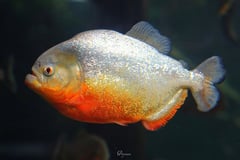
Pygocentrus nattereriRed Bellied Piranha
Serrasalmidae · Kner, 1858
The red bellied piranha, Pygocentrus nattereri, occurs through much of the Amazon basin and south into the Paraná and Uruguay river systems. Famed as a rapacious predator, it is among the most notorious freshwater fishes in the world. According to Herbert Axelrod (1976), the myth began with a feeding frenzy staged for Theodore Roosevelt in Brazil in 1913. Usually only juveniles form aggregations, and the species is relatively easy to breed in the aquarium.

Satanoperca jurupariDemon Eartheater
Cichlidae · (Heckel, 1840)
The demon eartheater, Satanoperca jurupari, is a cichlid recorded throughout much of the Amazon basin in Brazil, Bolivia, Peru, Ecuador and Colombia. In aquarium literature it is frequently confused with S. leucosticta, which has prominent white spots or vermiform markings on the sides of the head. Its precise identity is a confusing issue, and populations from the Tapajós, Xingu, Araguaia and Paraná are genetically distinct and may represent separate species.

Satanoperca lilith
Cichlidae · Kullander & Ferreira, 1988
Satanoperca lilith is an eartheater cichlid known only from Brazil, where it is widely distributed along the Solimões/Amazon main channel. Despite that extensive range it is uncommon in the ornamental trade, where it is sometimes called 'one-spotted demon fish' or 'one spot eartheater'. A single dark blotch on the flank separates it from the closely similar S. daemon, which has two.
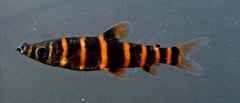
Synaptolaemus latofasciatus
Anostomidae · (Steindachner, 1910)
Synaptolaemus latofasciatus is a headstander from the upper Orinoco, the Casiquiare Canal and the middle-to-lower Amazon in Venezuela and Brazil. Described from a single specimen and placed in Leporinus until 2011, it was then recognised as the fish described as Synaptolaemus cingulatus. Alternating transverse bands of orange or yellow and dark brown or black run along the entire body, and snout shape and colour pattern vary with locality.
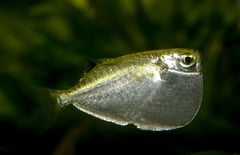
Thoracocharax stellatusSpotfin Hatchetfish
Gasteropelecidae · (Kner, 1858)
The spotfin hatchetfish, Thoracocharax stellatus, is the most widespread neotropical hatchetfish, recorded from much of South America. It is told from its only congener, T. securis, by a prominent dark spot in the dorsal fin, and is sometimes traded as 'platinum hatchetfish'. It feeds almost entirely on insects, and a tightly fitting cover is needed because it can clear several metres in one jump.

Aequidens tetramerusSaddle Cichlid
Cichlidae · (Heckel, 1840)
The saddle cichlid, Aequidens tetramerus, is a cichlid found across much of northern South America, from the Amazon and Orinoco basins to the Guianas. The type species of its genus, it occurs in several colour forms, and fish from Ecuador and Peru are sought after for the red or orange colouration on the lower head and belly. As currently recognised it is likely to represent a group of related fishes, some of which may be described as distinct species.
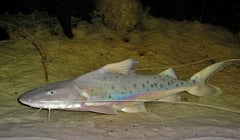
Brachyplatystoma capapretum
Pimelodidae · Lundberg & Akama, 2005
Brachyplatystoma capapretum is a large, piscivorous pimelodid catfish found throughout much of the Amazon basin, from near Belém to Iquitos in Peru. The largest recorded specimen measured 880 mm, and it is suitable only for public aquaria and a very small minority of private aquarists. It is very similar to B. filamentosum but smaller, with shorter maxillary barbels, a moderately forked caudal-fin with lobes of equal size, and adults very dark above.
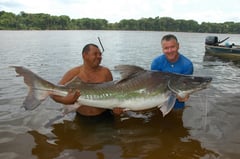
Brachyplatystoma filamentosumPiraíba
Pimelodidae · (Lichtenstein, 1819)
The piraíba, Brachyplatystoma filamentosum, is the largest catfish of the Amazon basin, also found in the Orinoco and river systems of the Guianas. Adults typically measure 2 to 2.5 m and weigh over 150 kg. In the Amazon only fish over around 160 cm are called 'Piraíba', and smaller ones 'filhote'. It is suitable only for public aquaria and a very small minority of private aquarists.
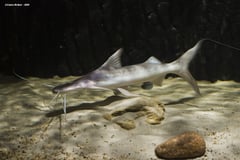
Brachyplatystoma platynemumSlobbering Catfish
Pimelodidae · Boulenger, 1898
The slobbering catfish, Brachyplatystoma platynemum, is a large migratory pimelodid catfish from the Amazon and Orinoco basins. The name refers to its relatively thick barbels, which give the impression that the fish is drooling. It travels considerable distances along deeper, flowing channels, and sexually mature adults have been observed in the upper rio Madeira basin, some 3000 km from the estuary. It grows to 1000 mm SL.
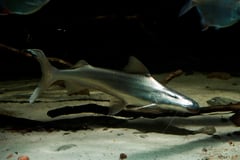
Brachyplatystoma rousseauxiiDourada
Pimelodidae · (Castelnau, 1855)
The dourada, Brachyplatystoma rousseauxii, is a large migratory pimelodid catfish from the Amazon and Orinoco drainages and rivers of the Guianas. Juveniles feed in the Amazon delta, while sexually mature adults are found only in the western Amazon. Some populations cover as much as 5500 km during migration from the delta, the longest known in any freshwater fish, and it is heavily fished during its upstream movement. It grows to 1900 mm SL.
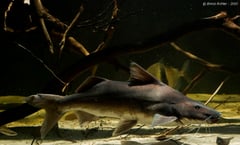
Brachyplatystoma vaillantiiPiramutaba
Pimelodidae · (Valenciennes, 1840)
The piramutaba, Brachyplatystoma vaillantii, is a large migratory pimelodid catfish from the Amazon and Orinoco watersheds and rivers of the Guianas. Juveniles feed in the Amazon delta before migrating upstream in massive numbers, when they are subject to intensive capture by commercial and artisanal fisheries. Sexually mature adults have been observed in the rio Caquetá basin, some 3500 km from the estuary. It grows to 1050 mm SL.
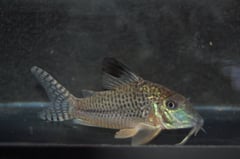
Corydoras acutusBlacktop Cory
Callichthyidae · Cope, 1872
The blacktop cory, Corydoras acutus, is an armoured catfish from the upper Amazon basin in Brazil, Peru, Ecuador and possibly Bolivia. It can be confused with three similar fishes known as C024, C077 and C109. C024 and C109 occur thousands of kilometres outside its range, but C077 lives alongside it in the rio Abunã and is only known to differ in growing smaller. Some specimens lack the dark marking in the dorsal fin.
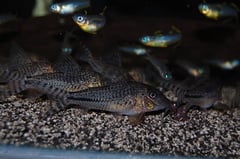
Corydoras sp.C115
Callichthyidae · authority not recorded
C115 is an unidentified armoured catfish from the upper Río Madre de Dios in southern Peru, between Manú National Park and Puerto Maldonado. It was traded as both C115 and C116, now thought to be the same species, and fish sold as C. sp. 'Manu' variants may belong here too. It grows to around 70 mm SL and is highly variable in colour pattern, particularly in the extent of dark pigmentation on the front of the body.
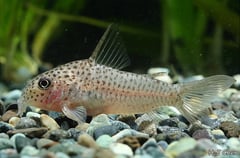
Hoplisoma albolineatumC056
Callichthyidae · (Knaack, 2004)
Hoplisoma albolineatum (C056), long known as Corydoras albolineatus, is an armoured catfish from the Río Iténez, or Guaporé, system in Bolivia and Brazil. It has a wide white longitudinal band and unmarked fins, and may be confused with the deeper-bodied H. xinguense. In the wild it forms aggregations of up to several thousand over sandy substrates and sand banks. It is not common in the hobby but is available occasionally.

Laetacara dorsigeraRedbreast Acara
Cichlidae · (Heckel, 1840)
The redbreast acara, Laetacara dorsigera, is a small cichlid from the Guaporé in Bolivia and Brazil, and the Paraná and Uruguay systems further south. Breeding males and females develop conspicuous red cheeks, opercula and belly, a feature L. curviceps lacks. A dark spot in the middle of the dorsal fin is shared only with L. curviceps and L. flamannellus. Populations vary in colour pattern, and it is a biparental substrate spawner growing to around 37 mm SL.
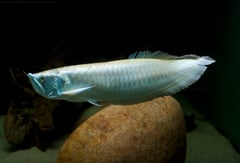
Osteoglossum bicirrhosumSilver Arowana
Osteoglossidae · (Cuvier, 1829)
The silver arowana, Osteoglossum bicirrhosum, is a large predator from the Amazon basin, plus river systems in Guyana and French Guiana. Reaching 80 cm, it is largely unsuitable for the home aquarium, and although juveniles are readily available, few private aquarists can house an adult long-term. Juveniles have a single dark lateral stripe, while in those of its only congener, O. ferreirai, most of the body and fins are dark.

Iguanodectes variatus
Iguanodectidae · Géry, 1993
Iguanodectes variatus is a characin from Brazil, recorded from the Guaporé, Madeira, Branco, Trombetas and Urubu river systems in the Amazon basin. It belongs to a small genus of elongate fishes in the family Iguanodectidae and grows to around 103 mm SL.