River
Tambraparni
Only species with a profile on Seriously Fish are counted.
- Species
- 5
- Families
- 3
- Photographed
- 5 of 5
- Difficulty rated
- 5 of 5
Shares fishes withspecies recorded from both

Barilius gatensisMalabar Baril
Cyprinidae · Valenciennes, 1844
The Malabar baril, Barilius gatensis, is a cyprinid endemic to the Western Ghats of southern India, in Karnataka, Kerala and Tamil Nadu. Occasionally seen in the trade, it has 13 to 15 dark blue vertical bars that often almost break up in adults. It inhabits well-oxygenated, fast-flowing rivers and streams, apparently favouring slower runs and pools, and its speed and vigorous feeding make it unsuitable for the general community.
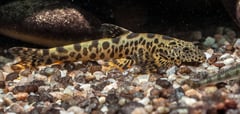
Bhavania australis
Balitoridae · Jerdon, 1849
Bhavania australis is a balitorid loach endemic to the Western Ghats mountains of southern India, recorded from Kerala, Tamil Nadu and Karnataka. An obligate dweller of shallow, fast-flowing, highly-oxygenated headwaters and minor tributaries, it has a flattened head and body and horizontally extended paired fins that form a powerful sucking cup for clinging to rocks. It is very rarely seen in the international aquarium trade but is maintained by a number of Indian aquarists.

Dawkinsia tambraparniei'Arulius' Barb
Cyprinidae · Silas, 1954
The 'arulius' barb, Dawkinsia tambraparniei, is a cyprinid possibly restricted to the middle Tambraparni River basin in Tamil Nadu, southern India. Described as a subspecies of D. arulius, it appears in most earlier aquarium literature as Puntius arulius or 'arulius barb' and is often still traded as such, although D. arulius is quite different-looking and rarely exported. Many fish in the trade are likely to have been bred commercially.

Puntius bimaculatusTwo-spotted Barb
Cyprinidae · Bleeker, 1863
The two-spotted barb, Puntius bimaculatus, is a small cyprinid from Sri Lanka and southern India. It lives in flowing hill streams and quieter stretches in the middle reaches of rivers, but tends to be absent from lowland environments. Also called the 'redside barb', it has 7 branched dorsal-fin rays and round dark spots at the base of the dorsal and caudal fins. Generally very peaceful, it is a schooling species and at least 6-10 should be kept.

Channa diplogrammaMalabar Snakehead
Channidae · Day, 1865
The Malabar snakehead, Channa diplogramma, is a large snakehead endemic to the southern Western Ghats in Kerala and Tamil Nadu, India. Treated as a synonym of the Indochinese C. micropeltes for over a century, it was revalidated in 2011 and has 103-105 lateral line scales, more than any other Channa. Its colour pattern changes markedly with age, and unlike most snakeheads it is pelagic and needs plenty of room to swim.