River
Terengganu
Only species with a profile on Seriously Fish are counted.
- Species
- 10
- Families
- 6
- Photographed
- 10 of 10
- Difficulty rated
- 10 of 10
Shares fishes withspecies recorded from both
Runs through
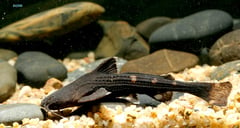
Acrochordonichthys rugosusAsian Banjo Catfish
Akysidae · Bleeker, 1846
The Asian banjo catfish, Acrochordonichthys rugosus, is an akysid catfish from Java, Sumatra, Borneo, Peninsular Malaysia and southern Thailand. The most commonly encountered member of the genus in the trade, it is still by no means common, and body colouration varies widely even among fish from a single locality. Like its congeners it can secrete a milky substance from the axillary pore when stressed, and this can quickly kill other fishes in the confines of an aquarium.
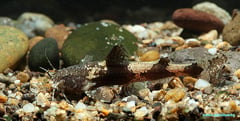
Akysis hendricksoniHendrickson's Stream Catfish
Akysidae · Alfred, 1966
Hendrickson's stream catfish, Akysis hendricksoni, is a small akysid catfish from much of Peninsular Malaysia and the extreme south of Thailand. One of the few members of the family exported for the hobby, it grows to around 50 mm SL and spends some of its time buried in sand with only the eyes showing. Colour pattern varies with locality, and like many fishes from running water it is intolerant of organic pollutants and needs spotless water.

Barbonymus gonionotus
Cyprinidae · Bleeker, 1849
Barbonymus gonionotus is a large cyprinid with an enormous distribution across Southeast Asia, from the Mekong to Java and Sumatra. It inhabits larger, slow-moving rivers and their floodplains, moving into flooded forest to feed and spawn, and is increasingly found in man-made canals and lakes. Plain grey caudal and dorsal fins and pale yellow pelvic and anal fins separate it from congeners. Populations in Peninsular Malaysia appear to be introduced.
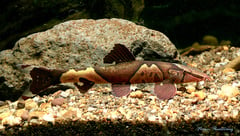
Homaloptera parclitella
Balitoridae · Tan & Ng, 2005
Homaloptera parclitella is a 'lizard' loach from Peninsular Malaysia and the Sai Buri, Bang Nara and Kolok river systems of southern Thailand. It was previously considered a form of H. orthogoniata and may be seen identified as such online and in print. It always has two large, saddle-shaped markings on the back, where H. orthogoniata has three, and it lives in swift, clear, oxygen-saturated streams.
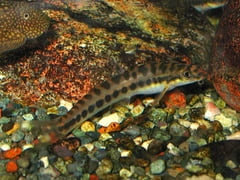
Nemacheilus masyaeArrow Loach
Nemacheilidae · Smith, 1933
Nemacheilus masyae is a nemacheilid loach from Thailand and Peninsular Malaysia. Its flanks carry 14-18 short dark bars and its back 12-17 saddles. It occurs in both small blackwater forest streams and turbid main river channels. It is very similar to N. pallidus but has a more slender body, and its dark bars and saddles are wider than the light interspaces between them.
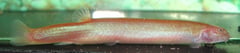
Pangio filinaris
Cobitidae · Kottelat & Lim, 1993
Pangio filinaris is a plain-bodied kuhli loach known only from Pahang and Terengganu states in Peninsular Malaysia. It has been confused with P. mariarum, which shares its plain patterning and nasal barbels, and has also been referred to by the invented name P. 'mariae'. It is sometimes exported for the aquarium trade, normally as by-catch among shipments of other species.
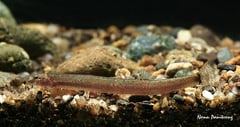
Pangio piperata
Cobitidae · Kottelat & Lim, 1993
Pangio piperata is a slender kuhli loach from Peninsular Malaysia, Riau Province in Sumatra and the Rajang river drainage in Sarawak. Its yellowish-brown body is peppered with small dark spots forming a rough stripe along the lateral line. Some populations of the variable P. shelfordii look similar and the two often occur together, but P. piperata is generally plainer and has fewer vertebrae. It is exported occasionally, most often as bycatch among congeners.
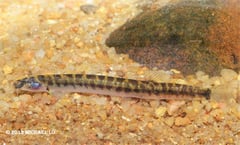
Pangio shelfordii
Cobitidae · Popta, 1903
Pangio shelfordii is a variably patterned kuhli loach from Peninsular Malaysia, Singapore, Sumatra and Borneo. Its patterning varies within and between populations, and as currently understood the species represents an assemblage containing a number of unidentified taxa. Some Sumatran and Bornean populations resemble P. piperata, which often occurs alongside it. It is exported occasionally, often as bycatch among shipments of congeners.

Puntigrus partipentazona
Cyprinidae · Fowler, 1934
Puntigrus partipentazona is a small cyprinid recorded from numerous river basins in Vietnam, Cambodia, Laos, Thailand and Peninsular Malaysia. It is easily told from congeners because the dark blotch on its dorsal fin extends onto the body. Typically found in heavily vegetated parts of rivers and sluggish streams, it is generally peaceful, though rival males continually battle for position within the group.
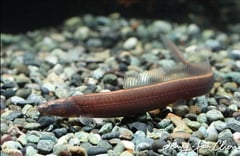
Vaillantella maassiFork-tailed Loach
Vaillantellidae · Weber & de Beaufort, 1912
The fork-tailed loach, Vaillantella maassi, is a loach from Sumatra, Borneo, Peninsular Malaysia and southern Thailand. Traded as 'chocolate scissor-tailed loach' and 'dragon loach' among other names, it has a bluish-brown body with an orange to yellow dorsal stripe. Rarely traded in numbers, it is among the more reclusive loaches and can be aggressive with its own kind and other fishes.