River
Valapattanam
Only species with a profile on Seriously Fish are counted.
- Species
- 5
- Families
- 3
- Photographed
- 5 of 5
- Difficulty rated
- 5 of 5
Basin
Shares fishes withspecies recorded from both
Runs through
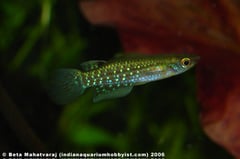
Aplocheilus blockiiGreen Panchax
Aplocheilidae · Arnold, 1911
The green panchax, Aplocheilus blockii, is a small killifish from Sri Lanka and southern India, growing to around 45 mm SL. Euryhaline, it mostly inhabits lowland, often coastal, still or slow-moving brackish or fresh water with surface vegetation or overhanging cover, and is commonly found in mangrove swamps and rice paddies.

Barilius bakeri
Cyprinidae · Day, 1865
Barilius bakeri is a fast-swimming cyprinid endemic to the Western Ghats of southwestern India, with records from many rivers in Kerala and Karnataka. It is traded as 'royal danio', 'blue-spotted hill trout' and 'blue-dotted mirror fish', and has a single row of bluish-green spots that get smaller with age. Its well-oxygenated, fast-flowing rivers are being polluted and degraded by exotic species and sand mining.

Barilius malabaricus
Cyprinidae · Jerdon, 1849
Barilius malabaricus is a cyprinid from southwestern India, known with certainty only from the Payaswini and Valapattanam river systems in Kerala. Before its revalidation in 2015 it was usually traded as B. canarensis or B. bakeri 'orange fin'. Bluish-green spots along the body and broad orange margins on the dorsal and anal fins distinguish it. It probably inhabits well-oxygenated, fast-flowing rivers and streams.

Sahyadria denisoniiRed-line Torpedo Barb
Cyprinidae · Day, 1865
The red-line torpedo barb, Sahyadria denisonii, is a cyprinid endemic to Kerala and Karnataka in southern India. Extremely popular since it appeared in the trade in the late 1990s, it is listed as Endangered by the IUCN, and collection for the aquarium trade has been held largely responsible for its decline. Large numbers are produced in Southeast Asia and Eastern Europe. The similar S. chalakkudiensis is occasionally traded as this species and is more belligerent.

Dario urops
Badidae · Britz, Ali & Philip, 2012
Dario urops is a badid from the Western Ghats of southwestern India, recorded from the Valapattanam and upper Cauvery systems in Karnataka and Kerala. Unlike the rest of the genus it occurs in southwestern India, grows to at least 28 mm SL, and has a conspicuous black eye spot on the caudal peduncle. Though described in 2012, it was first collected in the 19th century, when Day recorded Badis dario from 'Wynaad'.