River
Bhavani
Only species with a profile on Seriously Fish are counted.
- Species
- 7
- Families
- 4
- Photographed
- 7 of 7
- Difficulty rated
- 7 of 7
Basin
Shares fishes withspecies recorded from both
Runs through
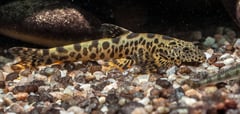
Bhavania australis
Balitoridae · Jerdon, 1849
Bhavania australis is a balitorid loach endemic to the Western Ghats mountains of southern India, recorded from Kerala, Tamil Nadu and Karnataka. An obligate dweller of shallow, fast-flowing, highly-oxygenated headwaters and minor tributaries, it has a flattened head and body and horizontally extended paired fins that form a powerful sucking cup for clinging to rocks. It is very rarely seen in the international aquarium trade but is maintained by a number of Indian aquarists.

Devario neilgherriensisPeninsular 'Danio'
Cyprinidae · (Day, 1867)
The peninsular 'danio', Devario neilgherriensis, appears endemic to tributaries of the Bhavani river system in the Nilgiri Hills, southern India. It is almost unheard of in the trade and little is known about it. Day described it with silvery flanks and a broad, indistinct steel-blue stripe bounded above and below by a narrow bright yellow band. Several of its hill-stream habitats lie around 2000 m AMSL.
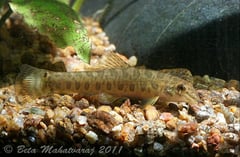
Paracanthocobitis mooreh
Nemacheilidae · Sykes, 1839
Paracanthocobitis mooreh is a nemacheilid loach known only from the Godavari, Krishna and Kaveri (Cauvery) systems in western and southern India. An incomplete lateral line ending near the pelvic-fin origin, with small, mostly vertical blotches along it connected to the dorsal saddles, separates it from congeners. It favours stretches of streams and small rivers where leaf litter collects over sand, cobbles and boulders, and is generally non-aggressive.

Sahyadria denisoniiRed-line Torpedo Barb
Cyprinidae · Day, 1865
The red-line torpedo barb, Sahyadria denisonii, is a cyprinid endemic to Kerala and Karnataka in southern India. Extremely popular since it appeared in the trade in the late 1990s, it is listed as Endangered by the IUCN, and collection for the aquarium trade has been held largely responsible for its decline. Large numbers are produced in Southeast Asia and Eastern Europe. The similar S. chalakkudiensis is occasionally traded as this species and is more belligerent.
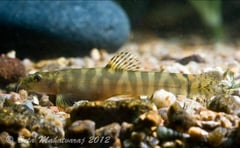
Schistura denisonii
Nemacheilidae · Day, 1867
Schistura denisonii is a nemacheilid loach from the Western Ghats of southern India, described from the Bhavani River in the Cauvery system. Widely referred to Nemacheilus, it matches the diagnostic characters of Schistura. The number and arrangement of its vertical body bars vary greatly, and whether it represents a complex of species or a single taxon remains unclear. Feisty, it is largely unsuitable for the general community aquarium.

Bagarius yarrelliGoonch
Sisoridae · Sykes, 1839
The goonch, Bagarius yarrelli, is a very large sisorid catfish recorded from the Indus in Pakistan east through Indochina to Sumatra and Borneo. Also known as the 'giant devil catfish' and 'sand shark', it reaches 1300 to 2000 mm and is fished for food across much of its range. That wide distribution appears doubtful, and Indian and Southeast Asian populations may prove not to be conspecific. It lives among boulders in the fast, turbulent rapids of large rivers.

Gymnostomus ariza
Cyprinidae · Hamilton, 1807
Gymnostomus ariza is a cyprinid widely distributed from the Indus basin in Pakistan through India, Bangladesh and Myanmar. Growing to around 300 mm SL, it inhabits flowing streams and tributaries with clear water. It has a confusing taxonomic history, having been placed in Bangana, Cirrhinus and Labeo in recent years. It breeds in temporarily-inundated zones in the wet season and is also produced commercially for food.