River
Xi
Only species with a profile on Seriously Fish are counted.
- Species
- 11
- Families
- 6
- Photographed
- 11 of 11
- Difficulty rated
- 11 of 11
Shares fishes withspecies recorded from both
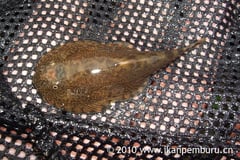
Beaufortia cyclica
Gastromyzontidae · Chen, 1980
Beaufortia cyclica is a hillstream loach known from a handful of localities in the Xi River drainage and the Tuoniang river system in southern China. Its flattened head and body and horizontal paired fins form a sucking cup that lets it cling to rocks in shallow, fast-flowing, highly-oxygenated headwaters. Kottelat (2012) states that B. cyclica may be a synonym of B. elongata.
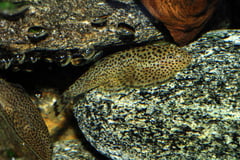
Beaufortia kweichowensisButterfly Loach
Gastromyzontidae · Fang, 1931
The butterfly loach, Beaufortia kweichowensis, is a hillstream loach from the Xi Jiang (West River) system in southern China. In many countries it is the most common gastromyzontid in the shops, one of several loaches traded as 'butterfly loach', 'Hong Kong plec' or 'Chinese hillstream loach' regardless of species. The name B. leveretti is often applied to it. It needs clean, well-oxygenated, fast-flowing water, and 16 to 24 °C is recommended.
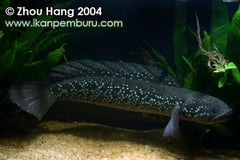
Channa asiaticaChinese Snakehead
Channidae · Linnaeus, 1758
The Chinese snakehead, Channa asiatica, is a snakehead native to central and southern China and northern Vietnam. One of several Channa lacking pelvic fins, it is told apart from them by vertical black bars on a brownish body and numerous white spots on the body and fins. It is best kept in a species tank. Pairs build no bubble nest, and both parents defend several thousand floating eggs and the fry.
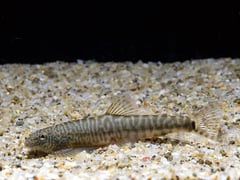
Erromyzon sinensis
Gastromyzontidae · Chen, 1980
Erromyzon sinensis is a gastromyzontid loach from the Xi Jiang (West River) system in southern China, mostly in Guangxi. It is extremely rare to nonexistent in the aquarium trade, although its name has been widely misapplied to congeners such as the unidentified E. sp. 'ER02'. An obligate bottom-dweller, it lives in shallow, fast-flowing, highly-oxygenated headwaters and minor tributaries, clinging to rocks with its flattened body and horizontally-orientated paired fins.
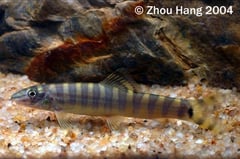
Parabotia lijiangensis
Botiidae · Chen, 1980
Parabotia lijiangensis is a botiid loach described from the Li River drainage near Guilin, in the Pearl River system of southern China. It has 10-13 dark vertical bars on the body and a dark, ocellated spot in the centre of the caudal-fin base. It probably inhabits clear, well-oxygenated running water, and the occasional specimen may turn up among shipments of similar-looking Sinibotia.
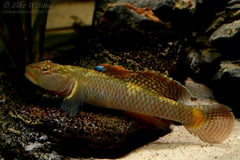
Rhinogobius leavelli
Gobiidae · (Herre, 1935)
Rhinogobius leavelli is a goby ranging from northeastern Laos through northern Vietnam to the Pearl drainage in Guangxi, southern China. It appears to exist in a number of forms that differ in colour pattern, morphology or both, although those in the aquarium trade all look similar. Fish identified as this species tend to have an orange blotch at the base of the caudal fin and a dark vertical bar at the base of the pectoral fin.
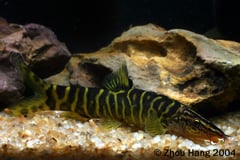
Sinibotia pulchraGolden Zebra Loach
Botiidae · Wu, 1939
The golden zebra loach, Sinibotia pulchra, is a botiid loach from the Zhu Jiang (Pearl River) system in southern China. It is also sold as the 'golden Chinese loach' or '12-banded Chinese loach' and, with S. robusta, is the most commonly traded Sinibotia, the two often imported in mixed batches. It is reclusive but very peaceful, and the gregarious nature of the genus means 3-4 should be the minimum purchase.
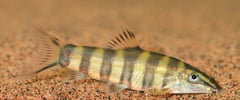
Sinibotia robustaKansu Loach
Botiidae · Wu, 1939
The Kansu loach, Sinibotia robusta, is a botiid loach from the Zhu Jiang (Pearl River) system in Guangxi, southern China. Its deeper, stockier body separates it from other Sinibotia. With S. pulchra it is the most commonly traded member of the genus, and the two are often imported in mixed batches. Young fish have around 6 dark bars that usually bifurcate as they mature.
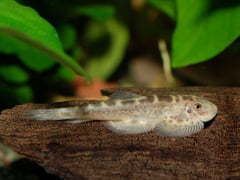
Sinogastromyzon wui
Balitoridae · Fang, 1930
Sinogastromyzon wui is a hillstream loach known only from parts of the Xi Jiang (West River) watershed in Guangxi and Guangdong, southern China. Probably the most common member of the genus in the aquarium trade, it is still not often exported in numbers and more often arrives in mixed shipments with Beaufortia or Pseudogastromyzon. It lives in shallow riffles and rapids with swift currents.

Ctenopharyngodon idellaGrass Carp
Cyprinidae · Valenciennes, 1844
The grass carp, Ctenopharyngodon idella, is a large cyprinid native to the Amur River system in eastern Russia and northeastern China. Adults typically reach 800 to 1200 mm, making it a wholly unsuitable aquarium subject, though an albino form is traded. Widely introduced for aquaculture and weed control, it has caused serious damage to natural waters, and unwanted fish should never be released.
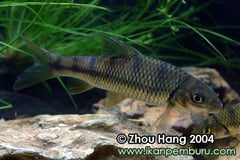
Acrossocheilus parallens
Cyprinidae · Nichols, 1931
Acrossocheilus parallens is a barred cyprinid from Guangdong and Hainan provinces in southern China, plus the island of Taiwan. It has five or six dark vertical bars on each flank, each two scales wide, a pattern it shares with A. paradoxus and several other congeners. Wild fish feed on small benthic invertebrates and graze biofilm from rocks and other solid surfaces.