River
Gui
Only species with a profile on Seriously Fish are counted.
- Species
- 6
- Families
- 4
- Photographed
- 6 of 6
- Difficulty rated
- 6 of 6
Basin
Also in the Zhu basinspecies recorded from both
Shares fishes with rivers elsewherespecies recorded from both
Runs through

Macropodus ocellatusRoundtail Paradise Fish
Osphronemidae · Cantor, 1842
The roundtail paradise fish, Macropodus ocellatus, is a labyrinth fish with an enormous range in China, Korea and Japan, north to the Amur River. It lives in ditches, rice paddies, marshes and river backwaters, where winter can freeze the surface and drop the water to 3 °C. It is sometimes referred to as M. chinensis in older literature, a name now considered a synonym of M. opercularis. Males are territorial when breeding and build bubble nests.
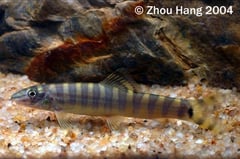
Parabotia lijiangensis
Botiidae · Chen, 1980
Parabotia lijiangensis is a botiid loach described from the Li River drainage near Guilin, in the Pearl River system of southern China. It has 10-13 dark vertical bars on the body and a dark, ocellated spot in the centre of the caudal-fin base. It probably inhabits clear, well-oxygenated running water, and the occasional specimen may turn up among shipments of similar-looking Sinibotia.
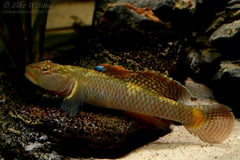
Rhinogobius leavelli
Gobiidae · (Herre, 1935)
Rhinogobius leavelli is a goby ranging from northeastern Laos through northern Vietnam to the Pearl drainage in Guangxi, southern China. It appears to exist in a number of forms that differ in colour pattern, morphology or both, although those in the aquarium trade all look similar. Fish identified as this species tend to have an orange blotch at the base of the caudal fin and a dark vertical bar at the base of the pectoral fin.
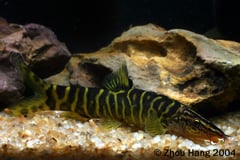
Sinibotia pulchraGolden Zebra Loach
Botiidae · Wu, 1939
The golden zebra loach, Sinibotia pulchra, is a botiid loach from the Zhu Jiang (Pearl River) system in southern China. It is also sold as the 'golden Chinese loach' or '12-banded Chinese loach' and, with S. robusta, is the most commonly traded Sinibotia, the two often imported in mixed batches. It is reclusive but very peaceful, and the gregarious nature of the genus means 3-4 should be the minimum purchase.
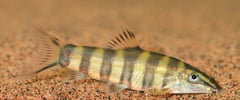
Sinibotia robustaKansu Loach
Botiidae · Wu, 1939
The Kansu loach, Sinibotia robusta, is a botiid loach from the Zhu Jiang (Pearl River) system in Guangxi, southern China. Its deeper, stockier body separates it from other Sinibotia. With S. pulchra it is the most commonly traded member of the genus, and the two are often imported in mixed batches. Young fish have around 6 dark bars that usually bifurcate as they mature.
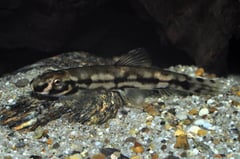
Yaoshania pachychilusPanda Loach
Balitoridae · Chen, 1980
The panda loach, Yaoshania pachychilus, is a balitorid loach from headwater streams draining the Dayao Mountain in Guangxi, southern China. The name comes from the black-and-white-striped juvenile pattern, which fades in older fish, so only young fish tend to be traded, sometimes labelled 'panda goby'. It needs clean, well-oxygenated, fast-flowing water, and though often marketed for them it is not suitable for tiny 'nano' aquaria.