Aphaniops dispar
Arabian Toothcarp
Formerly Lebias dispar Rüppell, 1829 · Cyprinodon lunatus Valenciennes, 1846 · Cyprinodon cilensis Gianferrari, 1930 · Cyprinodon darrorensis Gianferrari, 1933 · Cyprinodon zaccarinii Gianferrari, 1933 · Cyprinodon zaccarinii var. airebejensis Gianferrari, 1933
On this page13 sections
Quick facts
Difficulty4 of 8 measures
More bars, more demanding.
- Space
- large tank
- Water
- tap water
- Temp
- unfussy
- Diet
- unknown
- Temperament
- unknown
- Social
- shoal
- Compatibility
- unknown
Other demands
Each of these can raise the rating on its own, whatever the measures above say.
- Hardiness
- unknown
The Arabian toothcarp, Aphaniops dispar, is found around the coasts of the Red Sea and the Gulf of Aden. Inland populations also exist, and it tolerates anything from pure freshwater to hypersaline conditions. A 2003 phylogenetic study found it paraphyletic, and several populations once included in it have since been described as separate species, so forms are labelled by locality, such as 'Lake Assal'.
Etymology
Aphaniops: named for the related genus Aphanius, within which members were formerly placed, in combination with the taxonomic suffix -ops, meaning 'resembling'.
dispar: from the Latin adjective dispar, meaning 'different, dissimilar', in reference to the pronounced sexual dimorphism demonstrated by this species.
Distribution
Found around the coastlines of the Red Sea (Egypt, Sudan, Eritrea, Djibouti and western Saudi Arabia) and the Gulf of Aden (Somalia and Yemen, including Socotra). It has entered the eastern Mediterranean through the Suez Canal and is established on the coast of Israel.
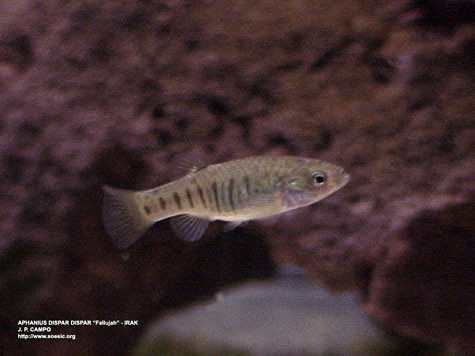
Inland populations can be found in Egypt (oases of Siwa and Al-Faiyum), Saudi Arabia (oases of Al-Hasa and Al-Kharj) and the salt lakes of the Afar Depression in Djibouti, including Lake Assal. Fish from the Persian Gulf, the Gulf of Oman, the coasts of Pakistan and western India, inland Iran and Iraq (including Fallujah) were long included in this species and are now Aphaniops stoliczkanus (Freyhof et al., 2017). The Dead Sea springs population in Israel and Jordan is A. richardsoni, and the Lake Afrera fish in Ethiopia is A. stiassnyae.
It has long been considered doubtful that all populations represent a single species and the fish exhibit variations in colouration and patterning depending on locality; several have already been described as separate species and it is likely that others will be named in the future. It is therefore important that the different forms be labelled with the collection details by aquarists and scientists in order to preserve bloodlines and maintain accuracy such as 'Lake Assal'.
Habitat
Found in numerous habitat types although it mostly inhabits shallow coastal waters such as lagoons and first order streams where submerged vegetation or filamentous algae grows thickly. It is highly adaptable and tolerant of a wide range of salinities from pure freshwater to hypersaline conditions. For example in the United Arab Emirates it has been introduced to freshwaters including agricultural runoff channels, bulldozed ponds, water tanks and cisterns as a form of mosquito control and has been shown to thrive in all these environments whereas in Lake Afera the salinity has been measured at 160g/L!
Unfortunately it is being outcompeted by Gambusia affinis and other introduced species across some parts of its range while habitat degradation and pollution continue to affect others; some populations have probably been wiped out already and studies suggest the situation is only likely to deteriorate in the future.
Aquarium size
A pair or trio can be kept in a container with base dimensions of 60 cm x 30 cm or so but as a general rule members ofthis genus do better when maintained as a larger group in a space measuring upwards of 120 ∗ 30 cm48 ∗ 12 in.
Maintenance
Even for long-term maintenance a simple set-up will suffice. The most important factors are the provision of plenty of cover and a suitable medium in which the fish can deposit eggs. It is a shy species and female/subdominant male individuals must be offered the opportunity of respite from the vigorous alpha males during the spawning season so much of the available space can be filled with clumps of Java moss/other fine-leaved plant and ideally filamentous algae.
The type of substrate used is crucial if you want the fish to breed as this species shows a strong preference towards spawning at the base of the tank (see 'Breeding'). Adding a few algae-encrusted rocks may represent the best option as it is known to deposit eggs on such surfaces in nature. Alternatively use a large grade of gravel or simply leave the base bare and allow a layer of organic detritus to form by only removing water from the top of the tank when performing water changes. Filtration need not be too strong.
It is possible, and preferable, to maintain it outdoors all year round in many countries and it will show better colours and overall condition if exposed to at least a few hours of natural sunlight each day. Try to find out the origin of your fish as some populations will do best in freshwater but if in doubt we recommend the addition of marine salt in the ratio of 1-3 g/L as most will need it. Those from hypersaline locations are likely to require concentrations in excess of 20 g/L in order to breed.
Water conditions
Temperature: Generally active over a wide temperature range of 39 - 86°F/4 - 30°C but some populations will not do well below 59°F/15°C. Studies have shown that this species is capable of withstanding temperatures in excess of 104°F/40°C.
pH: 7.5 – 9.0. It will probably not survive under acidic conditions.
Hardness: 15 – 35 dGH
These recommendations come from this profile’s own figures. They contain affiliate links, so we may earn a commission.
Diet
Omnivorous although it displays a marked vegetarian tendency compared to most congeners with a large proportion of the natural diet being composed of algae and other plant material. If the aquarium or container does not contain filamentous algae try to introduce a good quality dried product with added Spirulina content to the diet. It should also be offered regular meals of small live or frozen fare such as Artemia, Daphnia or bloodworm, this being particularly important during the months of spring and summer when the fish show a high reproductive effort.
Behaviour and compatibility
Its particular water requirements make A. dispar a poor choice for the community aquarium. Given its rarity in the hobby the emphasis should also be on captive reproduction and we strongly recommend maintaining it alone. It should be kept in a group with a ratio of two or three females to each male being the ideal.
Sexual dimorphism
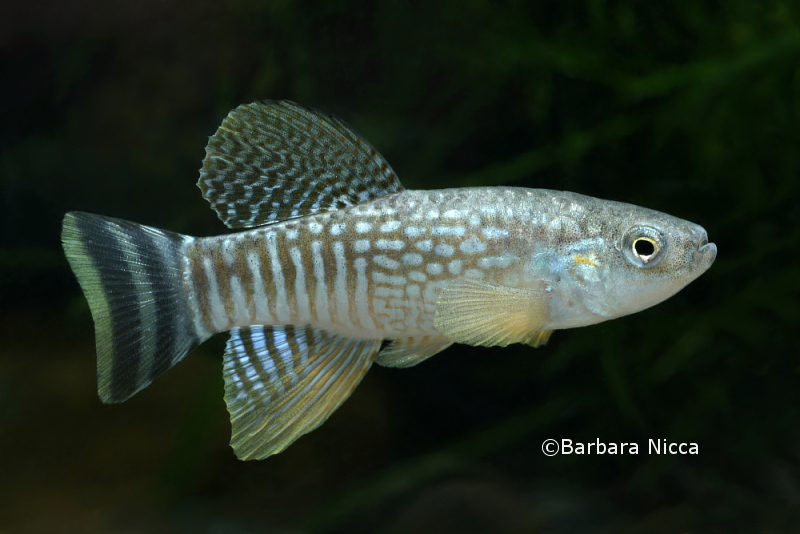
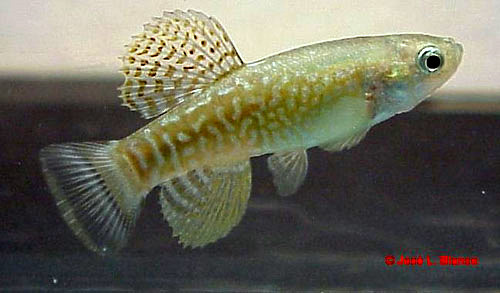
As with all members of the genus sexual dimorphism is pronounced but in this case the patterning varies according to the origin of the fish. The flanks of the male exhibit an irregular series of (usually silvery) spot-like markings which increase in size and/or develop into solid vertical bars in the rear portion of the body in some forms, while in others the spotting is retained throughout. Shared characters in all variants include the presence of 2-3 dark bars in the caudal fin and spectacularly extended dorsal and anal fins. Females are larger and much plainer possessing only a series of variable dark blotches or stripes on the flanks along and completely hyaline finnage.
Reproduction
Captive reproduction is not difficult if the tank or container is properly arranged and maintained (see 'tank set-up'). Unlike other Aphanius, A. dispar tends to deposit eggs in the substrate so there is no need to add spawning mops although filamentous algae can be useful. It is a fractional spawner with females depositing eggs on a more-or-less continuous basis between the months of April and September although some forms from Saudi Arabia and Iran are thought to breed year-round.
Males form temporary territories which they defend against rivals while attempting to entice females to spawn. Dominant individuals will show more intense colouration. Eggs are released singly or in small batches and are typically eaten by the adults if they find them so the tank base should be checked on a daily basis during the spawning period.
The eggs are very small and must be treated carefully. Use a fine pair of forceps to gently remove them whilst avoiding direct contact. Alternatively the adults can simply be removed post-spawning and the fry grown on in the spawning tank. If removed the eggs should be transferred to a container with water of the same chemistry and temperature as that of the adults. The incubation period can vary a little with the temperature but is usually between 10-14 days with the fry being large enough to accept Artemia nauplii, microworm etc. as soon as they can be seen free-swimming.
Notes
A. dispar should only be considered a nominal species as demonstrated by Hrbek and Meyer (2003) who conducted an in-depth phylogenetic study covering the majority of the genus. It was found to represent a paraphyletic grouping meaning it cannot be considered to be a species following the phylogenetic species concept. A. mento, A. sirhani and especially A. ginaonis and A. richardsoni were found to be its closest surviving relatives.
Hoedeman (1951) suggested that it should be moved into a separate genus, proposing the name Aphaniops, due to unique morphological characters such as the presence of 8-9 (vs. 10-14 in other Aphanius) dorsal fin rays and 7-8 (vs. 5-7) pelvic fin rays and Aphaniops is now treated as a valid genus.
You're unlikely to find it on sale in aquatic stores although it may be available via specialist breeders or associations from time-to-time. While these killifishes are certainly not as colourful as some of their relatives their interesting behaviour and continuous activity make them fascinating aquarium subjects and well worth a try if you possess the dedication to take on a long-term maintenance project since conservation is key with all members of the genus.
Aphaniid killifishes are thought to have derived from a common ancestor originally distributed around the periphery of the former Tethys Sea. None are particularly well-documented in aquarium literature although some are very beautiful and the majority are not too difficult to maintain and breed. Sadly most are on the verge of extinction for one reason or another with several existing only in remnant, highly-localised populations.
In practically all cases the root cause for this decline is the activity of humans and although some species are now protected by conservation law the mismanagement and degradation of their habitats continues at an alarming rate. A few species are still, inexplicably, listed as a species of Lebias by some sources although that name has long been considered a synonym of Cyprinodon by most authorities and an ICZN committee voted to suppress the name in favour of Aphanius as recently as 2003.
References
- Hrbek, T. and A. Meyer (2003). Closing of the Tethys Sea and the phylogeny of Eurasian killifishes (Cyprinodontiformes: Cyprinodontidae). Journal of Evolutionary Biology 16(1), 17-36
- Al-Kahem-Al-Balawi, H. F., K.A. Al-Ghanim, Z. Ahmad, T.A. Temraz, A.S. Al-Akel, F. Al-Misned and H. Annazri (2008). A Threatened Fish Species (Aphanius dispar) in Saudi Arabia, A Case Study. Pakistan Journal of Biological Sciences 11(19), 2300-2307.
- Campo, J.P. (2005). Aphanius dispar dispar (Rüppel 1829). SEI/GEVA Ficha.
Species images · 3
Used with the photographer’s permission. Not licensed for reuse.