Hobbyist group · Cyprinodontiformes
Cyprinodontoid Toothcarps
Cyprinodontoid Toothcarps spans 6 families.
- Species
- 51
- Families
- 6
- Genera
- 28
- Photographed
- 49 of 51
- Difficulty rated
- 51 of 51
Families
Where they come fromnative records only
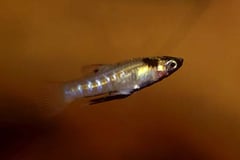
Girardinus metallicusMetallic Girardinus
Poeciliidae · authority not recorded
The metallic girardinus, Girardinus metallicus, is a small livebearer from Cuba. It lives in streams, ponds and ditches where the water is commonly stagnant and often brackish. Introduced to the aquarium trade in the early 20th century, it disappeared soon after and reappeared in a Berlin zoo in 1965. Breeding is very easy provided soft, acidic water is avoided.
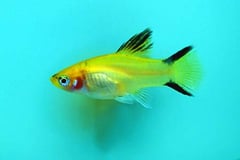
Xiphophorus maculatusPlaty
Poeciliidae · (Gunther, 1866)
The platy, Xiphophorus maculatus, is a livebearer from the Atlantic coastal plain of Mexico, Guatemala, Belize and Nicaragua. Wild fish are almost never seen in the hobby, where dozens of selectively bred varieties are available, some produced by crossing with other Xiphophorus species. Many commercially bred platies are not very hardy because of inbreeding and over-production. Very peaceful, it suits the beginner as long as the water is moderately hard or harder.
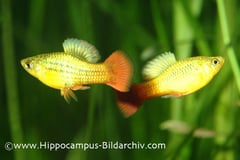
Xiphophorus variatusVariable Platy
Poeciliidae · (Meek, 1904)
The variable platy, Xiphophorus variatus, is a livebearer native to the Atlantic slope of Mexico, with feral populations in several other countries. Most on sale are mass-produced in the Far East and Eastern Europe, and many commercially bred platies are not very hardy because of inbreeding. Wild fish are slimmer than X. maculatus with a slightly longer dorsal fin, and should be kept from crossbreeding with domestic forms. It lives in shallow, heavily vegetated streams, ponds, swamps and ditches.
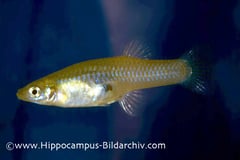
Gambusia affinisWestern Mosquitofish
Poeciliidae · authority not recorded
The western mosquitofish, Gambusia affinis, is a livebearer native to Mexico and the southern USA. It has been introduced to over 60 countries to control mosquitoes, often with detrimental effects, since it also preys on small crustaceans and the eggs and young of other fishes. It was long thought to be the same species as G. holbrooki. Hyper-competitive and a notorious fin nipper, it is best kept in a species tank.
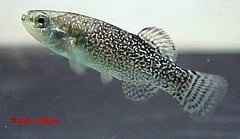
Apricaphanius saourensisSahara Toothcarp
Aphaniidae · (Blanco, Hrbek & Doadrio, 2006)
The Sahara toothcarp, Apricaphanius saourensis, is endemic to the Oued Saoura, an endorheic river basin in Algeria that drains into the Sahara. Described in 2006, it differs from A. iberus and A. baeticus in its mottled body patterning. In 2004 it was found only at Mazzer, and introduced Gambusia is thought to have extirpated it from its other localities. The describers suggest it should be considered critically endangered.
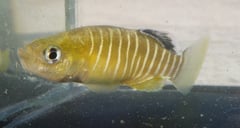
Esmaeilius vladykoviZagros Toothcarp
Aphaniidae · (Coad, 1988)
The Zagros toothcarp, Esmaeilius vladykovi, is restricted to a small area of the Zagros mountains in Chahārmahāl o Bakhtiyārī province, Iran. It lives over 2000 m above sea level in slow freshwater streams, pools and marshes of the upper Karun River basin. The dark dorsal fin of males separates it from its closest relative A. sophiae. Males are relatively peaceful towards one another, and it swims in large schools in nature.
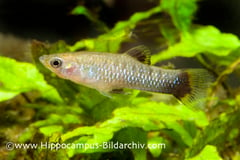
Limia melanogasterBlack-bellied Limia
Poeciliidae · authority not recorded
The black-bellied limia, Limia melanogaster, is a small livebearer endemic to Jamaica, where it usually lives in small streams. Originally placed in Limia, it was later treated as a member of Poecilia and has since been returned to Limia, but much of the literature still refers to it as Poecilia. Peaceful and easy to breed, it is not often seen for sale in the hobby.
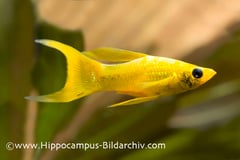
Poecilia latipinnaSailfin Molly
Poeciliidae · (Lesueur, 1821)
The sailfin molly, Poecilia latipinna, is a livebearer native to southern North America and Mexico, from Carolina to Veracruz. Bred into many colour morphs and crossed with P. sphenops, it can live perfectly well in fresh water provided it is not soft or acidic. Dark rectangular spots in the dorsal fin separate it from the similar P. velifera, and introduced populations in many countries often outcompete native species.
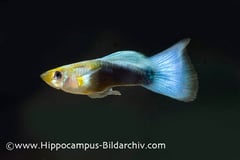
Poecilia reticulataGuppy
Poeciliidae · Peters, 1859
The guppy, Poecilia reticulata, is a livebearer native to northeastern South America and the southern Caribbean, including Venezuela and Trinidad. One of the most popular aquarium fish in the world, it is available in many aquarium-bred varieties with elongated finnage, while the wild form is seldom seen for sale. Many commercially bred guppies are weakened by inbreeding and over-production, and introduced or feral populations exist in around fifty other countries.
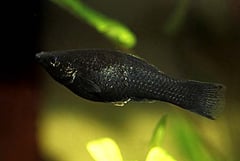
Poecilia sphenopsShort-finned Molly/Black Molly
Poeciliidae · Valenciennes, 1846
The short-finned molly, Poecilia sphenops, is a livebearer whose native range runs north from Venezuela and Colombia to Mexico. Many colour morphs exist, including the black molly, and years of inbreeding and over-production have left many of them weak and prone to disease. All the morphs do better in slightly brackish conditions and are much more prone to disease in fresh water that is not hard and alkaline.
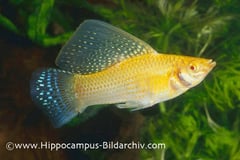
Poecilia veliferaGiant Sailfin Molly
Poeciliidae · (Regan, 1914)
The giant sailfin molly, Poecilia velifera, is a livebearer endemic to southeastern Mexico, with introduced populations in several other countries. Young fish are hard to tell from P. latipinna, and the only reliable method is to count the dorsal-fin rays: 18-19 in this species against 14. More difficult to maintain than others in the genus, it needs hard, alkaline water of high quality for males to develop the full sail-like dorsal fin.
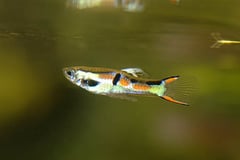
Poecilia wingeiEndler's Livebearer
Poeciliidae · Poeser, Kempkes & Isbrucker, 2005
Endler's livebearer, Poecilia wingei, is a small livebearer from the Campoma and Buena Vista lagoons in northeastern Venezuela. It hybridises with the guppy, P. reticulata, to produce fertile offspring, but Schories et al. (2009) confirmed it as a valid species. The fish are thought to be extinct at Laguna de Patos, the type locality, after the lake became polluted, and much of the species' natural variability has been lost through inbreeding in the hobby.

Procatopus nototaeniaLarge-finned Lampeye
Poeciliidae · authority not recorded
The large-finned lampeye, Procatopus nototaenia, is a killifish thought to be endemic to the Lobi and Kienke river basins in southwestern Cameroon. It lives in shady forest streams with clear, moderately flowing water. Several colour forms are known by collection locality, among them 'Kribi', 'Edea' and 'Kopongo', and should never be mixed. The males carry the differences in colour and finnage, their dorsal, anal and caudal fins lengthening as they mature.
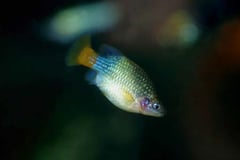
Xenotoca eiseniRedtail Goodeid
Goodeidae · authority not recorded
The redtail goodeid, Xenotoca eiseni, is a livebearer from Mexico, found in habitats from clear mountain streams to polluted roadside ditches. Very hardy and adaptable, it is less popular in the hobby than it once was, probably because of its often aggressive nature. Some specimens attack and kill other fish, catfish in particular, so a species tank is best. As in other goodeids, the developing young are nourished by a structure known as the trophotaenia.
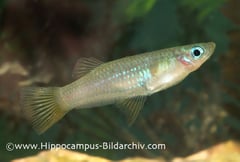
Alfaro cultratusKnife Livebearer
Poeciliidae · (Regan, 1908)
The knife livebearer, Alfaro cultratus, is a poeciliid from rivers, streams, ditches and backwaters in Costa Rica, Nicaragua and Panama. The common name comes from a keel of modified, paired scales running from the base of the anal fin to the caudal fin. Exceptionally hardy and adaptable, it can be aggressive, especially towards conspecifics, and breeds readily in the aquarium.

Fundulus xenicusDiamond Killifish
Fundulidae · Jordan & Gilbert, 1882
The diamond killifish, Fundulus xenicus, is a killifish native to the coastal waters of the northern Gulf of Mexico, from southern Florida to Texas. It lives in shallow lagoons, salt marshes and pools, usually in brackish water, and fares poorly with prolonged exposure to fresh water, so marine salt at 3-10 g/L is considered essential in the aquarium. Uncommon in the hobby, it is best kept on its own in a group of two or three females to each male.

Heterandria formosaLeast Killifish
Poeciliidae · (Girard, 1859)
The least killifish, Heterandria formosa, is a tiny livebearer from the United States, found in heavily vegetated margins of still or sluggish water. The smallest known livebearing fish, it is peaceful but not a community fish in the general sense, as the males reach only 2 cm and many commonly kept species will eat them. It is sometimes confused with the much more aggressive mosquito fish of the genus Gambusia.
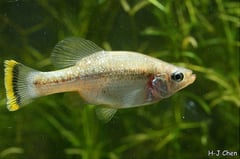
Ameca splendensButterfly Goodeid
Goodeidae · Miller & Fitzsimons, 1971
The butterfly goodeid, Ameca splendens, is a livebearer from the Río Ameca drainage in Jalisco, Mexico, and the neighbouring Sayula valley. Often referred to as extinct in the wild, it still survives at a few localities, and strong captive populations exist in the hobby. As in other goodeids, the developing young are nourished by a structure known as the trophotaenia. Males can be quite aggressive, and it is better kept in a species set-up.
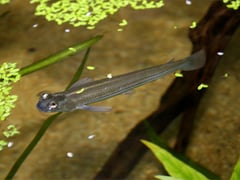
Anableps anablepsFour-Eyed Fish
Anablepidae · (Linnaeus, 1758)
The four-eyed fish, Anableps anableps, is a viviparous fish of brackish mangrove coasts in north-eastern South America, from Venezuela to Brazil. Each eye is split horizontally, with two corneas and two pupils, so it can see above and below the water at the same time. It moves in and out with the tides, and in aquaria it needs brackish water, shallow depth and a large surface area, with a group of at least six in a tank no smaller than 150 x 45 cm.

Anatolichthys anatoliaeAnatolian Toothcarp
Aphaniidae · (Leidenfrost, 1912)
The Anatolian toothcarp, Anatolichthys anatoliae, is a small killifish from central and western Anatolia in Turkey. The most widely distributed of the Anatolian species, it lives in fresh and mildly saline waters, and around Lake Tuz several populations have disappeared through pollution and water extraction. It needs a cold winter period, and given its conservation status it is best kept on its own, in a group with two or three females to each male.
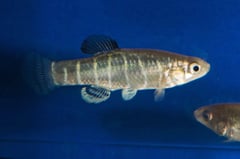
Anatolichthys danfordiiDanford's Toothcarp
Aphaniidae · (Boulenger, 1890)
Danford's toothcarp, Anatolichthys danfordii, is endemic to Turkey, in the middle and lower Kızıl, lower Yeşil and upper Seyhan river systems. It has a confused history, having been treated as a synonym of both A. sophiae and A. fasciatus, and A. chantrei is now known to be a junior synonym of it. Colour and pattern vary with locality, and forms such as 'Soysallı' and 'Kırşehir' are labelled to preserve bloodlines.
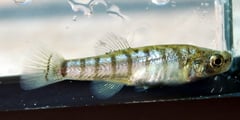
Anatolichthys saldaeSalda Toothcarp
Aphaniidae · (Akşiray, 1955)
The Salda toothcarp, Anatolichthys saldae, is endemic to Lake Salda in the Turkish Lakes region of southwestern Anatolia, Turkey. Lake Salda is a highly alkaline, magnesium-rich soda lake. The fish has an elongated, slender body, an angular lower jaw and reduced scalation that varies between individuals. It has been considered Critically Endangered by the IUCN since 1996.

Anatolichthys sureyanusBurdur Toothcarp
Aphaniidae · (Neu, 1937)
The Burdur toothcarp, Anatolichthys sureyanus, is endemic to Lake Burdur in the Turkish Lakes region of southwestern Anatolia, Turkey. The only fish in this extremely alkaline, saline lake, it has a slender body, an angular lower jaw and variable scalation. It has also gone by A. transgrediens, A. burdurensis and A. burduricus, and appears twice on the IUCN Red List as a result.
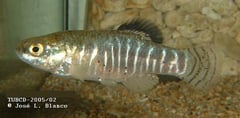
Anatolichthys villwockiSakarya Toothcarp
Aphaniidae · (Hrbek & Wildekamp, 2003)
The Sakarya toothcarp, Anatolichthys villwocki, is endemic to the Sakarya River basin, including Lake Çavuşçu, in western central Turkey. Formerly treated as a form of A. anatoliae, it has been shown to be the sister group to all other Anatolian Aphanius. It occupies habitats from clear, spring-fed freshwater to hypersaline Lake Çavuşçu, and colour and pattern vary with locality.
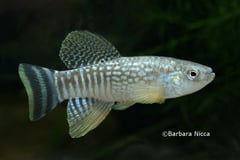
Aphaniops disparArabian Toothcarp
Aphaniidae · (Rüppell, 1829)
The Arabian toothcarp, Aphaniops dispar, is found around the coasts of the Red Sea and the Gulf of Aden. Inland populations also exist, and it tolerates anything from pure freshwater to hypersaline conditions. A 2003 phylogenetic study found it paraphyletic, and several populations once included in it have since been described as separate species, so forms are labelled by locality, such as 'Lake Assal'.
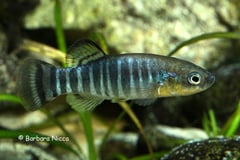
Aphaniops sirhaniAzraq Toothcarp
Aphaniidae · (Villwock, Scholl & Krupp, 1983)
The Azraq toothcarp, Aphaniops sirhani, is endemic to what remains of Azraq Oasis in the Wadi Sirhan valley of the Syrian Desert, Jordan. From the 1960s the aquifers feeding the oasis were pumped to supply Amman, and the IUCN considers it critically endangered. Vigorous spawning behaviour makes it a poor choice for the community aquarium, and the emphasis is on captive reproduction.
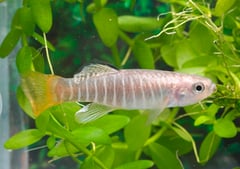
Aphanius fasciatusMediterranean Toothcarp
Aphaniidae · (Valenciennes, 1821)
The Mediterranean toothcarp, Aphanius fasciatus, occurs around much of the Mediterranean coast, from France and the Adriatic to Syria and Egypt. It mostly inhabits shallow lagoons, salt marshes and first order streams, and tolerates anything from freshwater to hypersaline conditions. Populations differ in colour and pattern but relatively little genetically, the exception being the isolated population in Lake Bafa, Turkey.
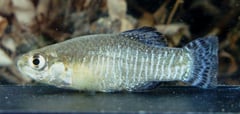
Apricaphanius baeticusBaetican Toothcarp
Aphaniidae · (Doadrio, Carmona & Fernández-Delgado, 2002)
The Baetican toothcarp, Apricaphanius baeticus, is endemic to a small part of southern Spain, mostly in the lower Guadalquivir River basin. It was considered a geographic variant of A. iberus until 2002, and differs in details such as thicker vertical bars in males and a few large dark markings in females. Only nine isolated populations remain, and it has been listed as endangered by the IUCN since 2006.
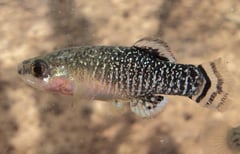
Apricaphanius iberusSpanish Toothcarp
Aphaniidae · (Valenciennes, 1846)
The Spanish toothcarp, or fartet, Apricaphanius iberus, is restricted to a few small areas of Spain's Mediterranean coast. These lie in Catalonia, Valencia and Murcia, and only 20 or so isolated populations remain, threatened by introduced Gambusia holbrooki and Fundulus heteroclitus, habitat degradation and pollution. Populations from the Atlantic coast and Algeria are now A. baeticus and A. saourensis.
Characodon lateralisRainbow Characodon
Goodeidae · Günther, 1866
The rainbow characodon, Characodon lateralis, is a goodeid putatively restricted to springs below the El Saltito waterfall in Durango, Mexico. Populations above the waterfall in the upper Río Mezquital appear to be the congener C. audax, and the names 'rainbow goodeid' and 'red prince' have been applied to both. Endangered in the wild, each population differs in colour and shape and should be kept separately in aquaria, never mixed with the aquarium strain of unclear origin.
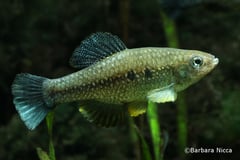
Cualac tessellatusCheckered Pupfish
Cyprinodontidae · Miller, 1956
The checkered pupfish, Cualac tessellatus, is a cyprinodontid endemic to a handful of springs in the Río Verde valley, San Luis Potosí, Mexico. Listed as Endangered by the IUCN, it lives in the shallow margins of crystal-clear, very hard spring-fed pools, including the Media Luna lagoon system. It is rarely available in the hobby, and captive breeding depends on very hard water, with the best results where chunks of gypsum rock are left to dissolve.
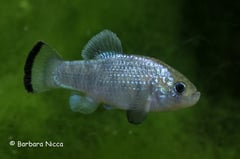
Cyprinodon alvareziPotosí Pupfish
Cyprinodontidae · Miller, 1976
The Potosí pupfish, Cyprinodon alvarezi, is a pupfish from a single isolated spring near El Potosí in Nuevo León state, northern Mexico. It has been extinct in nature since the late 1990s, after the spring-fed pond at La Hediondilla dried up through extraction of its water for irrigation and other human uses. The species now exists only in captivity, and its preservation means it is not recommended for the community fish keeper.
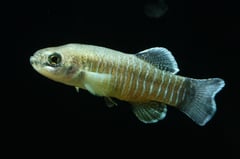
Esmaeilius arakensisArak Toothcarp
Aphaniidae · (Teimori, Esmaeili, Gholami, Zarei, & Reichenbacher, 2012)
The Arak toothcarp, Esmaeilius arakensis, appears to be endemic to a handful of natural springs near Arak in the Namak Lake basin, northern Iran. It was in the hobby for several years before its description, as Aphanius sp. 'Namak' or 'Namak River'. Externally it looks very similar to its closest relatives A. farsicus and A. sophiae. Aggressive spawning behaviour and its water requirements make it a poor choice for the community aquarium.
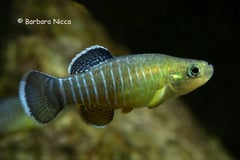
Esmaeilius persicusFarsi Toothcarp
Aphaniidae · (Jenkins, 1910)
The Farsi toothcarp, Esmaeilius persicus, is endemic to the Lake Maharlu basin near Shiraz in Fars Province, southern Iran. The hypersaline lake supports no fish, so it lives in the surrounding springs, pools, lagoons and marshes of fresh to brackish water. Males look very like those of its close relative E. sophiae, but females have stripes on the flanks where E. sophiae has spots. Most fish in the hobby come from Barm-e-shur spring.
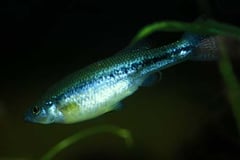
Ilyodon furcidensGoldbreast Goodeid
Goodeidae · authority not recorded
The goldbreast goodeid, Ilyodon furcidens, is a livebearer from Jalisco and Colima in Mexico, found in fast-flowing streams and small rivers. Also called the goldbreast splitfin, it is named for its fork-shaped teeth. Like other goodeids it nourishes its developing young through a trophotaenia, and females must be mated separately for each brood. A peaceful fish, it suits a community whose other species can cope with the lower temperatures it needs.
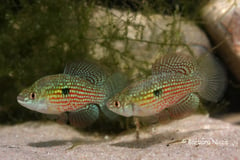
Jordanella floridaeFlorida Flagfish
Cyprinodontidae · Goode & Bean, 1879
The Florida flagfish, Jordanella floridae, is a cyprinodontid endemic to peninsular Florida in the United States. It lives in shallow, weedy backwaters, marshes, canals and ditches. A long-standing aquarium favourite, it is produced commercially and wild fish are very rare outside the U.S.A. Contrary to many reports it does not dig pits or exhibit extended parental care, and breeds as a fractional spawner like other cyprinodontids.
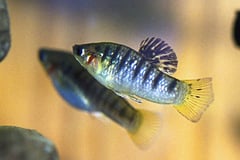
Limia nigrofasciataHump-backed Limia
Poeciliidae · authority not recorded
The hump-backed limia, Limia nigrofasciata, is a livebearer from Haiti and the Dominican Republic, found in shallow, heavily vegetated water. It usually swims in large shoals and also occurs in brackish conditions at several locations. Adult males develop a characteristic hump along the spine, caused by deposition of fatty tissue, and the species breeds very easily provided soft, acidic water is avoided.
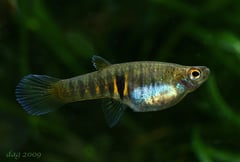
Neoheterandria elegansTiger Teddy
Poeciliidae · Henn, 1916
The tiger teddy, Neoheterandria elegans, is a small livebearer endemic to the Río Atrato drainage in northwestern Colombia. It appears to be quite rare in the wild and in the hobby. Shy and diminutive, it is best kept alone in a small colony in a heavily-planted tank with exceptionally clean water. The fry are only 2-3 mm long and initially need infusoria-type foods.
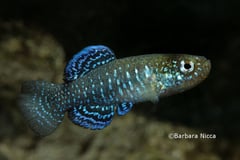
Paraphanius mentoIridescent Toothcarp
Aphaniidae · (Heckel, 1843)
The iridescent toothcarp, Paraphanius mento, occurs in eastern Mediterranean and Middle Eastern countries from Turkey and Israel to Iraq and Iran. Most aquarium fish come from Turkey's Mediterranean coast and the Ceyhan and Seyhan basins. One of the more ancient Aphanius, it has found greater popularity in the hobby than its relatives. Males are the most aggressive in the genus and will often fight to the death.
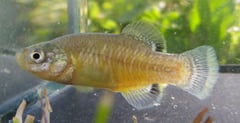
Tellia apodaFootless Toothcarp
Aphaniidae · Gervais, 1853
The footless toothcarp, Tellia apoda, is endemic to a small area of the Tellian Atlas mountains in northeastern Algeria. It lacks ventral fins and sits apart from the other western Aphanius in genetic terms. The last collection was in 1990, and rumours suggest it may already be extinct through introduced Gambusia affinis and agricultural pollution. Fish in the hobby should all come from the population at Aïn M'Lila.
Xiphophorus helleriiGreen Swordtail
Poeciliidae · Heckel, 1848
The green swordtail, Xiphophorus hellerii, is a livebearer native to southeastern Mexico, Guatemala, Belize and Honduras. Among the world's most recognisable aquarium fishes, it is ubiquitous in the trade, where selective breeding and hybridisation with X. maculatus and X. variatus have produced a bewildering array of ornamental forms. The name is often misspelled X. helleri.
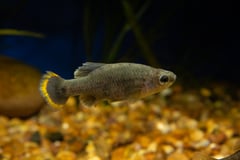
Zoogoneticus tequilaTequila Splitfin
Goodeidae · Webb & Miller, 1998
The tequila splitfin, Zoogoneticus tequila, is a goodeid endemic to the Río Teuchitlán in the Río Ameca headwaters of Jalisco, Mexico. Thought to be Extinct in the Wild when described, it has been the subject of a reintroduction project begun in 2015 by the University of Morelia, Chester Zoo and the Goodeid Working Group. A nippy livebearer, it has few suitable tankmates and needs space for females and subdominant males to escape breeding males.

Kosswigichthys asquamatusHazar Toothcarp
Aphaniidae · Sözer, 1942
The Hazar toothcarp, Kosswigichthys asquamatus, is a relict species endemic to Lake Hazar in southeastern Anatolia, Turkey. It has a more elongate body than other Aphanius, almost no scales and conical teeth. The lake water is hard, alkaline and rich in magnesium chloride, and in aquaria it seems to need certain salts for proper egg and fry development. Outside the spawning season it forms schools.
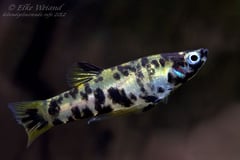
Phalloceros caudimaculatusDusky Millions Fish
Poeciliidae · (Hensel, 1868)
The dusky millions fish, Phalloceros caudimaculatus, is a small livebearer native to Brazil, Paraguay, Uruguay and Argentina. Feral populations in Australia, New Zealand, Ethiopia and Malawi were purportedly introduced for mosquito control and are now considered invasive. Highly variable in colour pattern, it is known in the hobby in spotted and golden ornamental forms. P. caudimaculatus is the type species of a genus that was monotypic until 21 new species were described in 2008.
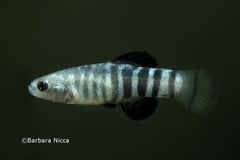
Anatolichthys transgrediensAcı Toothcarp
Aphaniidae · (Ermin, 1946)
The Acı toothcarp, Anatolichthys transgrediens, is endemic to the Lake Acı basin in the Turkish Lakes region of southwestern Anatolia, Turkey. The lake's extreme chemistry and fluctuating level mean it is mostly found in fresh and slightly brackish springs around the margins. In scalation, body form and jaw it is intermediate between A. anatoliae and A. splendens/sureyanus. It has been considered critically endangered by the IUCN since 1996.
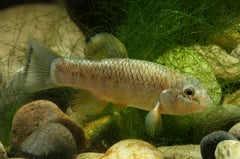
Cyprinodon pachycephalus
Cyprinodontidae · Minckley & Minckley, 1986
Cyprinodon pachycephalus is a pupfish endemic to the thermal spring of San Diego de Alcalá and its distributaries in Chihuahua state, northern Mexico. The springs produce water at a constant 43.8 °C, cooling downstream, and in the lower part of the system it forms natural hybrids with the congener C. eximius.
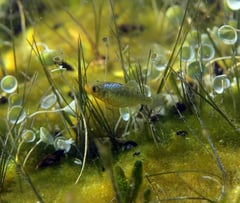
Cyprinodon variegatusSheepshead 'Minnow'
Cyprinodontidae · Lacepède, 1803
The sheepshead 'minnow', Cyprinodon variegatus, is a pupfish ranging from the northeastern U.S.A. to northeastern Mexico, the Bahamas and Antilles. It tends to be most common in brackish to hypersaline environments such as coastal salt marshes, lagoons and estuaries. On San Salvador Island in the Bahamas it appears to be the parent of a group of species living in sympatry and exploiting diverse but specific resources.
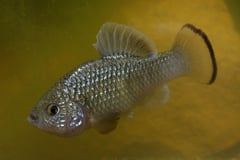
Cyprinodon veronicaeCharco Palma Pupfish
Cyprinodontidae · Lozano-Vilano & Contreras-Balderas, 1993
The Charco Palma pupfish, Cyprinodon veronicae, is a pupfish known only from the spring Ojo de Agua Charco Azul in Nuevo León, Mexico. The Bolsón de Sandia spring system has been dry since the late 1990s because of water extraction by local communities, and all four Cyprinodon species described from it are now considered extinct in the wild. Nuptial males are violaceous blue.
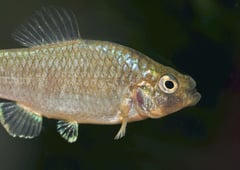
Cyprinodon brontotheroidesDurophage Pupfish
Cyprinodontidae · Martin & Wainwright, 2013
The durophage pupfish, Cyprinodon brontotheroides, is a pupfish endemic to six hypersaline lakes on San Salvador Island in the Bahamas. A specialised predator of hard-shelled invertebrates, particularly gastropods and ostracods, it has a shortened upper jaw and a protruding nasal region, and no other Cyprinodon species is adapted to hard-shelled prey. It occurs alongside C. variegatus in all six lakes and with C. desquamator in four of them.
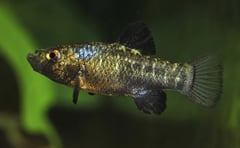
Cyprinodon desquamatorScale-eating pupfish
Cyprinodontidae · Martin & Wainwright, 2013
The scale-eating pupfish, Cyprinodon desquamator, is a pupfish endemic to six hypersaline lakes on San Salvador Island in the Bahamas. A specialised lepidophage, it takes approximately half its diet as the scales of other fishes, and its large supra-terminal jaws and elongate body are adapted to a fast biting action. No other Cyprinodon species feeds on fish scales, and it lives alongside C. variegatus in all six lakes.
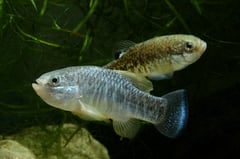
Cyprinodon julimesJulimes Pupfish
Cyprinodontidae · De la Maza-Benignos & Vela-Valladores, 2009
The Julimes pupfish, Cyprinodon julimes, is known only from a geothermal spring in the middle Río Conchos basin, Chihuahua state, northern Mexico. The water there fluctuates between 38 and 48 °C, and the spring is considered one of the hottest environments inhabited by fish in the world. Its closest relatives are C. eximius and C. pachycephalus.