Country · Africa
Egypt
Only species with a profile on Seriously Fish are counted, whether native or introduced.
- Species
- 14
- Families
- 11
- Genera
- 14
- Found only here
- 0
- Photographed
- 12 of 14
Shares its fishes withspecies recorded in both
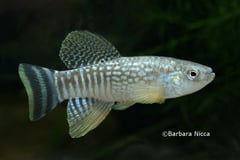
Aphaniops disparArabian Toothcarp
Aphaniidae · (Rüppell, 1829)
The Arabian toothcarp, Aphaniops dispar, is found around the coasts of the Red Sea and the Gulf of Aden. Inland populations also exist, and it tolerates anything from pure freshwater to hypersaline conditions. A 2003 phylogenetic study found it paraphyletic, and several populations once included in it have since been described as separate species, so forms are labelled by locality, such as 'Lake Assal'.
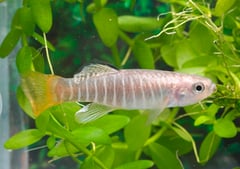
Aphanius fasciatusMediterranean Toothcarp
Aphaniidae · (Valenciennes, 1821)
The Mediterranean toothcarp, Aphanius fasciatus, occurs around much of the Mediterranean coast, from France and the Adriatic to Syria and Egypt. It mostly inhabits shallow lagoons, salt marshes and first order streams, and tolerates anything from freshwater to hypersaline conditions. Populations differ in colour and pattern but relatively little genetically, the exception being the isolated population in Lake Bafa, Turkey.
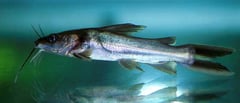
Clarotes laticepsWidehead Catfish
Bagridae · authority not recorded
The widehead catfish, Clarotes laticeps, is a large predatory catfish recorded across much of Africa, from Senegal and Guinea east to Egypt and Kenya. It inhabits large lakes and rivers and grows to 80 cm, though it is unlikely to reach this in captivity. Uncommon in the trade, it is capable of swallowing surprisingly large prey and is unsuitable for all but the biggest aquaria.

Ctenopoma murieiOcellated Bushfish
Anabantidae · authority not recorded
The ocellated bushfish, Ctenopoma muriei, is one of the smallest members of its genus, recorded from Egypt and Sudan south to Tanzania and Zambia. It lives in sluggish or still waters such as pools, lagoons and swamps, many of them low in dissolved oxygen. Rarely seen in the trade, it will eat only the tiniest fish and suits an African community with Alestiid tetras, dwarf cichlids and small Mochokid catfish.
Gymnarchus niloticusAba Aba
Gymnarchidae · authority not recorded
The aba aba, Gymnarchus niloticus, is a large predatory fish from much of the northern half of Africa, and the only species in its genus. An extended dorsal fin gives it the alternative name upside-down knifefish, although it is more closely related to the mormyrids, and it uses a weak electrical discharge to navigate and communicate. Growing to 165 cm and extremely aggressive, it is simply not suited to the home aquarium in any respect.
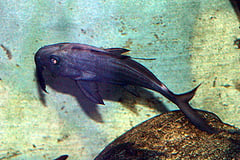
Hemisynodontis membranaceusMoustache Catfish
Mochokidae · authority not recorded
The moustache catfish, Hemisynodontis membranaceus, is a large mochokid widespread in Africa, from Egypt and Sudan to Senegal and Nigeria. Its 'moustache' is a membrane along the maxillary barbels. It feeds mainly on plankton, filtered through its many gill rakers, and often feeds at the surface upside down. Often sold as a spotted juvenile, it can reach 50 cm and becomes territorial with conspecifics as it matures.
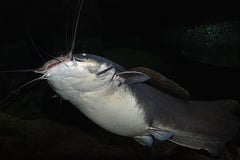
Heterobranchus longifilisVundu
Clariidae · authority not recorded
The vundu, Heterobranchus longifilis, is a clariid catfish widespread throughout Africa and one of the largest freshwater fishes on the continent. Growing to 150 cm, it is highly predatory, must be kept alone, and suits only public aquaria or a hobbyist able to house it properly. Its very long adipose fin separates it from similar members of the genus.

Oreochromis niloticus niloticusNile Tilapia
Cichlidae · authority not recorded
The Nile tilapia, Oreochromis niloticus niloticus, is a cichlid with a very wide natural range in Africa, from Senegal east to Egypt and Uganda. Bred in huge numbers as a food fish, it has been introduced to over 70 other countries and is one of the most invasive fish species in the world. It reaches 60 cm, though usually around 35 cm, breeds readily, is very messy and does not make a good aquarium subject.
Polypterus bichir bichirNile Bichir
Polypteridae · authority not recorded
The Nile bichir, Polypterus bichir bichir, is a large bichir recorded from Egypt, Kenya, Ethiopia and Chad west to Nigeria, Ghana and Guinea-Bissau. It grows to 72 cm, though rarely that large in aquaria, and belongs to the 'lower-jawed' group of Polypterus. It is one of the subspecies of the P. bichir complex, will eat any tankmate it can fit in its mouth, and needs a tight-fitting cover as an excellent escape artist.
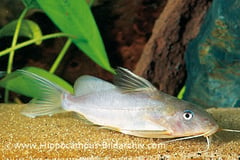
Synodontis schall
Mochokidae · authority not recorded
Synodontis schall is a large, predatory Synodontis catfish recorded from seventeen African countries, among them Nigeria, Egypt and Kenya. Regarded as the 'bad boy' of the genus in aquarium circles, it grows to 375 mm SL, is randomly aggressive and will eat smaller fish, so it should be kept only with tankmates that can stand their own ground. It is an important food fish in some of its native countries.

Ctenopharyngodon idellaGrass Carp
Cyprinidae · (Valenciennes, 1844)
The grass carp, Ctenopharyngodon idella, is a large cyprinid native to the Amur River system in eastern Russia and northeastern China. Adults typically reach 800 to 1200 mm, making it a wholly unsuitable aquarium subject, though an albino form is traded. Widely introduced for aquaculture and weed control, it has caused serious damage to natural waters, and unwanted fish should never be released.
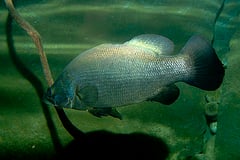
Lates niloticusNile Perch
Latidae · authority not recorded
The Nile perch, Lates niloticus, is a giant predatory fish from Central and Western Africa, reaching 193 cm and up to 200 kg. Introduced into many African countries as a food fish, it is thought to have contributed to the extinction of over 200 endemic species in Lake Victoria, and the IUCN lists it among the world's top 100 invasive species. Juveniles turn up in some aquatic stores, but it is not suited to captive life in any respect.

Pseudocrenilabrus multicolorDwarf Egyptian Mouth-brooder
Cichlidae · authority not recorded
The dwarf Egyptian mouth-brooder, Pseudocrenilabrus multicolor, is a small cichlid from Egypt, Sudan, Uganda, Rwanda, Kenya and Tanzania. One of the first cichlids to be spawned in captivity, it has been in the hobby for over a century and breeds easily as a maternal mouth-brooder. The two subspecies, P. m. multicolor and P. m. victoriae, differ in colour and pattern and should not be kept together, to prevent hybridisation.
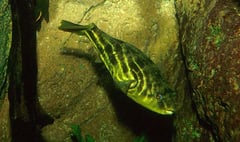
Tetraodon lineatusFahaka Puffer
Tetraodontidae · authority not recorded
The fahaka puffer, Tetraodon lineatus, is a large freshwater puffer from lakes and rivers across northern and West Africa, reaching 43 cm. Also known as the Nile puffer, it was previously named T. fahaka. One of the most aggressive puffers available, it learns to interact with its owner, but should be kept alone and needs no salt in its water.